Brigadier Heymans
Special edition Nongqai please!
Thank you.
Logan
SOUTH AFRICAN POLICE
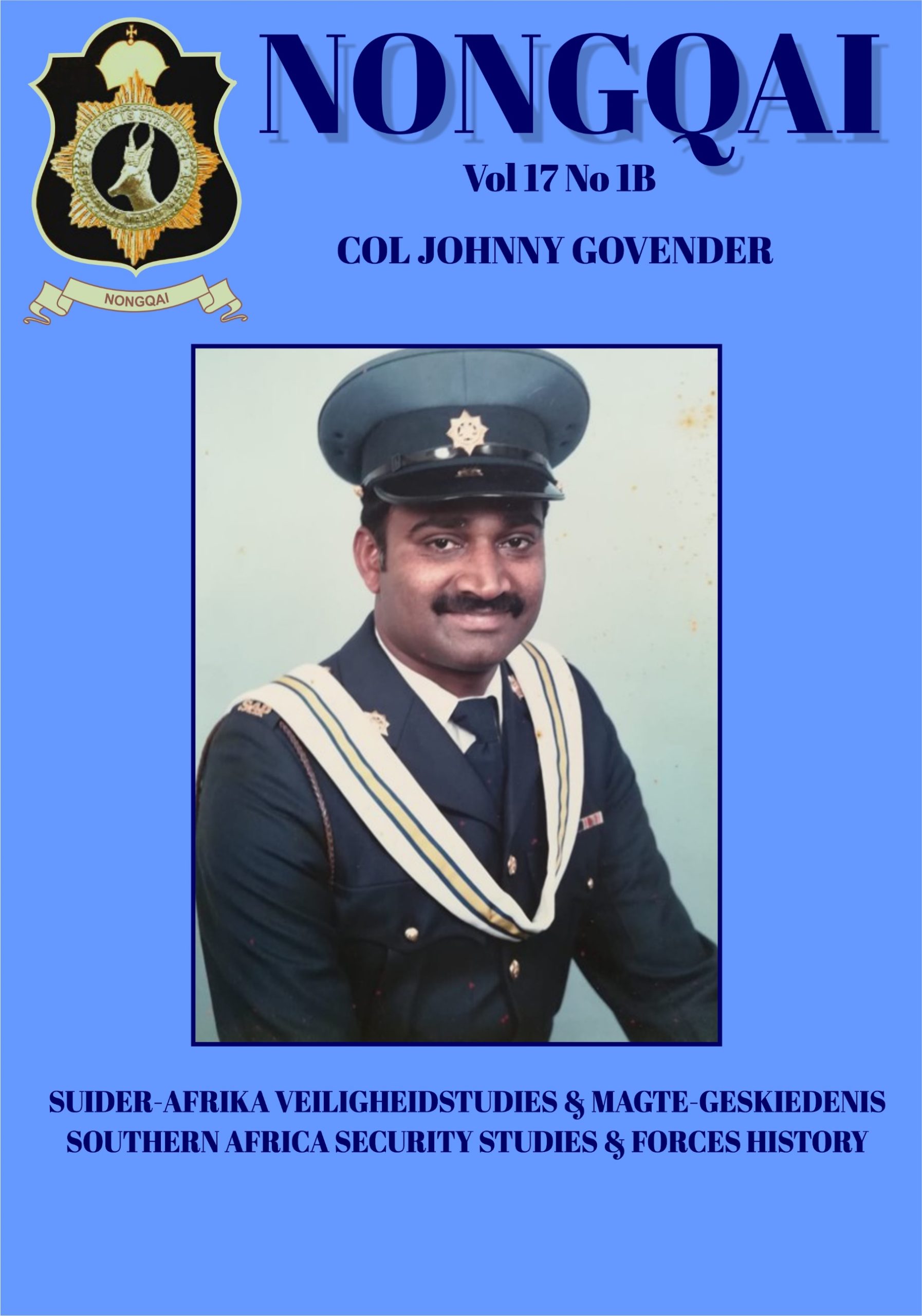
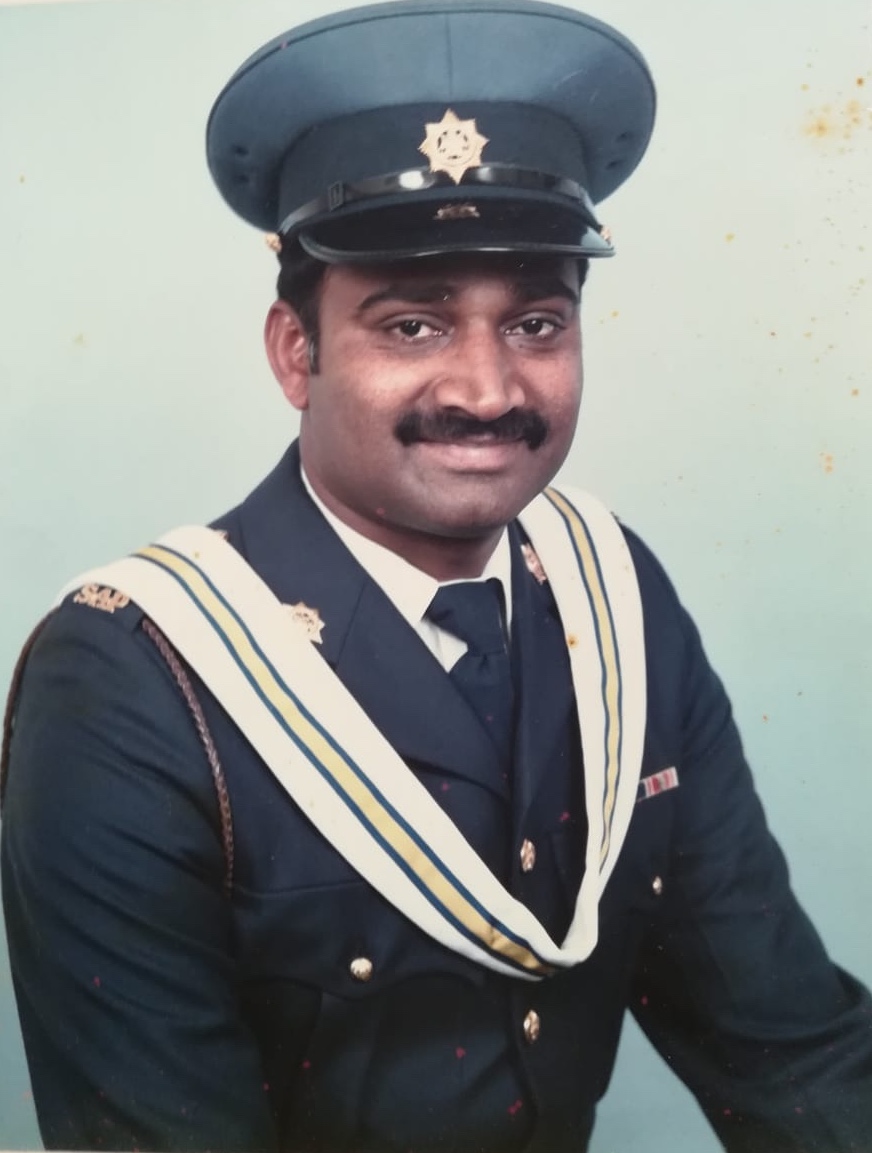
COLONEL JOHNNY GOVENDER
A BORDER VETERAN AND AN OFFICER AFTER THE HEART OF THE COMMUNITY HE SERVED
Cover photo
FOREWORD
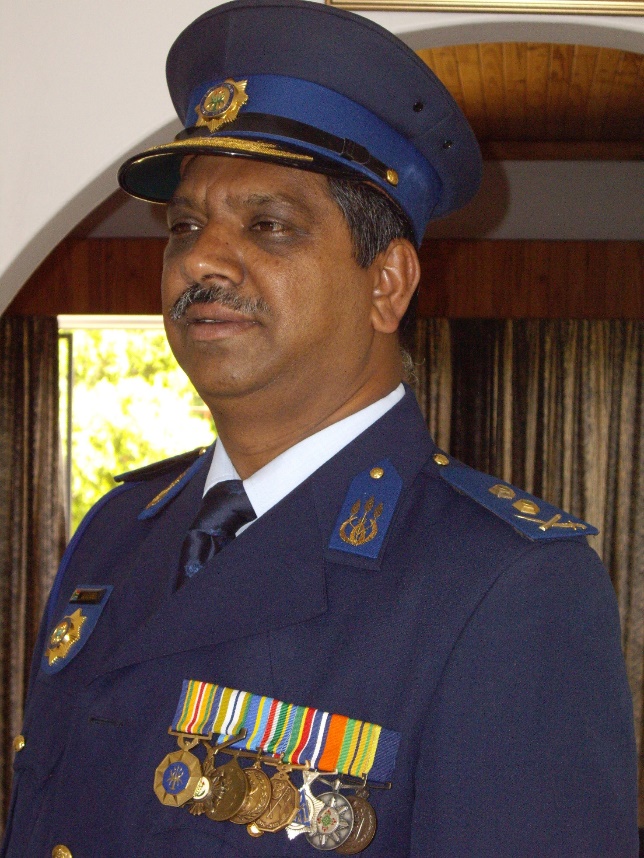 It gives me great pleasure to write this foreword in respect of Shunmugam @ Johnny Govender who was born on the 3rd of August 1950 in Charles Road, Pentrich, Pietermaritzburg. He joined the SAP on the 14th of March 1969, at the age of 18. I always knew Shunmugam Govender as Captain Shunmugam Govender, also known by family and friends as Johnny, was well known to me as an officer and gentleman. I met Warrant Officer Shunmugam Govender for the first time in 1984, while we on candidate officers’ course at Benoni. We became close friends. When on candidate officers’ course, Warrant Officer Shunmugam stood out to me as a very experienced and learned police officer. Whenever we engaged in debates on policing and other related matters, he would share his wealth of experience and wisdom. Warrant officer Shunmugam Govender also shared the number of times he performed border duties under dangerous circumstances and the many experiences he had encountered performing border duties. He also mentioned about the different ways they performed community policing in Pietermaritzburg, and the role he plays in community policing activities. At Benoni College we also shared some very interesting academic discussions as candidate officers together with our lecturers and other colleagues, that would help in designing and developing future candidate officer’s courses. At the end of 1984, after three months of intense training and development, we fifteen non-white candidate officers were appointed as Lieutenants and graduated together with other non-white senior officers namely Lieut Gen M Chetty (Late) and Lieut Gen DS Maharaj (Late) with a National Diploma in Policing, at the Benoni College Parade grounds. We were the first commissioned officers to be appointed to commissioned rank with a National diploma in Policing. We newly appointed commissioned officers (Lieutenants) were also simultaneously posted to take up command posts at different police stations in the country. Lieutenant Shunmugam Govender was posted as Station Commander at SAP Lenasia, in the Soweto district.
During 1989, I was appointed as a research field worker by the Commissioner of Police, to assist the Fischer Commission to collect data from police officials, nationally for a research project on Democratic Policing. This gave me an opportunity to travel around the country to the already sampled police stations to collect data. At SAPS Lenasia, I was hosted by then Lieutenant Shunmugam Govender, Station Commander of SAP Lenasia. He familiarised me with the area of SAPS Lenasia and its demographics in terms of the community and police officials working at SAP Lenasia.
I again met Captain Shunmugam Govender in 1991 at the Paarl College for Advanced Training, in the Boland, Western Cape, at a Skills Development Course arranged by SAP Head office for non-white officers, who were identified as leaders with the potential to lead the SA Police into the new democratic order. We as course goers on this course became more academically and socially acceptable to each other.
Captain Shunmugam was appointed to serve in different positions in Pietermaritzburg and the Transvaal. During 1977, while a Sergeant in the SAP, he on his own initiative took it upon himself to investigate a case of Culpable Homicide, while serving at the Mountain rise SAP in Pietermaritzburg, where the accused was successfully arraigned in a court of law.
Captain Shunmugam Govender was awarded service medals for his distinguished contribution to the SAP:
1. 1973-01-26 – The South African Police Medal for Combating Terrorism;
2. 1974-07-25 – The South African Police Bar for Combating Terrorism;
3. 1988-04-01 – The South African Police Seventy Fifth Anniversary Commemorative Medal;
4. 1991-01-05 – The South African Police Medal for Faithful Service for 10 years long Service and Exemplary Conduct;
5. 1991-01-05 – The South African Police Star for Faithful service for twenty years Faithful service and Exemplary Conduct.
Captain Shunmugam Govender was married. The Govender’s have 3 children 1 boy and 2 girls, the youngest Preshentha followed Dad’s footsteps and joined the SA Police Service.
Major General (Ret) George D Govender, DLitt et Phil, SOE, F.I.S (SA).
Professor in Criminal Justice Studies, University of South Africa
SOUTH AFRICAN POLICE
COLONEL JOHNNY GOVENDER
A BORDER VETERAN AND AN OFFICER AFTER THE HEART OF THE COMMUNITY HE SERVED
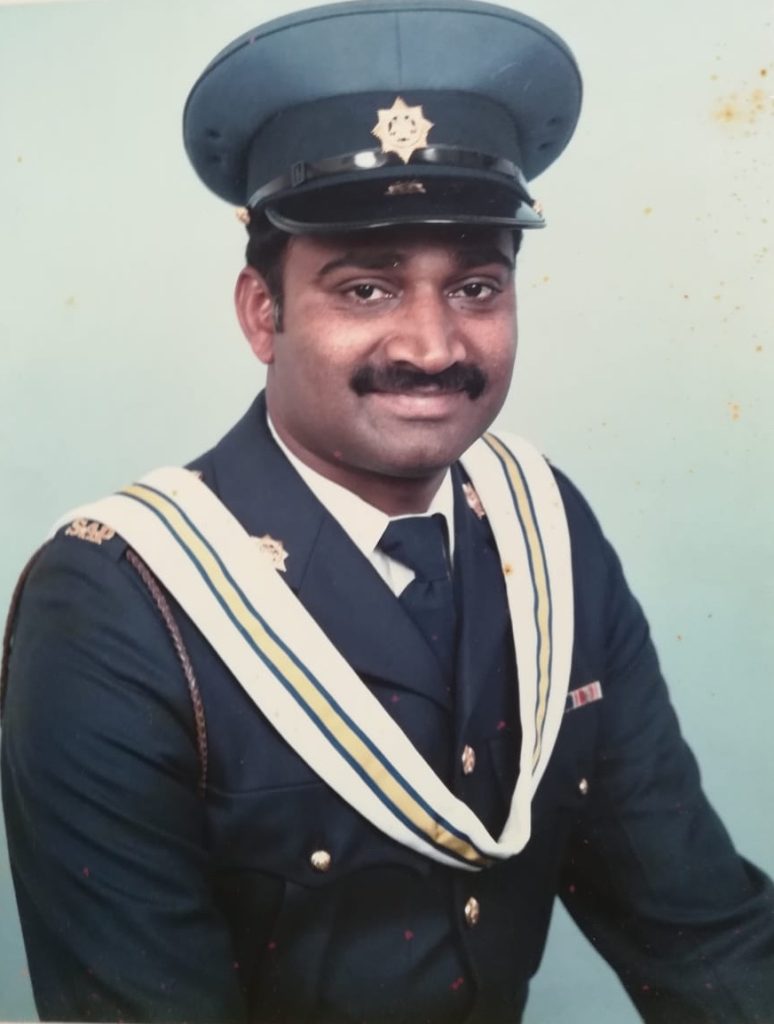
Colonel Johnny Govender
Authored, researched, compiled, edited, and submitted for publication by Logan Govender [LG], drawing on information provided by Colonel Johnny Govender, as well as various sources, police personnel, and other contributors.
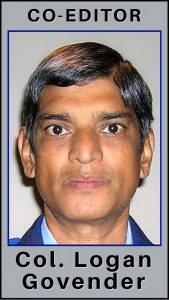
Logan Govender [LG]
AUTHOR’S NOTE
It is an honour and a privilege to introduce the biography and police career of Johnny Govender, a dear friend of mine since 1971. Back then, Johnny was a Sergeant, and my father, Sergeant Mariemuthu, was also a member of the police force. As a result, our family often welcomed police officers into our home, and it became customary for us to forge strong friendships. Some police members became as close as family. Johnny consistently exemplified integrity, dignity, and respect, treating everyone with kindness. To me, he was not just a friend; he was an inspiration and a role model.
I had always dreamed of following in my father’s footsteps and joining the police force. Johnny played a crucial role in that journey, encouraging me to join the South African Police Reserve Force, which he commanded. Our friendship deepened during this time, and before long, he convinced me to leave my well-paid job as an electrician to join the permanent force of the South African Police, predicting that I would rise quickly through the ranks.
In the 1980s, as a student, Johnny motivated me to pursue the National Diploma in Police Administration. With his support and guidance, I completed both the National Certificate and National Higher Certificate in a single year, even before attending police basic training. This achievement was only possible because of his dedication; he often stayed up late with me, ensuring I focused on my studies. I am deeply grateful for his kindness and the commitment he showed in nurturing my career. I ultimately completed the National Diploma after graduating from college.
In December 1984, Johnny received his commission at the South African Police, Mechanical School, while I was awarded my Diploma in Police Administration. I was commissioned in December 1986 and took on the role of Station Commander at the SA Police in Mountain Rise. At the same time, Johnny became the first Indian Station Commander in Lenasia, Gauteng. As a novice lieutenant, I frequently sought his advice on various challenges I faced in managing a large station. Johnny had amassed a wealth of experience and skills over the years, earning the respect and trust of everyone around him.
Through our journey together, Johnny’s influence has been immeasurable, and his legacy within the police force is one of dedication and excellence.
Colonel Govender was an experienced, knowledgeable, and intelligent officer. He understood his job very well and proved himself to be an excellent and effective commander. I was fortunate to learn a great deal from him through his guidance and mentorship. Because of his support, I developed into a capable commissioned officer as I moved up through the ranks. I will always be grateful to him for shaping me into an outstanding officer.
[LG]
“The Nation which forgets its defenders will itself be forgotten” – Calvin Coolidge
Johnny Govender was born on the 3rd of August 1950 in Charles Road, Pentrich, Pietermaritzburg. He was raised in a family of 6 children, two sons and four daughters, his father, Narainsamy Govender, and his mother, shaped the family with values of discipline and humility.
Narainsamy Govender was originally a tobacco farmer in Prestbury. In 1947, when the area was rezoned for whites only, he was forced to abandon farming and seek employment in the textile industry. This experience of dispossession and injustice influenced Johnny Govender’s view to fairness, resilience, and service to others.
On the 14th of March 1969, at the age of 18, Johnny Govender joined the South African Police (SAP). He underwent police basic training at the renowned SA Police, Training College, Wentworth. Durban forming part of Troop 13.
Due to insufficient Indian recruits, the college was closed for nine months prior. Among his peers were Chris Thaver, Hari Badul, (Tiger) Rajoo Ellappan, VN Pillay, BD Naidoo, Chaitoo and SR Naidu.
SOUTH AFRICAN POLICE
TRAINING COLLEGE
WENTWORTH, DURBAN
TROOP 13
NOVEMBER 1969 – APRIL 1970
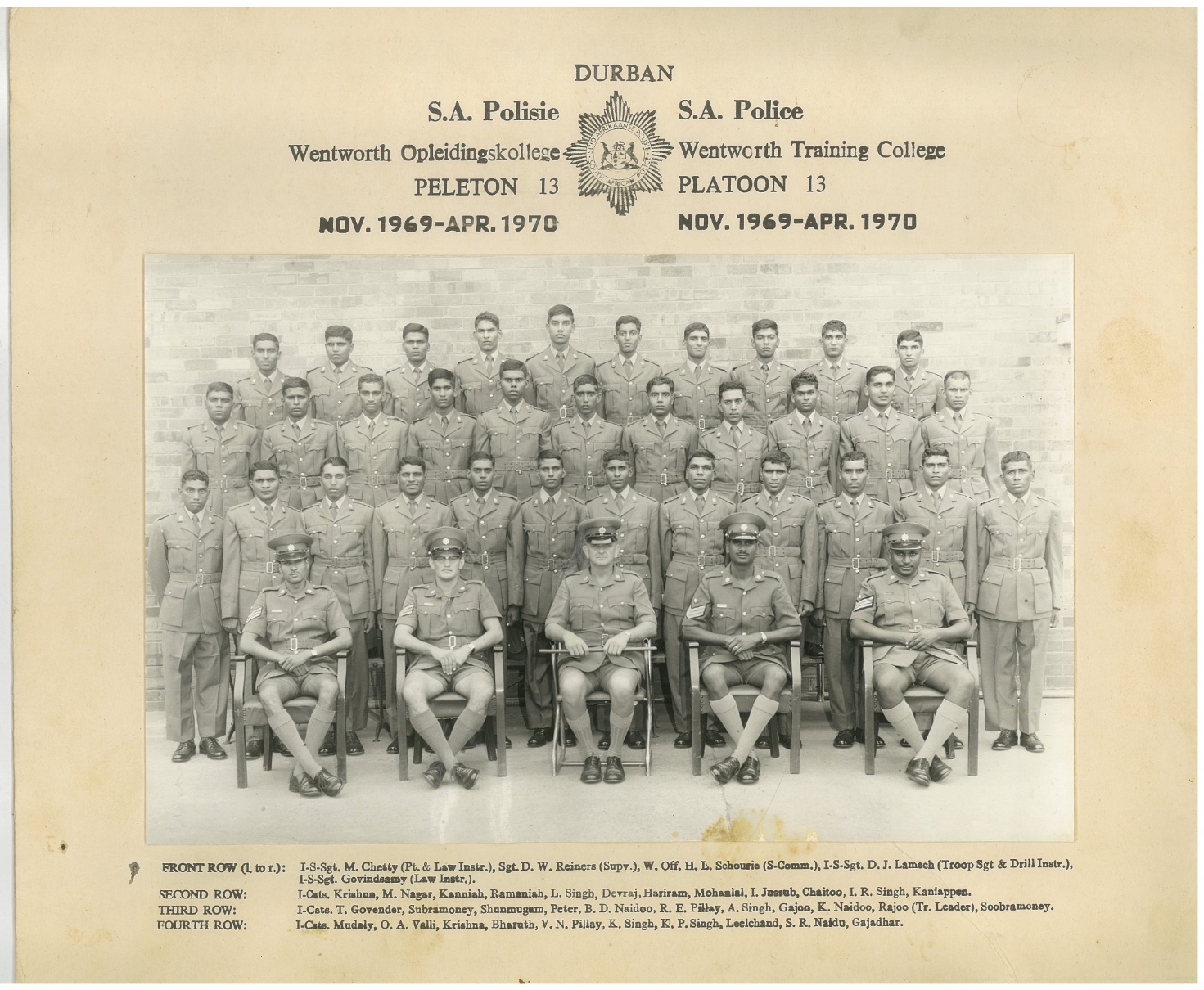
In 1969, Govender became part of the first group of Indian policemen posted to Vereeniging. His responsibilities included the foot beat, inspections of vacant premises, and general crime prevention duties on foot or pedal cycle.
At the time, there was no official accommodation for Indian or non-white members, compelling him to find lodging in Top Location, a historically significant era where Indian and African communities lived side by side in relative harmony. One of the first ladies of post-apartheid South Africa, Adelaide Tambo in her youth also resided in this location. This reinforced his belief in coexistence, mutual respect, and community-centred policing.
In January 1971, Govender was transferred to Howick, KwaZulu-Natal.
Govender was in the second group of Indian or Non-Whie members to be nominated to undergo a Counter Insurgency Course (COIN) at Maleoskop, Groblersdal during 1972.
From 1972-11-30 till 1973-03-22, he was deployed for border duty in the Eastern Caprivi Strip, South West Africa (now Namibia).
The deployment demanded exceptional discipline, vigilance, and resilience. Only three Indian police members served in that company.
At the time, promotion opportunities for Indian members were restricted, with no promotion examinations held for six consecutive years. Despite this, Govender remained focused on excellence rather than advancement.
From 1974-05-16 till 1974-07-25, now serving as a Sergeant, he was again nominated for border duty and was deployed at Plumtree, on the Rhodesia–Botswana border.
These deployments help broaden and his shaped his leadership abilities under high-pressure conditions.
On 9th November he married Silo.
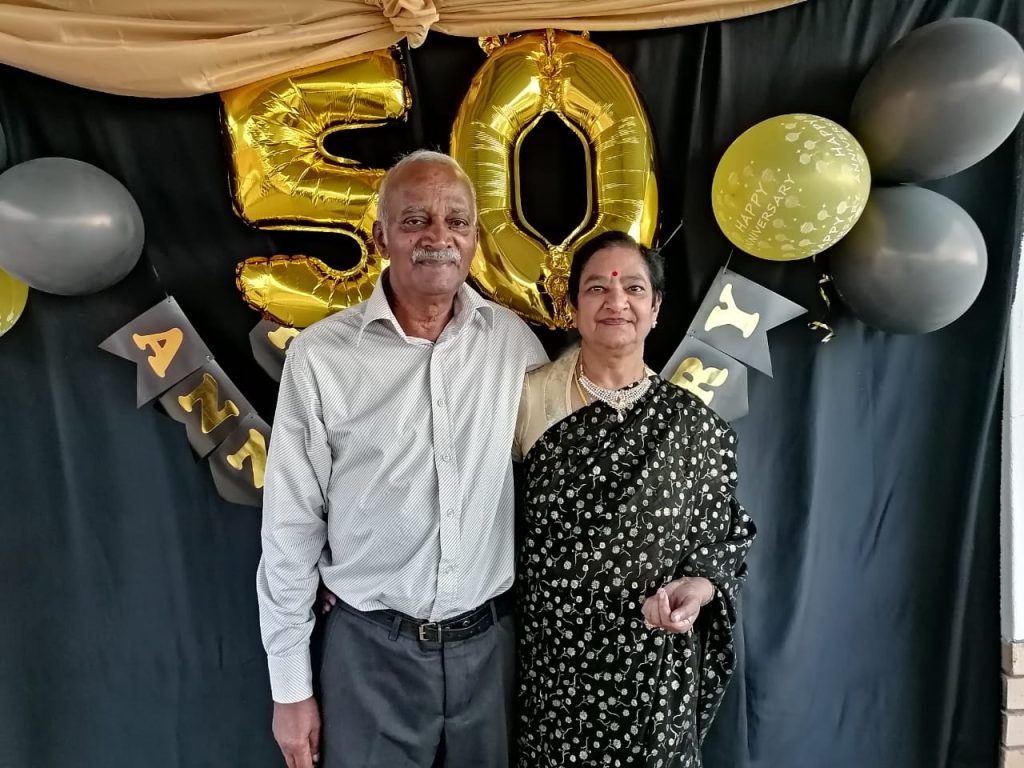
Johnny Govender and his dear wife Silo at the 50th (Golden) anniversary
They couple have 3 children 1 boy and 2 girls, the youngest Preshie followed Dad’s footsteps and joined the SA Police Service.
Johnny Govender, whilst a Sergeant stationed at Mountain Rise during 1977, identified a particular case docket as a challenge and signed for the Culpable Homicide case docket and undertook the investigation.
The circumstances surrounding this docket is that an unknown person was dropped off at the entrance to the casualty section of Northdale Hospital. He was thereafter admitted to ICU whilst unconscious with severe multiple injuries and sadly never regained consciousness. The incident was suspicious from the onset. There was no evidence neither were there any clues.
Later after initial investigation it was established that he was a school teacher based at the M L Sultan Technical College now a High School which is situated alongside the North bound N3 freeway at the entrance to Church Street, Pietermaritzburg. At a year-end gathering of fellow teachers held where the Allandale Pharmacy and Supermarket now stand; it was then vacant land.
The deceased a teacher was run over by a fellow teacher, who then reversed over him again causing severe multiple injuries. The suspect would not co-operate, so the skills, experience and acumen of the Sergeant was left in an attempt to solve it.
After careful examination of the deceased’s clothing traces of rubberising were found on it. This was the only other information available other than circumstantial evidence which was far and few between. The samples of rubberising were dispatched to The Forensic Science Laboratory. The sample taken off the deceased’s clothing and that of the vehicle undercarriage were a positive match.
The suspect was arrested and the case went to trial after 6 months of intensive investigation, all evidence was circumstantial expecting the Forensic Science Laboratory Report.
The accused was charged for Culpable Homicide and Obstructing or Attempting to Defeat the Course of Justice. The case was heard at the Pietermaritzburg Regional Court. The Magistrate was Mr Prinsloo, a former detective from Loop Street who investigated Commercial Crimes. The prosecutor Mr Tate and the Defence Advocate was Colin White. White questioned and cross examined Govender, the investigating officer for 3 ½ hours.
The accused was convicted on both counts, Culpable Homicide and Obstructing or Attempting to Defeat the Course of Justice and was hand a suspended sentence.
The case brought long-awaited closure to the victim’s family and firmly established Govender’s reputation as a meticulous, determined, and fair investigator.
His younger brother Mergan during 1976 became the first non-white to be awarded a bursary from the University of Rhodes, during the apartheid era in the Western Cape, a significant milestone that his father a textile industry worker, took pride in. He completed his honours degree in applied mathematics cum laude.
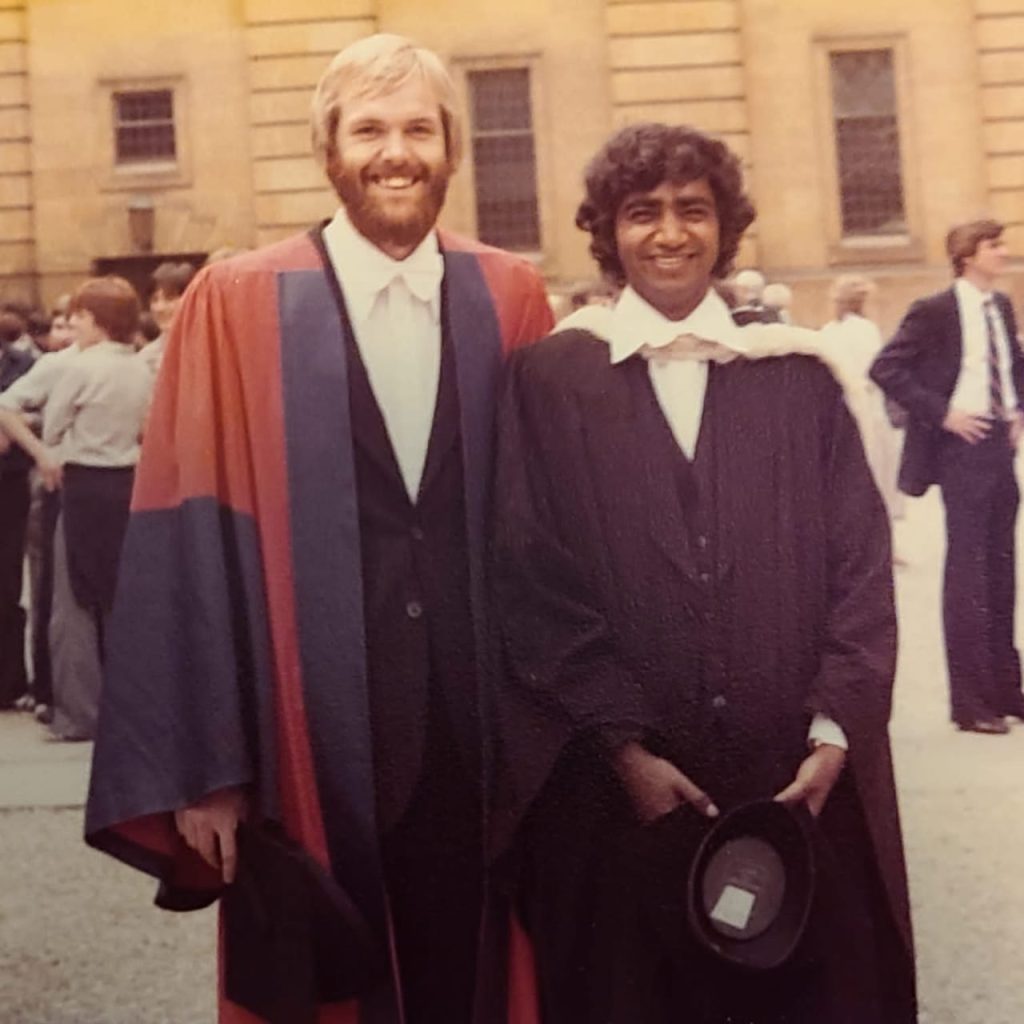
Megan’s Rhodes Scolarship at Baliol College at Oxford University
Frank Finchem graduated Doctorate and Mergan Govender Master’s
1978/79
Thereafter he obtained a scholarship and obtained two master’s degrees, one at Oxford University and another at Birkbeck University in the United Kingdom. He completed both within the financial constraints afforded by the Rhodes Scholarship, focusing on mathematics.
Mergan was later appointed a Mathematics Lecturer at the University of Durban-Westville now (UKZN).
Govender’s mentor, leader and teacher, in the police was none other than Captain Bob Sewpersad began his police career at SA Police, Mountain Rise as a Senior Sergeant, later as a Warrant Officer. By 1977, he was promoted to the rank of Lieutenant, showcasing his dedication and leadership abilities.
He worked under his mentorship for eight years, during which he learned how to manage a police station both administratively and operationally. His guidance assisted him to acquire the necessary acumen and skills to become an efficient Commander himself during the 1980’s.
“Throughout his career, Sewpersad demonstrated exceptional skills in maintaining discipline and commanding respect, qualities and he sought to emulate in his own career. Colonel Govender was an experienced, knowledgeable, and intelligent officer. He understood his job very well and proved himself to be an excellent and effective commander. I was fortunate to learn a great deal from him through his guidance and mentorship. Because of his support, I developed into a capable commissioned officer as I moved up through the ranks. I will always be grateful to him for shaping me into an outstanding officer. Bob, as he is fondly known, is still a great man and is full of integrity and respect. He enjoyed an illustrious career even though the opportunities were limited. Due to ill health, he had to be medically boarded at the height of his policing career. I have no doubt in my mind that Sewpersad would have been Pietermaritzburg’s first General of Indian descent. Fate robbed him and Pietermaritzburg of this accomplishment.
“A leader is one who sees more than others see, who sees farther than others see and who sees before others see.” – Leroy Eimes, author and leadership expert.” – said Johnny Govender
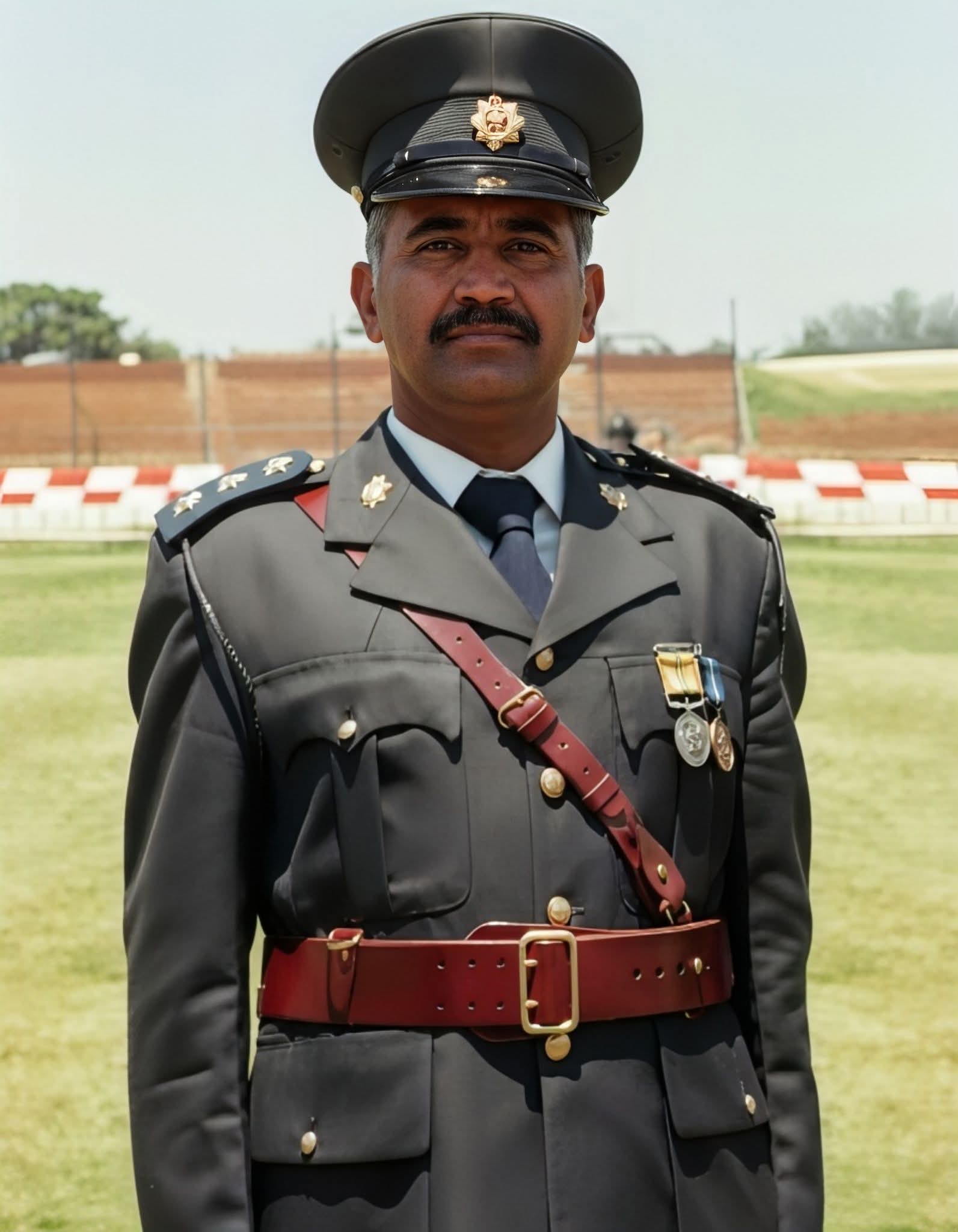
Captain Bob Sewpersad
Govender’s intellectual ability and discipline were formally recognised when he received the award for Highest Academic Achievement in his Rank, first noted in the late 1970s and during 1980.
That same year, he was promoted to Warrant Officer and honoured at a ceremony attended by Lieutenant Generals FLC Engels and M Van Eyk in Durban.
In 1984, Govender was nominated to attend the Candidate Officer’s Course at the South African Police, Mechanical School in Benoni. Upon completion, he was promoted to Lieutenant, becoming one of the first Indian officers posted to Gauteng. Perumal Naidoo was another.
SOUTH AFRICAN POLICE
CANDIDATE OFFICER’S COURSE
NO 6/84
NON-WHITES
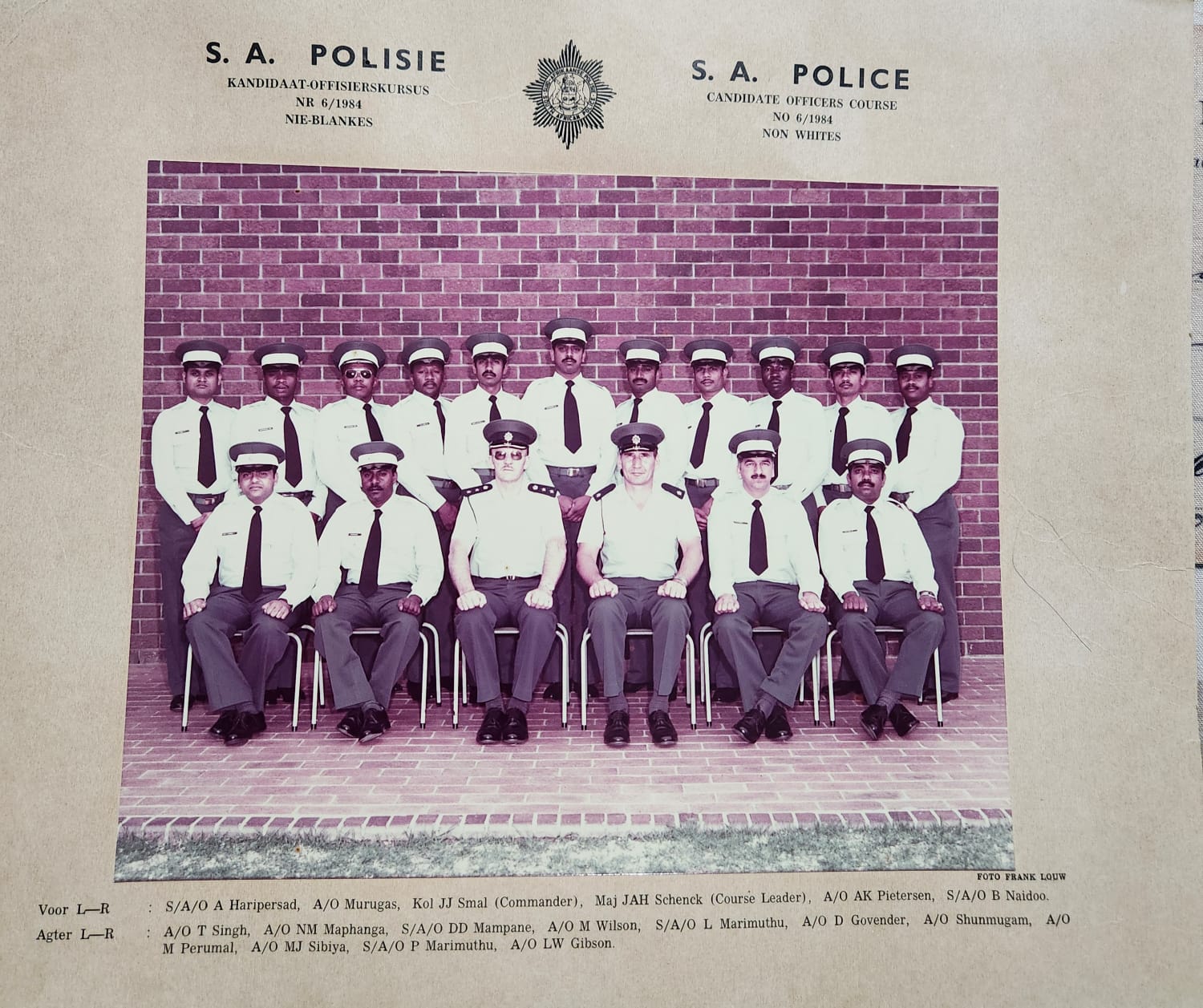
Rear row, 7th from left Johnny Govender
(Source Major General (Professor) George D Govender – [DG]
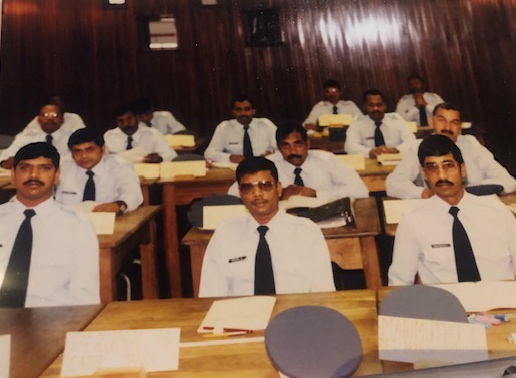
Attentive Candidate Officers at the lecture hall.
Front row, from left to right, George Govender; M Perumal; Reggie Marimuthu
Second row, from left to right, Anesh Haripersad; Bala Naidoo; Petersen
Third row, from left to right, Mampane; Murugas; Johnny Govender; Gibson
Fourth row, from left to right, Mampanga; Tiluk Singh; Christie Marimuthu; Wilson
(Source [DG])
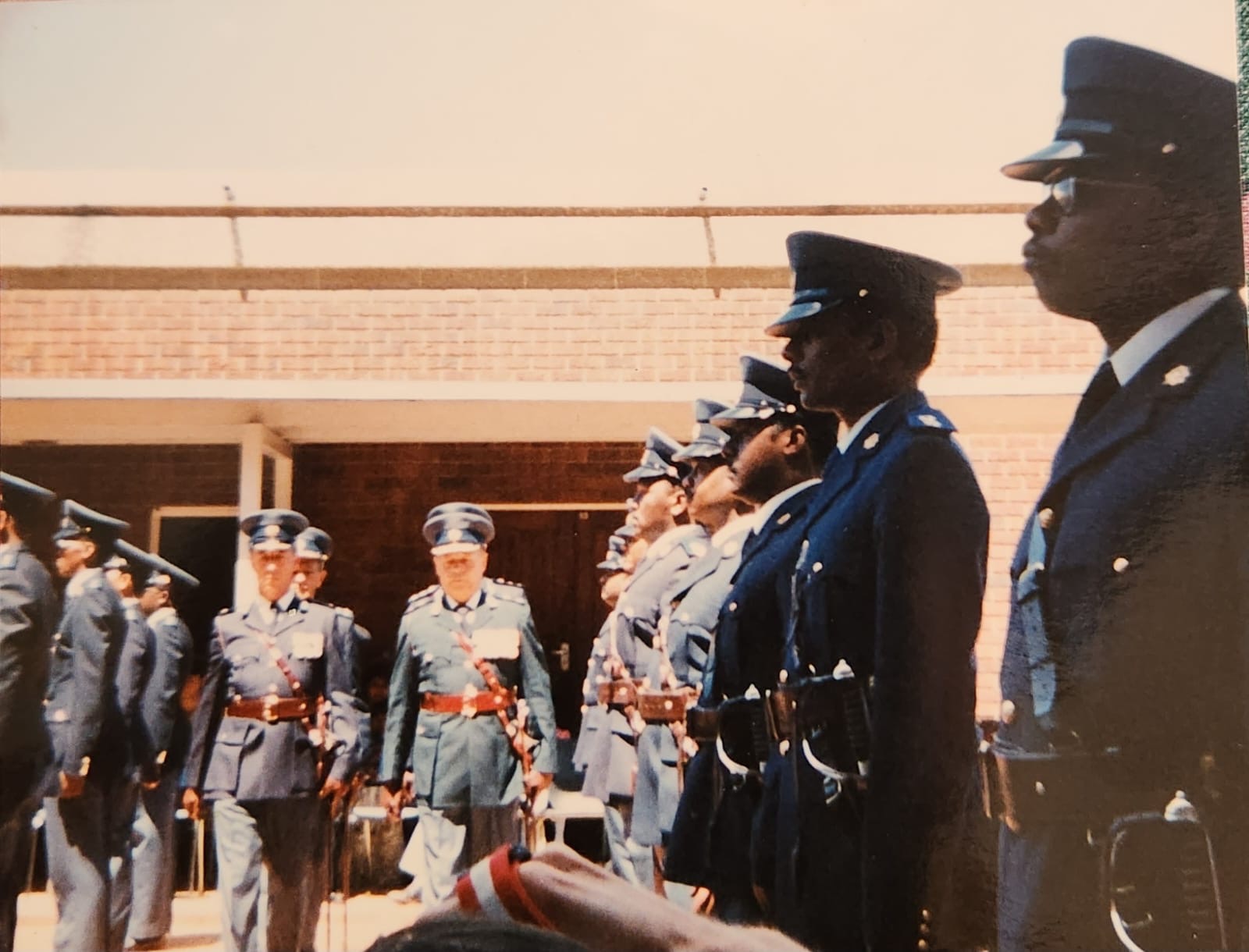
Inspection of the parade of Candidate Officers at their Graduation Ceremony during December 1984 at SA Police, Mechanical School, Benoni by Major General JAB Laubscher
(Source [DG])
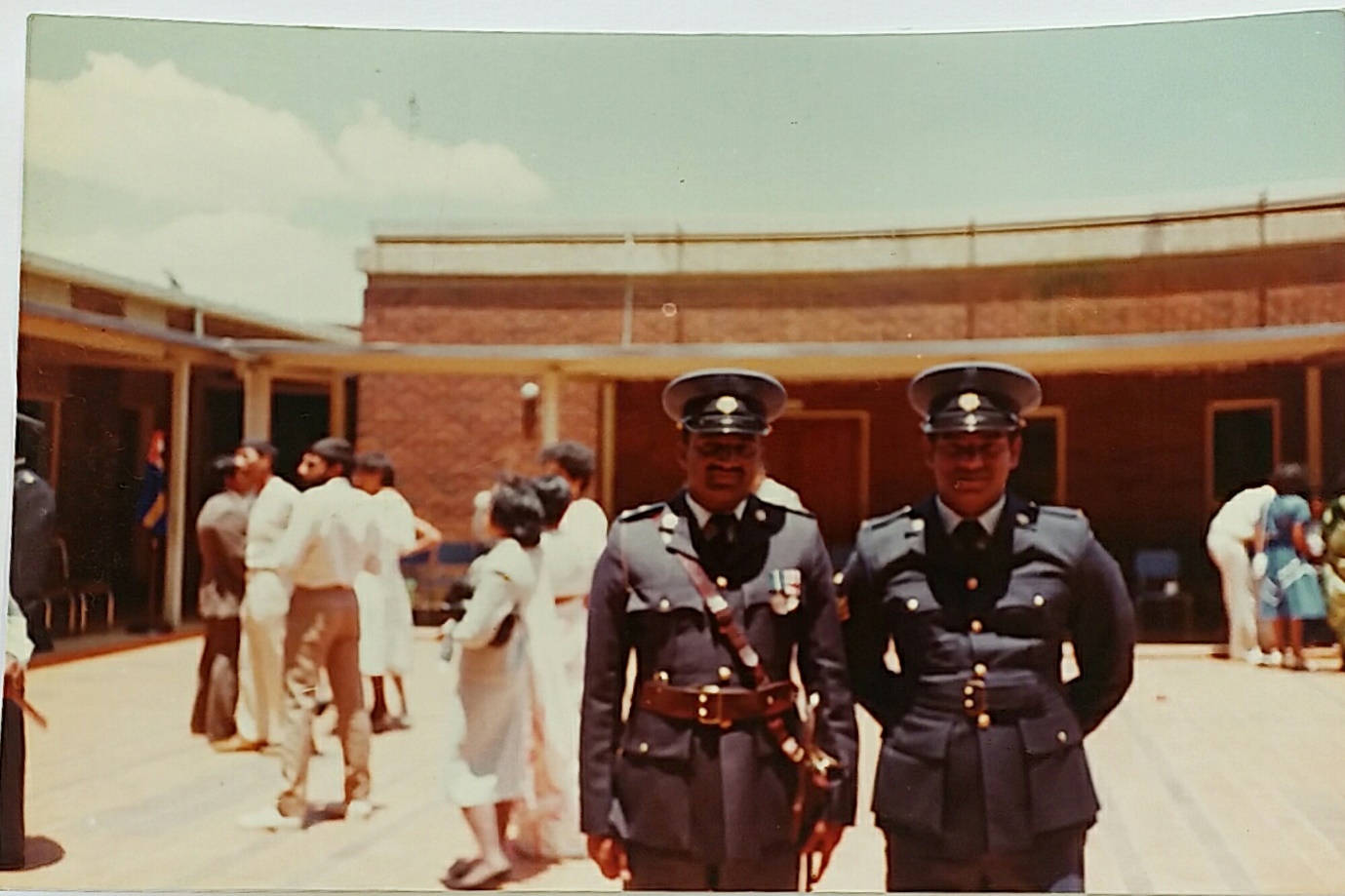
Lieutenant Johnny Govender and myself [LG] after the parade
(Source [LG])
He was assigned to Lenasia Police Station, where in 1986 he assumed command as Station Commander.
Under his leadership:
- Lenasia was nominated Best Managed Police Station for five consecutive years;
- The station received awards for Best-Kept Gardens;
- Discipline, operational efficiency, and community relations flourished.
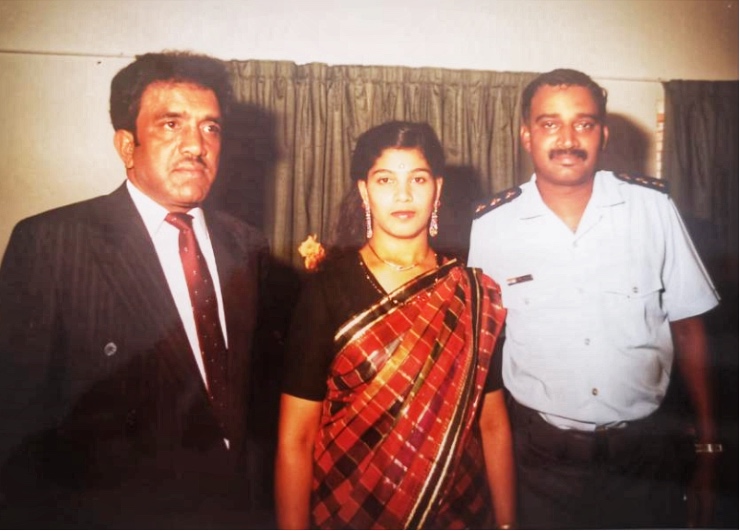
Warrant Officer Sham Singh, his dear wife Aasha and Captain Johnny Govender at Warrant Officer Singh’s retirement function at SA Police, Lenasia
In 1991, Govender was transferred to the Inspectorate of the Soweto Region, working alongside senior officers including Major Generals Viktor, Swart, Malan, and Nienaber, as well as Brigadiers Blom, Minaar, and Calitz.
SOUTH AFRICAN POLICE
COLLEGE FOR ADVANCED TRAINING
SKILLS DEVELOPMENT COURSE NO 1/1991
1991-02-04 TO 1991-02-28
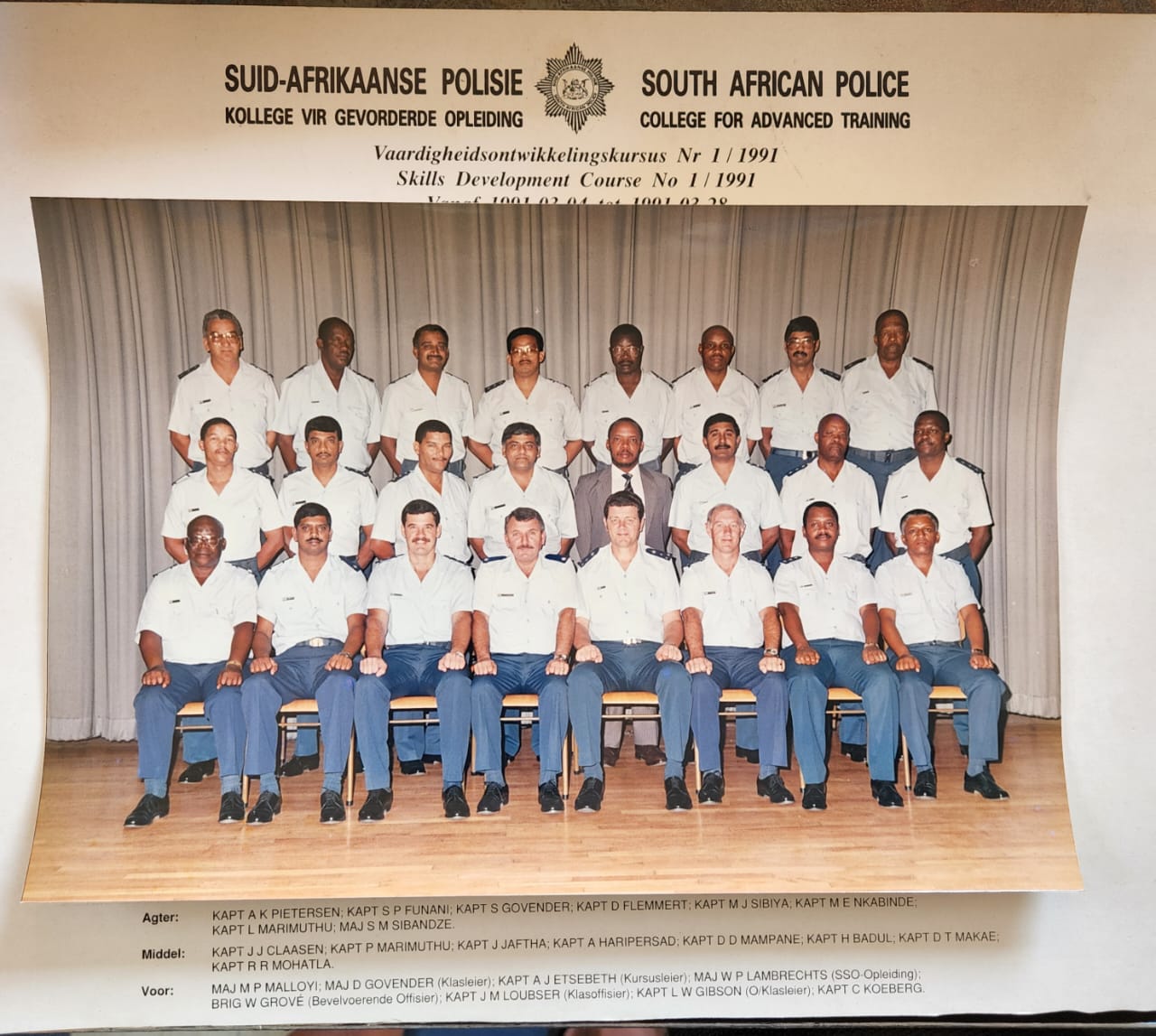
Rear row, 3rd from left, Captain Govender
(Source [DG])
(“This is the 1991 photo where the future non white senior officers were identified to be the new non-white officers to lead the SA Police into the new democratic order.” – [DG])
Later that same year, he reached a historic milestone when he was appointed Commander of the Soweto Flying Squad, an elite operational unit of approximately 210 members, traditionally dominated by white Officers only. Johnny Govender became the first non-white officer to command the unit.
Under his leadership, the Soweto Flying Squad achieved national recognition for:
- Rapid response times;
- Recovery of stolen vehicles;
- Seizure of illegal firearms.
The unit was rated the best Flying Squad in South Africa, surpassing even the renowned Brixton Flying Squad.
In 1993, Govender was promoted to Major and transferred to Plessislaer (formerly Sutherlands Police Station) during a period of severe political violence.
Adopting a community-centred approach, he initiated peace-building efforts through:
- Negotiations with local leadership factions;
- A soccer tournament between IFP and ANC supporters, sponsored by Govender’s Garage;
- Netball and ballroom competitions ahead of the national elections
These initiatives significantly reduced tensions and transformed police-community relations.
During his tenure at Plessislaer, Govender formally adopted:
- Umseni Old Age Home, later serving as a Board Member;
- Ekujabuleni Children’s Home
At Ekujabuleni, he played a pivotal role in the adoption of an orphan Carol, who was welcomed into the home of his sister Yano Govender and her husband Tommy Naidoo.
Carol went on to become Dux and Prefect, qualified as a medical doctor at the University of Cape Town, and now serves in a state hospital in Pietermaritzburg, giving back to the community from which she came.
After more than 26 years of distinguished service, Colonel Johnny Govender retired from the South African Police on 1997-07-31.
Major General Oswald D Reddy
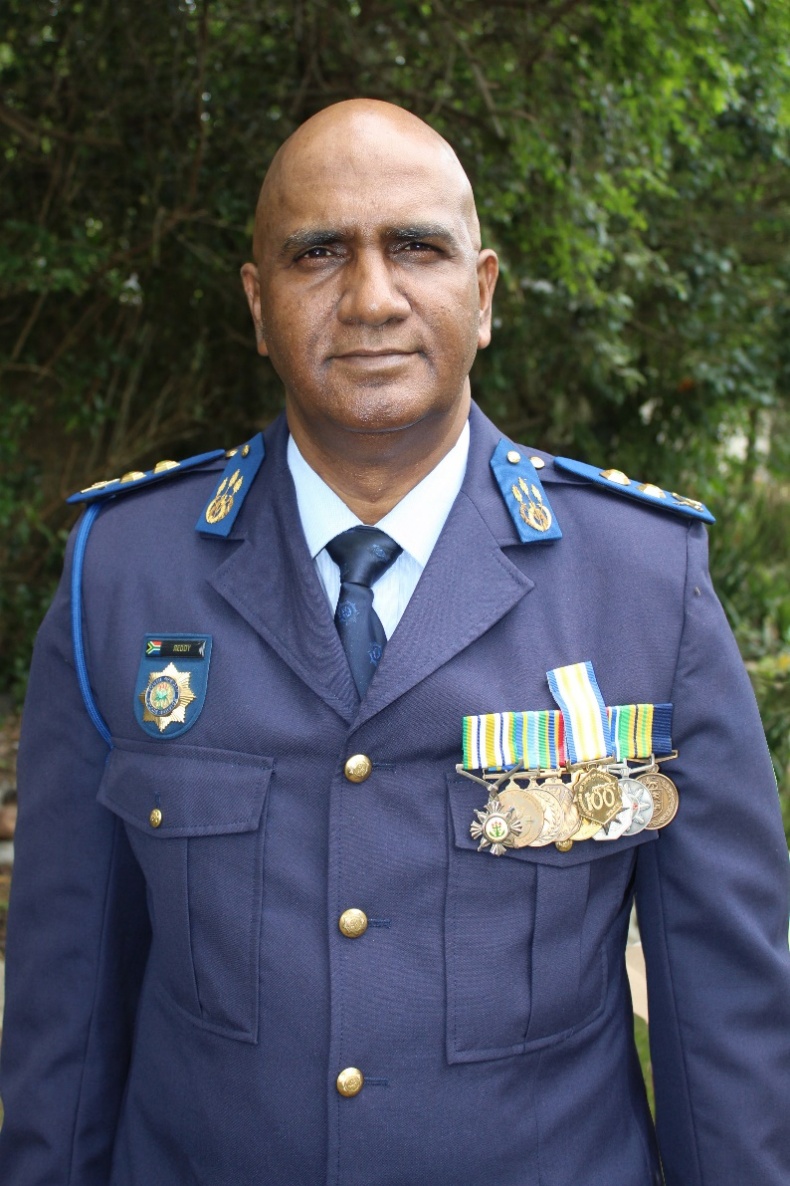
Major General Oswald D Reddy
I met Colonel Govender for the first time in 1991, when I was transferred to the Lenasia Police station in Soweto, as a Lieutenant to work under his command. He was serving as the Station Commander and held the rank of Captain at that time.
The warm welcome, reception and induction I received was unprecedent in policing. He assisted me with state accommodation. My first impression of him was that he was a father figure to all the police officials serving under his command.
He had completed the Officer’s course in Benoni in 1984 and on promotion to the rank of Lieutenant, was posted to SAP Lenasia as the Station Commander.
I found him to be a disciplined, humble, highly competent and experienced officer who was willing to share his knowledge and experience with everyone, especially us young officers.
He appointed me as the head of the Community Service Centre and shortly thereafter as the head of the Lenasia crime prevention unit.
He became my mentor who trusted, empowered, supported and guided me in my career. Further, he provided me with the resources to carry out my duties of fighting crime including supporting the social crime prevention initiatives, dealing with drug dealers, unlicensed liquor outlets and other criminals in Lenasia.
Shortly thereafter, he was promoted to rank of Major and was transferred to the District Commissioner’s office in Soweto.
He contributed immensely to my progress and advancement in the police because of his leadership and guidance and I remain indebted to this remarkable officer and gentleman.
“Great leadership is not about control. It is about empowering people.” Brigette Hyacinath
The service medals awarded to him in order of precedence
- 1973-01-26 – The South African Police Medal for Combating Terrorism;
- 1974-07-25 – The South African Police Bar for Combating Terrorism;
- 1988-04-01 – The South African Police Seventy Fifth Anniversary Commemorative Medal;
- 1991-01-05 – The South African Police Star for Faithful service for twenty years Faithful service and Exemplary Conduct;
- 1991-01-05 – The South African Police Medal for Faithful Service for 10 years long Service and Exemplary Conduct.
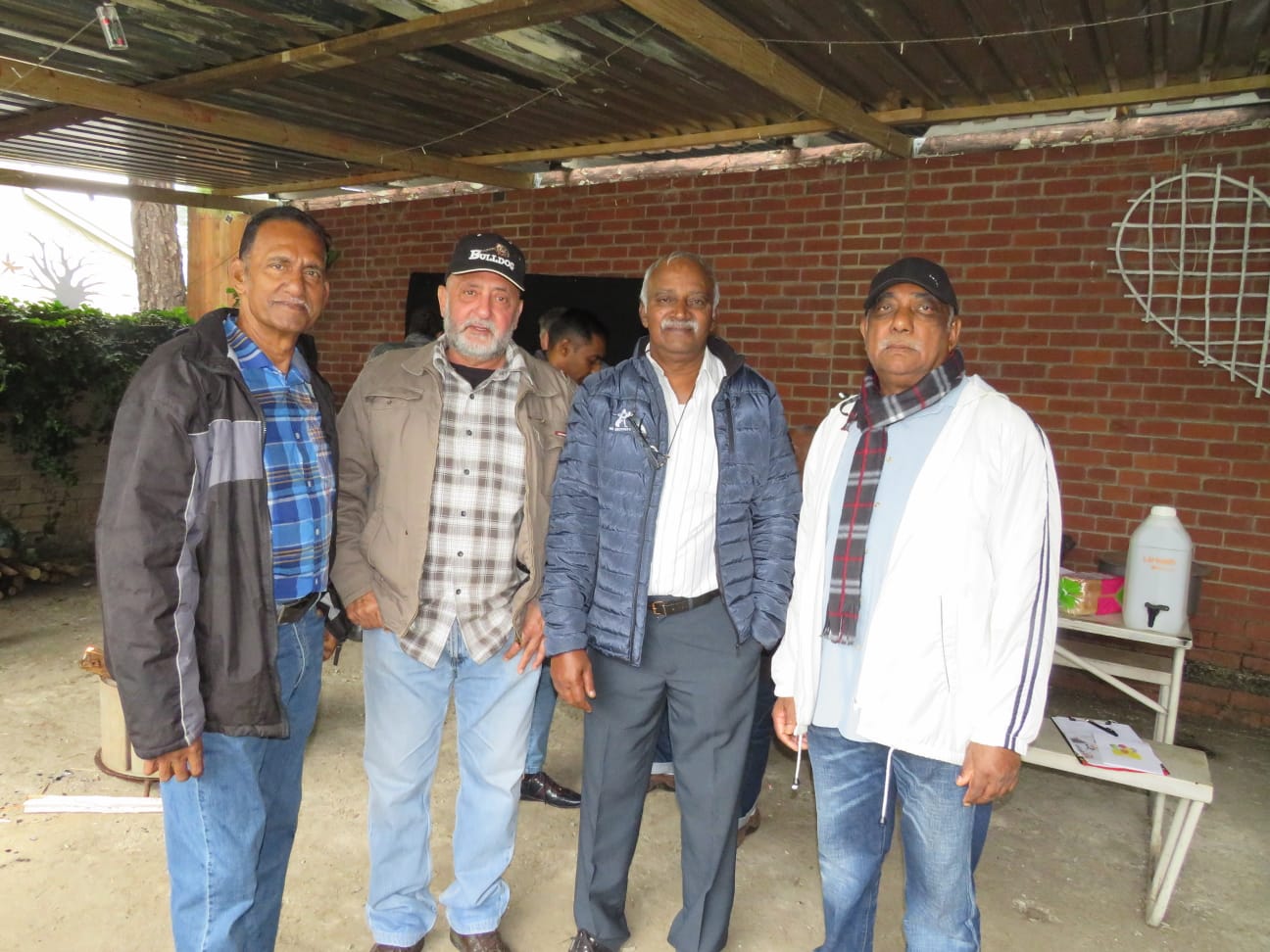
Meeting of retired police members in Pietermaritzburg during 2024
Left to right Brigadier Morgan Naicker; Lieutenant- Colonel Pipes YA Haffajee; Colonel Johnny Govender; Brigadier Bala Naidoo
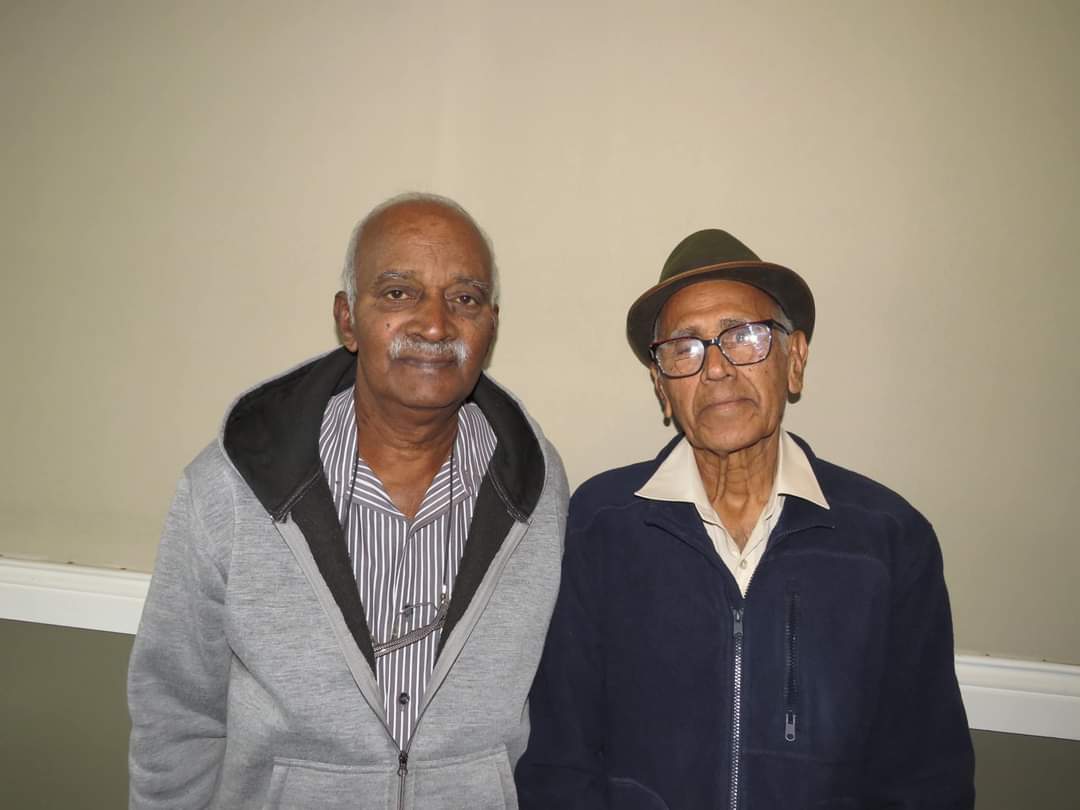
Meeting of retired police members in Pietermaritzburg during 2024
Colonel Johnny Govender with his mentor Captain Bob Sewpersad
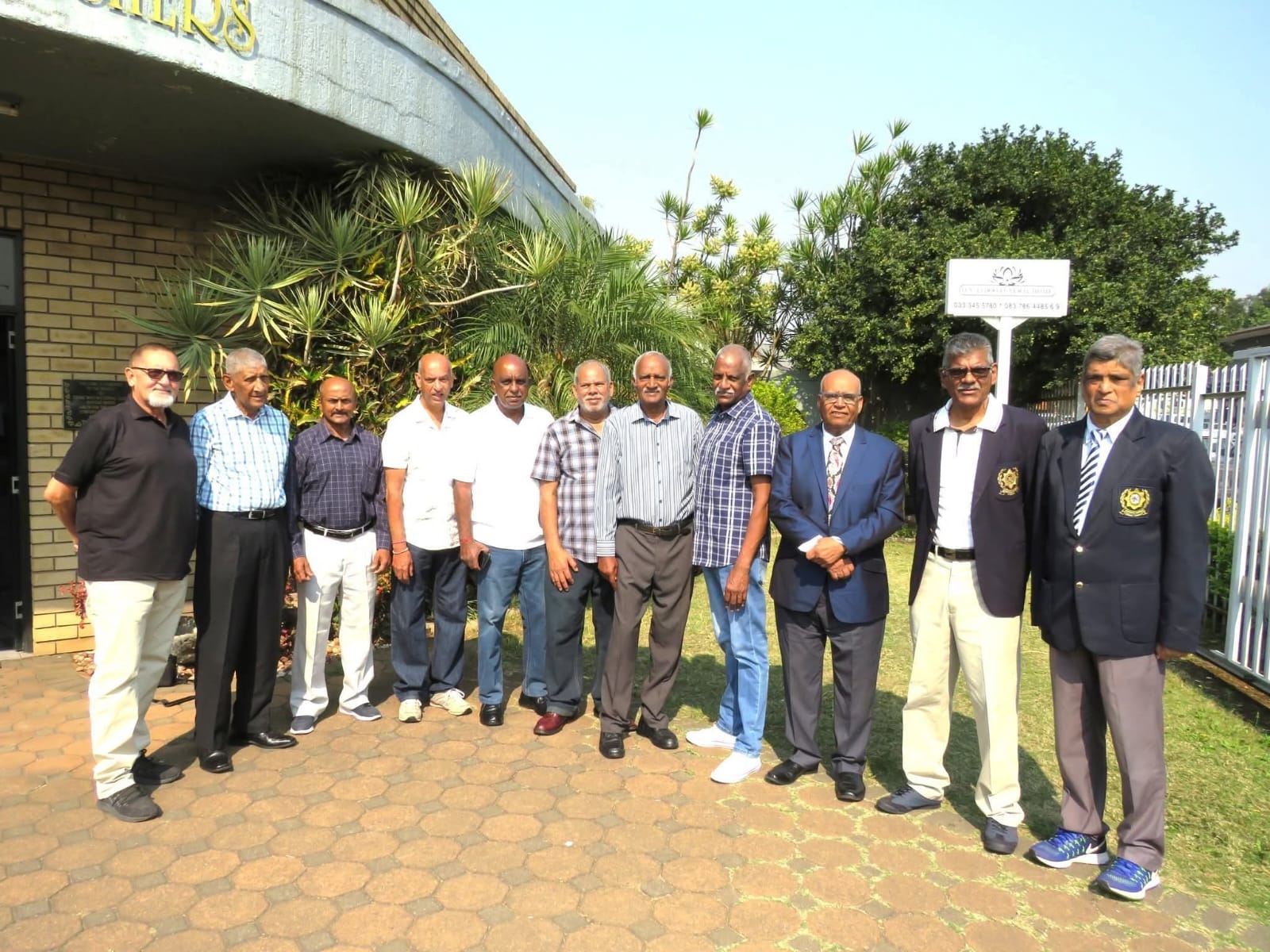
At the funeral service of Captain Bob Sewpersad
7th from left Johnny Govender
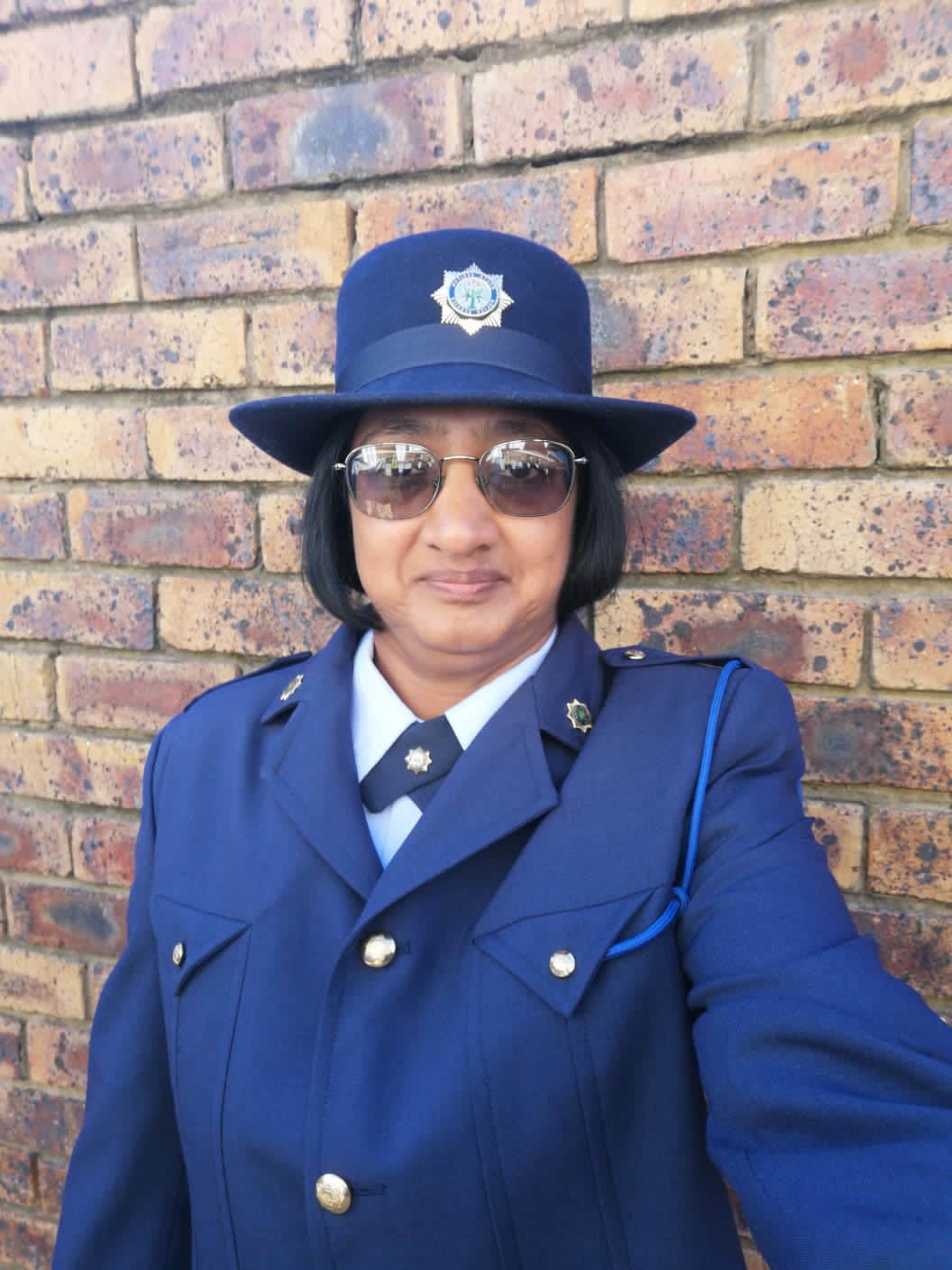
Preshie Govender, youngest daughter of Colonel Johnny Govender who followed Dad’s footsteps
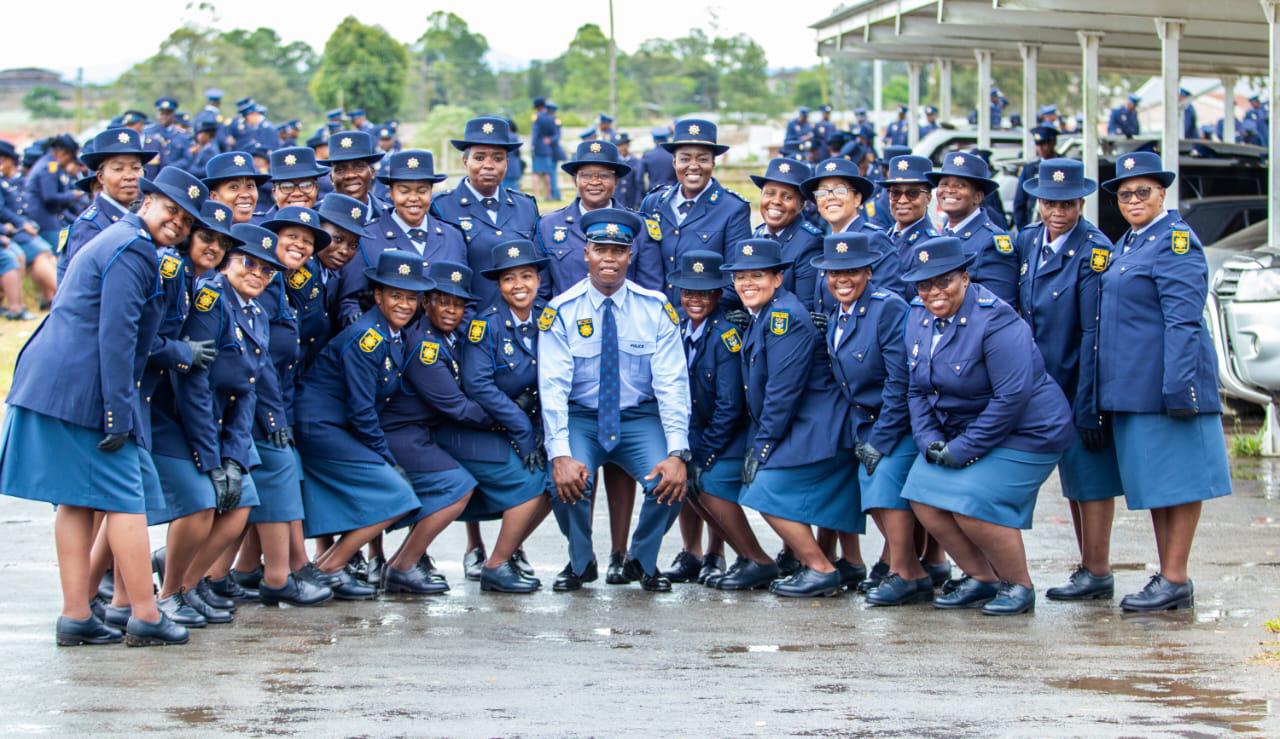
A platoon photograph of members together with their tutors at Bisho after a Refresher’s Course in December 2025
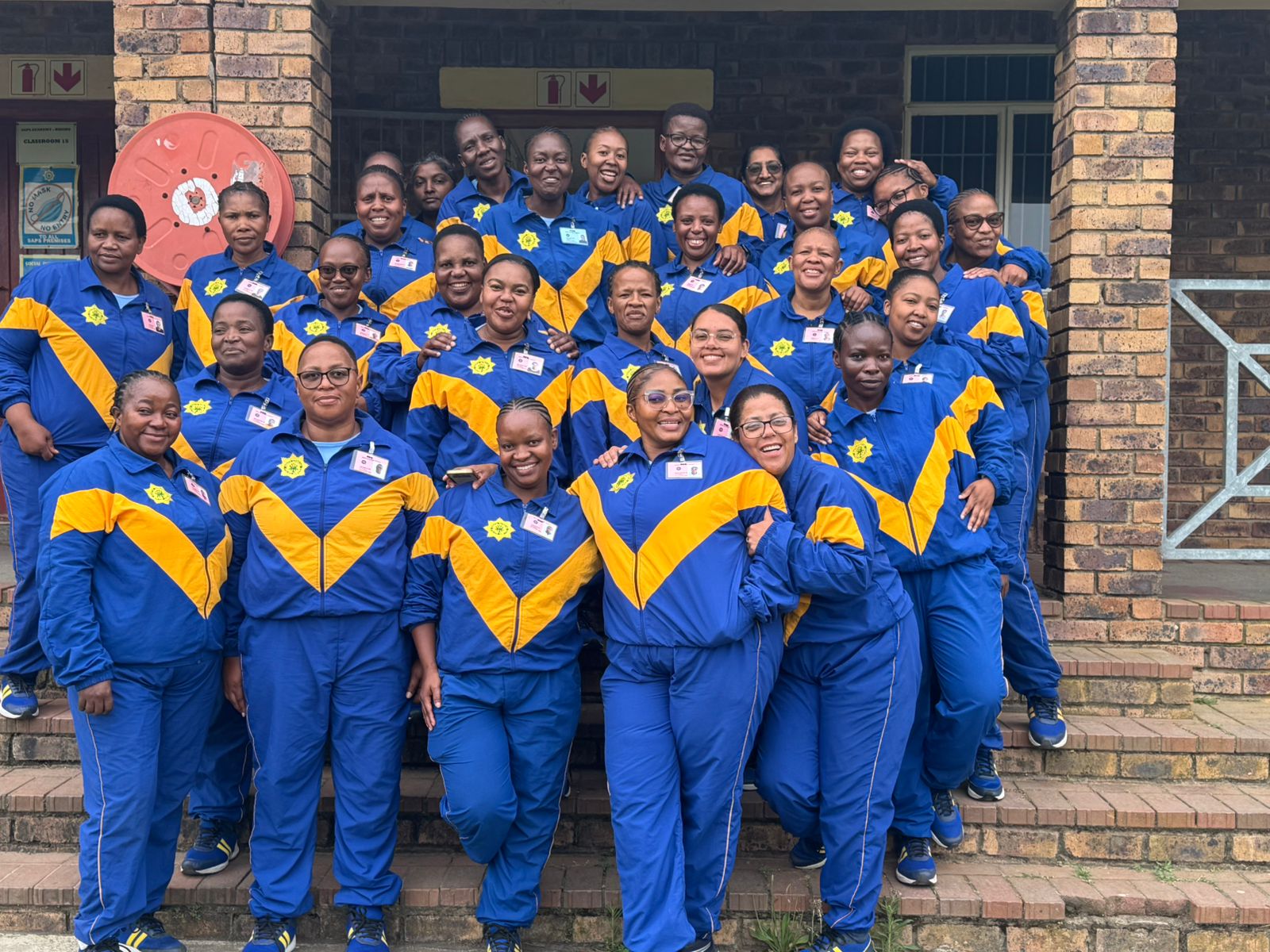
The ladies in official tracksuits at Bisho, Eastern Cape
His youngest daughter, Preshie Govender, joined the SA Police, at Hilton (N) on 2002-02-26 and has served for over 25 years as a Radio Operator at Pietermaritzburg Radio Control.
In 2015, she played a key role in a successful sting operation that led to the arrest and conviction of an individual involved in the illegal sale of a baby.
She continues the family’s tradition of compassion by celebrating family milestones at the Ekujabuleni Children’s Home to this day.
AFTERWORD
Colonel Johnny Govender’s life and career reflect the very best values of policing: integrity, service, humility, and leadership. Over more than three decades, he served the South African Police with dedication during some of the most difficult and divided periods in our country’s history. Despite facing racial barriers and limited opportunities, he never allowed bitterness or frustration to define him. Instead, he chose excellence, fairness, and compassion.
What truly set Johnny Govender apart was not only his professional competence, but his humanity. He led by example, earning respect rather than demanding it. Whether commanding large operational units, managing police stations, or working directly with communities torn apart by violence and mistrust, he consistently placed people first. His belief in community-centred policing helped build bridges where fear and division once existed.
As a mentor, Johnny invested deeply in the growth of others. He empowered young officers, shared his knowledge freely, and created opportunities for those under his command to succeed. Many officers, myself included, owe our development and advancement to his guidance and belief in our potential. He was not just a commander, but a father figure, teacher, and role model.
In my opinion, Colonel Govender possessed all the qualities required of a General. His operational experience, academic ability, leadership under pressure, and deep understanding of policing made him more than worthy of the highest ranks. Had circumstances and opportunities been fairer, I firmly believe he would have served with distinction as a General in the South African Police.
Beyond policing, his compassion extended into the community through his involvement with homes for the elderly and children, and through acts of kindness that quietly changed lives. His influence continues to be felt through the people he helped, the officers he mentored, and the communities he served.
Colonel Johnny Govender leaves behind a legacy of honour, courage, and selfless service. His story is not only a record of achievement, but a reminder that true leadership is measured by the lives we touch and the values we uphold. His contribution to policing and society will long be remembered with respect and gratitude.
[LG]
I want to acknowledge and respect these Officers for tireless behind the scenes, efforts in the production and publication of this magazine.
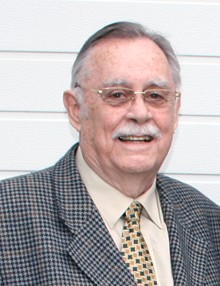
Brigadier Hennie Heymans, Editor in Chief of Nongqai
Brigadier Hennie Heymans, Editor in Chief of Nongqai. An experienced and highly skilled officer with an exceptional memory. His Dad was stationed at Somtseu Road and Mount Edgecombe during the 1940’s. Brigadier holds a Master’s degree in History. Was stationed with Lieutenant-Colonel (Ray) Mathura Munilall at Wentworth. He was also based at King’s Rest (Brighton Beach); and amongst others, Soweto Region, The Public Relations Officer at Head Office and later a District Commandant at Welkom in the Free State Province.
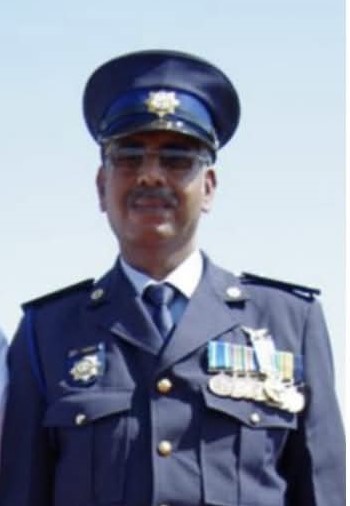
Captain DME Lazarus
Captain DME Lazarus, a Stalwart of SA Police, Chatsworth, Unit 02 & Unit 05, later SA Police, Training College, Chatsworth and Supply Chain Management, Durban, KwaZulu-Natal. An experienced and highly skilled officer with an exceptional memory.
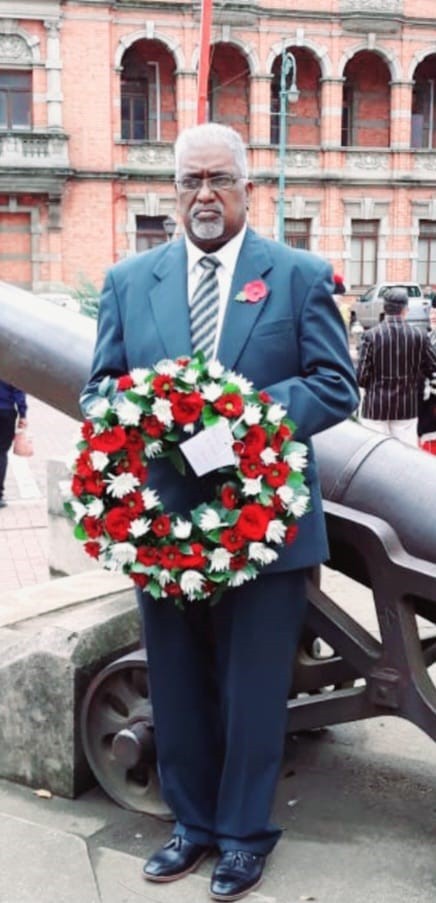
Captain DME Lazarus
Captain (Sooks) P Sokaloo laying a wreath at a Commemoration Service in Pietermaritzburg. His Dad was a World War 11 veteran. An experienced and highly skilled officer. He was nominated by Lieutenant General Andre Pruis to represent the SA Police at Interpol in the illicit trafficking of narcotic drugs, etc
ACKNOWLEDGEMENTS
I should like to express my sincere thanks and appreciation to the following: –
- The Editor, Nongqai, [HBH] for agreeing to publish a Special Edition of Nongqai to acknowledge, celebrate and honour the police career of Colonel Johnny Govender. The invaluable contributions by [HBH] in researching, recording and documenting the efforts of South African Police, Security and Military personnel, of ALL groups; particularly that of South African Police, Indian members;
- Major General (Professor) George D Govender [DG] for his keen interest, advice, inspiration and professional assistance always;
- Advocate Karen Pillay, daughter of the late Colonel Rungasamy (Dickey) Munsamy for her keen interest, professional advice, inspiration and assistance always;
- Advocates (Lieutenant General) Sally Khan; Yolan Denness; Major General Oswald Reddy; Lieutenant-Colonel (Advocate) Jay Govender and Captains DME Lazarus (Prakash) P Sokaloo for their respective contributions, herein;
- Last but by no means the least, my dear family for their inspiration, encouragement and patience.
“agnoscere et honorare servientibus” –
“to acknowledge and honour those who served”
“Soli Deo Gloria” – “To God Alone Glory”
Logan Govender

I served briefly with the, then, Captain Govender in Soweto. He was a very friendly and pleasant officer who was very competent.
Thank you, Sir