
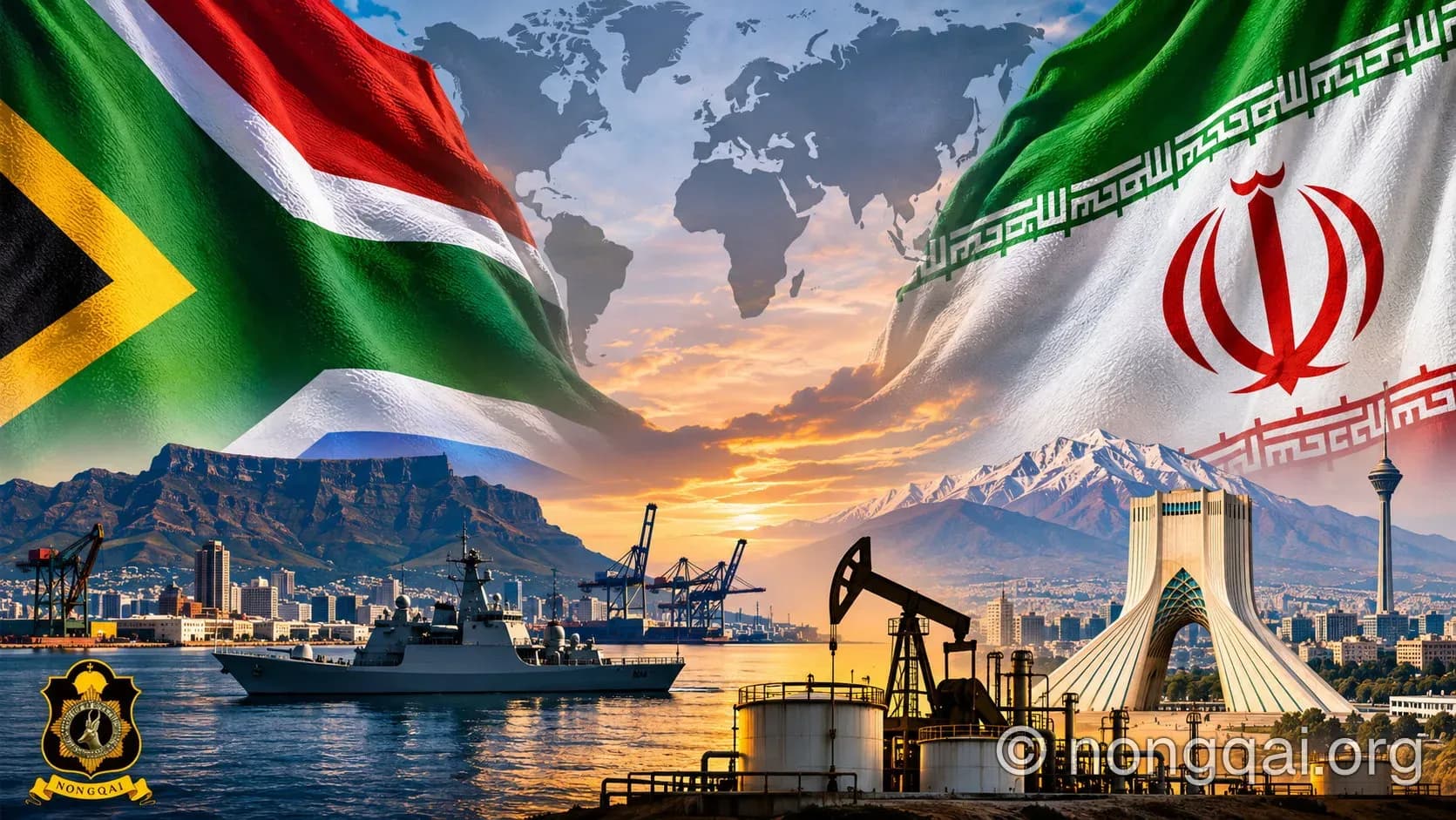
 AI image
South Africa and Iran – A History of Strategic Convenience

From oil and arms transactions under the National Party government to diplomatic solidarity and military engagement in democratic South Africa, the relationship between Pretoria and Tehran has been shaped by changing interests, political circumstances and strategic calculations. Its future, however, depends on clearly defined objectives, effective coordination between government departments and consistent communication of the strategic rationale guiding the relationship.
South Africa's relationship with Iran is often discussed through the lens of contemporary geopolitics: the ANC's foreign-policy orientation, its association with BRICS, its position on the Palestinian question and its sometimes difficult relationship with Western governments.
Yet the relationship has a much longer and more complicated history.
It predates democratic South Africa by several decades, survived a revolution that fundamentally changed Iran's political system, and has repeatedly demonstrated that diplomatic positions and practical national interests do not always coincide.
The history is instructive because it challenges the assumption that South Africa's engagement with Iran is primarily an ideological project of the ANC. Successive South African governments, operating under very different political circumstances, have found reasons to engage Tehran. The nature of those reasons, however, has changed considerably.
From the Shah to the Islamic Revolution
An early connection between the two countries emerged during the Second World War. Following the Anglo-Soviet invasion of Iran in 1941, Reza Shah was forced to abdicate and was exiled to South Africa, where he arrived in 1942. He died in Johannesburg in July 1944. Although this episode preceded the National Party's accession to power in 1948, it established an early connection between the two countries' political establishments.
The more substantial relationship developed during the 1970s, when Iran was ruled by Reza Shah's son, Mohammad Reza Pahlavi. The Shah's Iran and the NP government found considerable common ground in their economic interests and concerns about communist influence and Soviet penetration of the Indian Ocean region.
Energy was central to this relationship. Iran became South Africa's principal crude oil supplier, providing more than 90% of its oil imports by 1978. The two countries also had a significant stake in the Natref refinery at Sasolburg, inaugurated in 1971. Iran's National Iranian Oil Company held a 17.5% interest, alongside Sasol and Total, and undertook to supply crude oil under a long-term agreement.
Cooperation extended beyond petroleum. The relationship included military transactions and nuclear-related cooperation, although these activities should be distinguished rather than treated as a single programme. The Shah's government was prepared to pursue commercial and strategic relations with South Africa despite international opposition to apartheid. This did not mean that Iran endorsed every aspect of South African policy. The Shah occasionally expressed concern about apartheid's implications for Iran's standing in Africa, but his government's economic and strategic interests remained influential.
The 1979 Islamic Revolution transformed the relationship. The new Iranian government adopted a strongly anti-apartheid position, severed formal diplomatic relations and supported the South African liberation movements, including the ANC. Yet the practical relationship did not end as neatly as the diplomatic one.
Oil supplies continued for several years, reflecting existing commercial arrangements and Iran's financial interest in Natref. During the Iran–Iraq War, South Africa also became a source of military equipment for Iran. Research by H.E. Chehabi and other scholars documents arms transactions and arrangements involving the exchange of South African weapons for Iranian crude oil. Both countries faced Western restrictions on arms procurement, creating an unusual convergence of interests.
This period is particularly revealing. The NP government and the Islamic Republic were political adversaries in ideological terms, yet economic and military transactions continued where they served practical interests. Diplomatic hostility did not necessarily prevent commercial cooperation.
Democratic South Africa and the restoration of relations
Following the transition to democracy, relations were formally restored in May 1994. Iran had already lifted its trade and economic sanctions against South Africa earlier that year. The ANC's historical relationship with the Islamic Republic, including Iranian support for the liberation struggle, provided a political foundation for renewed engagement.
The relationship was subsequently institutionalised through a Joint Commission established in 1995. Its activities extended beyond trade to include political consultations, energy, science and technology, industry and defence cooperation.
There were also significant commercial interests. Sasol entered into a partnership with Iran's Pars Petrochemical Company to establish Arya Sasol Polymer Company, while MTN acquired a 49% interest in the consortium that secured Iran's second mobile telecommunications licence. These ventures reflected the commercial opportunities available to South African companies in a country with considerable energy resources and a large domestic market.
The relationship was not without complications. Iran's nuclear programme became an increasingly contentious international issue, particularly after the revelations about undeclared nuclear activities and the subsequent dispute with the International Atomic Energy Agency. South Africa generally defended Iran's right under the Nuclear Non-Proliferation Treaty to pursue peaceful nuclear technology, while also maintaining that safeguards and international verification obligations had to be respected.
This position reflected South Africa's broader commitment to nuclear disarmament and the principle that the international non-proliferation regime should be applied consistently. It also demonstrated the difficulty of reconciling non-proliferation concerns with the desire to preserve diplomatic relations and resist what Pretoria regarded as selective international pressure.
The relationship nevertheless suffered as international sanctions against Iran intensified. At the end of 2011, Iran supplied approximately one-third of South Africa's domestic oil requirements. By June 2012, sanctions had effectively prevented South Africa from continuing to import Iranian crude. South African exports to Iran also declined substantially, from approximately R1.27 billion in 2008 to R270 million in 2014.
President Jacob Zuma's state visit to Iran in April 2016 followed the implementation of the nuclear agreement and the easing of nuclear-related sanctions. The visit sought to revive trade and investment and elevate bilateral relations into a substantive strategic partnership. Several agreements and commitments were announced, reflecting renewed interest in energy, industry, agriculture, science and technology, and other areas of cooperation.
Defence diplomacy and the contemporary relationship
Defence cooperation has become a more visible component of the relationship in recent years. A memorandum of understanding on defence cooperation was signed in December 2016 during a visit to South Africa by Iran's then Defence Minister, Brigadier General Hossein Dehghan. The agreement provided a formal framework for military engagement, although it should not be confused with an operational defence alliance.
Naval diplomacy has been particularly prominent. Iranian naval vessels have visited South African ports, including the destroyer IRIS Dena, which called at Cape Town in 2023 during a global deployment. In August 2024, South African Navy Chief Vice Admiral Monde Lobese visited Iran, where he met senior Iranian naval commanders, including the commander of the Islamic Revolutionary Guard Corps Navy. The programme included visits to naval facilities, training institutions and elements of Iran's naval industry.
In August 2025, SANDF Chief General Rudzani Maphwanya also visited Iran and held discussions with senior military officials. The visit attracted controversy after remarks attributed to him by Iranian media appeared to suggest a degree of political alignment beyond the normal scope of military-to-military engagement. DIRCO subsequently clarified that the comments did not represent South Africa's official foreign policy position. Parliamentary committee chairpersons also raised concerns about coordination between defence diplomacy and the country's foreign-policy machinery.
These developments warrant attention, but it is important to distinguish military diplomacy and formal cooperation from an operational partnership or strategic alliance. Official visits, exchanges of professional experience, naval exercises and memoranda of understanding do not, by themselves, establish an integrated military relationship or mutual defence commitment. There is also a need to establish which proposed areas of cooperation have translated into practical activities and which remain diplomatic intentions.
The distinction matters because South Africa has legitimate reasons to maintain professional military relationships with countries beyond its traditional partners. Maritime security, naval training, operational experience and defence-industrial knowledge are all potential areas of engagement. Iran has developed military capabilities under conditions of international isolation, while South Africa has its own defence-industrial experience and maritime responsibilities. Carefully defined exchanges may therefore have practical value.
The question is not simply whether South Africa should cooperate with Iran, but what it expects to achieve through that cooperation and how it fits into a wider national defence and foreign-policy framework.
Strategic autonomy requires strategic coherence
The historical relationship demonstrates that South Africa and Iran have repeatedly engaged one another for reasons that extend beyond ideological affinity. Under the Shah, energy security and regional strategic considerations were central. After the revolution, commercial and military transactions continued despite political hostility. Democratic South Africa subsequently restored relations on the basis of historical solidarity, commercial opportunity, South-South cooperation and a shared interest in a more multipolar international order.
These different motivations should not be conflated. Nor should the relationship be judged solely through the prism of South Africa's current political alignment. Maintaining diplomatic relations with Iran does not require endorsement of its domestic policies, regional activities or political system. Equally, criticism of those policies does not automatically negate the value of diplomatic engagement.
The more pressing concern is whether South Africa has articulated a sufficiently coherent strategic purpose for the relationship. The Presidency, the Department of International Relations and Cooperation (DIRCO), and the Department of Defence and the SANDF have distinct responsibilities, but their activities are interdependent. Defence diplomacy cannot be conducted in isolation from foreign policy, just as diplomatic initiatives cannot disregard their defence and security implications.
Strategic objectives should be established before high-level engagements take place, not improvised or clarified only after controversy arises. The government should be able to explain the purpose of military cooperation, its intended benefits, its limits and the national interests it is intended to advance. It should also communicate these objectives consistently to domestic audiences and international partners.
South Africa's relationship with Iran need not be abandoned simply because it attracts criticism from Washington or other Western capitals. Nor should it be maintained unquestioningly because of historical solidarity or shared positions on selected international issues. Strategic autonomy requires independent judgement, but independence is meaningful only when decisions are guided by identifiable interests and consistently applied principles.
The history of South Africa–Iran relations offers a useful reminder: governments change, political systems evolve and international alignments shift, but the need to balance national interests with diplomatic realities remains. The challenge today is not necessarily to redefine the relationship, but to explain more clearly what South Africa seeks to achieve through it.
Diplomatic relations and military cooperation should be instruments of national strategy, not ends in themselves. Without coherent objectives, institutional coordination and consistent communication, even a relationship with legitimate strategic value can become a source of unnecessary ambiguity and diplomatic friction.
References
- Onditi, F. (2022). How to Think and Frame Third Worldism with Illustrations from Iran-South African Diplomatic Relations, 2006-2019. Qeios. https://doi.org/10.32388/TCB66W
- Chehabi, H. E. (2017). South Africa and Iran in the Apartheid Era. Journal of Southern African Studies, 42(4), 687-709. http://dx.doi.org/10.1080/03057070.2016.1201330
- Bakhash, S. (2017). ‘A matter of political expediency’: Iran, Britain, South Africa and the Settlement of Reza Shah’s Estate. Middle Eastern Studies, 53(6), 686-995. https://doi.org/10.1080/00263206.2017.1342628
- Onderco, M. (2016). A Battle of Principles: South Africa's Relations with Iran. Commonwealth & Comparative Politics, 54(2), 252-267. https://doi.org/10.1080/14662043.2016.1151168
Write to us about this article
Do you remember this, or know more? Your comment appears here once an editor has read it.
The editors may print your comment, with your name, in the monthly edition.
Related Articles
Beyond Capitalism and Socialism
November 17, 2026
South Africa's Defence Oversight Problem: When Parliamentary Scrutiny Fails to Deliver
November 12, 2026

Can Foreign Policy be Separated from Morality? Joan Swart
August 23, 2026
What Kind of Defence Force Does South Africa Need?
November 2, 2026
Voltaire, Huntington, Brzezinski and South African Strategic Identity in a Multipolar World, Joan Swart
September 5, 2026