
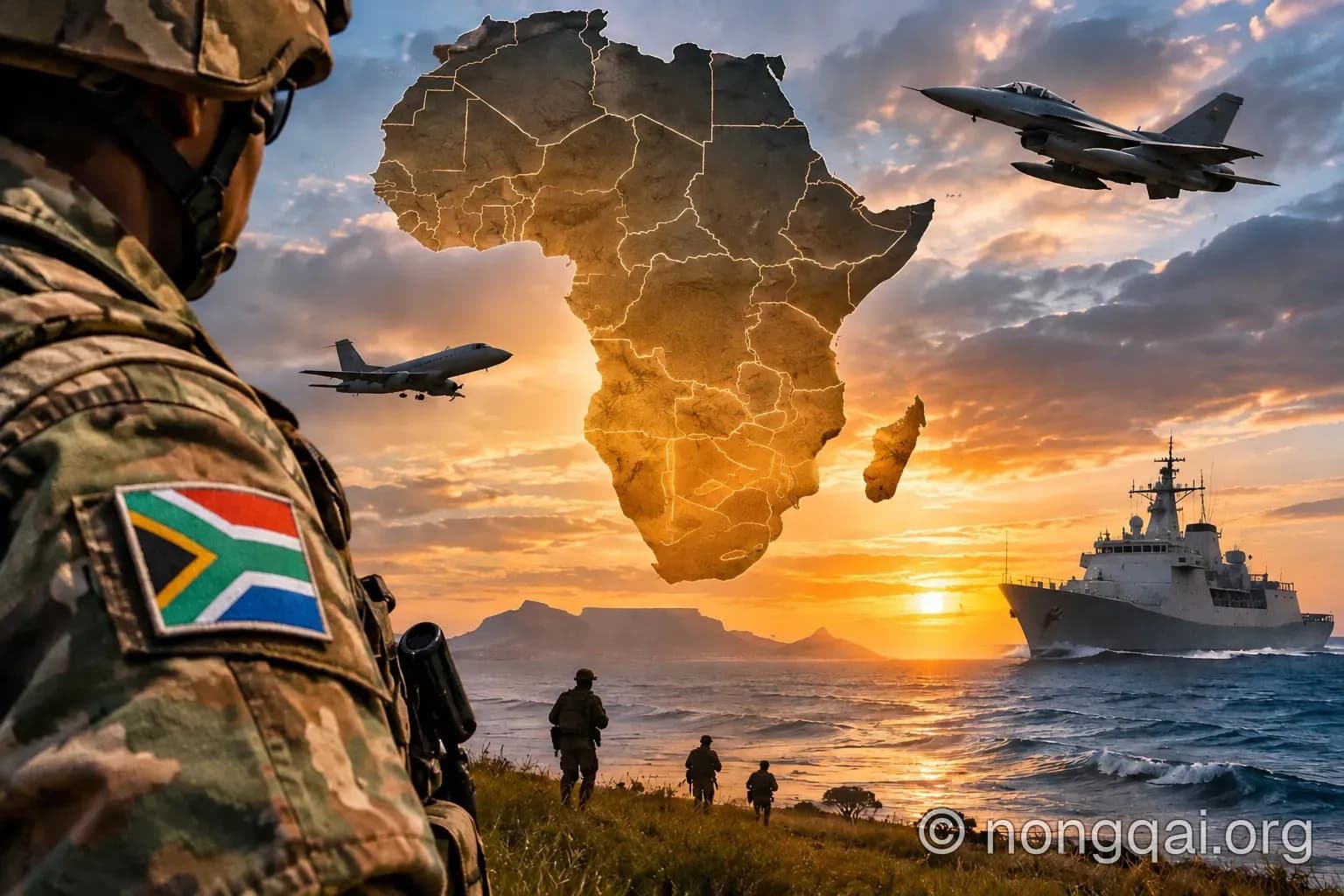
 AI image
What Kind of Defence Force Does South Africa Need?
Aligning military capability with South Africa's national-security priorities

South Africa's defence debate often begins with a familiar observation: the South African National Defence Force (SANDF) is underfunded, its equipment is ageing, and its operational readiness has deteriorated. These concerns are well founded, but they do not quite address the underlying problem. Before asking how much more money the country should spend on Defence, we need to establish what kind of military capability South Africa actually requires, what national interests it is expected to protect, and which responsibilities it can realistically sustain.
In my recent article on the 2026 Medium Term Budget Policy Statement, I considered the relationship between defence funding, operational readiness and strategic ambition. A response from retired police Brigadier Hennie Heymans raised an important additional consideration: South Africa appears to be attempting to maintain a full-spectrum military force with resources increasingly sufficient only for a substantially smaller one. His observation deserves attention because it brings the problem of defence funding back to the question of strategic priorities.
The SANDF is expected to perform a wide range of functions. These include border protection, maritime security, regional peace-support operations, support to the South African Police Service (SAPS), disaster relief and air transport. It also has diplomatic and strategic responsibilities through military cooperation, training and international deployments. Each function requires different combinations of personnel, equipment, logistics, training and maintenance. The question is not whether these responsibilities are individually legitimate, but whether the country has the resources to perform them simultaneously and at an acceptable level of effectiveness.
A military establishment can retain an impressive inventory on paper while losing the ability to employ much of it. As Brigadier Heymans observed, “inventaris is nie vermoë nie” (inventory is not capability). A fighter aircraft that cannot fly because specialised components are unavailable, or a naval vessel that spends extended periods undergoing repairs, contributes little to operational capability. The same applies to personnel who are insufficiently trained, logistical systems that cannot sustain deployments, and equipment that cannot be maintained over its intended service life.
The flying-hour and sea-hour figures discussed in the previous article illustrate the problem. By the middle of the 2026/27 financial year, the SANDF had recorded 2,954 flying hours against an annual target of 12,000, and 3,297 hours at sea against a target of 8,000. These were interim figures, and the Department of Defence anticipated improvement during the second half of the year. Nevertheless, the shortfalls point to the importance of maintenance, component availability and the resources required to convert nominal inventory into usable capability.
Heymans also highlighted the consequences of personnel expenditure consuming such a large proportion of the defence budget. When salaries and associated costs absorb most available funding, less remains for training, maintenance, fuel, ammunition, modernisation and equipment replacement. This is not an argument against maintaining an adequately staffed and professionally trained military. It is an argument that personnel structures, force size and equipment holdings must be considered together. A force that cannot afford to train and maintain its personnel and equipment is not necessarily more capable because it has more people or platforms.
The problem of strategic direction
These difficulties become more serious when considered alongside the absence of a clearly articulated and updated defence strategy. The 2015 Defence Review was developed in a substantially different international and regional environment. Since then, the character of conflict, the strategic importance of maritime routes, the use of unmanned systems, cyber operations and competition between major powers have all changed. Instability in parts of Africa has also continued to place demands on regional security arrangements and South Africa's willingness to contribute to them.
The Department of Defence has acknowledged the need to evaluate national defence policy and determine the country's level of ambition, capability requirements and sustainable funding model. This is an essential starting point. However, a review must do more than identify capability deficiencies or list equipment requirements. It must establish which national interests require military protection, what threats and contingencies are most consequential, and what level of military response the country is prepared and able to sustain.
There is also a political dimension that should not be overlooked. South Africa's Government of National Unity (GNU) brings together parties with substantially different views on foreign policy, particularly concerning relations with major powers and the country's international partnerships. The African National Congress (ANC) has maintained its position as the principal custodian of foreign policy, while the Democratic Alliance (DA) has called for a more collective approach and a shared definition of the national interest. These differences are not merely diplomatic disagreements.
Foreign policy and defence policy are closely connected. Decisions about military partnerships, joint exercises, training, procurement, intelligence cooperation and international deployments are influenced by the country's understanding of its place in the international system. If governing parties do not share a sufficiently clear understanding of national interests and strategic alignments, this can complicate the establishment of consistent defence priorities. Political disagreement does not automatically mean that defence planning is paralysed, but it creates a risk that needs to be addressed.
The question is particularly relevant when considering South Africa's external partnerships. Relationships with major powers and regional states may offer access to equipment, training, technology and logistical support. Yet diplomatic relationships and membership of multilateral groupings should not be confused with dependable military support. BRICS, for example, is not a collective-defence arrangement. South Africa needs to assess its partnerships in terms of what they actually provide, what dependencies they create, and whether they serve clearly defined national-security interests.
Different threats, different force requirements
Public discussion of the SANDF frequently turns to the military acquisitions of other African countries. Ethiopia's reported acquisition of advanced Russian aircraft and air-defence systems, and Algeria's substantial investment in modern military equipment, are sometimes presented as evidence of how far South Africa has fallen behind. Such comparisons can be misleading, not because these countries' modernisation programmes are unnecessary, but because their security environments and defence requirements differ from South Africa's.
Ethiopia and Algeria face security circumstances in which conventional military deterrence, territorial defence and the ability to respond to threats along their borders are important considerations. Their geographical circumstances, regional relationships, threat perceptions and strategic histories help explain their investment in conventional military capabilities. These are legitimate defence priorities. South Africa, however, does not face an identical set of immediate security challenges.
Its more pressing security concerns are predominantly internal and sub-state in character: organised criminal networks, violent unrest, gang violence, illegal mining, border vulnerabilities, poaching and threats to critical infrastructure. It also has important regional responsibilities involving disaster relief and peace-support operations. Maritime security remains a national interest, particularly given the importance of the country's ports, shipping routes and maritime resources. These requirements call for a different balance of capabilities.
This does not mean that conventional military capability is irrelevant to South Africa. The country still needs credible air and maritime capabilities, territorial surveillance, intelligence, logistics and the ability to respond to external contingencies. Nor should the SANDF be designed around an assumption that present threats will remain unchanged. Defence planning must allow for uncertainty and the possibility that the strategic environment could deteriorate. But the balance between capabilities should reflect the country's actual responsibilities and the risks it needs to manage.
There is also an important distinction between military and law-enforcement responsibilities. Organised crime and gang violence are primarily policing problems, requiring effective investigation, intelligence, prosecution and criminal-justice processes. The SANDF should not become a substitute for the police. Its contribution should be defined around the capabilities it can properly provide within its constitutional mandate: surveillance, mobility, logistical support, border operations, specialised military skills and assistance to civilian authorities when authorised. The objective should be to strengthen the overall security response without militarising problems that require civilian law enforcement.
Priorities before procurement
This has direct implications for force design and procurement. South Africa should not acquire equipment simply to match the inventories of other states or preserve the appearance of a technologically modern military. Nor should it assume that every capability currently listed in its force structure must be retained. The more difficult task is to determine which capabilities are indispensable, which can be reduced or reconfigured, and where investment would produce the greatest strategic return.
For some requirements, the priority may be less expensive platforms and more investment in surveillance, communications, intelligence, mobility, engineering, logistics, medical support and maintenance. Maritime monitoring, for example, depends not only on ships but also on the ability to detect, identify and respond to activity across a large maritime area. Border operations similarly require persistent surveillance, reliable transport and effective coordination with civilian agencies. Regional deployments demand forces that can be sustained beyond the initial deployment, with adequate transport, maintenance and medical support.
This is where the concept of a smaller but more sustainable force deserves serious consideration. It may be necessary to maintain fewer capabilities at a credible level of readiness rather than attempt to preserve a nominally comprehensive force that cannot perform many of its assigned functions effectively. That is not an argument for abandoning strategic ambition. It is an argument for defining ambition realistically and investing accordingly.
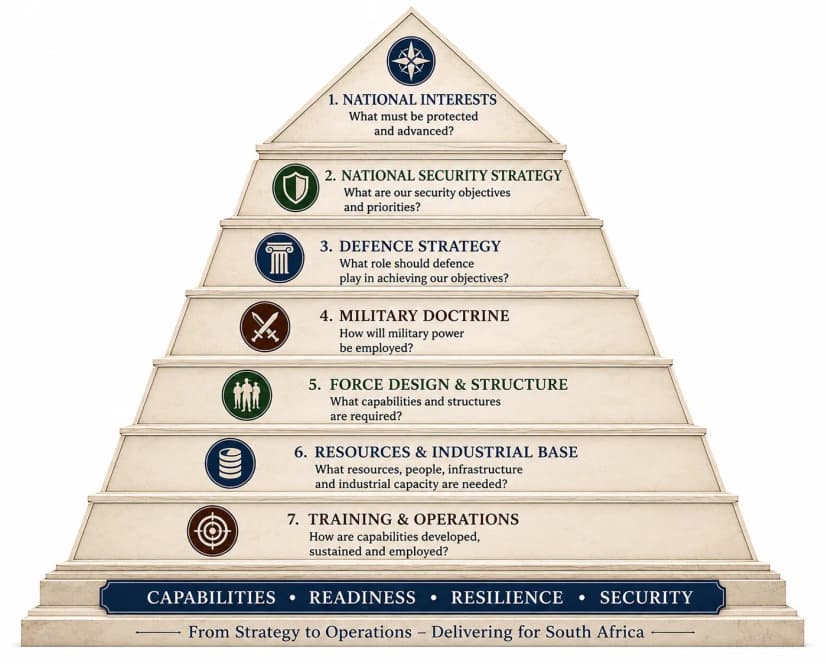
The challenge is therefore not simply to increase defence expenditure, although the present funding constraints are difficult to ignore. It is to establish a coherent relationship between foreign policy, national-security priorities, military strategy, force design and the resources available to implement them. Without that foundation, additional funding risks being absorbed by existing pressures without producing a meaningful improvement in capability.
South Africa needs to decide what it expects its military to do, where it expects it to operate, which partnerships can support those objectives, and what it is prepared to fund over the long term. Only then can procurement decisions be evaluated properly and operational shortcomings addressed systematically.
A defence force should not be judged by how closely its inventory resembles that of another country. It should be judged by whether it can protect the interests of the state, fulfil its assigned responsibilities and remain operationally effective when required.
The central question for South Africa is no longer simply whether it can afford the SANDF it has. It is whether it has clearly defined the SANDF it needs.
Write to us about this article
Do you remember this, or know more? Your comment appears here once an editor has read it.
The editors may print your comment, with your name, in the monthly edition.
Related Articles
Medium Term Budget Policy Statement and SA Defence, Joan Swart
October 22, 2026

South Africa’s Defence Dilemma in a Changing Security Environment - Joan Swart
May 21, 2026
The SANDF’s Crisis Is Not Financial — It Is Strategic, Joan Swart
June 3, 2026
Defence Governance: Another Task Team or a Strategic Reset? Joan Swart
June 10, 2026
Beyond Guns and Butter: Why Strategy Must Come Before Budgets, Joan Swart
June 19, 2026