9 articles match your filters
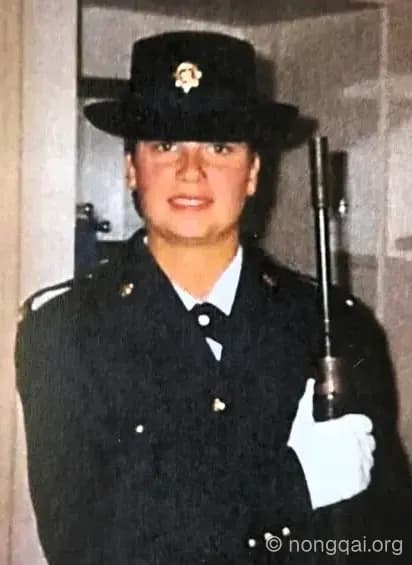
SOUTH AFRICAN POLICE SERVICE‘n Persoonlike verhaal van Antonette Raath Muller oor haar liefde vir wapens, haar toetrede tot die Suid-Afrikaanse Polisie en haar loopbaan as polisievrou en SWAT-instrukteur.

Local South African Police ForcesA personal and historical reflection on policing at King’s Rest and the Bluff, spanning from colonial Natal Police days to the modern SAP era.
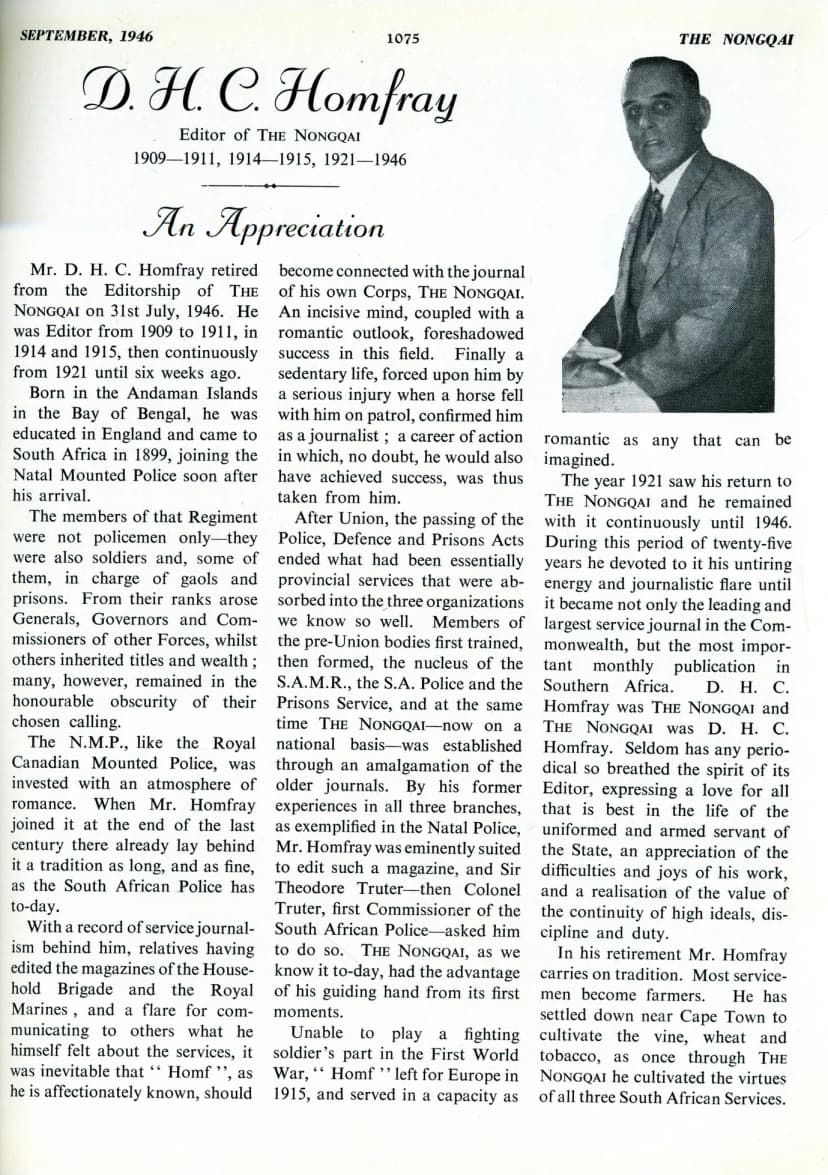
NongqaiD. H. C. Homfray served as the long‑standing editor of The Nongqai, shaping the journal from its early years into the leading service publication in Southern Africa. Born in the Andaman Islands and trained in England, he joined the Natal Mounted Police in 1899, where his experiences across policing, military duties and prison administration informed his later editorial vision. A severe injury redirected him from active service to journalism, and his tenure as editor — spanning 1909–1911, 1914–1915 and 1921–1946 — gave The Nongqai its distinctive character rooted in tradition, discipline and the ethos of uniformed service. After retiring in 1946, Homfray settled near Cape Town as a farmer, continuing a life shaped by service and dedication.

1988 Perd-standbeeld - SAP-kollegeThe Eques Incognitus statue’s journey reflects the enduring spirit of South Africa’s Mounted Police, moving from the SAP College to Potchefstroom as a living symbol of service and tradition. It stands today as a tribute to loyalty and heritage, echoing the legacy of Abadan L123 and the men and horses who served with honour.
ABS - ISUWar in Peace: The Truth About the South African Police’s East Rand Riot Unit, 1986–1994 by Sgt Nick Howarth is a firsthand account of policing during one of the most volatile periods in South African history. Unlike political or academic narratives, this book is written from the perspective of a frontline riot policeman who served in the East Rand during the final years of apartheid and the transition to democracy. Drawing on real incidents, lived experiences and the emotional realities of daily service, Howarth captures the fear, confusion, courage, camaraderie and dark humour that shaped the lives of Internal Stability Division members. The book honours the thousands of riot police officers and their families whose sacrifices were seldom acknowledged, and provides younger and international readers with rare insight into a world usually described from the outside. Its global reception underscores the universal human themes of loyalty, survival, loss and brotherhood. War in Peace stands as an important historical record of a country in conflict, and a tribute to the men who served during those turbulent years.

1982 - 10th Anniversary of Women PoliceThis article by Ida Steyn recounts the creation of the Polisiedame, a rose, a unique yellow rose cultivated to commemorate the tenth anniversary of the appointment of the first women in the South African Police Force. Brigadier Steve van Rooyen and Amanda Louw initiated the idea, and renowned rose grower Ludwig Taschner developed the cultivar with the approval of the Commissioner, General Hennie de Witt.
The rose, symbolising light, hope, warmth, and appreciation, was named “Polisiedame” to honour the courage and dedication of South African policewomen. The first rose was presented to Mrs. Corrie Vlok, wife of Minister Adriaan Vlok, marking its place as a living monument to the pioneering women of the police. The article concludes that the rose continues to bloom as a lasting tribute to their service and legacy.
(Cited from the document: “Die Polisiedame-roos herinner ons daaraan dat die nalatenskap van die pioniersvroue… leef in ’n blom wat hul moed, deursettingsvermoë en diens aan Suid-Afrika simboliseer.”)

DurbanThis article reflects on a recent conversation with former members of the South African Railway Police Special Task Force and explores their lesser‑known connections with the National Intelligence Service (NIS). Through personal recollections, operational insights, and historical context, the narrative highlights the unique capabilities of the Railway Police, the covert contributions of NIS operatives, and the importance of compartmentalisation within intelligence structures. The article also revisits significant historical intelligence figures and underscores the ongoing need to document South Africa’s covert security history. Nongqai continues to serve as a platform dedicated to preserving national security heritage with accuracy, balance, and respect for the past.

1939 - 1945: The Wartime SA PoliceCaptain Johannes “Jan” Taillard (1904–1987) was one of South Africa’s most effective and least known undercover policemen. Fluent in German and trusted across social divides, he played a decisive role in dismantling the Nazi Party in South West Africa in 1939, stealing the complete membership index and enabling the arrest of 2 284 members. In 1941 he infiltrated anti government networks in the Brits district, gained the confidence of Abwehr agent Robey Leibbrandt, and led him into a police ambush — an operation that prevented a planned assassination of Prime Minister Jan Smuts. Taillard’s long police career included senior command posts in Queenstown, Umtata, Johannesburg, and Cape Town, where he managed political unrest, labour strikes, and major security operations. Despite his contributions, his pension was severely affected by a break in service during undercover work, and his later life was marked by hardship. He died in 1987 without honours or police representation at his funeral. His story remains one of the most remarkable — and overlooked — chapters in South African policing history.
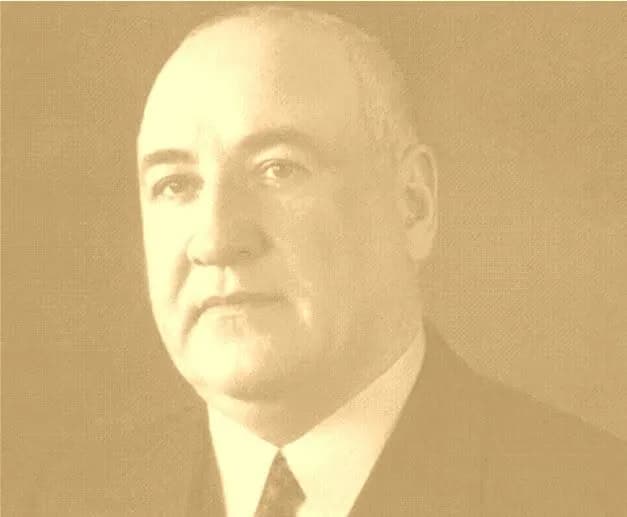
Contemporary Police History / Eietydse PolisiegeskiedenisDetective Head Constable Lourens Wilhelm Johannes Arangies served nearly 36 years in the South African Police, distinguishing himself as one of the most capable detectives of his era. Joining the force in 1913, he worked through major events such as the 1914 strike and later became a key figure in the Criminal Investigation Department. Arangies was renowned for his exceptional ability to gather, interpret, and connect information, a skill that contributed to solving an estimated 500 murder cases. His career included service in Johannesburg, Durban, Newlands, and Krugersdorp, where he rose to the respected rank of Head Constable. He volunteered during World War II, earning the Africa Service Medal and the Good Service Medal. Arangies played a decisive role in several high profile investigations, including complex murder and robbery cases between 1934 and 1946. He retired in 1949 and passed away in 1969, leaving behind a legacy of dedication, investigative excellence, and service to his community.