Foreign policy is often presented as a calculation of national interest, separate from emotion and morality. Yet national interest itself is shaped by history, values and strategic culture, raising a difficult question: when principle, international law and material interests conflict, how should a state decide what it ought to do?
South Africa inherited distinct military and political traditions that were never fully synthesised into a coherent post-1994 strategic culture. Rebuilding effective military strategy and doctrine therefore requires neither restoration nor rejection, but a deliberate synthesis of professional, technological and operational strengths with the legitimate lessons of the liberation experience.
Recurring disruptions in the Red Sea and Strait of Hormuz have restored the strategic importance of the Cape Sea Route. Yet South Africa continues to treat its maritime position primarily as a transport issue rather than a national strategic asset. This article argues for an integrated national strategy to transform geographic advantage into economic resilience, maritime security and national power.
South Africa's draft Strategic Petroleum Stocks Policy is about far more than fuel security. It signals a renewed appreciation that national resilience cannot be left entirely to market forces, and that strategic endurance requires deliberate investment before—not during—times of crisis.
Amazon's planned entry into South Africa's satellite internet market fundamentally shifts the Starlink debate from individual companies to the governance of strategic digital infrastructure. As communications infrastructure becomes increasingly central to national development and resilience, states must develop governance frameworks that balance investment, local capability, digital sovereignty and national interests.
The funeral of Ayatollah Ali Khamenei demonstrates how states can employ ritual, symbolism and mass mobilisation as instruments of strategic communication before military force is ever employed. Recognising and correctly interpreting such signals is an increasingly important competency for military professionals operating in a multipolar world.
Defence research is about far more than technology. It is the mechanism through which a defence establishment learns, adapts and remains strategically relevant. This article argues that the real challenge is not simply increasing R&D expenditure, but ensuring that research continuously informs strategy, doctrine, capability development and defence policy.
Five years after the July 2021 unrest exposed serious weaknesses in South Africa's national security architecture, questions remain about the country's preparedness for future instability. Drawing on the findings of the Expert Panel and SAHRC investigations, this article examines what lessons were identified, what vulnerabilities remain, and whether South Africa is better equipped to prevent localised unrest from escalating into a broader national crisis.
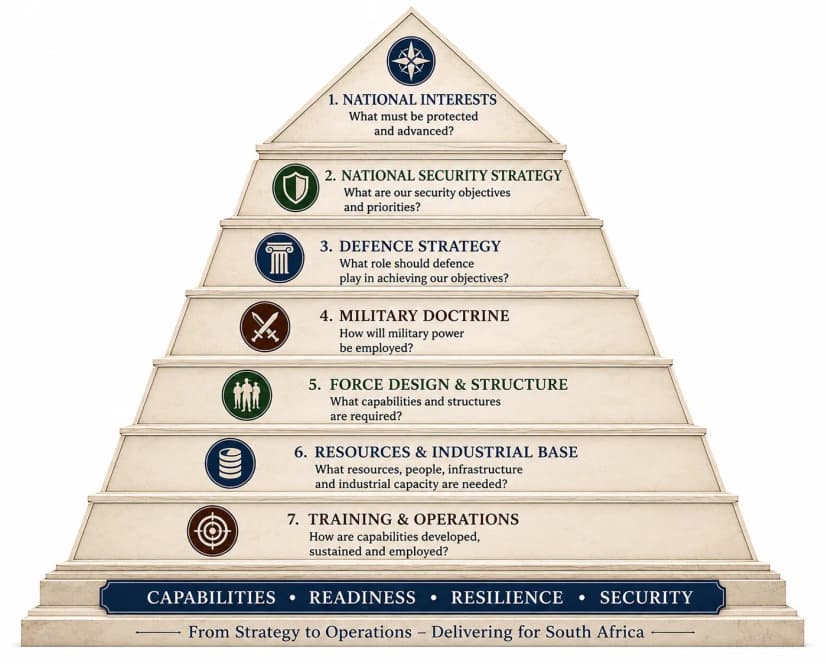
The debate over defence spending is often framed as a choice between security and development. This article argues that the real challenge is not choosing between "guns" and "butter", but ensuring that resource allocation is guided by clearly defined national interests, strategic objectives and long-term priorities. Strategy should inform budgets, not the other way around.
South Africa's defence sector does not appear to suffer from a shortage of audits, reviews, investigations or task teams. It suffers from a shortage of implementation. Using recent calls for a new defence task team as a starting point, this article explores why many of the same governance, capability and institutional challenges continue to reappear, and argues that meaningful reform may require greater strategic clarity, alignment and accountability across South Africa's defence ecosystem.
South Africa’s defence crisis is often framed as a problem of insufficient funding. This article argues that the deeper challenge is one of strategic incoherence. Using the Clausewitzian framework of ends, ways, and means, it examines how misalignment between political ambition, force design, and available resources has contributed to the SANDF’s gradual erosion. The article contends that sustainable defence renewal requires sequenced institutional regeneration, realistic strategic prioritisation, and a revitalised defence-industrial base rather than aspirational expansion alone.
This article examines the persistent gap between symbolic recognition and functional capability in Africa’s post-independence statecraft. Using the Alliance of Sahel States and South Africa’s defence-industrial ecosystem as empirical anchors, it argues that strategic autonomy is engineered through institutional coherence, fiscal discipline, and accountable state-industry alignment. Sovereignty is not inherited; it is continuously built.