12 articles match your filters
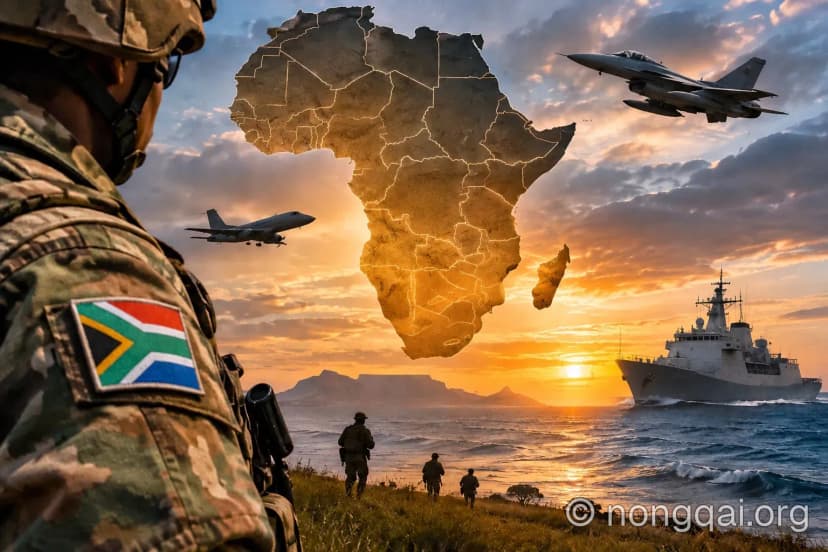
SANDF / SANWSouth Africa's defence challenges extend beyond inadequate funding and declining operational readiness. The country needs to reassess the purpose, structure and capabilities of its defence force in relation to its own security environment, national interests and available resources. Comparing military inventories with other African states misses the more fundamental question of strategic relevance.
Defence Policy and StrategySouth Africa’s 2026 Medium Term Budget Policy Statement highlights the gap between defence funding, operational readiness and strategic ambition. Examining budget adjustments, military performance indicators and the unresolved strategic framework, this article considers whether the SANDF can sustain its commitments within the country’s fiscal constraints.
Defence Policy and StrategySouth Africa’s Zama Zama crisis extends beyond illegal mining into organised crime, institutional vulnerability and national security. Tactical operations can disrupt activity, but lasting progress requires intelligence-led investigations, institutional integrity, financial disruption, community cooperation and economically viable long-term solutions.
Defence Policy and StrategyMilitary power is constrained by more than weapons, soldiers and technology. From Napoleon's disastrous Russian campaign to the US war with Iran and South Africa's operations in Central Africa, the ability to sustain forces at distance can determine what military power can actually achieve.
Crime IntelligenceThis chapter provides a detailed account of one of South Africa’s most significant modern counter espionage investigations: the case of Navy Captain Bradley Stanford Morris. It contextualises espionage in South Africa by outlining historical examples of foreign intelligence penetration during the apartheid era, including the Kozloff and Wierzba cases, and the high profile treason conviction of Dieter Gerhardt.
The chapter then documents the operational process followed by South African security structures—State Security Agency, Defence Intelligence, Crime Intelligence, and the Hawks—in identifying, infiltrating, and prosecuting Morris for unlawfully possessing and distributing highly classified military information.
Through undercover operations, forensic searches, and extensive document analysis, investigators uncovered 43 sensitive documents and multiple security breaches. The chapter concludes with Morris’s conviction under the Protection of Information Act and reflects on the broader implications for national security, intelligence oversight, and the enforcement of Minimum Information Security Standards in South Africa.

CSIRDefence research is about far more than technology. It is the mechanism through which a defence establishment learns, adapts and remains strategically relevant. This article argues that the real challenge is not simply increasing R&D expenditure, but ensuring that research continuously informs strategy, doctrine, capability development and defence policy.
National Security - Nasionale VeiligheidFive years after the July 2021 unrest exposed serious weaknesses in South Africa's national security architecture, questions remain about the country's preparedness for future instability. Drawing on the findings of the Expert Panel and SAHRC investigations, this article examines what lessons were identified, what vulnerabilities remain, and whether South Africa is better equipped to prevent localised unrest from escalating into a broader national crisis.
Defence Policy and StrategyThe debate over defence spending is often framed as a choice between security and development. This article argues that the real challenge is not choosing between "guns" and "butter", but ensuring that resource allocation is guided by clearly defined national interests, strategic objectives and long-term priorities. Strategy should inform budgets, not the other way around.
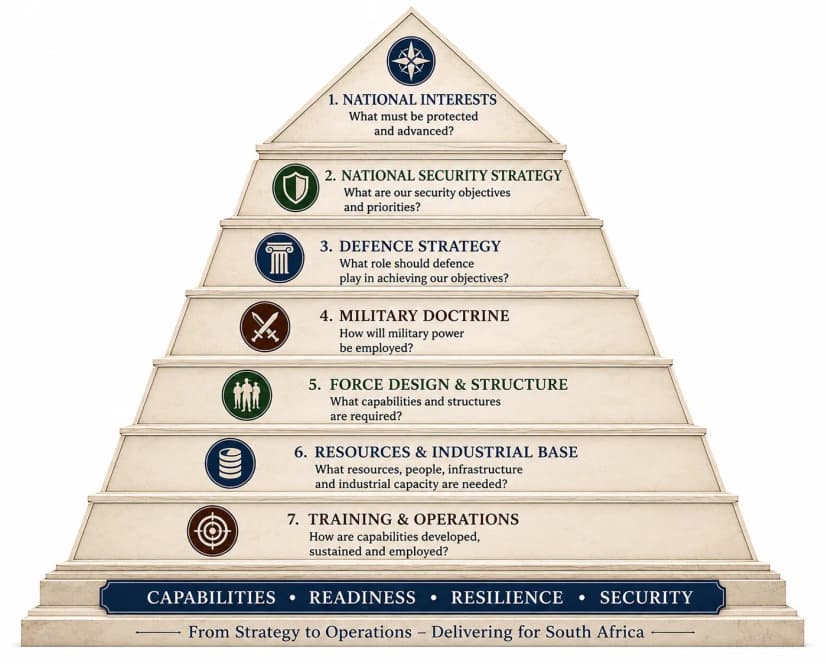
Defence Policy and StrategySouth Africa's defence sector does not appear to suffer from a shortage of audits, reviews, investigations or task teams. It suffers from a shortage of implementation. Using recent calls for a new defence task team as a starting point, this article explores why many of the same governance, capability and institutional challenges continue to reappear, and argues that meaningful reform may require greater strategic clarity, alignment and accountability across South Africa's defence ecosystem.
Africa and Global PowerSouth Africa’s defence crisis is often framed as a problem of insufficient funding. This article argues that the deeper challenge is one of strategic incoherence. Using the Clausewitzian framework of ends, ways, and means, it examines how misalignment between political ambition, force design, and available resources has contributed to the SANDF’s gradual erosion. The article contends that sustainable defence renewal requires sequenced institutional regeneration, realistic strategic prioritisation, and a revitalised defence-industrial base rather than aspirational expansion alone.
Africa and Global PowerThis article examines the persistent gap between symbolic recognition and functional capability in Africa’s post-independence statecraft. Using the Alliance of Sahel States and South Africa’s defence-industrial ecosystem as empirical anchors, it argues that strategic autonomy is engineered through institutional coherence, fiscal discipline, and accountable state-industry alignment. Sovereignty is not inherited; it is continuously built.
Africa and Global PowerSouth Africa’s defence difficulties are increasingly framed as a budget and personnel problem within the SANDF. This article argues that the deeper challenge is one of strategic coherence. Growing misalignment between political ambition, operational commitments, institutional capability, and changing security realities is weakening South Africa’s national security posture and regional influence within Southern Africa.