
Baie dankie vir 'n interessante artikel.
HB HeymansNovember 12, 2026
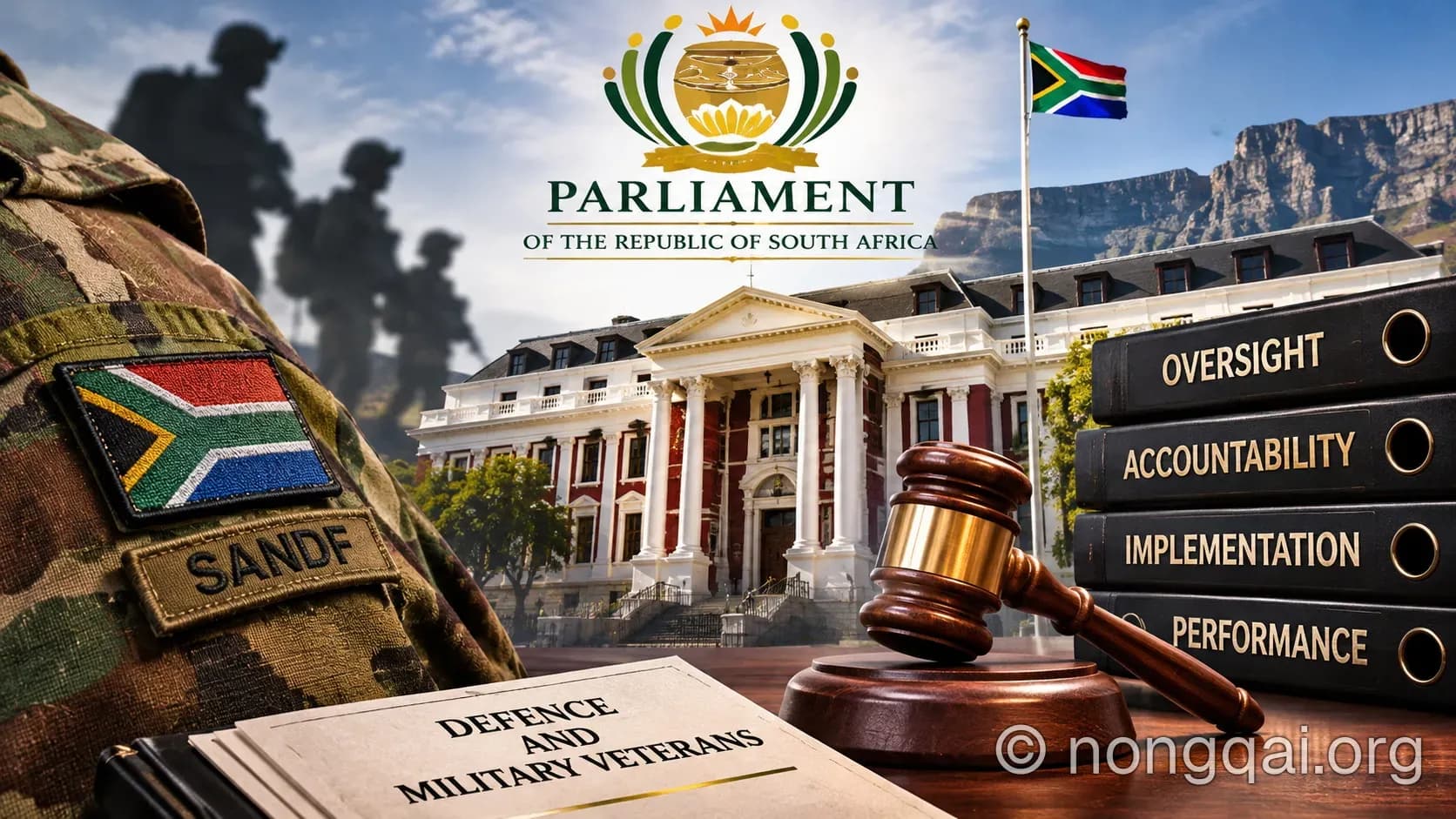 AI image
The growing gap between parliamentary scrutiny, executive accountability and institutional performance.

South Africa does not lack policies, strategies, parliamentary committees or formal mechanisms of oversight. Over the years, successive governments have commissioned reviews, established task teams, conducted investigations and made commitments to address persistent weaknesses in the defence sector. Parliament, through its committees and other constitutional mechanisms, has also repeatedly raised concerns about institutional performance, financial management and the declining capacity of the South African National Defence Force (SANDF). Yet many of these concerns continue to reappear, often with little evidence that earlier interventions have produced lasting improvements.
This raises a question that deserves more attention than it generally receives: what happens when parliamentary oversight identifies a problem, obtains explanations and records commitments, but cannot ensure that corrective action follows?
The distinction matters.
Oversight creates an obligation to explain.
Accountability requires an obligation to correct.
Without that second element, parliamentary scrutiny risks becoming an administrative exercise rather than an effective instrument of democratic control.
The Portfolio Committee on Defence and Military Veterans meeting of 11 November 2026 provided a useful illustration of this tension. The meeting dealt, among other matters, with the Department of Military Veterans and progress in implementing a High Court order concerning veterans' benefits. The Minister of Defence and Military Veterans, Angie Motshekga, and the Acting Director-General, Nontobeko Mafu, were absent. Apologies had reportedly been submitted the previous day, with the Minister attending a Cabinet meeting and the Acting Director-General undertaking an official overseas trip. The Deputy Minister and departmental officials were, however, present.
The committee's response to these absences exposed a legitimate disagreement about the purpose and effectiveness of oversight. Some members argued that the meeting should be postponed because the Minister and accounting officer carried responsibilities that could not simply be delegated to other officials, particularly in relation to matters before the courts. Others maintained that veterans had already waited too long for answers and should not be denied an opportunity to receive an update. The committee therefore proceeded, with the understanding that certain questions might still require responses from the absent senior officials.
The more consequential exchange came later in the meeting. Members raised concerns about outstanding responses and undertakings made by the Department, including a commitment to provide monthly progress reports on the implementation of the High Court order. According to the discussion, the committee had not received those reports despite the undertaking having been made in June. Members also questioned the Department's compliance with the expected seven-day response period for parliamentary questions and other requests for information.
The significance of this exchange lies less in the disagreement over attendance than in the underlying problem. A committee can request information, record an undertaking and return to the matter at a subsequent meeting. But if the promised information does not arrive, and the same issue is repeatedly placed back on the agenda without a demonstrable consequence, the oversight process has not necessarily achieved anything beyond documenting non-compliance.
This is not to suggest that every missed deadline should result in disciplinary action, or that officials should be held responsible for circumstances beyond their control. Nor should the presence of a Minister or accounting officer be treated as a substitute for effective departmental administration. The issue is whether repeated failures to honour commitments are followed by a clear process to establish responsibility, identify the reason for non-performance and secure corrective action.
The distinction is particularly important in the defence portfolio, where institutional performance has implications beyond ordinary departmental administration. Failures in procurement, maintenance, personnel management and financial controls can affect the military's ability to fulfil its constitutional responsibilities. In the case of military veterans, administrative delays and failures can also have direct consequences for people who are entitled to benefits and services under the law.
The concerns raised in November should not be interpreted as evidence that parliamentary oversight has simply deteriorated in a continuous or uninterrupted fashion. Research into the history of defence oversight provides a more nuanced picture.
A 2020 study by Wilhelm Janse van Rensburg, François Vreÿ and Theo Neethling, published in the African Evaluation Journal, examined the use of parliamentary oversight tools between 1994 and 2014. It considered parliamentary debates, written and oral questions, special inquiries, oversight visits and external audit processes. The authors found that these mechanisms had all been used, but with varying degrees of effectiveness. Their overall assessment identified a declining trajectory in parliamentary oversight of the military during the period under review, with particular concerns about the declining use of committee debates and in-depth inquiries, as well as the effectiveness of parliamentary questions.
The study also raised an issue that remains relevant: the distinction between Parliament and the executive can become blurred by party-political loyalties. When parliamentary representatives are reluctant to challenge an executive drawn from their own political party, the constitutional purpose of oversight may be weakened. The study further noted instances in which departmental non-responsiveness was attributed to security considerations, raising questions about the balance between legitimate confidentiality and the obligation to account.
That research provides an important historical baseline, but it should not be treated as a description of parliamentary performance today. Subsequent work examining defence procurement oversight through to 2022 identified improvements in the use of oversight mechanisms during the fifth and sixth Parliaments. Parliamentary questions and committee engagement became more consistent. However, the broader distinction between obtaining explanations and ensuring consequences for non-performance remained significant. More activity does not necessarily translate into more effective accountability.
Parliamentary findings in more recent years suggest that the underlying implementation challenge has not disappeared. In September 2022, the Portfolio Committee on Defence raised concerns about recurring audit and governance problems within the Department of Defence, including procurement compliance, asset management and internal audit capacity. The committee called for outstanding investigations to be finalised and for consequence management to be applied where appropriate. These were not merely technical accounting concerns. Weak internal controls and unresolved governance failures can undermine the Department's ability to manage public resources and sustain military capability.
In May 2026, parliamentary concerns about the Department of Military Veterans included senior vacancies, budget pressures, delays in the provision of benefits and deficiencies in its call-centre arrangements. The committee also referred to an earlier instruction to establish a fully functional call centre that had not been implemented. The reported difficulties experienced by veterans in accessing benefits were particularly troubling given that some had been waiting for many years.
These examples concern two distinct departments with different responsibilities and should not be conflated. They nevertheless illustrate a broader institutional problem: parliamentary bodies can identify shortcomings and call for improvements, but the existence of a recommendation or instruction does not establish that the required action has taken place.
The Constitution provides a clear basis for parliamentary oversight. Section 55(2) requires the National Assembly to provide for mechanisms to ensure that all executive organs of state are accountable to it, and to maintain oversight of the exercise of national executive authority and the implementation of legislation. Section 56 gives the Assembly and its committees powers to summon persons to give evidence or produce documents, and to require reports from persons or institutions.
These provisions are not incidental procedural arrangements. They are central to the constitutional relationship between Parliament and the executive. The executive exercises authority and manages departments, but Parliament must be able to examine how that authority is exercised and whether public resources are being used in accordance with approved policy and legislation.
The difficulty is that the existence of these powers does not automatically produce effective accountability. Parliamentary committees can summon officials, request reports, conduct oversight visits and make recommendations. They can expose shortcomings and place matters on the public record. Yet the effectiveness of these mechanisms ultimately depends on what happens after the scrutiny has taken place.
There is a difference between a department explaining why a commitment was not met and demonstrating how it intends to remedy the failure. There is also a difference between accepting a recommendation and assigning responsibility, resources and a realistic timetable for its implementation. Unless these elements are connected, oversight can generate a substantial record of institutional shortcomings without changing the conditions that produced them.
This is particularly problematic where failures are recurring rather than isolated. An unanswered parliamentary question may be an administrative lapse. A delayed report may reflect capacity constraints or competing priorities. But when the same departments repeatedly fail to provide information, implement instructions or resolve previously identified weaknesses, the issue becomes one of institutional performance. At that point, explanations alone are no longer sufficient.
The problem is not necessarily that Parliament lacks the authority to act. It may also reflect limitations in the way oversight findings are followed through, the political willingness to insist on compliance, and the ability to distinguish between genuine constraints and avoidable institutional failure. Accountability requires more than identifying who should have acted. It requires establishing what prevented action, who was responsible, what must change and how Parliament will determine whether that change has occurred.
There is also a risk that oversight becomes absorbed by the administrative cycle it is meant to supervise. A committee receives a briefing, raises concerns, requests additional information and schedules a follow-up meeting. If the follow-up produces another explanation and another undertaking, the process can continue indefinitely. The volume of parliamentary activity may suggest scrutiny is taking place, while the underlying problem remains unresolved.
Effective oversight should not be measured primarily by the number of meetings held, questions submitted or reports received. These are important instruments, but they are means to an end. The more meaningful measure is whether oversight produces identifiable improvements in institutional performance and whether persistent non-compliance is addressed.
This does not mean that parliamentary committees should assume the responsibilities of departmental management or become involved in operational decisions. The executive must retain responsibility for policy implementation and administration. Parliament's role is to ensure that this responsibility is exercised effectively, that failures are explained and that appropriate corrective measures follow.
There are practical ways to strengthen this process. Committee undertakings should be recorded clearly, with named institutional responsibilities and agreed reporting dates. Outstanding commitments should remain visible on a consolidated record until they are fulfilled or formally explained. Where deadlines are repeatedly missed, committees should require a substantive explanation and a corrective action plan rather than simply requesting another update. Where appropriate, unresolved matters should be referred to the relevant oversight or investigative bodies, and the committee should monitor the outcome.
It is equally important to distinguish between different forms of failure. A department operating under severe financial or capacity constraints may be unable to meet every objective, even where officials are acting in good faith. Such constraints should be made explicit and subjected to scrutiny, including whether the executive has provided the resources and policy direction required. Conversely, repeated failure to comply with lawful obligations or parliamentary undertakings cannot be indefinitely excused by reference to general resource pressures.
For the defence portfolio, the consequences of weak accountability are particularly serious. The SANDF faces long-standing challenges involving equipment, maintenance, personnel and operational readiness. These cannot all be attributed to failures of parliamentary oversight, nor can Parliament resolve them through committee proceedings alone. However, when deficiencies are repeatedly identified without effective follow-through, the oversight system is failing to provide one of the essential safeguards against further institutional deterioration.
The same principle applies to military veterans. Their entitlements should not depend on whether a department can maintain an effective administrative system or whether a committee manages to secure another briefing. The state has obligations towards them, and those obligations must be translated into functioning processes and measurable outcomes.
Ultimately, parliamentary oversight is not an end in itself. It exists to ensure that executive authority is exercised responsibly and that public institutions deliver on their mandates. A committee that consistently identifies the same problems but cannot secure corrective action risks normalising the very failures it is meant to address.
South Africa does not need oversight that merely records institutional shortcomings. It needs oversight that closes the gap between commitments and performance, and that makes it possible to determine whether those entrusted with public responsibilities have fulfilled them. Without that connection, scrutiny may remain visible, but accountability will continue to be elusive.
Baie dankie vir 'n interessante artikel.
Do you remember this, or know more? Your comment appears here once an editor has read it.
The editors may print your comment, with your name, in the monthly edition.
June 10, 2026

November 2, 2026

October 22, 2026

May 27, 2026
June 3, 2026