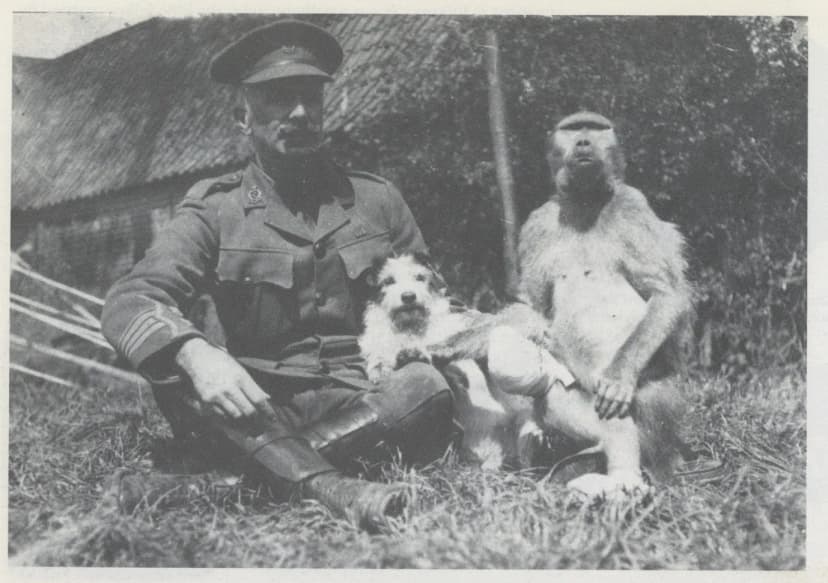
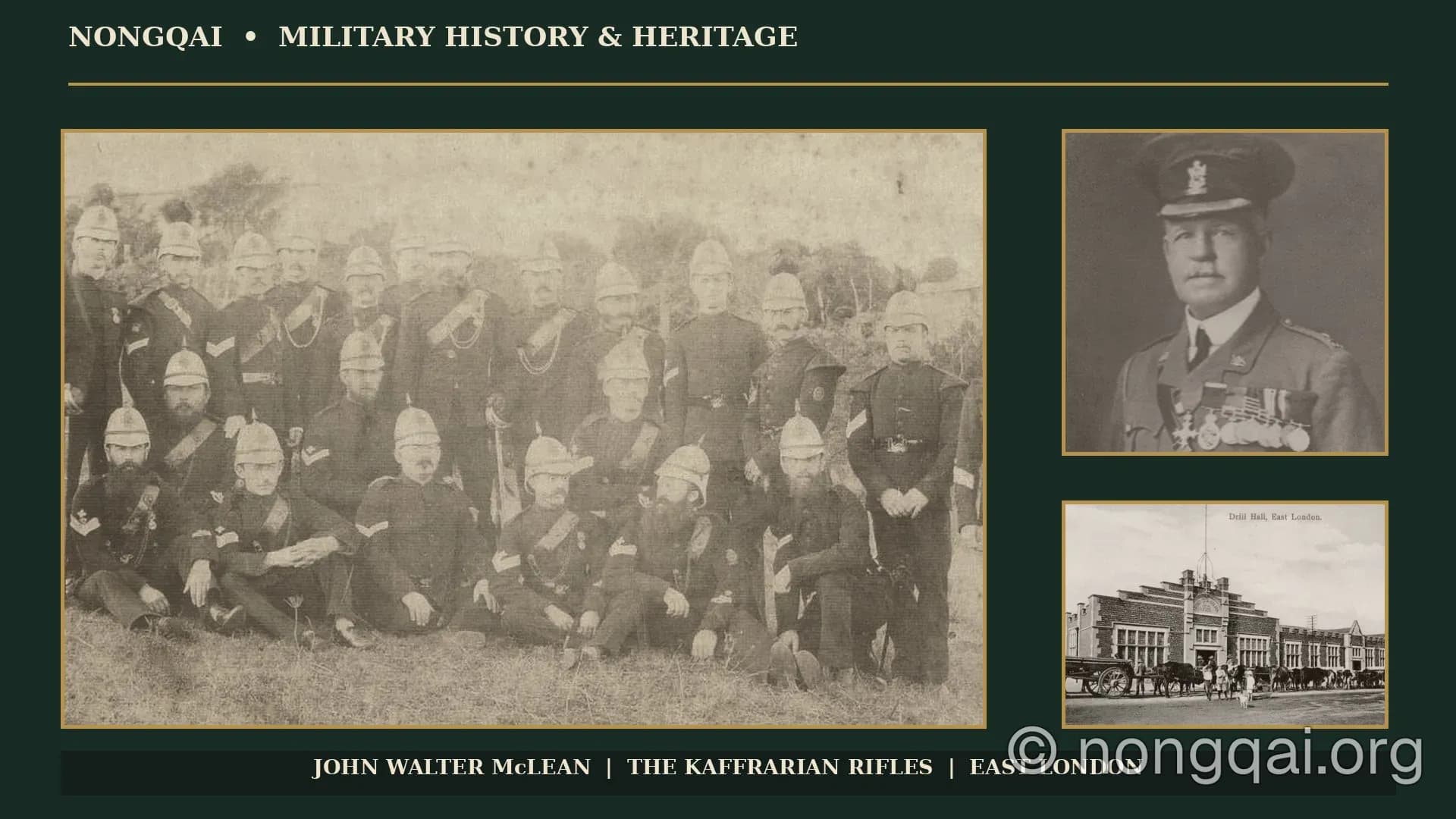
The Life and Times of Lieutenant Colonel John Walter McLean OBE VD (MID), 1855–1939
A Volunteer Soldier, Campaigner and Community Leader in East London
By MWO Craig Stuart Brown MMM JCD
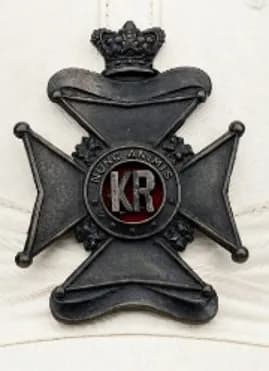
Lt Col John Walter Mclean OBE VD (MID)
10th April 1855–21st August 1939
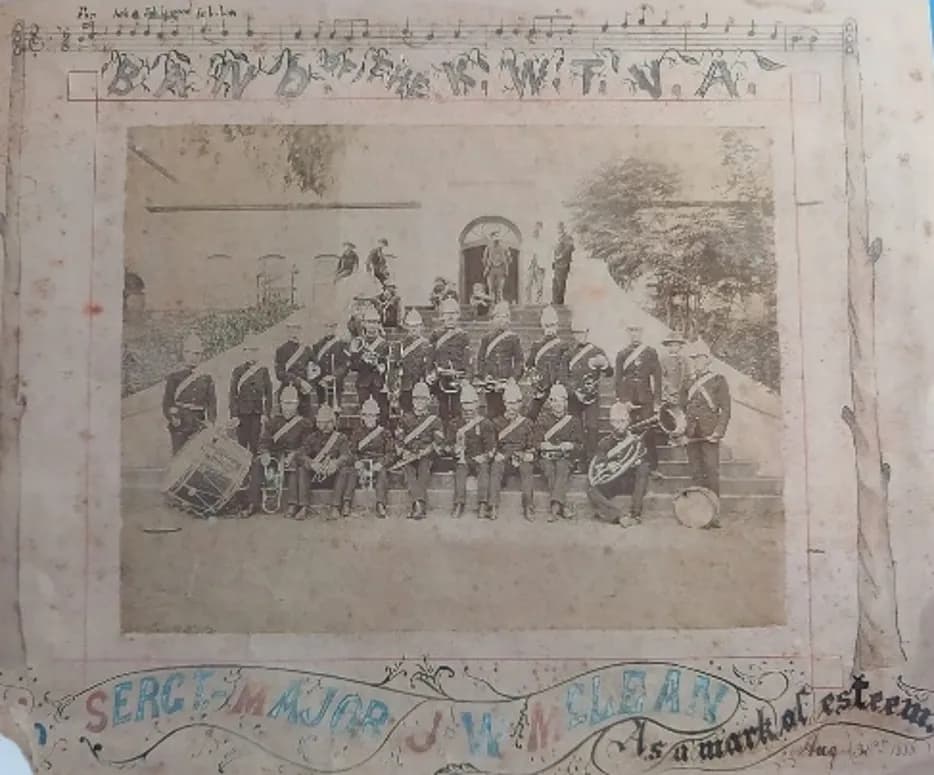
Presented to Sergeant Major J.W. McLean 1888
“As a mark of Esteem”
From the Officers and Men of the King William’s Town Volunteer Artillery
Compiled from the research, recollections, newspaper articles,
family information and historical notes assembled
by
MWO Craig Stuart Brown MMM JCD
(Ex RSM of First City and the Ex-Curator of The Kaffrarian Rifles Regimental Museum)
A working historical document
Any information or correction most welcome
Source discrepancies are retained and identified rather than silently reconciled.
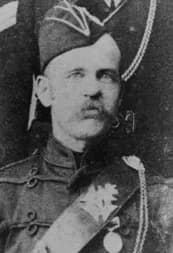
RSM John Walter McLean
The Kaffrarian Rifles 1876-1910
Regimental Sergeant Major of 1887-1897
(Later Lt Col J.W. McLean OBE VD – R & H Brigade)
1. Introduction
This document brings together the material assembled by Master Warrant Officer Craig Brown concerning one of his Regimental Heroes Lieutenant Colonel John Walter McLean OBE VD (MID), a long-serving volunteer soldier, campaigner, administrator and prominent figure in the history of East London, The Kaffrarian Rifles and the Railway and Harbour Forces.
The purpose of this record is to preserve the information for future generations, particularly for the continuing history of the Old Eastern Cape Regiments. It combines personal research notes, family information, the 1937 Daily Dispatch reminiscences, the Men of Our Times biographical entry, and research supplied by Craig’s cousin Mr. Brian Thomas on the “Green Ribbon”.
Where different sources give different spellings, dates, descriptions or versions of an event, those differences have deliberately been retained. They are part of the research record.
2.A Early life and arrival in South Africa
Mr. John Walter McLean was born in Stranraer, Wigtown, Scotland, on the 10th of April 1855. His father was Major J. W. McLean of the Royal Engineers who died relatively young at the age of 35 leaving a wife to bring up five children. The Information on his mother his sisters and the death of his younger brother Robert in a cricket accident at the Duke of York Military School all from the Daily Dispatch 18th September 1937.
He came to South Africa in 1876 as a Merchant Sailor and arrived in East London at the age of 21. Soon after his arrival he became involved in the life of the young port and in the local volunteer movement. He served in the Lifeboat Crew, where he was involved in very dangerous work, saving lives in and around the harbour, and subsequently worked as a signalman and later worked on the crane Herculis building the Break wall.
He later became a clerk with the Kaffrarian Landing and Shipping Company. He went to the Diamond Fields in Kimberley in Griqualand West, returning to East London and becoming associated with William & McLean, auctioneers and brokers and land and estate agents.
The Men of Our Times account records that he arrived in East London in 1876, worked with the lifeboat crew, became a signalman and then joined the Kaffrarian Landing and Shipping Company before going to Kimberley and entering mercantile life.
2.B Marriage and Family
John Walter McLean married Miss Catherine McCrann on 25 August 1879 at the School Chapel of St Peter’s Anglican Church, West Bank, East London. His notes record that the marriage took place shortly after his return from the Morosie’s Mountain Campaign in the Transkei. At the time he was associated with the boat company and was working as a clerk.
Catherine McCrann was born in1856 in the Cape Colony, the family notes state that she “only had the one name Catherine” Catherine died on 15th of December 1932 aged 76 years at her home 242 Seventh Avenue, Bezuidenhout Valley, Johannesburg, Transvaal and was buried on the 16th of December 1932 in the then New Cemetery, Brixton, Johannesburg in the Transvaal, John now lies buried next to her in the same grave, grave 7323 Plot 7322/3, General Section. Brixton Cemetery apparently there is no Gravestone for either of them
John Walter McLean died on 21 August 1939 at Frere Hospital in East London.
It must be assumed that after the death of his wife and his retirement he moved back to East London to be near his remaining family. John would have been buried a few days after his death as his body had to be transported to Johannesburg for burial I sure it would have gone by rail, He was buried at Brixton Cemetery next to his wife. His death notice was signed by his adopted daughter, Mrs G. Cook. Both of his sons had died before him.
McLean or MacLean
Miss Catherine McCrann was the adopted daughter of Colonel Sir John and Mrs MacLean. The notes further record that Colonel Sir John MacLean (1810-1874) was Lieutenant Governor of British Kaffraria and subsequently Governor of Natal.
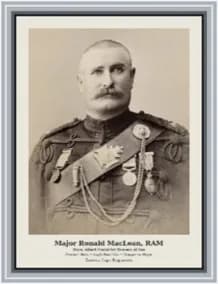
Major Ronald MacLean RAM
The family material also records a close connection with Colonel Sir John’s son Major Ronald MacLean “Ronnie”. Major Ronald MacLean who had served with Lieutenant Colonel John Walter McLean throughout all the Campaigns, went through all the ranks together from Trooper to Major, he and his wife were Hilda’s Godparents. Ronald MacLean himself is recorded as having received the Royal Albert Medal for Bravery for saving lives at sea and had a second Bravery medal as seen on the above photo, he was one of only 26 men to have all three Clasps on the Cape General Service Medal, Basutoland, Transkei & Bechuanaland.
The family information records three children:
2.1 Walter William McLean, born at Kimberley on 27 August 1882 and Baptized on the 15th of October 1882 at St Cyprian’s Anglican Church. John Walter McLean was recorded as Storekeeper in Kimberley. Godparents his father, William McCrann and Emily Bulkley, Emily was Mildred “Grace” Cook nee Shooter natural mother.
Walter died on the 12th of March 1927 General Hospital in Johannesburg of Malaria he was a Draughtsman in the Mines
Married in Glasgow Scotland Margaret Mathison born 14th of June 18881 Glasgow Scotland
Died 29th of October 1964 aged 83 years in Kensington, Johannesburg
They had two daughters
Alison Kathleen McLean was born in 1909
Margaret Mary McLean was born in 1911
2.2 Hilda Kathleen Mary McLean, born in East London on 23 October 1893. Baptized on the 26th of November 1893, her father was recorded as a Fruitier in East London Her godparents were her mother and Major Ronald MacLean and his wife, Elizabeth Jane. Some records appear to spell the family surname as MacLean.
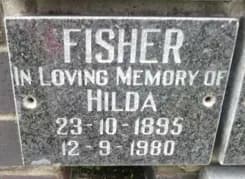
Hilda died on the 12th of September 1980 in East London
Hilda was born 1893 not 1895
She was married at Christ Church, Johannesburg on the 8th of April 1940 JW McLean gave consent
Herbert Stephen Fisher born 1887 in Dordrecht, Cape Colony and died on the 19th of March 1969 aged 82 years in Salisbury, Rhodesia
They had three children
Aston Walter Fisher was born 1914, died 1942 Johannesburg, married Maria Helena Keyter
Sue Fisher was born on the on the 20th of July 1918 Gedulo Mine died in 1963 in the USA married a Franklin
Beryl Fisher was born on the 9th of August 1920 Gedulo Mine, married Frank Sampson (Barrass)
The two daughters Sue & Beryl baptized together in Springs on the16th November 1920 their father was shown as a Storekeeper.
2.3 John Gammersep “Jack” McLean, born at East London on 28 July 1897 and baptized on the 12th of September 1897 at St John’s the Evangelist (The Garrison Church), East London. His father was recorded as a fruitier His Godparents were Edward John Carroll (OC KRs), Richard Currin (Later RSM & OC) & Eliza Jane Currin. One record gives the spelling of his second name as “Gamasich”.
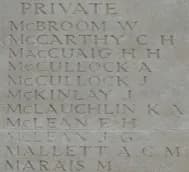
Killed during the Battle of Delville Wood on the 15th of July 1916 (His father says the 16th) while serving with the 3rd Regiment, South African Infantry Brigade his name appears on the Thiepval Memorial for those with no known grave. He never married and had no children.
They also had an adopted daughter who signed his with the death notice in 1939
2.4 Mildred “Grace” Cook nee Shooter 9th of October 1886and died on the 13th of February 1956 aged 69 in the Frere Hospital, East London and is buried in the Cambridge Cemetery
who was married to James Henry Cook
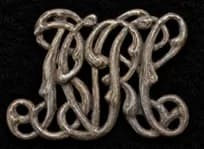
The Buffalo Volunteer Rifle Corps
4. The Buffalo Volunteer Rifle Corps (Buffalo Rifles)
John Walter McLean joined the Buffalo Volunteer Rifle Corps which formed part of the Kaffrarian Volunteers, also referred to in the sources as the Buffalo Rifles, in 1876.
The first parade of the Buffalo Volunteer Rifles is recorded as having taken place on the 16th of August 1876. John McLean therefore became involved in the East London volunteer military tradition virtually from its beginning and served in The Kaffrarian Rifles for over 20 years.
His early military career was closely connected with the frontier campaigns of the late nineteenth century. The record that follows draws particularly upon the 1937 Daily Dispatch reminiscences and the Men of Our Times account.
4.1 Gaika-Galeka War, 1877–1878
The research notes record McLean as having served during the Gaika-Galeka campaign of 1877–78 with the Buffalo Rifles and as having held the rank of Corporal.
The later accounts of his service emphasize that these early campaigns formed the beginning of an unusually long volunteer military career.
The South African War Medal is recorded with the 1877-78 clasp on the Roll of The Buffalo Volunteer Rifle Corps.
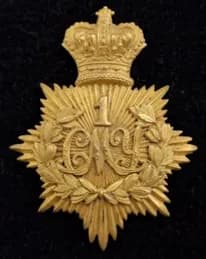
1st Cape Mounted Yeomanry
Late 1878 - 1882
5. 1st Cape Mounted Yeomanry
5.1 Morosi Campaign, 1879
The notes record John McLean as having served during the Morosi campaign in 1879 with the 1st Cape Mounted Yeomanry, again as a Corporal later Sergeant.
The South African War Medal is recorded with the 1879 clasp on the Roll of the 1st Cape Mounted Yeomanry as a Corporal surname again spelt Maclean.
5.2 Basutoland Campaign, 1880–1881
During the Basutoland campaign of 1880–81, John McLean served with G Troop of the 1st Cape Mounted Yeomanry. The research notes record him as Troop Sergeant Major. This appears on the Roll of the Kaffrarian Rifles (1st CMY)
The 1937 Daily Dispatch article contains a detailed account of his participation in the fighting and reproduces a letter from Colonel E. Y. Brabant dated 20 December 1894. Brabant argued strongly that Sergeant-Major W. McLean deserved recognition for his conduct at Kalabani Kopje and stated that the Victoria Cross had on occasions been awarded for courage no greater than that displayed by McLean.
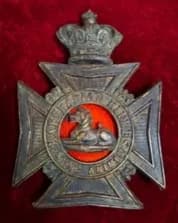
The Kaffrarian Rifle Volunteers
6. The Kaffrarian Rifle Volunteers 1883 - 1910
The Kaffrarian Rifles were formed in 1883 from the earlier volunteer tradition of the Buffalo Volunteer Rifle Corps of 1876. McLean joined the Kaffrarian Rifles as a private a few months after their formation, according to the 1937 Daily Dispatch reminiscences.
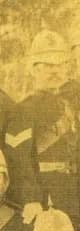
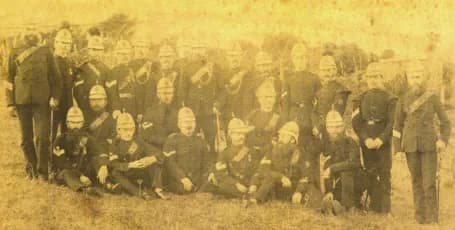
As a Sergeant in the 1880’s with the OC, SMs & NCOs of the Kaffrarian Rifles
The two Sergeant’s Majors on either side of the photo must be two of the earliest SM sadly I have no names.
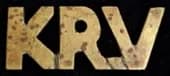
The Kaffrarian Rifle Volunteers
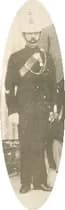
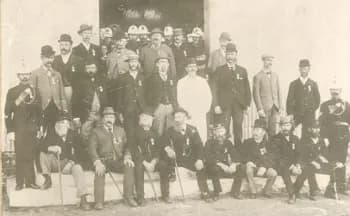
RSM in 1894 - The Queen’s Birthday Parade with Veterans of the Frontier Wars
He served for more than twenty years and rose through the ranks. He became Regimental Sergeant Major in 1887 and later received a Field Commission in 1897. He Commanded the F Squadron the Highland Company and was appointed as the Regimental Quartermaster and was closely associated with the development of the regiment’s Scottish traditions finishing up as a Major in his Regiment.
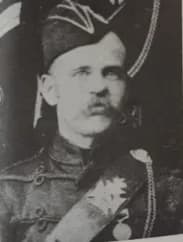
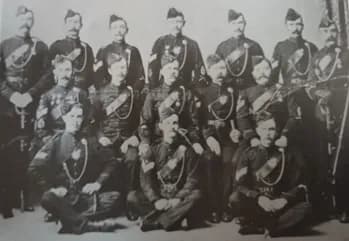
As the RSM in 1894 - The Queen’s Birthday Parade with his Senior NCO’S
6.1 Langeberg / Bechuanaland, 1897
In 1897, during the Bechuanaland/Langeberg campaign, John McLean served as Regimental Sergeant Major of the Kaffrarian Rifles. The sources record that he was commissioned in the field by Colonel Dalgety Officer Commanding the Bechuanaland Field Force. His name appears on the Roll of The Kaffrarian Rifles as a Lieutenant and surname spelt Maclean.
The Daily Dispatch account describes the mobilization of Kaffrarian volunteers, the march of approximately 300 miles and the attack on Langberg.
Brian Thomas’s research records the Cape of Good Hope General Service Medal with Clasps for Basutoland and Bechuanaland, and a commission as Lieutenant in 1897 followed by Captain in 1899.
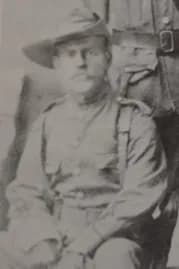
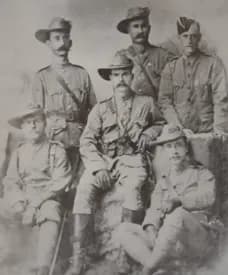
As a Lieutenant - 1897 with Officers of The Kaffrarian Rifles Bechuanaland
The Officer in the middle at the back is Captain Ronald MacLean
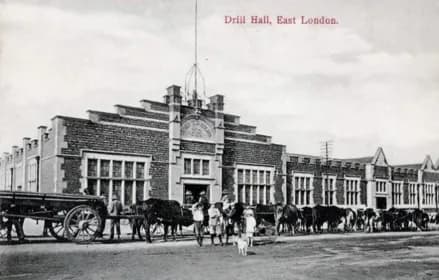
The Kaffrarian Rifles Drill Hall, corner of Fleet and Buffalo Street
The Colonel was very involved in having the main Drill Hall built and then the 1907 extension of the Drill Hall.
6.2 The Drill Hall and Kaffrarian Rifles Heritage
McLean played an important part in the development of the Kaffrarian Rifles’ traditions.
The Daily Dispatch records that the regiment initially experienced difficulties with suitable accommodation and drill space. A grant of land and £800 was obtained during the period of Sir Gordon Sprigg’s premiership, and the main Drill Hall was subsequently built. Ownership of the Drill Hall was passed from OC to OC until 1913 when it became part of the Ministry of Defence and this was not done without a fight.
The research notes connect McLean directly with the Drill Hall at the corner of Fleet Street and Buffalo Street and with the Drill Hall extensions made in 1907.
The Kaffrarian Rifles and the Anglo Boer War 1899-1902
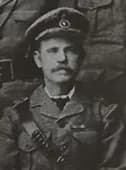
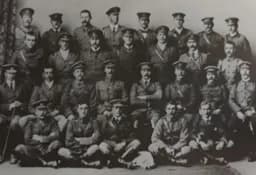
As a Captain 1902 with Officers of The Kaffrarian Rifles Anglo Boer War
6.3. Anglo-Boer War, 1899–1902
During the Anglo-Boer War, John McLean served as a Captain and company commander and later the QM. The sources identify him particularly with “C” Company and the Kaffrarian Rifles.
The 1937 Daily Dispatch account records service at Molteno, Bushman’s Nek, Stormberg, the siege of Wepener and the Wittebergen operations, including the surrender of Prinsloo.
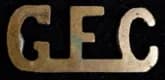
He subsequently served with Gorringe’s Flying Column in a special company. The article records an interview involving Lord Roberts and General Kitchener.
The research notes state that his active service during the war extended over approximately two and a half years and that he was mentioned in dispatches.
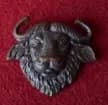
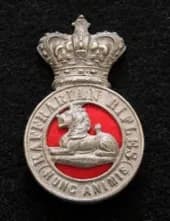
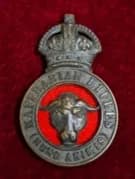
The Kaffrarian Rifles Collar badge
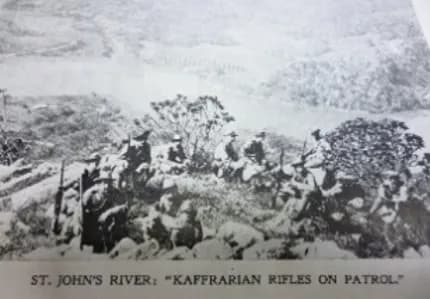
The Kaffrarian Rifles Port St John’s River Patrol
6.4 The Scout in War Memorial
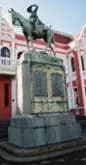
“The Scout in War”.
East London Town Hall and the Colonial Scouts Monument
The Colonel was very involved in having this beautiful monument erected
He was also associated with the Colonial Division Memorial. The Daily Dispatch records that a committee including McLean worked on the memorial, known as “The Scout in War”. A marble tablet was placed at the City Hall, and a stained-glass window was installed at St John’s.
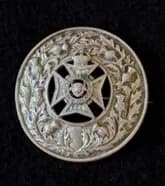
F Squadron, the Highland Company
NCO Plaid badge
6.5. The Highland Company
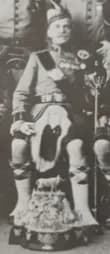
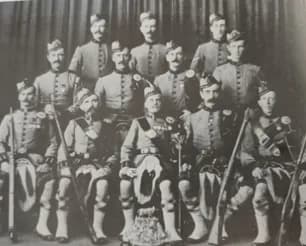
Captain JW McLean 1908 with Officers and Senior NCOs of Highland Company
The sources also record his Highland Company’s connection to Seaforth Highlanders.
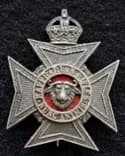
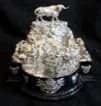
Winners of the beautiful Dawson’s Trophy
During the Anglo Boer War, he was a Company Commander and later QM and again in1904 he was appointed as the Regimental Quartermaster and by 1908 was Company Commander of F Squadron, the Highland Company of the Kaffrarian Rifles
Belt Buckel of The Kaffrarian Rifles
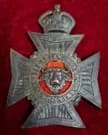
The Kaffrarian Rifles
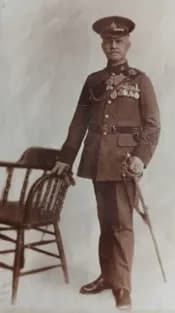
Major J.W. McLean VD
The Kaffrarian Rifles
In this photo he is only wearing the VD and not his Long Service Medal
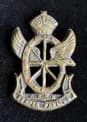
Railways & Harbours Brigade
7. Railways & Harbours Rifles & Railways and Harbours Brigade
McLean left East London in 1909 and moved to Johannesburg. The sources associate him with the Railway and Harbour organization from 1910 and with the development of the Railway and Harbour Rifles and later the Railway and Harbour Brigade until about 1923.
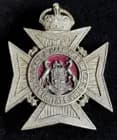
Railway & Harbours Rifles
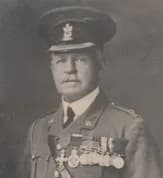
Maj later Lt Col JW McLean OBE VD MID
Railway & Harbour Brigade
In this photo as a Major, he is wearing all nine of his medals so taken after 1923
He became Brigade Major in peace and was appointed Lieutenant Colonel in 1919.
The Daily Dispatch states that he was appointed Brigade-Major by Sir William Hoy. He was also involved in railway organization and became associated with the Mines Battalion.
7.1 The Great War and the South African Native Labour Corps
During the First World War, Major McLean was too old even though he tried to join up in 1914, according to the 1937 Daily Dispatch account, to enter ordinary active service in the manner he had done during previous campaigns. Instead, he became deeply involved in the formation and organization of the South African Native Labour Corps (SANLC).
The Daily Dispatch records that General Louis Botha offered him a captaincy and command of approximately 500 men if he was to revert from his substantive rank of Major. John McLean was involved in training at Rosebank and eventually travelled with a contingent of approximately 850 men.
Before reaching his intended destination he suffered appendicitis and was landed at Plymouth. The ship subsequently sank, according to the 1937 account, approximately eleven miles off the Isle of Wight. The article states that about 650 men were drowned and about 350 survived.
SS Mendi – (saved by a burst appendix)
SS Mendi sank on the 21st of February after colliding with the SS Darro 646 dead mostly SANLC
John McLean was reported as drowned. The article records that General Smuts read his obituary out in the House of Assembly and that newspaper obituaries appeared. McLean subsequently recovered from his appendicitis and was able to continue his war service in France.
He later went to the Thetford depot and then to France, where he commanded the 19th Company of the SANLC unit of approximately 500 men. He spent over two years in France. His duties included work connected with the docks at Rouen. He spoke very highly of his men in the SANLC and their excellent work.
Later in the war he was associated with the SS Reranga, carrying approximately 2,000 returning troops. The Daily Dispatch records that the vessel reached Cape Town without loss and that McLean was Commended and discharged when the war ended.
7.2 The SS Mendi Account
The research material contains a further reference to the SS Mendi. Brian Thomas records a South African Railways and Harbours Magazine account which apparently stated that McLean had been “rescued” from the Mendi episode.
The 1937 Daily Dispatch account instead gives the detailed version concerning the ship on which John McLean was travelling, his appendicitis, his landing at Plymouth, the later loss of the vessel and the report of his death.
These differing accounts should remain visible in the research record.
7.3 Jack McLean and Delville Wood
One of the most personal elements of John Walter McLean’s story concerns his younger son,
John Gammersep “Jack” McLean.
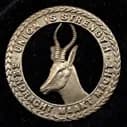
- 842 Private John “Gammersep” McLean served in German South West Africa with the Depot Battalion, 10th Infantry.
- His father’s address was recorded as Johannesburg.
- He appears on the 1914–15 Star roll for the 10th Infantry.
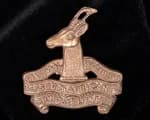
3rd Regiment, South African Infantry Brigade
- 7343 Private John G. McLean served with the E Company, 3rd Regiment, South African Infantry Brigade.
- He was Killed in Action at Dellville Wood on 15th of July 1916, aged 19. His father writes the 16th.
- His father’s details were recorded as being on active service in France.
- He was entitled to the 1914/18 British War Medal and 1914/18 Allied Victory Medal which appeared on the 3rd Regiments Roll.
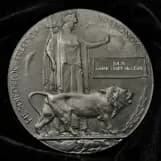
The research notes record:
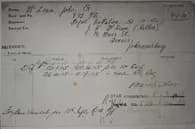
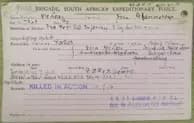
The Daily Dispatch records that John McLean planned to take part in a 1938 British Empire Service League pilgrimage to the battlefields of France and Belgium and intended to visit his son Jack’s Memorial the Thiepval Memorial, the Memorial for those with no known grave.
The research notes state that John Walter McLean did eventually visit Jack’s Memorial in 1938.
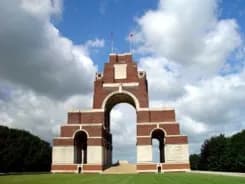
Thiepval Memorial, the Memorial for those with no known grave
Pier and Face 4C
7.4 The 1922 Rand Rebellion
The Colonels involvement in the events of the Rand Rebellion of 1922, when martial law was declared. The notes describe the circumstances as a “tragic situation”.
The research notes record his service with the Railway and Harbour Brigade until his retirement and another 20 years 0f Military service.
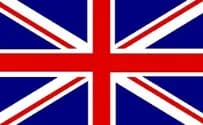
8. Decorations, Medals and Honours
The material assembled for this history records an extensive list of military decorations and long-service distinctions that Lt Col J.W. McLean received over his long Military Service
The Honours recorded include:
- Officer of the Order of the British Empire (OBE), Civil Division. 1923
- Volunteer Officers’ Decoration (VD). 1908
- Colonial Auxiliary Forces Long Service Medal. 1900
- South African War Medal, campaign Clasp 1877/78 & Clasp 1879. It must be noted if he had remained in the same unit he would have received one Clasp 1877-78-79
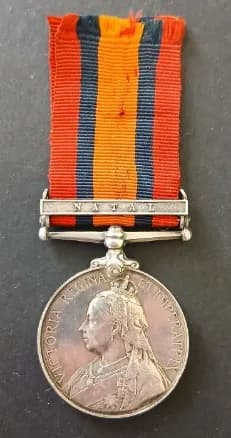
- Cape of Good Hope General Service Medal, Clasp Basutoland (1880-1881) and Clasp Bechuanaland (1897).
- Queen’s South Africa Medal, with Clasps Cape Colony, Wepener, Wittebergen and Transvaal clasps.
- King’s South Africa Medal, with Clasps South Africa 1901 and South Africa 1902.
- 1914/18 British War Medal.
- 1914/18 Allied Victory Medal.
- Mentioned in Dispatches during the different wars on a number of occasions.
The 1937 Daily Dispatch describes McLean as having seven medals, two orders and ten clasps. Some individual medal details differ between the sources.
It must be noted that his surname was often misspelt McLean which is correct and MacLean which was often mistaken spelling in those old days.
The research notes state that McLean’s medals were reportedly donated to the South African National War Museum by Miss A. K. McLean (His Granddaughter).
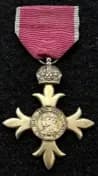
Officer of the Order of the British Empire (OBE), Civil Division, 1923
Awarded 1923 while Brigade Major of the Railways & Harbour Brigade, Union of South Africa.
King’s Birthday Honours List 1923
Supplement to the London Gazette of the 1st of June 1923, Published 2nd of June 1923
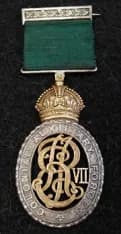
Colonial Auxiliary Forces Officers’ Decoration (VD)
Awarded on the 10th November1908 as a Captain in the Highland Company, The Kaffrarian Rifles.
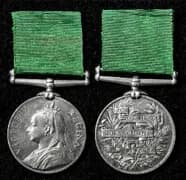
Colonial Auxiliary Forces Long Service Medal, associated with twenty years’ service
Awarded on the 6th of July 1900 as a 2nd Lieutenant in The Kaffrarian Rifles.
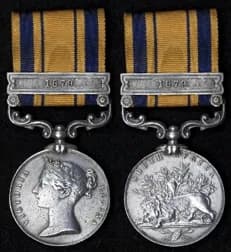
South African War Medal, with the relevant campaign clasps 1877/78 & the Clasp 1879
Awarded while serving with the Buffalo Rifles (BVRC) and then with the 1st Cape Mounted Yeomanry when the old units were absorbed into the new 1878 Cape Mounted Yeomanry.
As I’ve mentioned he should have had this Clasp 1877-78-79.
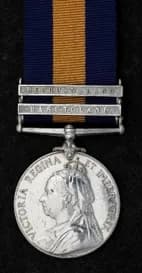
Cape of Good Hope General Service Medal, Basutoland Clasp and Bechuanaland Clasps.
Awarded while a Troop Sergeant Major in the 1st Cape Mounted Yeomanry when as the
Regimental Sergeant Major later 2nd Lieutenant in The Kaffrarian Rifles
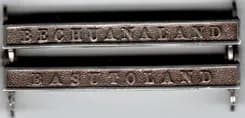
John McLean’s Two CGH GSM Clasps
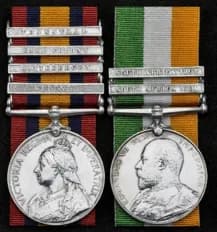
Queen’s South Africa Medal, with Clasps Wepener, Wittebergen, Cape Colony and Transvaal.
King’s South Africa Medal, with Clasps South Africa 1901 and South Africa 1902.
Awarded as a Captain Company Commander in The Kaffrarian Rifles and then a Company Commander with Gorringe’s Flying Column.
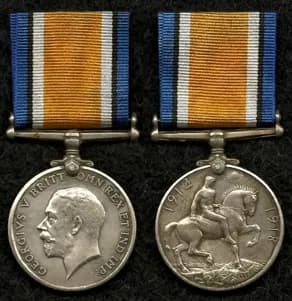
1914/18 British War Medal
Awarded as Company Commander in France with the South African Native Labour Corps (He was a Major in the Union Defence Force but served in France as a Captain).
British Empire Service League Pilgrims British Empire Service League Pilgrims
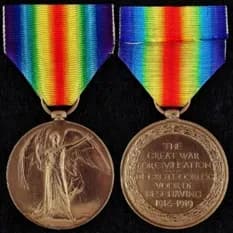
1914/18 Allied Victory Medal.
Awarded as Company Commander in France with the South African Native Labour Corps.
Mentioned in different Dispatches on numerous occasions thought his war services.
9. The Colonel Commanded the S.A. Corps of Commissionaires.
Founded in 1859 to assist wounded and later all discharged Veterans
This would have been the forerunner of the SA Legion, of the MOTHS etc.
10. Freemasonry and Community Life
John McLean was associated with Buffalo Lodge No. 1824 and is recorded as having been a Freemason, including involvement with the Royal Arch.
The Men of Our Times account also refers to his involvement in the Oddfellows and in local affairs.
His life therefore extended well beyond military service. He combined military duties with employment, civic involvement, fraternal organizations and family responsibilities.
11. 1939 Death of a Legend in his time
His long life had encompassed the transformation of the East London volunteer movement from the Buffalo Rifles of 1876 through the 1st Cape Mounted Yeomanry to The Kaffrarian Rifles, the frontier wars, the Anglo-Boer War, the Great War, the Railway and Harbour forces and the military events surrounding the Rand Rebellion. He was also connected to two of the greatest events of South African Military History, his son Jack dying at Delville Wood and the sad loss of his Troops on the SS Mendi.
His military career stretched across more than six decades of South African history.
I now include the three articles pertaining to Colonel McLean’s life story.
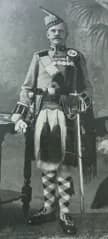
Captain JW McLean
12.1 Men of our Times — Capt J. W. McLean
The following is the biographical material supplied from Men of Our Times, page 295.
Men of our Times about Old Colonists of the Cape Colony
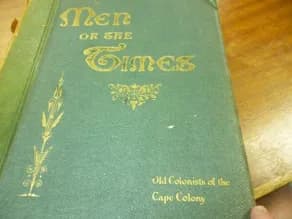
(A beautiful book to read if you like Cape History)
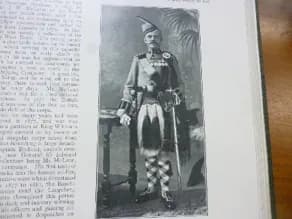
Copy from the Cory Library
Transcription from the supplied document and photograph — page 295
Men of our Times
Capt J. W. McLean
ONE of the most interesting personalities in the Eastern Province is that of John Walter McLean, who settled at East London as long ago as 1876. Born at Stranraer, Scotland, in 1855, he is the son of the late J. W. McLean, of the Royal Engineers. Educated at the parish school, after a few years at home, he succumbed to the wandering spirit so noticeable among his fellow countrymen and sailed for South Africa, landing at East London in 1876. At that time the now busy port was merely a collection of tin shanties, confined to the West Bank. The young man's first employment was of a charitable nature, for he joined the life-boat crew, and whilst serving in this capacity saved many an unfortunate from an early death by drowning. His next step in life was his appointment as signalman, and this work he carried on assiduously for two years, when he occupied a post as clerk in the Kaffrarian Landing and Shipping Company. A quiet life, however, was not to his liking, and he went off to the Diamond Fields at Kimberley, there to seek that fortune which so few found in the early days. Mr. McLean again returned to East London and for a time devoted himself to mercantile business.
In 1876 the Buffalo Rifles were enrolled, and he was one of the first to join, taking part in the first parade drill of the corps.
The native troubles which for many years had been threatening, came to a head in 1877, and war was declared. Though there was a garrison at King William's Town the campaign was largely carried on by means of the permanent volunteer and irregular corps raised from the border towns, East London furnishing a large detachment of volunteers under Captain Brabant, captain commanding the Buffalo Rifles, now General Sir Edward Brabant, among the first to volunteer being Mr. McLean, and he served throughout this campaign. His first taste of active service only served to make him the keener soldier, and he participated in all the native wars which devastated the country during the years 1877 to 1881, the Basuto war being the last of the series until the Langeberg campaign of 1897. Mr. McLean throughout this period constantly came to the front, his dash and bravery winning for him the commendation of his officers and gaining for him the honour of being mentioned in dispatches on several occasions.
Shortly after the formation of the Kaffrarian Rifles in 1883 he joined this corps and rose from the ranks to be regimental sergeant-major of his regiment, in which capacity he served for ten years, receiving his commission on the outbreak of the Langeberg campaign. Promotion being slow he did not receive his captaincy until the Anglo-Boer War, when he took the field as captain of C company. On the regiment being mounted he took over the position of captain and quartermaster, and he also commanded a squadron in Colonel Gorring's flying column.
When peace was declared Mr. McLean returned to East London and settled down to mercantile life again and is now a member of the firm of Williams & McLean, auctioneers, brokers, land and estate agents. He still retains his love of soldiering and now commands the Highland Company of the Kaffrarian Rifles.
In the course of his military service Mr. McLean has won a number of decorations, and has a right to wear the Gaika and Galeka medal with two clasps, for 1877, 1878, and 1879, included in which is the Morisi campaign; the long service medal, for twenty years' service; the general service medal and two clasps for 1880 to 1881, and 1897, included in which are the Basutoland and Langeberg campaigns; the Queen's medal and four clasps, and the King's medal and two clasps for the late war; altogether five medals and ten clasps. Captain McLean's record is a unique one in the Volunteer service of South Africa.
In private life Mr. McLean is a Freemason of high rank in the Eastern Province and is a past master of the Buffalo Lodge 1824; he is also a Royal Arch Mason, and a past Principal Z of the Sinia Chapter 1824 and was one of those selected to proceed to Umtata to open the John Blakway Royal Arch Chapter. He has been the recipient of a number of jewels as a slight recognition of his services. He is also a past Provincial Grand Master of the Independent Order of Oddfellows, Manchester Unity, and was presented with a past Provincial Grand Master's jewel by his Lodge as a reward and token of esteem for his services. Besides Freemasonry and Odd-fellowship, Mr. McLean takes a great interest in local affairs generally and is a member of the Junior Club. He is married and has three children.
Capt. J. W. McLean.
[ 295]
Transcription notes: The wording, historical spelling and punctuation have been retained as far as they are legible in the supplied photographs.
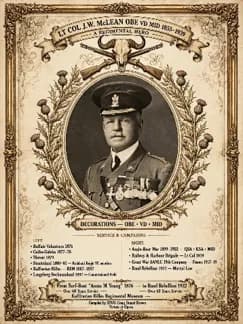
John Walter McLean in his own words
The two articles in the Daily Dispatch of the 18th & 25th September 1937
13.1 Daily Dispatch — Saturday, 18 September 1937
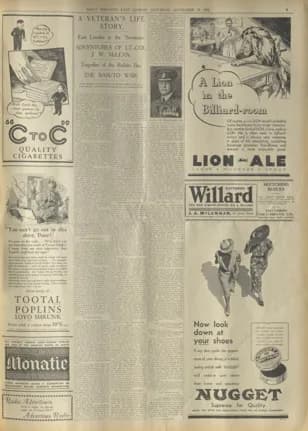
Original Newspaper, page 9.
Adventures of Lt.-Col. J. W. Mclean
“Tragedies of the Buffalo Bar” — “The Basuto War”
Daily Dispatch, 18 September 1937
Many of the readers of your paper who are friends of mine have been asking me to place on record through the columns of your paper a brief outline of my life and military record since coming to South Africa, especially of the early days of the port and town of East London, otherwise many historical events may be forgotten.
I was born on the strength of the “British Army,” my father being a member of that distinguished regiment, the Royal Engineers. He died at the early age of 35, leaving my mother with five children—two boys and three girls—so that at an early age we had to go out into the world. My youngest brother, Robert, was killed by a cricket ball on the playing fields of the Duke of York Military School. My youngest sister died at an early age; my other two sisters married but have long since passed away. My mother died at the age of 87. I am the only one left of the family.
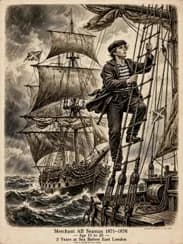
Seaman for 5 years
At the age of 15 I went to sea as an ordinary seaman on a full-rigged ship named the Agincourt up the Mediterranean and was away nine months. The life on a windjammer in those early days was a rough one. Those were the days of salt horse and weevilly biscuits and hard knocks. During that first voyage I learned to reef and steer, splice, box the compass, and all the duties that fall to the lot of an ordinary seaman. I was five years at sea. My last voyage was out to South Africa.
I left a ship and was paid off at Liverpool. After a holiday on shore, my money getting done, I considered it time to ship, so I went down to the shipping office but hadn’t been there long when the usher came out and shouted, “Wanted: A crew for South Africa.” I, with others, went in. The “ship’s husband,” who was shipping the hands, looked at me and said, “Are you an A.B.?” I said “Yes.” He said, “You look very young. Have you got discharges?” I said “Yes,” and handed them to him. Having read them he said, “These are good, I’ll take you.” So, I signed on.
The crew left that night on the cross-channel boat for Dublin. It was one of the wickedest nights I ever knew at sea. After a breakfast we left for Kingstown by sail to join the ship. And when we saw her, we got a shock. She wasn’t much bigger than a surfboat, a small brig with a hurricane deck named the Annie M. Young, of about 303 tons register. She was at anchor off the shore and was in ballast. We went on board and were received by the first mate, who told us the captain was ashore getting married and would come on board tomorrow with his wife, who was going part of the voyage with the ship. We were ordered to go forward to the foc’sle and as we had been travelling all night we needn’t turn to until the morning.
Off to South Africa
In the morning we turned to and scrubbed the deck. The captain came on board with his wife. He mustered the hands aft and told us we were setting out on a long voyage up past Copenhagen through the Cattegat into the Baltic to a place called Sundsvall, and there take in a cargo of deals. We were coming back again round the Land’s End of England to Falmouth for orders. He expected to get orders for some port in South Africa. At Falmouth we got orders for Cape town.
So we squared away for Cape town. After a long voyage of 95 days, with the usual storms, calms, and whistling for wind about the doldrums, we arrived and dropped anchor in Table Bay. The captain went ashore and got orders for East London, as the cargo of deals had been sold to the Cape Government Railways. So, we left to come round the coast to East London, and one afternoon the captain came on deck, where I was at the wheel, and said, “I am sure we must be near East London now, as that is the rock called Cove Rock and is described on the chart as looking from the sea like a rock split in two.” Shortly afterwards we saw the shipping in the roadstead, riding it out in a westerly gale of wind. We were under reefed topsails. I steered the ship in and out among the shipping to her berth. I was ordered to put the helm down and the ship came to the wind, the yards were tacked and we dropped the anchor. We had arrived.
At East London
There were 23 sailing ships in the roadstead. Many of them had been there for weeks, and had not discharged a package, there being no surfboats to land the cargo, or only a few, and those very small, and they could only get in and out at the top of high tide. The river mouth was silted up and only a small stream of water across the river-mouth and a large sandbank out to sea on the bar. One could walk across the river-mouth quite easily. A three-masted schooner had been stuck in the river for 11 months and could not get out. The crew were discharged. She was lying at anchor where the bridge is now. This was in the beginning of 1876. What a difference now, with the turning basin, the depth of water in the river and on the bar, and the expectation of getting in the large mail-boats shortly.
We lay in the roadstead for some time and then slipped the anchor and went to sea owing to bad weather and no hope of getting a lighter or discharging cargo. Then it started to rain and came down continuously for about a fortnight so hard that the scuppers couldn’t clear the deck of water. The river was in spate and everything was being washed out to sea—sand, dead cattle, trees, snakes, etc. When the river went down, soundings were taken. There was 20 feet of water! All the ships came into the river and were moored in mid-stream and commenced discharging. Soon cargo of every description lined both banks of the river. Ships were anxious to get away in case the bar silted up and they couldn’t get out. Having no dredgers to keep it clear, the river and bar gradually silted up again.
In those early days work was plentiful, and wages were good and having got tired of the ship I wanted a spell on shore, so asked the captain for my discharge. At first, he refused, but finally consented, so I was paid off at the old Port Office on the West Bank by the harbour master, Captain Walker.
The port captain asked me if I knew anything about signalling—semaphore and lamp work. I told him I did. He said he wanted a hand for the signalling staff and to be a member of the lifeboat crew and offered me the job. I took it and I was there three years. It was hard and dangerous work, as we had to do the work of the port, crossing the bar at all hours and in all weathers. We also worked the rocket apparatus and were the means of saving many a crew from a watery grave, as many ships came ashore in bad weather in those early days.
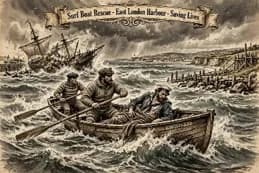
Lifeboat days
Work in the Lifeboat
One afternoon, when a heavy westerly gale was blowing with a bad sea, the Berstead, an American iron barque, parted, and before she could get her anchor chain clear and her sails loose, she struck far out on the reef at Bats’ Cave. After a hard struggle we got the lifeboat over the bar and the sea and wind carried us down to the reef. We knew that if we got into the surf in such a sea, we would never get out, but we could not leave the crew to perish. Great green seas were sweeping over her and soon her masts would go and open out the decks, and the crew would be swept away, so we decided to take the risk. The captain and crew had taken to the rigging. In going round her counter to get on the lee side, the lifeboat was nearly swept on to her deck. We had difficulty in getting alongside as it was dangerous work, but we managed it. We got the captain and crew into the boat and then beached the lifeboat. As she struck the beach, we all jumped over the weather side as the boat might roll on us and some of us get hurt. Nobody got hurt and we never lost a man. For this act of bravery and seamanship, the crew received the thanks of the Government. A few days after we went back to the wreck with a wagon and gear and got the lifeboat off and took her over the bar, sitting in water up to our waists. The ship’s carpenter of the port office, Dan Decker, repaired her, and she did many years’ service after this.
Capsized on the Bar
On another occasion we went out to a ship that was adrift and in coming over the bar shipped a heavy sea which swept the coxswain off the whaleback and over the side; but he hung on to the yoke lines and after the sea passed, we pulled him into the boat.
One Sunday morning a party of men from the shore went over the bar to fish and in coming in late in the afternoon were capsized on the bar. We launched the lifeboat, but somebody shouted to us that we were too late, and they were all washed up among the rocks on the west side of the breakwater. I ran down through the harbour works on to the breakwater, and when I got there, I could see a man in the dusk far out hanging on to the rocks, with the sea breaking over him. I jumped over the wall and after a hard struggle got him alongside the wall and pulled him up. He was Captain Ballard, of the 24th Regiment, stationed at Fort Glamorgan. Four or five were drowned, including Dr. Thompson, of the West Bank.
One morning we went over the bar to the coaster Florence with the ship’s agent, Mr. Nettleton, in the boat. We went to several ships and took three ship captains into the boat who were coming ashore, also a boatswain off one of the ships. We had, all told, 15 in the boat, including the boat’s crew. Coming over the bar we shipped a heavy sea. The boat capsized and never righted but was washed up on the east beach. Every time we were washed away when we came to the surface and we made back for the boat and hung on. All those who didn’t reach the boat were drowned. The last time I was washed away I was a long way inshore of the boat, so I thought I could make the beach. I was the first one to get ashore. I staggered out and flopped down. Seeing some of the men trying to reach the beach, I got up and went into the sea again, but I was so gone in that I could do nothing and staggered out again. The agent, Mr. Nettleton, was saved. The three ship captains were drowned and the boatswain died on the beach. The coxswain was saved. There were seven drowned out of 15. Those of us who were saved were so knocked about, cut and bruised that we did not work for a week.
Work on the Breakwater
After this accident I met the mechanical engineer of the harbour works, Mr. Parker, who said to me, “Why don’t you leave that boat? If you don’t you will leave your bones, there.” He said he could give me a job on the big crane, the Hercules, then laying the blocks of the breakwater. So, I took it. I liked my new job, had good pay and made lots of overtime as we had to work to suit the tide. We had three white men on the crane and a gang of boys. I helped to lay many of the blocks of the breakwater and so ended my three years’ service in the lifeboat. I was glad to get away, and I think I hear you say, “Time, too.”
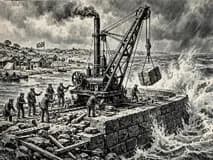
Hercules the EL Crane
I can’t remember what date the first issue of the Daily Dispatch had been printed, but I think it was in 1872 in a wood and iron building in Smith Street. Mr. Lance, who was the first editor, used to come to the port office for shipping news, and I used to show him the log book. It was a very small paper of about two sheets. Still, in those early days we used to watch for the day it was on sale, as we used to get items of news we never got before. The port and town have advanced since then, and the paper has advanced with it and has greatly helped to forward the progress of East London.
The Buffalo Volunteers
It was in 1876 that a list was sent round for all those to sign who were willing to form a volunteer corps. Three companies were formed, Nos. 1 and 2 on the East Bank and No. 3 on the West Bank. We held a meeting and decided to name the corps the Buffalo Volunteers. It was decided the uniform should be grey with black facings, with staff cap and cover. Each man was to purchase his own uniform at a cost of £4, and 2s. 6d. per month toward rent for a place to drill in. The first drill was held in Walker’s wool store.
Mr. Nettleton, the agent of the Donald Currie Line, was elected captain and Mr. Smith lieutenant. Sergeant Caulder (of the C.M.R.) was appointed instructor. The member for East London (Captain E. Y. Brabant) was elected captain commanding.
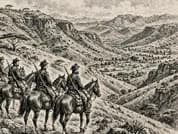
Gaika - Galeka
The kafirs (sic) had long been troublesome, and when the new Governor, Sir Bartle Frere, after a visit to the Border, went back to Cape town, Chief Kreli and his tribe over the Kei broke out into open rebellion, burning the farms and laying the country waste. The farmers, with their wives and children, had to flee for their lives into laager. The Colonial Forces were called up, and the Buffalo Rifles, on September 29, 1877, left on active service 300 strong, under the command of Captain Brabant. We marched to the Kei Mouth to protect a large laager and to guard the drifts and so prevent the kafirs (sic) from breaking through into the Colony.
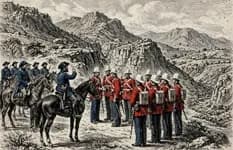
Kei River Drift 1878
We then crossed the Kei River and marched through the Transkei. On the homeward march we came across the Imperial Battalion, the 24th, on the banks of the Kei, guarding the drift. Little did we think that this battalion, in 1879, would be cut to pieces in the Zulu War. Two companies put up a wonderful defence at Rorke’s Drift.
We had again to take the field to deal with the Chief Sandile and his tribe. During these two wars, which lasted about three years, many murders were committed, and the country was laid waste. The people on the West Bank lived in terror that the kafirs would attack and wipe them out. No. 3 Company of the Buffalo Rifles did a month’s garrison duty at Fort Glamorgan. The Government paid us £3 and rations. We went about our daily work and occupied the fort at night. When any little amusement was on—concert or dance—we went with a rifle, bayonet and ammunition, and stood them in the corner. Nothing happened, however, at the fort, only one night one of the sentries, an Irish chap, bayoneted a pig. The guard went to the cookhouse, made hot water and scraped and cleaned the pig, so we had pig’s cheek, feet and many fine joints of pork. The Irish chap was asked what the pig said when he bayoneted it. He replied, “Never a word, only a grunt.” I was interested to read in the Daily Dispatch recently that the magazine in the middle of the fort had been declared an historical building.
1st Cape Mounted Yeomanry
The Government at this time decided to raise three regiments of yeomanry. Captain Brabant was given the command of the 1st Regiment with the rank of Lieut.-Colonel, and Captain Dalgetty was adjutant. The men had to enlist for three years and were given £25 the first year and £12 10s. for the next two years capitation grant to keep a horse. All men were supplied with uniform and top boots. A troop, “G Troop,” was formed on the West Bank. Captain Nettleton, Lieut. Smith and many men transferred to the G Troop of yeomanry, also myself and my comrade, O. Lewis, who worked with me on the same machine. In 1879 we were called up and ordered to go to Umtata as the Pondos were giving trouble.
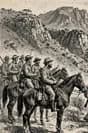
Moirosi’s Mountain
We lay there a fortnight and were then ordered to Moirosi’s Mountain. We were a long time getting there as we had to cross the Drakensberg Mountains, and the last two days had to skirmish our way through. We arrived a day too late for the first attack. The troops under the command of Colonel Griffith had been repulsed, many men being killed and wounded. Quite a number of men were wandering about with bandages round their heads—the Basutos had rolled stones down on top of them.
It was decided to wait for reinforcements and get ready for a second attack. The second attack was under the command of Colonel E. Y. Brabant. The artillery bombarded the mountain for three days, and at night fired star shells. In the morning we moved out at daybreak in three columns. My comrade Lewis and myself were attached to one of the storming parties. The attack failed. We got up as far as the first wall and there the forces stuck and could not retire until under cover of darkness. We lost many killed and wounded. My comrade Lewis was seriously wounded, but stuck it out until the afternoon, when I volunteered to take him down the mountain to save his life. He was nine months in hospital and was awarded a life pension. His wound was eventually the cause of his death, which occurred on the West Bank. For this I was mentioned in the dispatch of the officer commanding the stormers, Captain J. T. O’Connor, of the C.M.R. I attach a copy of his report:—
“D.”
Office of the Resident Magistrate of Nqamakwe, Transkei.
December 29, 1894.
To Captain H. B. Cuming,
Officer Commanding, Kaffrarian Rifles.
Service of Sergt. -Major McLean, Kaffrarian Rifles.
Sir,—I have the honour to acknowledge the receipt of your letter of the 22nd inst., concerning the above non-commissioned officer, and in reply thereto I have great pleasure in bearing testimony to the good services rendered by Sergt.-Major McLean during the second attempt to storm the stronghold of the Baputi Chief Morosi in 1879, now known as Moroisi’s Mountain, when I led the storming party, although unsuccessful in that attack as well as on the first occasion when Colonel Grant led the stormers, owing to the strength of the enemy’s defences. Many signal acts of bravery and individual courage were displayed by our men, not the least conspicuous among which was that of Sergeant-Major McLean, who went with a wounded comrade down the mountain under a most deadly fire, and placed him in safety.
I sincerely trust that the services of Sergt. -Major McLean will meet with due recognition and that your efforts on his behalf may be successful.—I have the honour to be, Sir,
Your obedient servant,
J. T. O’CONNOR,
Late Captain, C.M. Riflemen,
Resident Magistrate, Nqamakwe.
The yeomanry and most of the forces were ordered home with the idea of investing the mountain and starving the enemy out, I was not present at the third attack, when Colonel Bayly and the CM.R. and a few details took the mountain, Chief Morosi and most of his tribe were shot
13.2 Daily Dispatch — Saturday, 25 September 1937
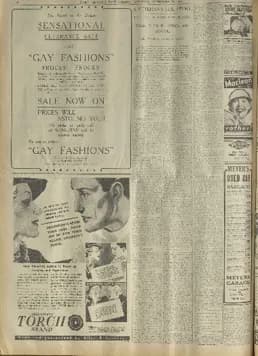
Original newspaper page 8
The following section preserves the material from Saturday 25 September 1937 Daily Dispatch article as supplied for this research
A Veteran’s life Story
Lieut.-Col. McLean’s Reminiscences
Wars in South Africa and Europe
The Native Labour Corps
In our issue of Saturday, September 18, Lieut.-Col. J. W. McLean, O.B.E., V.D., brought his reminiscences down to the late seventies. In the following article he relates his experiences in the Basuto and Bechuanaland campaigns, the Anglo-Boer War and the Great War. Reference is made to the Kaffrarian Rifles (with which Col. McLean was connected for 20 years), to the building of the East London Drill Hall, and the erection of the Colonial Division Memorial.
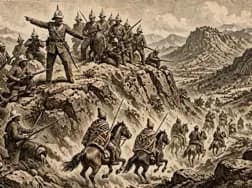
“Holding the line”
1st Cape Mounted Yeomanry
Basutoland
The Basuto War, 1880–81
After my return from Morosi’s Mountain in 1879, I was married at St. Peter’s Church on the West Bank to Miss C. McCrann, the adopted daughter of Colonel and Mrs. Maclean. The Colonel was the Governor of Kaffraria and afterwards of Natal and died on the West Bank after having been an invalid for 20 years.
The Basuto War of 1880–81 came about owing to the Prime Minister of the Colony, Sir Gordon Sprigg, trying to disarm the Basutos. This war lasted the best part of two years. All the Colonial Forces were called out, and many engagements and much heavy fighting took place, especially on the morning the forces crossed over the border to relieve Colonel Carrington at Mafeteng, when 30 men of the Yeomanry were killed at Kalabani, principally from Grahamstown, King William’s Town and East London men. In this engagement I was mentioned in general dispatches for distinguished conduct in the field.
I attach a report of Colonel E. Y. Brabant on this engagement.
(Copy.)
Gonubie Park,
East London, C.C.
December 26, 1894.
To the Officer Commanding,
Kaffrarian Rifles.
Sir, —In reply to your letter of December 22, 1894, asking me to support you in endeavouring to obtain some recognition of the services of Sergt.-Major J.W. McLean, now of the Kaffrarian Rifles and late of the 1st Cape Mounted Yeomanry, I beg to state that I have the greatest pleasure in assisting in bringing the services of so distinguished Colonial soldier to the favourable consideration of His Excellency the Governor.
Apart from the fact that during his service under my command in the 1st C.M.Y., Sergt.-Major McLean bore an irreproachable character and did his work as Troop-Sergt.-Major of “G” Troop, 1st C.M.Y., to my entire satisfaction, his special claim for consideration rests on his gallant conduct during the action at Kalabani in Basutoland.
During that action five troops of the 1st C.M.Y., under the immediate command of Captain Dalgety, the Adjutant of the Regiment, were ordered to occupy a rising ground on the left flank of the column advancing to relieve Colonel Carrington at Mafeteng. The order was given by Colonel Mansfield-Clarke, then Commandant-General of the Colonial Forces. Unfortunately, no precautions were taken to ascertain the strength, or the actual position of the enemy, with the result that the men, while advancing in skirmishing order, dismounted, were charged by masses of Basuto horsemen concealed behind the rising ground above-mentioned, and the men having at that time no side arms—having emptied their carbines—were practically helpless.
Before they could regain their horses 30 men were killed. On remounting they continued to retreat until Sergt.-Major McLean called upon the very few men of his troop who were unwounded to support him, faced about and afforded a rallying point on which the other troops quickly re-formed line and charged the enemy, regaining the ground upon which were the dead bodies of their comrades, and, on being reinforced by the Second Regiment of Yeomanry, they together attacked the Basutos, drove them round the rear of the Kalabani Kopje and completely cleared the left flank of the relieving column.
I may state that I was not present, being at the time in command of the advance guard of the column with the remaining three troops of the regiment. But I was assured by Captain Dalgety, Captain Nettelton and all the officers present that to Sergt.-Major McLean’s coolness and courage were primarily due the rapidity with which the regiment rallied, re-formed and renewed the attack after so heavy and unexpected a loss.
I have always maintained that the V.C. has been frequently given for courage and conduct not surpassing that shown by Sergt.-Major McLean on this occasion, the more so as the courage and example shown had the most immediate and valuable effect.—I have the honour, etc.,
E. Y. BRABANT, (Later General Sir Edward Yewd Brabant KCB CMG MLA)
Late Colonel, 1st C.M.Y.
It was a hard-fought war. The Colonial Forces were not strong enough to overrun Basutoland, and we were always on the defensive. Many officers, N.C.O.’s and men were killed, and the troops suffered much hardship. The Sprigg Government resigned and so ended the war. It was a rather unsatisfactory ending: the British Government took over Basutoland, and the Basutos kept their rifles.
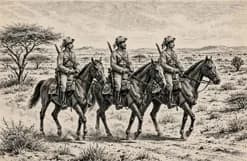
Bechuanaland, 1897
The murder of a storekeeper named Robinson on the order of Chief Gert Mahura by the two sons of the chief was the cause of the Langberg Rebellion in 1897. After the murder, Luka Jantje, the paramount chief of the Bechuanas, and his tribe fled to the Langberg. The Government called out detachments of the Colonial Forces and the C.M.R. and ordered them to proceed to the Langberg under the command of Colonel Dalgety, C.M.R., as Officer Commanding the Bechuanaland Field Force. Captain Lukin was Field Adjutant.
Their forces met with a serious reverse, many being killed and wounded. The Government then decided to call out further reinforcements and called up 100 men from each corps of the Colonial Forces. The Kaffrarian Rifles had a meeting at the Drill Hall, when volunteers were asked for and 130 men stepped out. I got the detachment ready for active service, for at this time I was Battalion Sergt.-Major, a position which I had held for the previous ten years.
In a few days we left by rail for Vryburg, and from there, with the other detachments, marched to the Langberg, under command of Captain H.B. Cuming, who was in command of The Kaffrarian Rifles and the senior officer. On arrival at the Langberg I was commissioned in the field by the Officer Commanding the Bechuanaland Field Force, Colonel Dalgety.
The forces again attacked the Langberg. This time we made no mistake. The K.R.’s and P.A.G.’s stormed and captured Luka Jantje’s fighting kopje. He was killed and also Gamagonyane, his fighting general, while Chief Galishwe was wounded. Many of the headmen and a large number of the tribe were killed and wounded. We then burned the chief’s stad at the head of Twaai’s Kloof. Sergt. Hall and Pte. Mercer of the K.R.’s were killed. Next day over 3,000 of the tribe surrendered, and so ended the rebellion. We then marched to Kuruman and on to Vryburg, and entrained for home. We had marched about 300 miles; the hardships were great and many fell by the way.
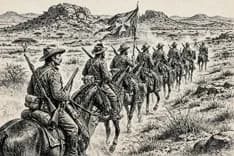
Patrol
The Anglo-Boer War, 1899–1902
It is not my intention to enter into details of this war. It is too big a thing, and it is still fresh in the memory of many South Africans. The first officer to come to East London was Captain Fitzclarence, who recruited his company mostly from the K.R.’s. Martial law was declared and the Kaffrarian Rifles called up. We started to train for active service and recruited from a paper strength of 350 to about 950. This was made possible by the number of men who were forced out of Johannesburg and who, on arrival at East London, came to the Drill Hall and enlisted.
We camped on the Recreation Ground and trained very hard. I was in command of “C” Company. The first Base Commandant was Colonel Ewart, who ordered 200 men and officers to proceed to Molteno. I was picked to command this force. I was in occupation of Bushman’s Hoek when General Gatacre came to Sterkstroom to assemble the Third Brigade.
After the Stormberg disaster the Kaffrarian Rifles fell back to Queenstown to get mounted. We mounted 850 men out of 950, the balance going to garrison Port St. Johns and relieve the C.M.R.. We were fighting inside of 14 days as a mounted unit, truly a hard and magnificent piece of military organisation. I had to give up my company to be Captain and Quartermaster of the regiment.
We left by rail for Dordrecht. We had a couple of skirmishes on the way to Aliwal. The Boers retreated but we pressed the enemy so hard over the bridge at Aliwal that although the bridge was mined, they hadn’t time to blow it up. After a couple of days to rest the horses we crossed the river and trekked up through Rouxville and Zastron into Wepener, where we were besieged.
For 17 days and nights we were in the trenches hanging on to the position. It was one of the most successful defences of the war. It rained for a week, and we had a hard and miserable time. We lost a large number of men killed and wounded. A special bar was given for Wepener. We lost one-half of the horses—strayed and shot.
The regiment fought in all the big engagements in the Orange River Colony, Transvaal and Cape Colony, including Wittebergen and the surrender of Prinsloo. The orderly-room records disclose that the regiment was 90 times under fire in the year 1900.
I was in command of a special squadron for four months under Colonel Gorringe’s flying column, and we had four months’ very hard soldiering. This squadron of KR’s was principally men out of the Railway Workshops at East London—splendid fellows.
After being about two years in the field the regiment was in such a state that the O.C., Colonel Cuming, decided to go to Pretoria to see the General Officer Commanding-in-Chief, Lord Roberts, to ask for permission to go to the base (East London) to recruit, re-mount and equip. The C.O. asked me to go with him, and we had an interview with Lord Roberts and General Kitchener.
They did not seem too willing, but in the morning the Commander-in-Chief said: “I have talked this matter over with Kitchener and we have agreed that as other corps have been granted this privilege your regiment should be granted a month’s holiday at the base to recruit and equip, and on taking the field again I hope the regiment will do the same good work in the future as they have done in the past.”
I look back on this interview—and it was a long one—with pride at having had an opportunity to talk to such famous generals. The regiment enjoyed its holiday, again took the field, and saw the war through. It was two and a half years’ active service. I was several times mentioned in dispatches and by the C.O. in his final dispatch.
The Kaffrarian Rifles
I joined the K.R.’s as a private a few months after its formation in 1883, served over 20 years, and retired with the rank of Major. I also commanded the Highland Company of the K.R.’s for a number of years. We wore the kilt (the Seaforth tartan) and had a fine pipe band under Pipe-Major Ross.
In those early years the corps was very much handicapped for the want of a drill hall, and we used a small railway building opposite the fire station. We had to shift from there and the Railway lent us a large goods shed inside the Railway Reserve abutting on Oxford Street. The N.C.O.’s put up a wooden floor at a cost of £150 and paid for it by giving entertainments.
Again, we had to shift, and for some time we met at the corner of the street. Eventually the Prime Minister, Sir Gordon Sprigg, with the consent of the Government, gave the corps a free grant of land—the present Drill Hall site—and also a grant of £800. We collected from the merchants and storekeepers and townspeople a large sum, and with regimental funds we built the main hall. The title deeds were made out in the name of the O.C. and his successors. After the war we completed the Drill Hall as it now stands.
The Colonial Division Memorial
After the Siege of Wepener the Colonial Division had a meeting. Every officer, N.C.O. and man (about 2,000) gave a day’s pay towards erecting a memorial in memory of their fallen comrades. It was decided to erect it at East London.
The committee elected, as far as I can remember, comprised Colonel Dalgety, Colonel H. B. Cuming, Captain Lukin, Captain R. H. Price, Captain J. W. McLean and Captain Clowes. This committee was responsible for the erection and presentation to the city of “The Scout in War,” also the marble memorial tablet erected on the stairs of the City Hall, together with the stained-glass window in the east of St. John’s Church.
I must say that for many years I was in business in East London and during these years identified myself with every public movement, Outside of soldiering I was Master of the Masonic Buffalo Lodge in 1903, Preceptor of the Lodge of Instruction, and first Principal of the Royal Arch Chapter, Past District Grand Warden of District, Grand Lodge and Past Scribe of District Grand Chapter, I have been a member of the Oddfellows Lodge since 1879, and a Past Provincial Grand Master of the Kaffrarian District, In 1936 I represented the Kaffrarian District at the Oddfellows conference held on the Isle of Man where 800 delegates sat for a week
In 1909 I left East London and went to Johannesburg. I felt the breaking up of old associations very much, especially with my old battalion. I thought I had finished with soldiering, as I had been in the K.R.’s over 20 years, and yet I went up to Johannesburg and did another 20 years. On leaving East London I was presented with many tokens of regard and esteem.
Railways and Harbours Rifles Railways and Harbours Brigade
In Johannesburg I joined the Railway service. I was sent for by the General Manager, Sir William Hoy, who asked me to join a committee to go into the question of forming two battalions of railwaymen for the defence of the railways. We completed the work, after which the secretary of the committee,
(Captain E. H. Honeywell), and myself visited the chief railway centres, putting up the organization.
I was then appointed full-time Adjutant of the First Battalion, and held this position for many years, and was a very busy man.
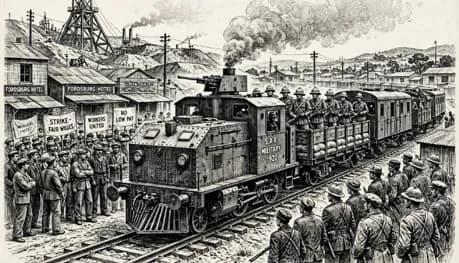
Rand Rebellion
In 1922, when martial law was proclaimed, we were called out with the other corps of Johannesburg. The strike, or revolution, was very terrible. We stuck to our job, the Railways, and we were in action several times and lost a few men. I didn’t like this work and was glad when it ended.
We were then formed into a Railway Brigade with transportation battalions, armoured trains and a medical company. I toured the Union with the Assistant General Manager, Colonel Cresswell Clark, fixing up this organization. On my return the Brigade Commander, Sir William Hoy, sent for me and said: “Now we are a Brigade, what about this job for you?”—Brigade-Major.
I thanked him and said I was quite satisfied with my present job. He said: “Yes, but I want a Staff Officer whom I can rely on.” And so I had to take the Brigade-Major’s job. I held this position for a number of years until I left the service.
The Great War, 1914–1919
My age was against me for this war, as it was a young man’s war. I had a chance to go overseas in 1914 to take charge of a training camp, but my Brigade-Commander would not agree, and so I was forced to remain.
When they started to form the Native Military Labour Corps I went to interview Sir William Hoy and pointed out to him that the Brigade was being destroyed by the number of men volunteering for active service. He said: “Yes, one-half of the Railways are tied up, and on that account I think you can go and I am sure you can do good work.”
A few days after I got a telephone message to go to Pretoria, where General Botha wanted to see me. He said: “You are a Major and Adjutant of the Defence Force. I can offer you the rank of Captain and command of 500 men.” I agreed and a few days later I left for Capetown.
I reported at Headquarters, Capetown. They said: “We are short of instructors at Rosebank, where there are over 2,000 men there. Will you train, clothe and equip your own 500 men? It will help us greatly and we won’t interfere with you.”So I started in
It was a new experience for me to command Natives. They were good, amenable to discipline, willing to learn and very keen. I was about six weeks at Rosebank. We were then told that a convoy would leave in about a week, and we were to get ready for embarkation and France.
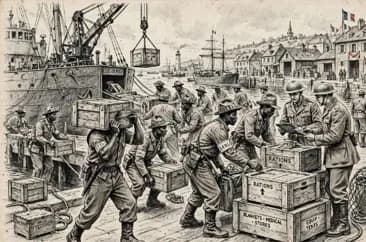
SANLC Hard work on the Harbour
The Native Labour Corps
I then received orders that I was to be OC Troops on the Troop ship Mendi. I had 850 officers, N.C.O.’s and men on board. We had no trouble, but I developed appendicitis and was landed at Plymouth for an operation.
The Mendi was run down about 11 miles off the Isle of Wight. 650 officers, N.C.O.’s and men being drowned. Three hundred and fifty men were in No. 2 hold and only one got out. There was no panic on board; the Natives behaved well; they surely gave their lives for their country, equally with the white troops in the trenches in France. I cannot describe my sorrow when I heard this sad news.
I had been very ill and was two months in hospital. I was reported drowned, and my name was read out by General Smuts at the head of the list in the House of Assembly. I read long accounts about myself in the newspapers, so I am one of those who has read his own obituary notice.
I made good, reported in London and was ordered to go to Thetford to establish a small depot for 100 sergeants who were wanted in France to take charge of small working parties. There were about 3,000 white troops at Thetford, all labour battalions. We marched about four miles to Thetford station and entrained for London and then for Folkestone.
We were there about two weeks when I received orders to see them on board the cross-Channel boat for France. They were splendid men — no trouble — all fully trained.
A few days after I crossed over to France and there took over the command of the 19th Company of the S.A.N.L.C., made up to a strength of 500 men. I was two years working in various parts of France and finally went to Rouen, where I did dock work—loading and unloading ships and trains. The Natives did splendid work in France—work of all descriptions—and gave no more trouble than white troops.
Their time had long expired, their contract period was up, and they wanted to return home. The Government offered them an extra £1 a month, making £4 a month all found, which shows what value the Government placed on their labour.
I was sent for by General Head Quarters and told to hold myself in readiness to be O.C. Troops, troopship Renanga, in command of 2,000 officers, N.C.O.’s and men, on their return time expired to South Africa. Eventually I landed this force at Cape town, without the loss of a single man, although at one time I had 20 men in the sick bay. I was complimented by the General Commanding at Cape town on this piece of good work.
I went to report my arrival to Sir William Hoy, who was pleased to see me. After a long talk he said: “What are you going to do now?” I said, “I have written instructions to return to France with the next convoy.” He said, “We have lots of work for you here. The Brigade wants re-forming; you have done good work and I am satisfied, and the war is coming to an end.” Application was made for my release, and I was discharged. So ended my service in the Great War.
Decorations and Service
I hold the undermentioned decorations: —
Gaika-Galeka and Morosi Medal, 2 clasps.
Basuto and Langberg Medal, 2 clasps.
Anglo-Boer War (Queen’s) Medal, 4 clasps.
Anglo-Boer War (King’s) Medal, 2 clasps.
Great War (British) Medal.
Victory (Allies) Medal.
Long Service Medal.
Colonial Forces Auxiliary Officers’ decoration.
Order of the British Empire.
Total: 7 medals, 2 Orders, 10 clasps
I was gazetted in Defence Force General Orders and also in the Government Gazette as entitled to wear the Volunteer Officers’ Decoration and the Long Service Medal, together having completed the full qualifying period of service for each, viz., 40 years.
(Continued next column)
I am going overseas in the early part of next year with the British Empire Service League Pilgrims on a visit to the battlefields of France, and Belgium including a goodwill visit to Germany
I am looking forward to the trip as my youngest son, Jack, was killed in the Wood on July 16, 1916.
On April 10 next I will be 84, and I sail on the Edinburgh Castle from Cape Town on May 13.
I have always had good health—only minor ailments —and my doctor says I am fit to go round the world if I want to go. I have always lived an active life. This ends my brief record, from which many interesting items have had to be left out on account of time and space. I think I can say that I have served South Africa to the best of my ability and South Africa comes first with me.
The End
14. Conclusion
John Walter McLean’s life represents an unusually long period of South African Military and Civic History.
From the formation of the Buffalo Volunteer Rifles in 1876, through the frontier campaigns with the 1st Cape Mounted Yeomanry, the establishment and development of the Kaffrarian Rifles, the Bechuanaland campaign, the Anglo-Boer War, the Railway and Harbour forces, the First World War and the South African Native Labour Corps and the 1922 Rand Rebellion, McLean remained connected with military service and public life.
His story is also a family story. His marriage to Catherine McCrann, his three children and an adopted daughter, and particularly the death of his brother Robert and many years later the death of his son Jack at Delville Wood, add a personal dimension to the record.
For the history of the Kaffrarian Rifles, his association with the Drill Hall, the regiment’s Highland traditions and the Colonial Division Memorial is especially significant.
This document is intended as a working historical record preserving the material gathered to date. It should be regarded as a foundation for further archival research rather than as a final scholarly biography. The source differences recorded here are valuable because they show exactly where further research is required.
15. Acknowledgements
This historical record has been compiled from material gathered over time by the Ex-Curator of The Kaffrarian Rifles Regimental Museum MWO Craig Brown. Craig was responsible for all photographs in the history of The Kaffrarian Rifles “Nunc Animis” and kept records of this. For the original research, personal notes, Regimental records, recollections, photographs, family information and extensive work over 40 years in bringing the material together. He is busy with the project of all RSM information pertaining to Prince Alfred’s Guard, First City & The Kaffrarian Rifles.
Acknowledgement is made to:
- Mr Brian Thomas, The Green Ribbon for his research notes, military-record references, medal information and additional historical leads concerning Lieutenant Colonel John Walter McLean.
- The South African Library for supplying the original copies of the actual two articles.
- The Daily Dispatch, particularly the 18 September and 25 September 1937 material concerning Lieutenant Colonel McLean’s reminiscences and military career.
- Mr Zane Russell for the photos of the badges from his magnificent collection and of the original photograph of Major Ronald MacLean
- Cory Library - Men of Our Times, for the biographical entry “Capt. J. W. McLean”.
- Cape Archives and the identified archival service records, including the reference to file 1/298, for future verification of McLean’s service history.
- The South African National War Museum and associated museum records referred to in the research concerning McLean’s medals and military history.
- The McLean family records and information concerning John Walter McLean, Catherine McCrann, their children, and the family’s connection with the military history of the Eastern Cape.
- The many historical records, newspaper reports, regimental traditions and family documents that have helped preserve the memory of John Walter McLean and the Kaffrarian Rifles.
- The East London Museum – Early Regimental Photographs
- The South African War Grave – Ralph McLean - photo of Jack’s name on the Thiepval Memorial
This document is respectfully preserved as part of the continuing historical record of the Kaffrarian Rifles and Eastern Cape Regiments for future generations.
NUNC ANIMIS
Write to us about this article
Do you remember this, or know more? Your comment appears here once an editor has read it.
The editors may print your comment, with your name, in the monthly edition.