
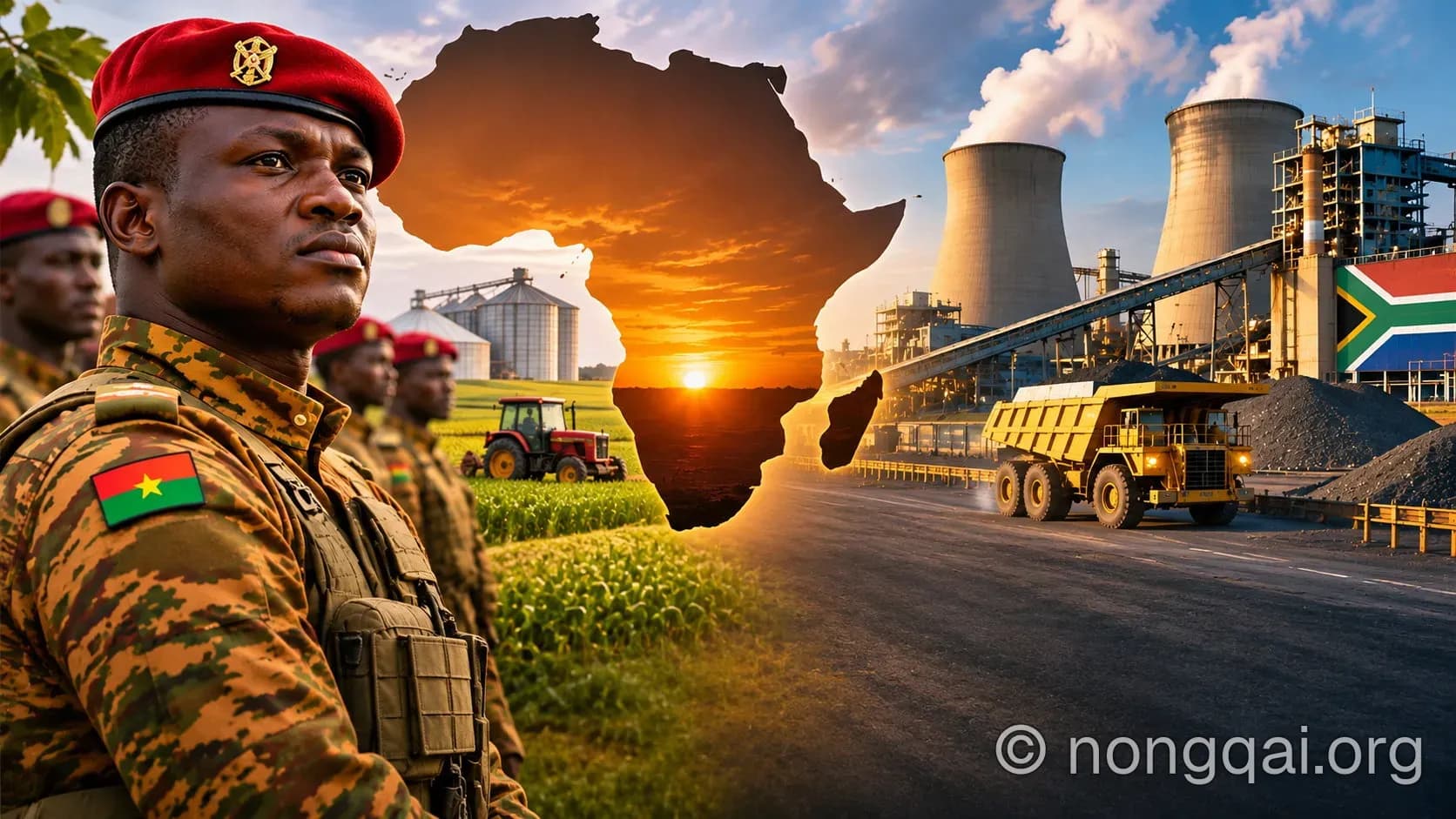
 AI image
Beyond Capitalism and Socialism
Why Leadership, Institutions and National Circumstances Matter More Than Labels

Abstract: Economic development cannot be reduced to ideological choices between capitalism and socialism. Examining international examples and South Africa's institutional experience, this article argues that leadership, institutional capacity, accountability and national circumstances matter far more than economic labels. It considers why pragmatic policy and strategic autonomy are essential to sustainable national development.
Few economic debates are as persistently framed in ideological terms as the contest between capitalism and socialism. Communism is frequently added to the discussion, often as though the three represent clearly defined, mutually exclusive alternatives. In popular discourse, capitalism is associated with freedom, prosperity and individual initiative, while socialism and communism are portrayed as pathways to economic failure, authoritarianism and oppression. Such characterisations may serve political arguments, but they offer limited insight into how economies actually function.
Any serious discussion must acknowledge the historical record. Communist regimes have been responsible for catastrophic famines, forced collectivisation, political repression and mass human suffering. These are not incidental details to be explained away. Equally, the developmental achievements of countries such as China and Vietnam complicate simplistic assertions that communist-party governance is inherently incapable of producing economic progress. Their transformations, however, have involved substantial economic reforms and the incorporation of market mechanisms. Recognising both realities is not an endorsement of either system; it is a prerequisite for meaningful analysis.
The more useful question is not which economic ideology is inherently superior, but what enables a country to organise its resources, develop productive capabilities and improve the living conditions of its population. The answer depends on considerably more than the economic philosophy a government claims to follow.
Beyond ideological labels
Capitalism, socialism and communism have distinct intellectual and historical foundations. Capitalism generally relies on private ownership, market exchange and the accumulation of capital. Socialism encompasses a broad range of approaches advocating greater social or collective ownership, control or distribution of economic resources. Communism, in classical Marxist theory, envisages a classless society in which the means of production are held in common. The centrally planned economies historically governed by communist parties represent particular political and economic interpretations of that ideal.
In practice, however, most contemporary economies combine market mechanisms with varying degrees of state intervention, public ownership, regulation and social provision. The United States maintains extensive public healthcare programmes, social security and industrial subsidies. Nordic countries combine competitive private enterprise with substantial public services and social protection. China retains Communist Party political control while incorporating private enterprise, market competition and international investment. These arrangements differ considerably, but demonstrate the limitations of classifying entire economies through a single ideological label.
China's transformation is particularly instructive. Since the economic reforms initiated in 1978, the country has achieved extraordinary industrial expansion, infrastructure development and poverty reduction. The World Bank estimates that almost 800 million people were lifted out of extreme poverty over four decades. Vietnam offers another example. Its Đổi Mới reforms, introduced in 1986, transformed a largely centrally planned agrarian economy into a major manufacturing and export economy, with substantial improvements in incomes and living standards.
Neither example demonstrates that traditional central planning is inherently successful. Rather, they illustrate the capacity of governments to adapt economic arrangements, combine state direction with market incentives and respond pragmatically to changing circumstances. South Korea's earlier industrialisation offers a further illustration: extensive state coordination and support for selected industries helped develop a globally competitive private manufacturing sector.
The lesson is not that one particular model should be replicated, but that economic development rarely follows the ideological purity suggested by political debate. There are, however, other factors that are equally important in determining whether an economic model succeeds or fails. Among these, the quality of leadership and the capacity of the institutions responsible for implementing policy are particularly significant.
Leadership and institutional capacity
Economic systems do not manage themselves. They are designed, administered, regulated and adapted by people exercising political and institutional authority. Consequently, the quality of leadership is among the most important determinants of economic performance.
Good leadership establishes standards of integrity, appoints people on merit, develops professional capacity, allocates resources responsibly and creates incentives for performance. It also establishes accountability and ensures that misconduct and incompetence have consequences. These responsibilities extend beyond the management of individual organisations. They determine the institutional culture and, ultimately, the capacity of the state.
Institutional strength and leadership are therefore interdependent, but not interchangeable. Effective leaders create the conditions in which capable institutions develop. Strong institutions, in turn, preserve professional standards and ensure continuity beyond the tenure of individual leaders. The ultimate achievement of good leadership should be to create institutions that no longer depend on the personal qualities of those who established them.
This distinction is important when evaluating both state-directed and market-oriented economies. State ownership does not guarantee effective management, just as private ownership does not guarantee efficiency, competition or accountability. A government can pursue an admirable programme of social development while lacking the administrative capacity to implement it. Equally, a market-oriented economy can become distorted by monopolies, political patronage and concentrated economic power.
Institutional failure is not necessarily evidence of the failure of an economic philosophy. It may instead reflect poor leadership, inadequate institutional design, corruption or an inability to adapt.
Development is not a one-size-fits-all exercise
Economic policy must be considered within the historical, political and geopolitical circumstances of individual countries. A developing economy emerging from colonial exploitation, conflict, limited industrialisation or entrenched poverty faces different challenges from a mature industrial economy with developed infrastructure, capital markets and established institutions.
For many developing countries, greater state involvement may be necessary to establish productive capacity, develop infrastructure, secure essential resources and reduce strategic dependencies. Governments may need to support domestic industries, coordinate investment and protect capabilities that private markets are unwilling or unable to sustain at a particular stage of national development. Such interventions are not necessarily socialist; they are instruments of economic development and national strategy.
Burkina Faso provides an interesting contemporary case. Under Ibrahim Traoré, the government has emphasised agricultural production, domestic processing, resource sovereignty and reduced dependence on external partners. These priorities reflect a state-directed development approach informed by national circumstances and security challenges. Whether the initiatives will deliver sustainable improvements in living standards and institutional capacity remains to be demonstrated. Nevertheless, the country's circumstances deserve consideration beyond the ideological labels attached to its leadership.
The broader principle is that national development should not require the mechanical adoption of externally prescribed economic or institutional models. Countries should be able to evaluate different approaches, retain what works and develop arrangements suited to their own requirements. Economic sovereignty includes the capacity to determine national priorities rather than simply conform to prevailing ideological expectations.
This does not imply that every government policy is justified by national sovereignty, or that political accountability can be postponed indefinitely. Development must ultimately be assessed through its consequences for society, including economic opportunity, security, living standards and institutional sustainability.
South Africa: when institutions lose their purpose
South Africa offers a particularly relevant illustration of what happens when institutional capacity is progressively undermined. Its electricity sector, defence industry, petroleum refining capacity and transport infrastructure represent strategic capabilities essential to economic development and national resilience. Their deterioration cannot be explained simply by the shortcomings of state ownership or government intervention.
Eskom's decline, the financial and operational difficulties at Denel, the deterioration of Transnet's freight and port operations, and the loss of domestic petroleum refining capacity have different histories and causes. Not every failure can be attributed to corruption or political interference. However, prolonged governance weaknesses, inadequate investment, poor management, political appointments and the erosion of professional expertise have contributed significantly to the deterioration of important state capabilities.
The findings of the Zondo Commission exposed how state capture and the deliberate weakening of governance and procurement controls affected strategically important institutions. The Auditor-General's 2024/25 report subsequently identified poor-quality financial and performance reporting at 13 of the 17 state-owned entities with completed audits, material compliance findings at 15, and R13.44 billion in irregular expenditure across SOEs and their subsidiaries. These findings illustrate that institutional weaknesses remain a serious concern.
The consequences extend beyond financial losses or organisational inefficiency. A country cannot credibly pursue energy security while its electricity infrastructure remains vulnerable. It cannot strengthen military capability while neglecting its defence-industrial base. Nor can it develop export competitiveness while its railways and ports constrain the movement of goods.
South Africa's experience is therefore not simply an argument against state ownership. It demonstrates that ownership without competent leadership, institutional integrity and accountability is insufficient. Equally, transferring assets to private interests will not automatically resolve failures arising from inadequate regulation, weak competition or deficient governance.
State ownership is not synonymous with state capacity, just as market efficiency is not necessarily synonymous with national resilience.
Beyond ideology: towards effective national governance
For African countries in particular, the challenge is to move beyond ideological conformity and develop economic approaches informed by their own histories, circumstances and strategic priorities. The continent's development cannot be separated from its colonial experience, its position in the international economic system, its productive capacity and the geopolitical relationships that influence access to markets, capital, technology and resources.
The work of thinkers such as Walter Rodney, Samir Amin and Amílcar Cabral offers important perspectives on these relationships, while also raising questions about the responsibilities of political leadership and the importance of intellectual and economic autonomy. Their arguments need not be accepted wholesale to recognise the value of examining development from African historical and strategic perspectives.
Ultimately, economic systems are instruments, not ends in themselves. Their value lies in what they enable a society to achieve. A country does not become prosperous simply by adopting the correct ideological label. It develops through effective leadership, capable institutions, sound economic management and the ability to translate its resources into sustainable productive capacity.
The more pertinent question, therefore, is not whether capitalism or socialism is inherently superior, but whether those governing a country possess the integrity, competence and strategic judgement to create the conditions for its development. The answer will depend on the circumstances of each nation, but the importance of leadership and institutional accountability is universal.
Write to us about this article
Do you remember this, or know more? Your comment appears here once an editor has read it.
The editors may print your comment, with your name, in the monthly edition.
Related Articles
South Africa's Defence Oversight Problem: When Parliamentary Scrutiny Fails to Deliver
November 12, 2026
The Department of Defence’s Journey to Greatness: Nearly Two Years On
November 14, 2026

Amazon Changes the Starlink Debate, Joan Swart
July 17, 2026
Voltaire, Huntington, Brzezinski and South African Strategic Identity in a Multipolar World, Joan Swart
September 5, 2026
Strategic Petroleum Stocks: A Test of South Africa's National Strategy, Joan Swart
July 24, 2026