
 AI image

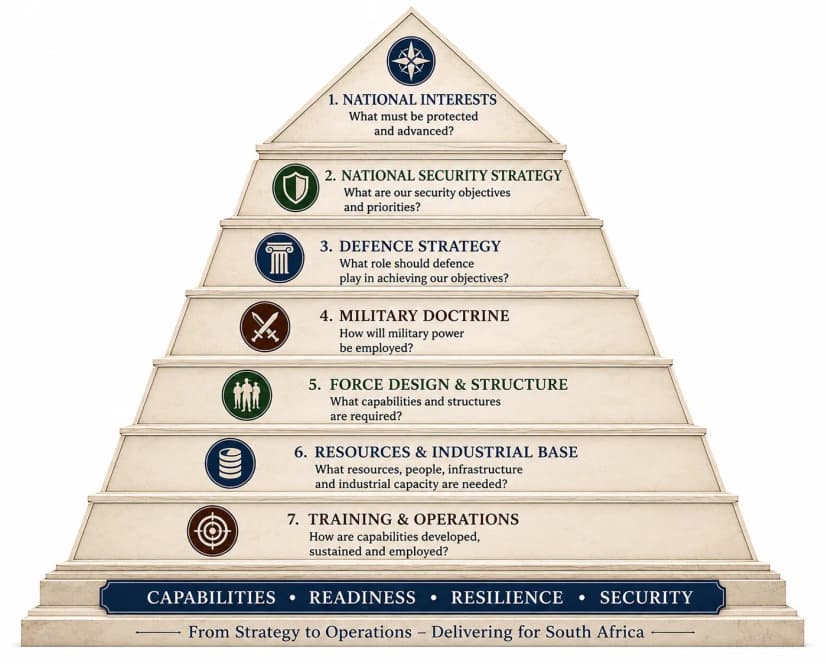
The Joint Standing Committee on Defence’s meeting on 13 November 2026 brought an important question back into focus: can the Department of Defence translate its strategic ambitions into measurable outcomes, and can Parliament hold it accountable for doing so? The discussion centred on the Defence Industry Lekgotla, including concerns raised about funding, institutional responsibility, implementation timelines and accountability in the context of the Department’s broader strategic undertaking: the Journey to Greatness.
The distinction between ambition and implementation is particularly important in defence. South Africa has no shortage of policy documents, reviews and plans describing the capabilities the country requires. The persistent difficulty has been turning those ambitions into funded programmes, functioning institutions and operational improvements. The Journey to Greatness must therefore be assessed not simply on the strength of its vision, but on the credibility of the route proposed to achieve it.
From strategic ambition to measurable delivery
The Department’s Strategic Plan for 2025–2030, effective from 1 April 2025, identifies implementation of the SANDF Long-Term Capability Development Plan, known as the Journey to Greatness, as a performance indicator under the outcome of establishing an effective and sustainable defence force.
The plan identifies several priorities for the current planning period. These include restructuring the force, developing a disaster management capability, improving border safeguarding, renewing information and communications technology, establishing a rapid deployment capability, developing model units and ensuring that personnel are properly equipped. These are not peripheral projects. They address significant weaknesses in the SANDF and are central to its ability to fulfil its constitutional and operational responsibilities.
The difficulty is not identifying what needs to be done.
It is establishing what can realistically be delivered, in what sequence and with what resources. The Department's performance framework sets the desired outcome as the implementation of all identified deliverables. Yet the underlying assumption for achieving this is stated simply as: “Sufficient funding to implement the SANDF Long-Term Capability Development Plan (‘Journey to Greatness’).”
That assumption deserves closer scrutiny.
Funding is obviously essential to capability development, but the plan does not make clear, within this performance framework, what constitutes sufficient funding or how priorities will change if the necessary allocations are not secured. Which capabilities will be protected? Which programmes will be deferred? What operational risks will be accepted? And, most importantly, what can the SANDF deliver with the resources actually available?
These are practical questions, not objections to the ambition itself. A strategy must provide direction under real conditions, including those in which resources fall short of requirements.
Planning for fiscal reality
A credible defence strategy cannot depend on a single funding assumption. It should provide alternative pathways that allow capability development to proceed under different fiscal conditions. The Department should be able to demonstrate what can be achieved within existing allocations, what becomes possible through moderate increases and what additional capabilities would require substantially greater investment.
A constrained-funding scenario, for example, should identify the capabilities that must be preserved to maintain essential operational functions, those that can realistically be regenerated and those new capabilities that can be developed without undermining current commitments. A baseline scenario should set out what can be achieved through existing allocations and credible reprioritisation. Enhanced and accelerated scenarios should identify the additional capabilities that greater investment would make possible, together with the associated personnel, procurement, infrastructure and institutional requirements.
This is not an argument for lowering the level of ambition. It is an argument for making that ambition achievable.
A defence force cannot suspend its existing responsibilities while waiting for a future funding settlement. It must maintain what remains operational, address the most serious deficiencies and develop future capabilities in a sequence that reflects both strategic priorities and financial constraints.
Without alternative pathways, an accountability gap emerges.
An organisation cannot be assessed meaningfully against an ambition without disclosing the resources, dependencies and decisions required to achieve it. If the Department's performance framework assumes sufficient funding, it must also explain what it intends to do when that assumption is not met. Otherwise, missed targets can too easily be attributed to inadequate funding without examining whether available resources were prioritised effectively or whether realistic alternatives were considered.
A strategy is not a funding wish list.
It requires choices, trade-offs and the willingness to adjust plans when circumstances change. The Department must retain a clear long-term destination while demonstrating that it has more than one route towards it.
Resources, governance and institutional responsibility
Funding, however, is only part of the problem. The Department's own Strategic Plan acknowledges shortcomings in governance and internal controls, including insufficient progress in addressing matters raised by Parliament and the Auditor-General. The Acting Secretary for Defence identifies the need to strengthen governance, risk management, internal controls and accountability. The plan also acknowledges that the digital transformation of the Department's information and communications systems has not received the attention required.
These are not administrative distractions from the business of defence. They affect the Department's ability to manage procurement, maintain equipment, execute projects and account for public money. Additional funding cannot, by itself, resolve weaknesses in financial management, project execution or consequence management. Unless these institutional problems are addressed, increased allocations risk being absorbed by existing inefficiencies rather than translated into improved military capability.
The same need for clarity applies to the relationship between the SANDF and the defence industry. Their interests are closely connected, but their institutional responsibilities and performance should remain distinct. The defence industry must demonstrate commercial viability, competitive products, reliable delivery and the ability to sustain itself in domestic and international markets. The SANDF, in turn, must remain an independent and discerning customer, procuring according to operational requirements, technical performance, affordability and lifecycle value.
There may be strategically important domestic capabilities that the state considers necessary to retain, even where commercial returns are limited. If so, the case for supporting them should be explicit, transparent and separately accounted for. The operational requirements of the SANDF should not be subordinated to the commercial interests of suppliers, nor should the difficulties of the defence industry be treated as a substitute explanation for shortcomings in military capability.
Strategic alignment is necessary; institutional dependency is not.
South Africa has encountered the consequences of failing to connect defence ambitions to sustainable resources before. The 2015 Defence Review set out a comprehensive vision for the future of the SANDF, but its implementation was undermined by the failure to secure the necessary funding. The Department's current Strategic Plan itself acknowledges that the expected incremental funding for the earlier Plan to Arrest the Decline was not realised and that reductions in the defence baseline exacerbated the deterioration of capabilities.
The lesson is straightforward: approving a strategy does not provide the means to implement it. Nor does the prospect of future funding remove the need to manage the resources already available.
Nearly two years on: what can Parliament measure?
The Journey to Greatness is a long-term undertaking extending across several planning periods. It would be premature to pronounce it a failure. However, the Department's current five-year Strategic Plan has been in effect for approximately nineteen months. There is now a reasonable basis for asking whether the foundations for implementation are being established and whether progress can be demonstrated against the commitments already made.
The relevant test is not whether the SANDF has reached its intended future state. It is whether the Department can show that it is moving towards that state through funded priorities, defined responsibilities and measurable improvements. This requires more than reporting that structures have been established or that planning processes are under way.
Parliament should be able to establish what has been implemented, what remains outstanding, what resources have been committed and what obstacles have affected delivery. It should also be able to see which decisions have been taken to address those obstacles, and whether the Department has adjusted its priorities in response to changing financial circumstances. Annual reporting against the Journey to Greatness indicator should provide evidence of progress, rather than simply restate the ambition.
The committee's recent discussion of the defence industry illustrates the importance of this distinction. Implementation frameworks and reporting structures may be useful, but they cannot compensate for the absence of clear strategic priorities, realistic costing and assigned responsibility. The same applies to the Journey to Greatness as a whole. Its credibility will depend on the Department's ability to connect its long-term objectives to the decisions, resources and institutional performance required to achieve them.
South Africa needs a defence force capable of fulfilling its responsibilities, and it needs a defence industry able to contribute to that capability. Both require sustained strategic attention. But neither will be strengthened by aspirations that are disconnected from fiscal reality or by plans that do not make institutional performance measurable.
Ultimately, the Journey to Greatness should be judged not by the scale of its ambition, but by the Department's ability to make difficult choices, manage available resources, adapt to changing circumstances and deliver measurable improvements in defence capability. Nearly two years into the current planning cycle, the essential question is whether the Department can demonstrate, with evidence and accountability, how it intends to get there.
Write to us about this article
Do you remember this, or know more? Your comment appears here once an editor has read it.
The editors may print your comment, with your name, in the monthly edition.
Related Articles

South Africa's Defence Oversight Problem: When Parliamentary Scrutiny Fails to Deliver
November 12, 2026

What Kind of Defence Force Does South Africa Need?
November 2, 2026

Medium Term Budget Policy Statement and SA Defence, Joan Swart
October 22, 2026

The SANDF’s Crisis Is Not Financial — It Is Strategic, Joan Swart
June 3, 2026
Defence Governance: Another Task Team or a Strategic Reset? Joan Swart
June 10, 2026