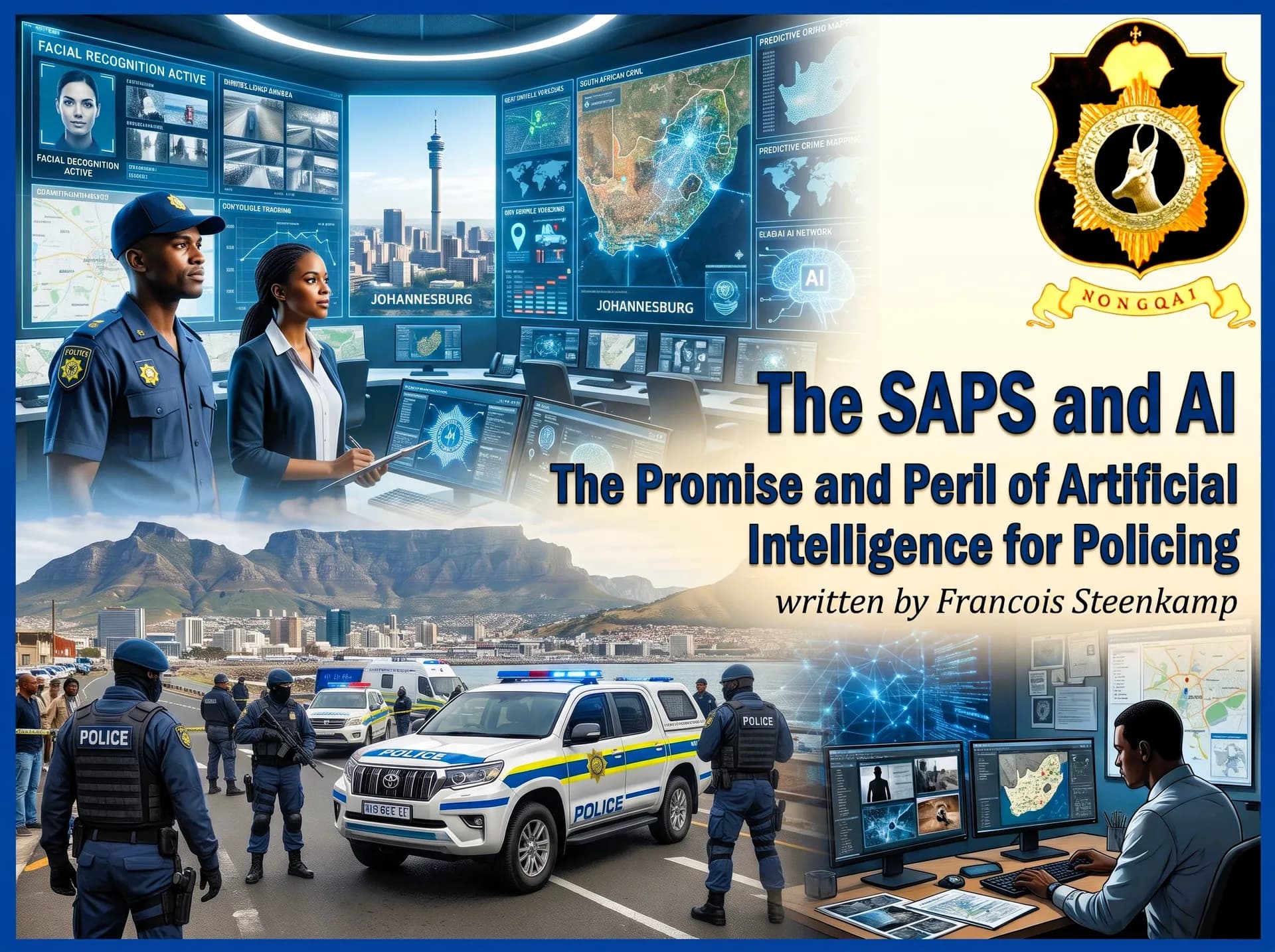
SAPS and AI
The Promise and Peril of Artificial Intelligence for Policing
Author's note: Nongqai's IT Development and Operations Officer recently asked Anthropic's Claude AI for an article on how AI can assist the SAPS in improving policing in South Africa (as part of a test during Nongqai's transition to its own new AI-assisted platform hosted on the Azure cloud server, sponsored for us by Microsoft). The blog post below is what Claude AI came up with - it was so interesting that we decided to share it with our readers.
A new kind of partner
Policing in South Africa has always depended on people: the constable on foot patrol, the detective working a docket, the radio operator in the control room. Artificial intelligence (AI) will not replace them, but it is starting to work alongside them. The question is no longer whether AI will reach the South African Police Service, but how it will be used, and who will keep it in check.
 AI image
Where AI could help
AI is good at one thing people find tiring: finding patterns in very large amounts of information. For a police service that is often short of people and money, that matters. Possible uses include:
- Crime pattern analysis: spotting hotspots and times of day where house robberies or cable theft increase, so patrols can be planned better.
- CCTV and number-plate recognition: flagging stolen or wanted vehicles as they pass cameras, rather than waiting for someone to notice.
- Gunshot detection: acoustic sensors that pinpoint where shots were fired. Cape Town has tried this kind of system in some of its most affected areas.
- Docket and case management: sorting statements, linking related cases across stations, and reminding investigators of deadlines.
- Translation: helping officers take statements from members of the public in any of the country's official languages.
- Forensics: faster matching of fingerprints, ballistic evidence and digital evidence from seized phones.
The benefits
Used well, these tools could give officers back their most scarce resource: time. A detective carrying a heavy caseload who no longer spends hours cross-referencing dockets has more time to interview witnesses. A control room that is warned about a stolen vehicle within seconds can send a response vehicle while the trail is still warm.
There is also a case for fairness. Decisions based on evidence, such as where to deploy patrols, can be more consistent than decisions based on habit or hunches, provided the input data was sound.
 AI image
The risks
The same tools carry real dangers, and South Africa's history makes them sharper here than in many countries.
Bias in, bias out. An AI system learns from past records. If some communities were policed more heavily in the past, the system will "learn" that crime happens there, and send even more police to the same places. Facial recognition has also been shown internationally to make more mistakes with darker skin tones, a serious concern in a country where most people are Black.
Privacy. The Constitution protects the right to privacy, and the Protection of Personal Information Act (POPIA) limits how personal information may be collected and used. A network of cameras that can follow a person across a city raises hard questions about where public safety ends and surveillance begins.
Accountability. When a system flags someone as a suspect, who is responsible if it is wrong? An officer must still be able to explain, in court, why action was taken. "The computer said so" is not an answer.
Security and cost. Police systems are an obvious target for criminals and hackers. And an expensive system bought without trained people to run it, or funds to maintain it, quickly becomes both a white elephant and a backdoor into the system.
Getting it right
None of these risks is a reason to reject AI outright. They are reasons to introduce it carefully:
- Start with low-risk uses, such as docket management and translation, before moving to surveillance.
- Keep an officer responsible for every decision that affects someone's freedom.
- Test systems on South African data, and publish how well they perform.
- Give Parliament and independent oversight bodies the power to audit how AI is used.
- Train officers not only to use the tools, but to constantly question them as well.
Conclusion
AI could help a stretched police service work smarter, but trust is earned slowly and lost quickly. If the SAPS introduces these tools openly, lawfully and with firm human oversight, they could become a valuable partner in keeping communities safe. If not, they risk multiplying injustices with new technology.
 AI image

© nongqai.org
Write to us about this article
Do you remember this, or know more? Your comment appears here once an editor has read it.
The editors may print your comment, with your name, in the monthly edition.