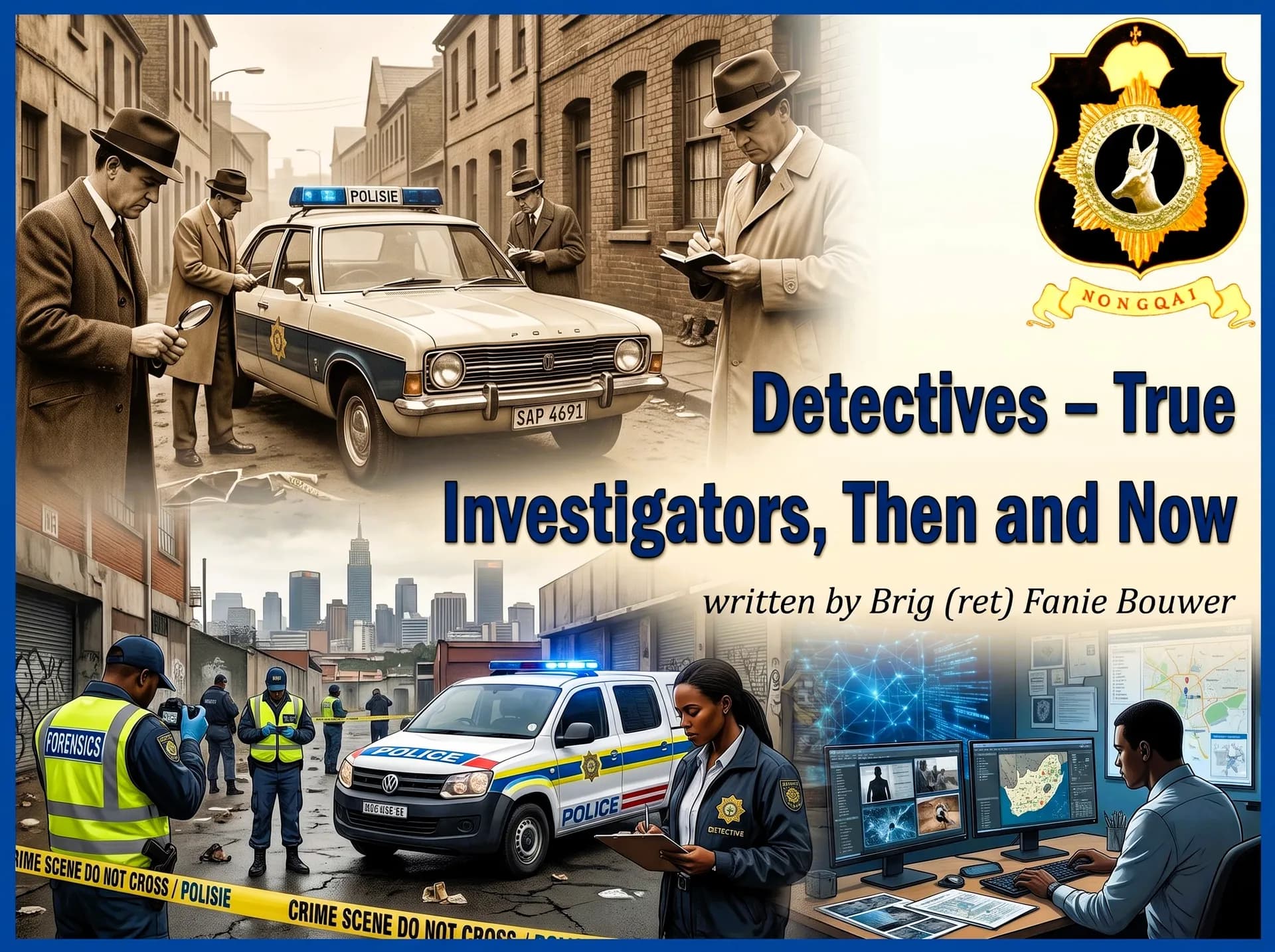
Detectives – True Investigators, Then and Now
A Reflection on Detective Work, Investigation Standards and Criminal Case Detection in South Africa

The other day I was talking to someone about the investigation of criminal cases (dockets) these days. More specifically, we discussed the worrying trend whereby cases appear to be closed as Undetected with increasing ease. In my opinion, this points to the wrong, and possibly even a flawed, mindset towards investigative work.
How often do we read reports suggesting that there is more urgency to close a docket as Undetected than to do everything possible to identify and track down the perpetrator?
I recently read how someone recalled that, several decades ago, after several weeks of investigation, he had still failed to trace a suspect. Out of sheer frustration, he recorded in his investigation diary that he was now thoroughly fed up with the case.
Then the officer responsible for inspecting the dockets arrived. His instruction to the investigator was short and to the point:
"Keep tracing!"
I relate this anecdote because it says something about the attitude towards investigative work and the tracing of offenders that prevailed at the time. The message was simple: investigate, keep searching and find the perpetrator.
It was a positive and purposeful approach.
The detectives of yesteryear
Approximately 67 years ago, serious unrest broke out in Pondoland (Transkei). The situation became so serious that Prime Minister Hendrik Verwoerd declared a state of emergency. This led, among other things, to the arrest of almost 500 residents.
The South African Police subsequently dispatched a team of detectives to the area to investigate the causes of the unrest and the crimes committed during that period, with a view to prosecution.
Thorough and painstaking investigative work followed. Court cases ensued, and eventually no fewer than 30 residents were sentenced to death, 23 of whom were later hanged at Pretoria Central Prison.
That sounds almost unbelievable today. One may rightly ask how such a situation would be handled in the present day.
I stand to be corrected, but I am under the impression that Lang Hendrik van den Bergh and Mike Geldenhuys were also involved.
What does this history tell us about the attitude and professional dedication of detectives who had to undertake investigations on such a scale without today's technological tools, facilities and forensic support?
Brigadier Hennie Heymans has a report written by his late father, Sergeant A.F. Heymans, about the unrest that took place there at the time. It would be interesting to have that report brought to light again.
The present-day reality
Much has changed since then. The Constitution and the Bill of Rights have, of course, introduced new requirements and safeguards governing the treatment of suspects and the conduct of investigations. These are essential features of a democratic society.
However, there have also been other, less positive changes: poor leadership, inadequate training and, in my opinion, at times a lack of professional commitment and a sense of responsibility.
In the meantime, we have had the Scorpions, followed by the Hawks, and more recently the NPA's Investigating Directorate Against Corruption (IDAC), which has also been given investigative powers.
These units make use of forensic investigators, accountants and other specialists, among others. Add to this the enormous advances in technology and the investigative tools available today.
The focus is largely on economic crime, state capture, corruption and organised crime. This is understandable, given the scale of these offences and the damage they cause to the country.
But I cannot help wondering whether the ordinary detective at a local police station has increasingly become the poor relation of the Detective Service.
I hear very little about proper detective training and specialised detective courses. This makes me wonder how much attention is still being given to developing competent, experienced and dedicated detectives.
Just look at the murder detection figures.
According to the SAPS 2024/25 Annual Report and information presented to Parliament on 15 October 2026, only 9.5% of all murder cases were solved. The target, remarkably, was 60%! In the previous financial year, the detection rate stood at 10.13%.
This is a serious indictment of the Detective Service's ability to investigate one of the country's most serious crime problems effectively.
What do the other figures tell us?
Parliament was recently informed that more than five million dockets had been closed over a period of five years because of a lack of evidence. These figures were provided in a written parliamentary reply.
One cannot help wondering how many of these cases were the result of inadequate investigative work, insufficient follow-up or even the complete absence of proper investigation.
Figures were also provided for the number of cases closed as Undetected each year. The average is more than one million cases annually.
That amounts to almost 3,000 cases being closed as Undetected every day, without the victims necessarily receiving the justice to which they are entitled.
Behind these figures are people and families. They include horrific murders, rapes, brutal assaults and kidnappings.
This is the painful reality South Africans have increasingly had to face over the years: a police service that often fails to respond in time, struggles with inadequate resources and poor leadership, and sometimes lacks the necessary skills or mindset to perform its duties properly.
Where does the problem lie?
Speaking of inadequate resources: how strategically and sensibly is the SAPS's annual budget of approximately R120 billion allocated?
Do investigative units, and particularly detectives at ordinary police stations, receive the financial and human resources they need to do their jobs properly?
I strongly suspect that the problem is not simply a shortage of money. Poor financial management and the incorrect prioritisation of resources also play a significant role.
Consequently, the SAPS Detective Service is under enormous pressure. Detectives are overloaded, overworked and understaffed, which inevitably affects the quality of investigations and, ultimately, the success of prosecutions.
According to a parliamentary reply by the Minister of Police, Firoz Cachalia, the figures as at 31 July 2026 were as follows:
Detectives at police stations countrywide: 20,051
Docket investigators (also referred to as docket carriers): 15,962
Cases under investigation: 1,691,312
This works out to an average of approximately 84 cases per detective.
The average alone is alarming. However, this is a national figure, and the actual workload will naturally vary from station to station and from detective to detective. Some detectives carry hundreds of dockets.
How, under such circumstances, can any meaningful investigation be conducted?
And the question remains: I sometimes wonder whatever happened to the mindset of those old-school detectives. The men and women who, often with very few resources, persevered until they solved a case.
Technology has advanced, investigative methods have evolved, and more expertise and tools are available today than ever before.
However, technology, money and personnel can never replace a dedicated detective with a strong sense of responsibility and a genuine desire to see justice done.
Conclusion
Perhaps the SAPS needs to return, at least in part, to that simple but powerful instruction from years ago:
"Keep tracing!"

© nongqai.org
Write to us about this article
Do you remember this, or know more? Your comment appears here once an editor has read it.
The editors may print your comment, with your name, in the monthly edition.