Congratulations on your achievement, Sir.
Logan November 13, 2026
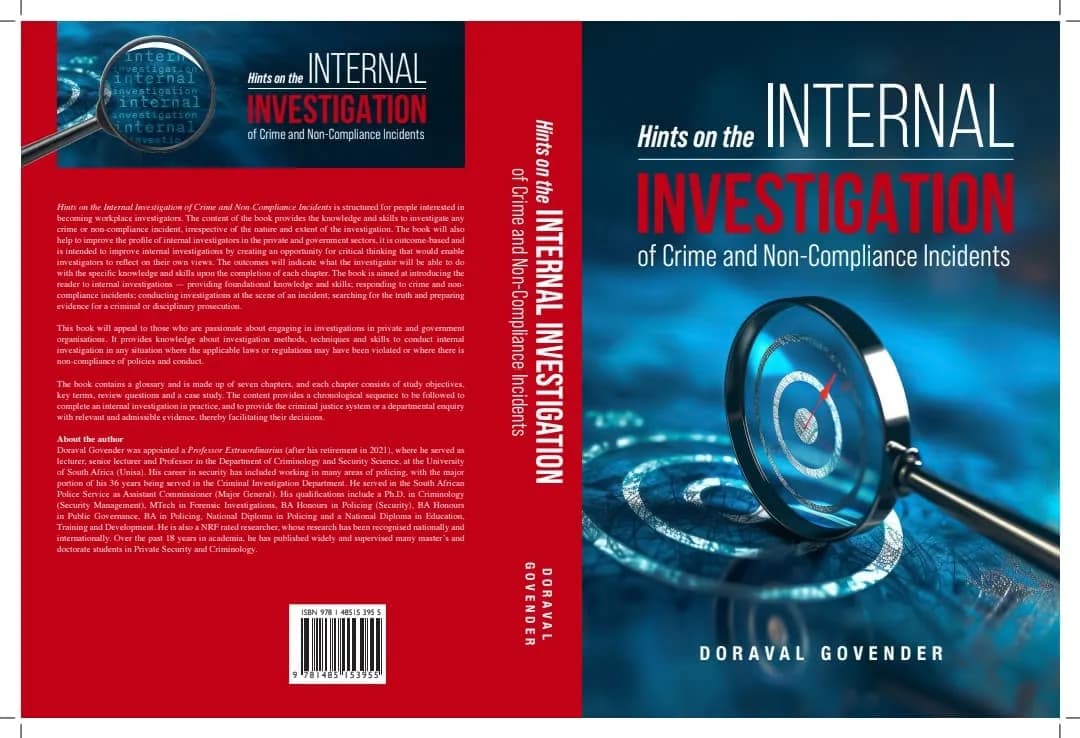
Book written by Professor Govender, an expert with extensive experience in criminal and departmental investigations



BOOK REVIEW : HINTS ON THE INTERNAL INVESTIGATION OF CRIME AND NON- COMPLIANCE INCIDENTS
FOREWORD 1
Organisations, whether private or public, large or small, have specific values that define who they are and shape their image. The behaviour of employees towards customers or clients, their interactions with one another, and their engagement with other stakeholders, including their management of resources, can lead to the need for internal investigations. Some of these investigations may escalate to criminal inquiries, depending on the nature of the misconduct. Failing to address unethical behaviour in an organisation, regardless of its form, can have far-reaching consequences. It can undermine the organisation’s ability to achieve its mission, as unethical staff may remain and cause ongoing harm.
This book offers valuable insights, tips, and procedures for those responsible for conducting internal investigations, equipping them to effectively gather information and help ensure fair and just decisions. Written by Professor Govender, an expert with extensive experience in criminal and departmental investigations, Hints on the Internal Investigation of Crime and Non-Compliance Incidents is rooted in the South African context but addresses universal principles of internal investigative work. The guidance and advice provided can be applied in various settings to help ensure that the conduct of internal investigators are both professional and effective.
The book serves as both a field guide for internal investigations and a reference for anyone interested in the investigative process. It emphasises the skill, perseverance, and attention to detail required to uncover the truth at internal criminal investigation or non-compliance scenes. Additionally, it underscores that an investigation is not an end in itself, but a means to achieve justice and improve service delivery.
In conclusion, as internal investigators use this book, they are reminded that their work must always seek truth, accountability, and evidence in a manner that is ethical and fair. This approach will aid the relevant authorities in making informed decisions regarding the allegations they face.
25 October 2024
Dr Leah Shibambo is a discipline leader (HoD) at STADIO Multiversity in the School of Policing and Law Enforcement, responsible for the Master’s programme. She is a retired Lieutenant General of the South African Police Service, with more than 30 years of experience. She is also the chairperson of the council for the Private Security Industry Regulatory Authority (PSIRA). She holds a Master’s in Public Administration (UP) and a D Phil in Leadership and Change (RAU).
SECOND FOREWORD
Professor D Govender is committed to knowledge sharing in different ways. He demonstrated this in various ways throughout his career. For example, in the academic space, he shared knowledge through his research, teaching and learning, academic citizenship and engaged scholarship. He mentored many emerging scholars, and he continues to do so in his current role as Academic Associate in the category of Professor Extraordinarius in the College of Law, University of South Africa. It is always exciting to read his work which ranges from research articles, his students’ works, to books and study guides, and more.
In this book, Professor Govender, was able to address the evolution of internal investigations. He is clearly articulating the fact that investigations are about gathering both relevant and admissible evidence so that the crime or offence that is committed should fully satisfy the elements of that crime or breach. For the benefit of the corporate industry, more emphasis is placed on internal investigations and how they should be approached. Focus is on training and retraining investigators to be ready for the ever-changing role of the internal investigator who uses dynamic technologies in the investigation of crime.
This book outlines clearly the need to view the acts of crime and the noncompliance as risks to any organisation, hence the need for the private and public sector to manage these risks. Professor Govender argues that, even if all systems are in place, a breach may occur at some stage as a result of risks associated with security control measures. However, if there is a security breach, then a dedicated and experienced internal investigator must be appointed to investigate the security breach. This is called a reactive approach to the risk in an organisation. Clear and detailed processes are outlined which need to be followed for the successful conclusion on an investigation.
The book also clarifies the approach to be adopted for conducting crime or incident scene investigations. The roles and expectations of the first person (eg, security officer) in the incident of an investigation are also clearly articulated. All actions of the respondents to the scene of incident should be guided by policy and the law.
The book further emphasises the importance of the investigation of crime or non-compliance which involves searching for the truth so that the bodies responsible for making decisions on omissions or commissions of crimes or noncompliance can do so either on a balance of probabilities or beyond reasonable doubt. The conclusions should be supported by credible witnesses as clearly outlined in the book. The book clearly points out that the preparation of evidence is crucial. This evidence is collected through various forms. For example, statements taken from complainants, witnesses, transgressors, or any other document that supports an account of crime or non-compliance as alleged. In a statement, events should be clearly written in chronological order as they unfolded. A high level of professionalism should always be maintained when writing a statement as part of preparing for evidence.
In conclusion, the book recommends investigative processes and practices in the investigation filed in the public and private sectors. It also points out the need for an organisation to act if there is crime or security breach committed. Common mistakes in investigations are outlined so that they can be avoided. This book adds value to the existing body of knowledge and I would highly recommend it to students, academics, researchers, specialists, practitioners and aspirant investigators.
I would like to take this opportunity to thank Professor Govender in all his efforts in writing this book - thank you.
March 2025
Associate Professor of Criminal Justice
Deputy Executive Dean: College of Law : University of South Africa
ABSTRACT
This book can be seen as an important toolkit to help any internal investigator to investigate incidents in any private and government organisation. Any allegation of crime, criminal conduct, grievance or complaint of non-compliance against a personal member, in any private and government organisation should go through a investigation process, before any steps are taken against the personnel member. This book will empower any human resource official or internal investigator with skills and knowledge to manage, supervise and investigate any transgression in any private business and government organisation. This book should be seen as an instrument that can also improve your knowledge, skills, attitudes, and courage in internal investigations. To be a successful internal investigator it is vital that you provide a professional, reliable service. This book is written as a handbook for internal investigators and managers in the organisational environment who will be engaged in criminal and non-compliance investigations. It aims to detail the various techniques and methods of internal investigations and to equip the internal investigator to investigate a criminal or non-compliance incident efficiently and effectively, providing the criminal justice system or a departmental enquiry with relevant and admissible evidence to facilitate their decisions.
ABOUT THE AUTHOR
Doraval Govender was appointed a Professor Extraordinarius (after his retirement in 2021), where he served as lecturer, senior lecturer and Professor in the Department of Criminology and Security Science, at the University of South Africa (Unisa). His career in security has included working in many areas of policing, with most of his 36 years being served in the Criminal Investigation Department (CID). He served in the South African Police Service as Assistant Commissioner (Major General). His qualifications include a Ph.D. in Criminology (Security Management), MTech in Forensic Investigations, BA Honours in Policing (Security), BA Honours in Public Governance, BA in Policing, National Diploma in Policing and a National Diploma in Education, Training and Development. He is also a NRF rated researcher, whose research has been recognised nationally and internationally. Over the past 18 years in academia, he has published widely and supervised many master’s and doctorate students in Private Security and Criminology.
BOOK OVERVIEW
Hints on the Internal Investigation of crime and non-compliance incidents by Professor Doraval Govender, provides a framework on how to conduct internal investigation into any situation where the policies or code of conduct of a private or government organisation, or the applicable laws or regulations may have been violated. Although the author focused on the South African jurisdiction, the ideas discussed in this book may be applied more broadly in any other jurisdiction, where an internal investigation is being carried out.
The intention of the author is to position internal investigations as a science which is developing and knowledge extending through technological progress on practically all spheres of modern investigation of crime, in as much as techniques and methods used by transgressors have become more complicated and scientific. If properly conducted, internal investigations can help private and government organisations to respond adequately to adverse situations that arise from possible wrongdoing, avoid or mitigate risks and potential disciplinary or criminal liability and take measures to punish and prevent any form of misconduct or criminal behaviour.
Once an allegation is made, private or government organisations should have in place an efficient, reliable, and properly structured process for responding to internal allegations. There should also be systems to record the allegation and documenting the response, including any disciplinary or remedial measures taken. Organisations may want to consider taking note of best practices from any reported violations and investigation outcomes, so that internal controls and compliance programs may be updated and focus future training on such matters.
The structure of the book coincides with the chronological sequence followed during an internal investigation. It ranges from the first stage, when a crime or non-compliance incident is reported, until its conclusion for a successful prosecution.
Book structure
The 7 chapters running into approximately 2002 pages is designed for ambitious persons who want to pursue a career as an investigator to investigate internal crime and non - compliance incidents in the private and government sectors.
After completing these chapters, you should be able to conduct internal investigations in private and government organisations or train and develop novice investigators
Chapter 1: Evolution of Internal Investigations
Chapter objectives
Chapter 2: Response to Crime and Non-Compliance Incidents
Chapter objectives
CHAPTER 3: Initial Investigation
Chapter objectives
CHAPTER 4: Internal Investigation
Chapter objectives
CHAPTER 5: Searching for the Truth
Chapter objectives
CHAPTER 6: Preparation of Evidence
Chapter objectives
CHAPTER 7: Investigation of Specific Crimes and Non-Compliance Incidents in Practice
Chapter objectives
The book may be purchased for R300-00 (Three handed rands only) plus courier delivery charge if you cannot arrange to pick up the book in Pretoria. If you are interested in this book, you may email Prof D Govender for bank details etc. The purchase of 10 or more books will be discounted at R250-00 (two hundred and fifty rands) per book, plus courier delivery charge if you cannot arrange pick up the books in Pretoria. Please provide full names, home address and cellphone number in the email. Email address: doraval.gov@gmail .com
On behalf at Nongqai, I am honoured and privileged to share this review.
Professor Govender, A Career of Dedication and Achievement
Professor Govender has had a distinguished career in security and policing, with 36 years of service. During this time, he worked in different areas of policing, spending most of his career in the Criminal Investigation Department (CID). He also served in the South African Police Service as an Assistant Commissioner (Major General).
His academic achievements are impressive. They include a PhD in Criminology (Security Management), an MTech in Forensic Investigations, a BA Honours in Policing (Security), a BA Honours in Public Governance, a BA in Policing, a National Diploma in Policing, and a National Diploma in Education, Training and Development.
His first book, Managing Security Information, was launched at UNISA in 2019. This latest publication is his second book and marks another important achievement in his professional and academic career.
Congratulations to Professor Govender on this wonderful achievement. His dedication, knowledge, experience and contribution to security and policing deserve great recognition. We wish him continued success and many more achievements in the years ahead.
Logan Govender

© nongqai.org
Congratulations on your achievement, Sir.
Do you remember this, or know more? Your comment appears here once an editor has read it.
The editors may print your comment, with your name, in the monthly edition.