 AI image
The Military Lineage of the Afrikaner O'Reillys
From Baltrasna Estate to a Boere-plaas, via Boer War Concentration Camp
Author’s notice of subjective predisposition: This article deals with my own family roots (on my mother’s side, I’m a twelfth-generation direct descendant from the last Lord of Bréifne, Edmund O’Reilly). I hope that the article will be of value for all those interested in the multivariate lineages represented in South African military history. Especially so, for the Boere-Irish among us and the Afrikaner O’Reilly clan in particular. As a Boere-Irish author writing on this subject, the fact that I may appear to be somewhat less than objective regarding the Sons of Albion is in my humble opinion only natural (given the harsh nature of both Irish and Afrikaner historical interactions with the English crown’s minions). So, I thank you in advance for your understanding for any such perceived bias as you may sense to detect.
1. Historical background.
Ireland has been subject to many invasions over the millennia. Many of these have succeeded, largely because of the tendency on the part of the Irish clans not to unite. About the only time that the whole of the island was (briefly) united, was under the famed High King Brian Boru around the year 1014, when Brian put a stop to Viking raiding. But even then Boru was merely the first among equals in an alliance of clan lords who ruled their own principalities. This fragmentation was made worse by the Irish customs of succession – which entailed that, upon the death of a lord, his territory and sovereignty wasn’t inherited by his eldest living son, but was divided among his sons. So that, by the time that the O’Reilly clan came to prominence, they (like the other lords) each ruled over a relatively small part of the island.
What set the O’Reilly lands apart, though, was its developed governance (the only Irish principality to mint its own coins, for example), its relative wealth (leading to the saying: “living the life of Reilly”) and the redoubtable military prowess of its leaders and clansmen (such as my famous forebear Myles “the Slasher” O’Reilly, son of Lord Edmund, who latterly has become known as the “Braveheart” of Ireland).
This article sketches that foundational family history back in Ireland, and then traces our line’s progression through to Colonel Anthony O’Reilly’s arrival in South Africa in the early 1800s (the first O’Reilly to settle on these shores). From there, the history made by his descendants such as grandson “Diamond Jack” “Oreilly (who was primarily responsible for the identification of the first diamond as being such) and Captain John Robert, my direct forebear), illuminating the latter’s spat with the governor and his subsequent trek north with his Afrikaans wife, to settle in what became the Newcastle area. Recounting also the exploits of Lt Bill O’Reilly DTD of the Free State Artillery Corps during the 2nd Anglo-Boer War (grandson of Jack) and how my own grandfather – then only three – got interned in the Pietermaritzburg concentration camp with the rest of the family because of my great-grandmother’s altercations with the Tommies. Finally, how my mother then married a young police constable who was to become the later Major General Frans Steenkamp, national commanding officer of the SAP Special Branch during the early 1980s.
2. The Bréifne O’Reilly principality
The O’Reillys settled the East Bréifne area in the eighth century AD. At some point they had splintered off from the O’Rourke dominated Uí Briúin sept and then became known alternatively as the O’Raghallaigh and the Muintir-Maelmordha (meaning the “people of Maelmordha”), so named after their chief Maelmordha who lived in the 9th century. This name Maolmordha or Mulmora was Latinised "Milesius" and anglicised "Miles" or "Myles", a favourite personal name among the members of the sept (later to gain fame in the person of prince Myles “the Slasher”).
The eventual surname that came into common usage in the early 11th century was to become O’Raghallaigh, from the chieftain Raghallach, who was a grandson of Conchobar, the Lord of Connacht, with Concobar himself a descendant of the fabled warrior-lord “Conn of a Hundred Battles”. Lord Raghallach was slain at the Battle of Clontarf, 1014, alongside the then High King of Ireland, Brian Boru. One version of the Gaelic meaning of the name Raghallach is that it is composed of "ragh" meaning a race, and "ceallach," meaning extrovert or gregarious. Another interpretation is “radh” meaning a saying and “eloach”, meaning learned/skillful.
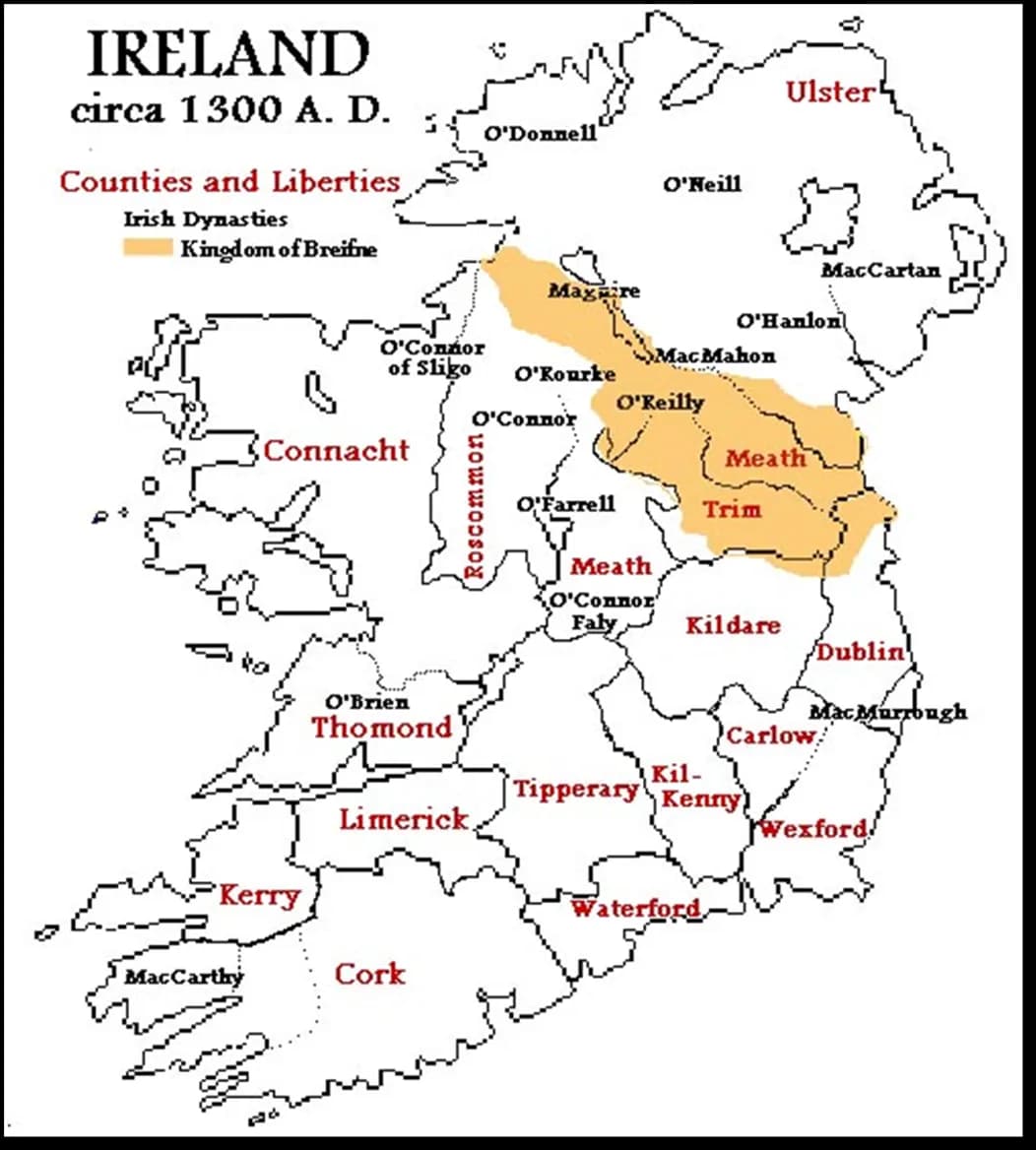
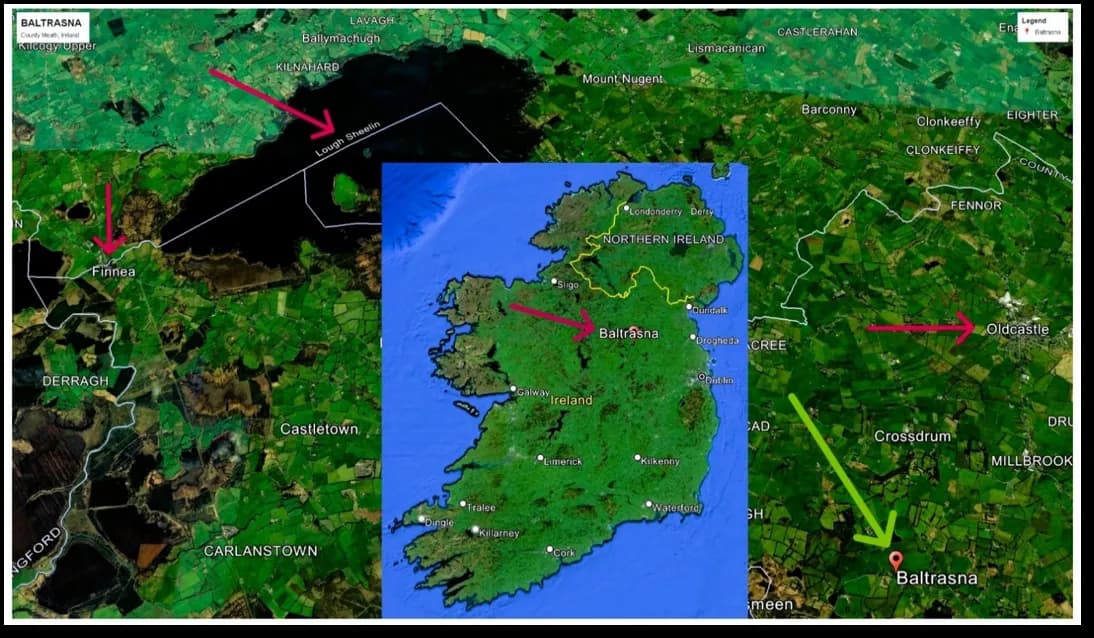
The O’Reilly clan soon enough successfully challenged the O’Rourkes for control over East Bréifne, breaking free from O’Rourke domination in 1256 and establishing their own independent kingdom there. East Bréifne is located in the north-central hill country, between Ulster in the north and the so-called “Pale” (the area around Dublin – the main Viking/Norman and later English settlement). Today East Bréifne is constituted principally of the modern-day county of Cavan, and parts of Meath (Baltrasna, our family seat, is situated near the town of Oldcastle, in West Meath). This geographical location in between Ulster and Dublin was to significantly influence the course of the history of East Bréifne and its rulers, the O’Reilly.
In May of 1169 the Anglo-Normans (after having conquered England in 1066) turned their gaze upon the Emerald Isle. By this time, the earlier Viking threat had been contained by the Irish.
The first Anglo-Norman landings in Ireland were not executed by the then English king, but by Anglo-Norman warlords serving as mercenaries aiding the deposed Irish Lord of Leinster, who had requested their help to re-gain his throne and who had thus invited them in.
Dublin became the main seat of the Anglo-Normans, the area around which became known as the Pale. This gave rise to the English expression: “beyond the pale”, which depicts all things and peoples geographically located “outside of the Pale” (as in: the rest of Ireland) as being savage and vulgar. That said, most of these Anglo-Norman settlers fully integrated and soon became “more Irish than the Irish themselves”. In other words, quite distinct from the English and Scottish settlers that would follow in later centuries…
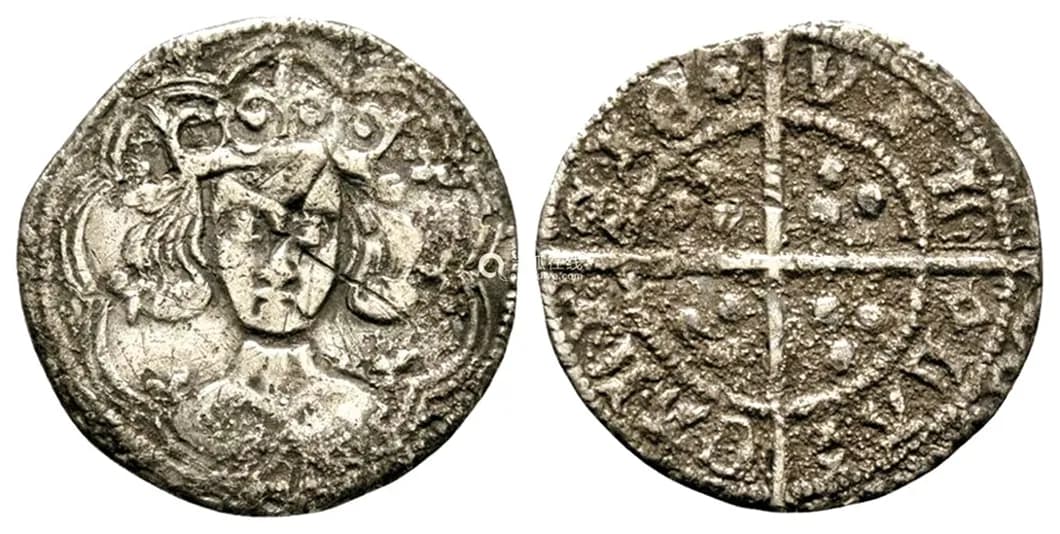
Due to the location of their realm, the citizens of “Bréifne O’Reilly” (as it was known) became adept at commerce and finance. Theirs was the only Irish principality (sometimes referred to as kingdom) to mint its own coins, known as “Reillys”. Their relative wealth gave rise to the Irish expression ”living the life of Reilly” (for someone who is monied).
The O’Reillys were also adept at diplomacy and making war, being particularly known for the quality of their horses, their cavalry, and for the construction of many castles (most of which, unfortunately, did not survive the wars against the English).
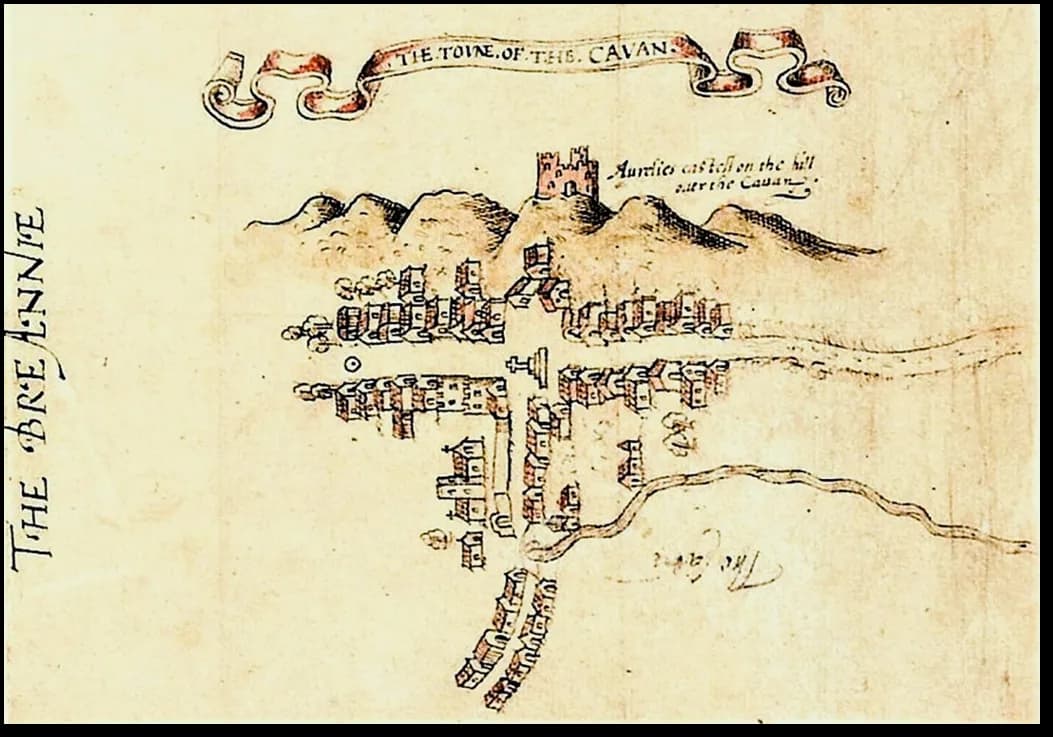
The capital of the princedom of Bréifne O’Reilly was the town of Cavan, where “The O’Reilly” (as the lord was called) resided in Tullymongan Castle, built on the hills above the town. Cavan is today the capital of the county of the same name.
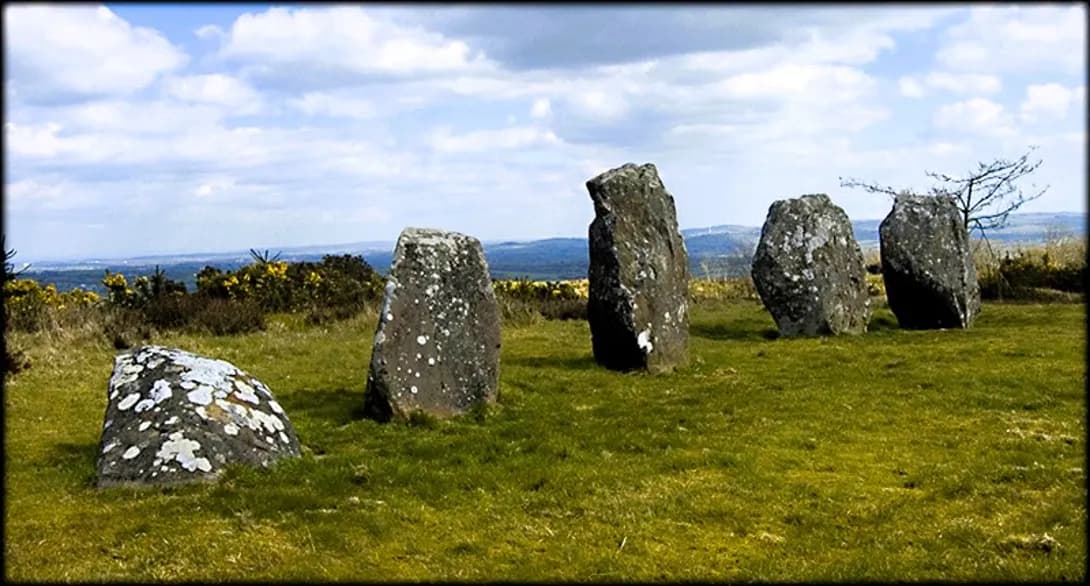
The first O'Reilly lords were inaugurated on the Hill of Shantemon between Cavan and Ballyhaise, on the summit of which may still be seen the remains of a Druidical temple consisting of several huge stones standing upright and known as “Finn McCool's fingers”. (In later times “The O’Reilly” were inaugurated on the Hill of Tullymongan, above the town of Cavan).
Cavan as Bréifne’s capital and its castle was an obvious target for the English occupiers. The era of Ireland’s Gaelic lords came to an end through the defeat of the Irish forces and the establishment of Island-wide English control at the end of the Nine Years’ War in 1603, leading to the so-called “flight of the Earls” in 1607. The last O’Reilly lord, Edmund, had died in 1601. Sporadic flare-ups occurred, until English parliamentary forces re-established control through the Eleven Years’ War, also known as the Irish Confederate War (1641 – 1653).
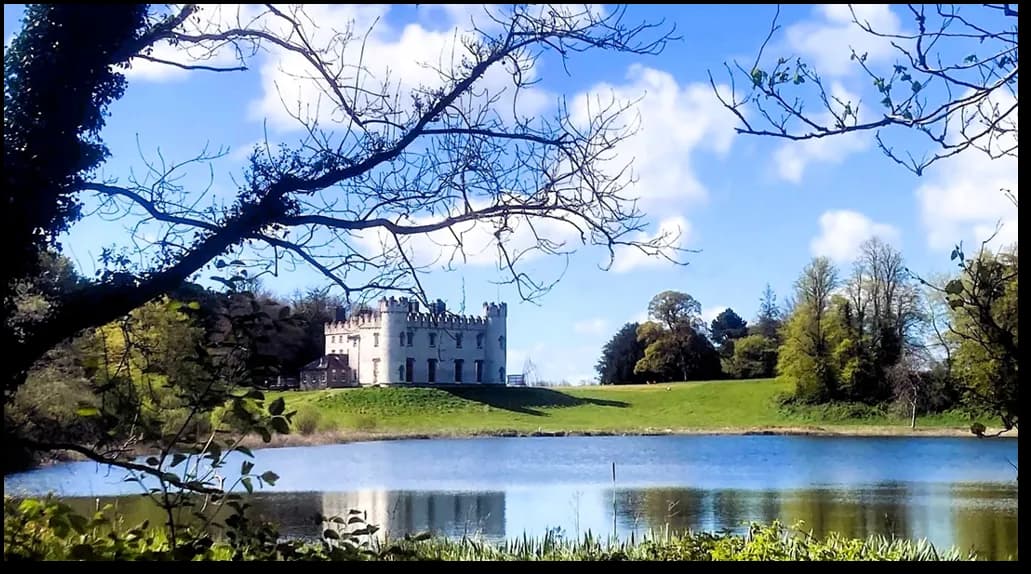
After this defeat, the O’Reilly family seat (now shorn of its traditional powers) was shifted from Cavan to Baltrasna House on the similarly named estate located just south of the town of Oldcastle in Meath. Baltrasna is some 27km south of Cavan Town.
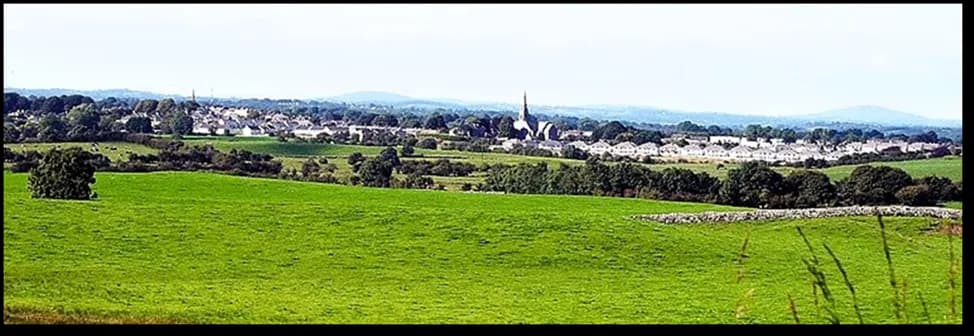
For context and thus better appreciation of our Irish family roots in the era just prior to the first O’Reilly having settled in South Africa, it is opportune now to trace for you our direct lineage back to Edmund, the last king of East Bréifne.
3. My Family Bloodline (going back to Edmund, the last king of Bréifne O’Reilly):
- EDMUND O’Reilly, last lord of East Breifne.
- MYLES “The Slasher” O’Reilly, son of Edmund (defender of Finea Bridge, 1644).
- Colonel JOHN O’Reilly son of Myles “the Slasher”, married to MARGARET O’REILLY of County Cavan. They had five children: Brian (a captain in the army), Eugene, Myles, Cornelius and THOMAS.
- THOMAS O’REILLY married ROSE MACDOWELL of County Roscommon. They had five children: JAMES, Nicolas, Dominic, Anthony Alexander (who became famous as a Spanish count, governor and general – who we will mention again), and a daughter.
- JAMES O’REILLY married CATHERINE TUITE and had two sons: THOMAS ALEXANDER and James.
- THOMAS ALEXANDER O’REILLY (an officer in the British Army), married MARGARET SIBTHORP, daughter of the Hon. Justice Sibthorp, whose wife was Marianne Cockrane, daughter of General Cockrane and niece of Thomas, 8th Earl of Dundonald. Their children were: James, Robert, Thomas and ANTHONY ALEXANDER O’REILLY.
- Colonel ANTHONY ALEXANDER O’REILLY, born 23 September 1776 at Baltrasna, Oldcastle, County Meath. He was an officer in the 4th Dragoons. He married ANNE GRAVES, born 1780, daughter of Edward Andrew Graves and Susanna Brennan, a Quaker, on 5 August 1799. After the marriage they moved to South Africa by way of India with the military (4th Dragoons and later 21st Light Dragoons), and lived there until his death on 27 May 1870 in East London, South Africa. Anne died in Grahamstown on 1 June 1860. Their children were Anne, Caroline Blanche, Thomas, James and JOHN ROBERT O’Reilly.
- Captain JOHN ROBERT O’REILLY married CATHERINE HENRIETTA GERTRUDE HENDRIKZ. Their children were Antoinette Augusta, Robert John Oertel and JAMES WILLIAM O’REILLY, born on 7 August 1855.
- JAMES WILLIAM O’REILLY married MARIA MAGDALENA MAARTENS, born 10 July 1867. Their children included (as youngest) JAMES JOHN THOMAS O’REILLY - my grandfather “Tom” O’Reilly, born 3rd of March 1897.
- JAMES JOHN THOMAS O’REILLY married ANNA CHRISTINA UYS. Their children included MARIA MAGRIETA O’REILLY, born 1 June 1932.
- MARIA MAGRIETA O’REILLY married Major-General FRANCOIS MICHIEL ALEXANDER STEENKAMP; their first-born was me, WILLEM PETRUS (I am thus an eleventh-generation direct descendant of Edmund, the last lord of Bréifne O’Reilly).
The O’Reilly princedom benefited from its location bordering the region around Dublin known as the Pale, particularly through facilitating trade between Dublin/the Pale and the rest of Ireland. It was thus necessary to maintain workable relationships with the Anglo-Normans and the English, in the same manner that the O’Reillys had earlier established a modus vivendi with the Dublin Vikings (which latter alliance was essentially what had allowed the O’Reillys to overcome the O’Rourkes and gain control of East Breífne).
At one stage, the O’Reillys had even agreed to Breífne O’Reilly being made an English shire, with “The O’Reilly” its lord under English law – but they soon enough realised that the English were not acting in good faith. Which resulted in the O’Reilly clan becoming implacable foes of the English in the wars that followed…
4. The Tudor English (re)Conquest of Ireland
The English conquest (or reconquest) of Ireland took place during the 16th century under the Tudor king Henry Vlll. Anglo-Norman warlords, invited in by the king of Leinster as mercenaries to back him in his fight with his peers, had conquered swathes of Ireland in the late 12th century, bringing it under English rule. By the 14th century, however, the area of English rule had shrunk markedly, from which time most of Ireland was again effectively controlled by native Gaelic chiefdoms.
In the 1530s, the English Crown set about forcibly restoring its authority. Henry VIII of England was made "King of Ireland" by London’s unilateral Crown of Ireland Act of 1542. The conquest involved assimilating the Gaelic nobility by way of "surrender and regrant" of their lands (re-issued to them in the guise of English shires), or the outright confiscation and colonization ('plantation') of lands with settlers from Britain, as well as by the imposition of English law and language, the banning Catholicism, dissolving the monasteries and making Anglican Protestantism the state religion.
The Tudor policies of conquest and forced Anglicization in Ireland sparked rebellions and wars, most notably the Nine Years' War (1594–1603), which the Irish lost. By 1603 the entire country was once again under English rule. Ireland’s “Flight of the Earls” in 1607 (they fled to Europe) largely completed the destruction of the Gaelic aristocracy and left the way open for establishing the English/Scottish Plantation of Ulster, which settled a large British Protestant population in the north of Ireland.
Their defeat in the Nine Years’ War did not dampen Irish desire for independence. The opportunity offered itself to take up arms again when the English crown was weakened by the power struggle between the Royalists and Parliamentarians in England from 1639 to 1653 (which led to the overthrow and beheading of King Charles and the establishment of the republican-styled Protectorate under Oliver Cromwell). In Ireland this had morphed from the War of the Three Kingdoms (Ireland, England and Scotland) which started in 1639, into the setting-up of the Irish Catholic Confederacy among the Gaelic chiefs, and the Irish Confederate Wars.
Edmund O’Reilly’s son Myles (“The Slasher”) O’Reilly played a memorable role in the Confederate Wars, to the point that latterly Myles has been styled “the Braveheart of Ireland”.
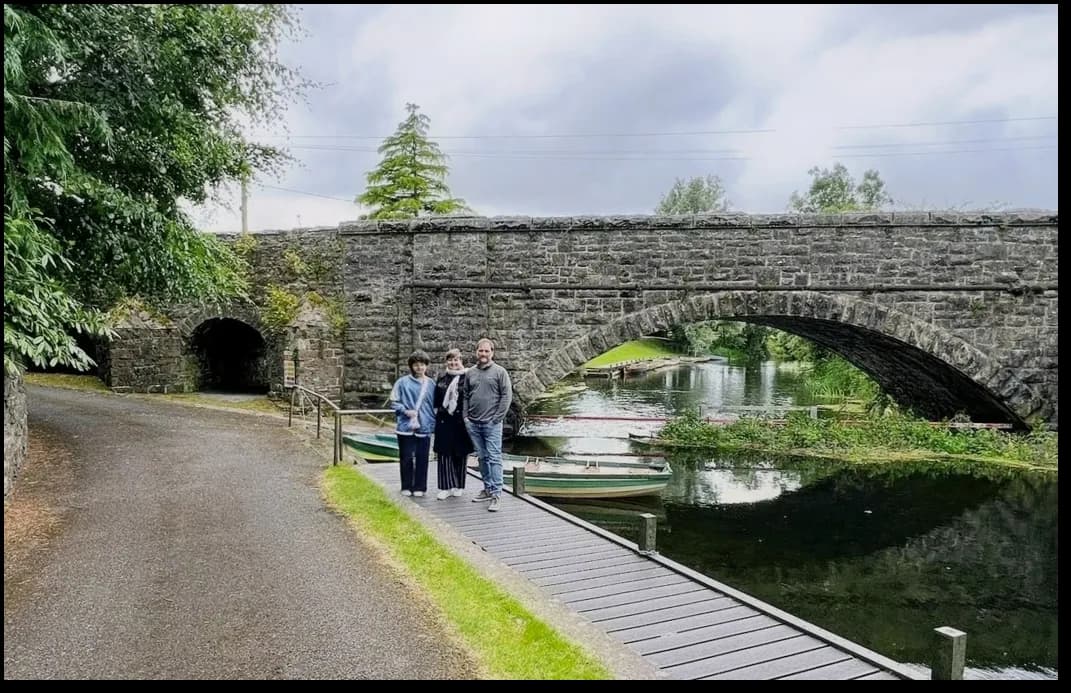
During this war, in the summer of 1644, the Irish Confederate commander Owen Roe O’Neill was camped with his Irish forces in County Meath. An English and Scottish army under General Monroe, some 17,000 strong in total, was approaching from Cavan intent on marching south into Leinster via the bridge over the Inny River at Finea (this was the only practicable route of approach for them, because to the west of the narrow land spit stretched the waters of Lough Kilane, and to the east, the even larger Lough Shileen, with the two lakes linked by the River Inny – the bridge across the Inny at Finea was thus the only means through this bottleneck).
O’Neill’s Irish army had not yet reached a state of preparedness which would equip it to face such a mighty fighting force as that commanded by Monroe, and so it was decided that a small but elite force would attempt to halt the English/Scottish vanguard’s advance, doing so at the bridge. This elite force consisted mostly of O’Reilly dragoons under Myles “The Slasher”, son of Edmund.
The Irish defenders of the bridge were in position for but one day when Monroe arrived and attacked with ferocity with a force of more than a thousand of his men. With equal ferocity and (given their grossly outnumbered forces), with far greater courage the Irish defended all day long. By evening almost all the Irish force had been killed or seriously wounded. However, Monroe’s losses were also of such horrendous proportions that, fearing an encounter with the redoubtable O’Neill, he retreated through East Cavan and Louth to the Protestant stronghold of Ulster.
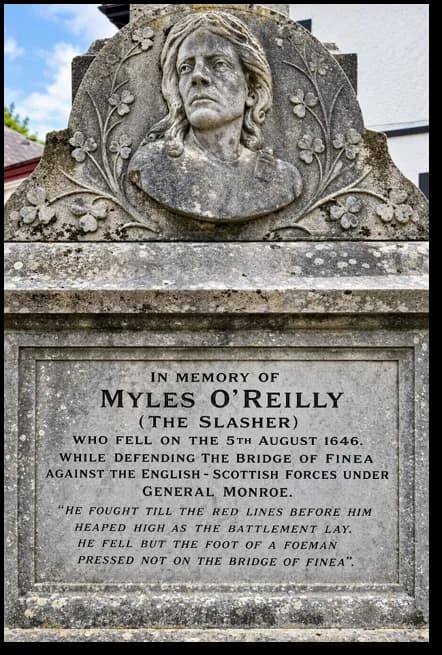
On August 3rd, 1913, an imposing memorial to the memory of Myles O'Reilly (The Slasher) was unveiled in the village of Finea. It erroneously indicates the date of the battle as 1646 (not 1644) and describes the battle as follows: “The Slasher had with him 100 horse while the enemy was 1,000 strong. They fought them the whole day long until his followers were nearly all slain. Finally, he was encountered by a gigantic Scotsman who thrust the point of his sword through the Slasher’s cheek. The latter closed his jaw on the blade and held it as if in an iron vice while he slew his antagonist cutting him through his steel helmet down to his chin with one blow, both falling together. At that moment reinforcements arrived from Granard and the Bridge was saved”.
In his famous poem of one hundred and thirty-one lines titled “Myles the Slasher”, William Collins wrote:
“But alas for the cause of Green Erin,
The heart of that hero is cold.
He died waving free in the blast,
With his hand on the hilt of a sword.
There is, however, persuasive evidence that Myles actually had not been killed in the battle, and that the story of his (feigned) death was spread as a subterfuge – for example: the “corpse” presented, was headless. Myles, severely wounded, was allegedly smuggled away and is now believed to have died in a monastery in France in 1674 – his pretended death at Finea having saved him from British vengeance and also served to save his sons and the remaining family lands. It will be noted that, on the memorial, it is stated that he “fell”, which does not necessarily mean he died.
The Confederate Wars finally ended when Colonel Philip O'Reilly (Irish: Pilib MacAodh Ó Raghallaigh) formally surrendered to Oliver Cromwell at Cloughoughter Castle on 27 April 1653, being the last Irish garrison to do so. Although the defeat of the Catholic Confederacy spelled the definitive end of Gaelic rule in Ireland, another war would follow 30 years later, again pitting the Irish Catholics Jacobites (supporting the Catholic English king James ll) against the Dutch king William, who had been offered the English throne by Protestant parliamentarians in the “Glorious Revolution”. These were the Williamite Wars of 1689 to 1691, with once again the Catholic Irish having supported the losing side.
As ever, our family had had a leading role in this war. Colonel John O’Reilly, son of Myles “the Slasher”, had raised at his own expense for the service of King James II a regiment called "Reilly's Dragoons" (a dragoon was a mounted infantryman – unlike cavalry who fought from the back of a horse, a dragoon would ride to battle, dismount, and fight on foot). Colonel John O’Reilly fought at Derry, Belturbet, the Boyne, Aughrim, and Limerick, but saved his property from confiscation by being one of three Irish military leaders specifically singled out by name in the Articles of the Peace Treaty of Limerick as not to be penalised (included to induce them to finally surrender).
Here are some quotes from original Irish sources about the military fame achieved abroad by some noteworthy members of our family, who went abroad because of the English take-over of Ireland:
The O'Reillys were for centuries the ruling family of the kingdom of East Breffny, and at their height controlled most of County Cavan and large parts of County Meath. The family was widely involved in trade in medieval Ireland and at one time 'reilly' was a term for Irish money, subsequently banned by the English. It has also been suggested that they lived well, as the phrase 'the life of Reilly' indicates. They were also notable as ecclesiastics, the family, since the sixteenth century, providing five Primates of All-Ireland, five bishops of Kilmore, two of Clogher and one of Derry.
The chief of this numerous sept was styled Breifne O’Reilly. When the Breifne O’Reillys were driven from their lands, as aristocrats they could offer credentials as exalted as any demanded by the courts of Europe for senior service in their armies. Few other families can boast such variety in the spelling of their name. There are at least seventeen different dialectical variations, including Oreigle, Oragill, Oreille, Orely. The countries in which they settled transformed their name to accord with local pronunciations, for example, Orely in Spain, Oreille in France.
Is any other Irish name found more frequently in the army lists of Europe? In the 1700s, Colonel Edmond O’Reilly had no less than 33 O’Reilly officers under his command, while Colonel Mahon had sixteen in his. In the complicated religious and territorial wars of that time, there is no doubt that O’Reillys fought on every side: French, Austrian, Prussian, Spanish, Italian and Russian. They were professional soldiers who preferred to put their swords at the disposal of the monarchs of Europe than to fight for the colonisers who had overrun their country.
The exploits of the O’Reillys abroad span many continents. Count Alexander (Alejandro) O’Reilly (1722-94) was born in Baltrasna, County Meath, and fought for Spain with the Irish Brigade. He was a Field Marshal and Inspector General of the Spanish Army, as well as Governor of Spanish Louisiana and later of Madrid, Captain General of Andalusia and Governor of Cadiz. "Was it for this that General Count O’Reilly, who took Algiers, declared I used him vilely?" is asked in Byron's poem Don Juan. "General Count O Reilly did not take Algiers", writes Lord Byron, "Algiers very nearly took him".
In 1769, Count Alexander O’Reilly sailed for New Orleans with a strong military force (to put down a rebellion there). His affability allayed all suspicion and, after investigating the popular leaders, he invited them to a reception where he had them arrested. Five were put to death and others were imprisoned in Havana, which put an end to the revolution.
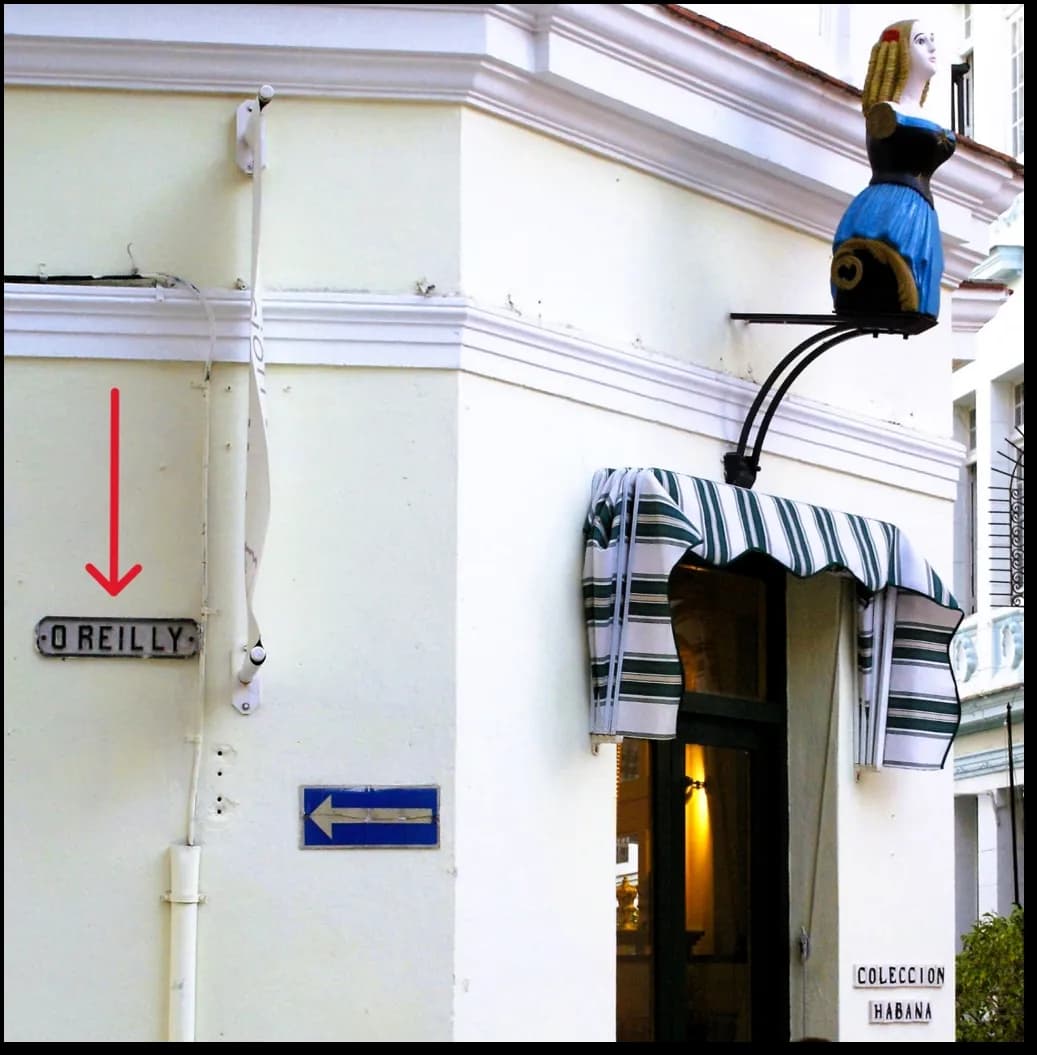
Count O’Reilly’s rule was regarded as liberal and enlightened. He had such a high regard for his Irish heritage that, not long before he died, he sent home 1,000 guineas to have an Irish genealogist set out his pedigree for him. Descendants of the O’Reillys of Baltrasna have been in Cuba for two centuries where, as Counts of Castillo and Marquis of San Felipe y Santiago, their lineage is to be found in the archives of Havana. One of Havana's main streets is the Calle O’Reilly. There are also streets in Madrid, Barcelona and Cadiz bearing their name.
Count Andrew O’Reilly of County Westmeath was a Field Marshal in Empress Maria Theresa's Austrian army. He supposedly fought a duel and killed his opponent to win the hand of his wife, a Bohemian heiress. Although the French won the battles of Marengo and Austerlitz, O’Reilly was accorded battle honours. In 1809, when he was Governor of Vienna, he suffered the humiliation of having to surrender the city to Napoleon, from whom he received an honourable mention as worthy opponent. Andrew O’Reilly completed his Austrian service as Chamberlain to the Emperor.
Alexander O’Reilly (1845-1912), descendant and namesake of the Austrian Field Marshal from Baltrasna in County Meath whose descendants are now Spanish, was born in Philadelphia. From 1902 to 1909 he was surgeon general to the US army. He was personal physician to President Cleveland. After the Spanish American War, he helped reorganize the U.S. Army medical system”.
5. Baltrasna House, from where the South African O’Reillys originally hail:
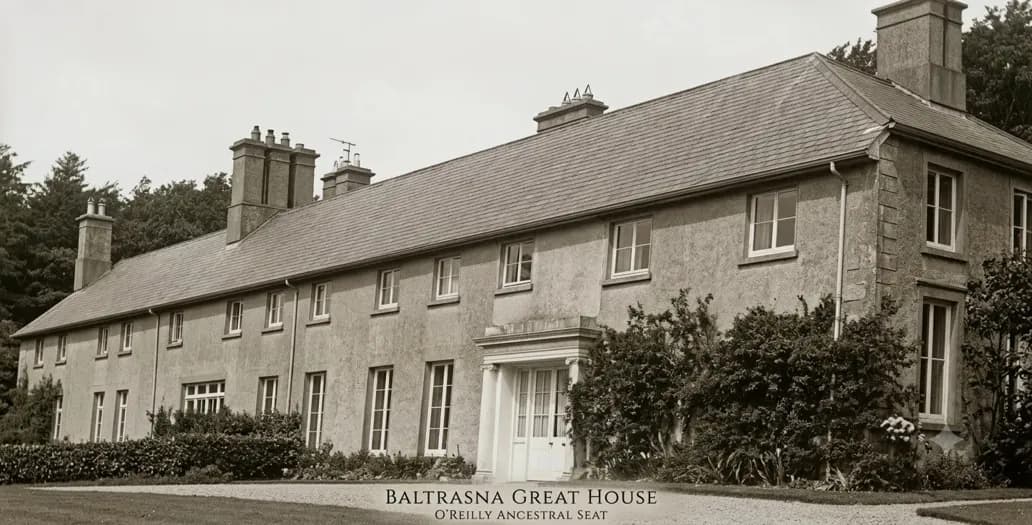
After his death the original lands of “The O’Reilly”, the lord Edmund, were confiscated (“attained”) by the English crown, through an act of the English parliament – this was a common lot for the possessions of Irish aristocrats. Their ancestral lands at Cavan having been confiscated our O’Reilly forebears eventually settled at the Baltrasna Great House in the parish of Moylough, just south of Oldcastle, County Meath, as their new home. It was there that, some generation later, our first ancestor to settle in South Africa was born in 1781 – Colonel Anthony Alexander O’Reilly, son of Thomas Alexander.
Here are some quotes from Irish writers about the ties of Baltrasna House with the O’Reillys in the years after the fall of the kingdom of Bréifne O’Reilly:
The father of Myles “the Slasher”, Edmund O’Reilly from Kilnacrott, was the last member of the O’Reilly clan to hold the title of “O’Raghallaigh” before Breffni was shired in 1584 and became County Cavan. Edmund was killed in Cavan town in 1601. John O’Reilly (son of “The Slasher”) was elected a knight for the county of Cavan in May 1689. He raised a regiment of dragoons for King James II and served in the Jacobite army in the war against King William of Orange, fighting at the siege of Derry and the Battles of Aughrim and the Boyne. John O’Reilly was one of three individuals mentioned in the military articles connected with the Treaty of Limerick that was signed on October 3, 1691, and was allowed to keep his lands.
In 1718, Thomas O’Reilly succeeded his father as master of the estate. His son James later became a Protestant in order to retain control of his property. (Note: This James was the grandfather of our forebear, Colonel Anthony Alexander, who settled in South Africa).
Frederick O’Connor’s song titled “The Old House” was sung to the air of the popular Welsh song, “The Ash Grove”. It was part of the then famous singer John McCormack’s repertoire and he even sung it at his farewell concert at the Royal Albert Hall.
The Old House
Lonely I wander, through scenes of my childhood,
They bring back to memory those happy days of yore,
Gone are the old folk, the house stands deserted,
No light in the window, no welcome at the door.
Here’s where the children played games on the heather,
Here’s where they sailed wee boats on the burn,
Where are they now? Some are dead, some have wandered,
No more to their home shall those children return.
Lone stands the house now, and lonely the mooreland,
The children have scattered, the old folk are gone.
Why stand I here, like a ghost and a shadow.
‘Tis time I was moving, ‘tis time I passed on…
In modern times the late Sir Tony O’Reilly of Irish and British Lions rugby fame (and for some time the wealthiest man in Ireland), had named his famous horse-breeding operation at his Castlemartin estate in County Kildare the Baltrasna Stud, after the family’s ancestral seat and its association with the O’Reilly military tradition of fighting as mounted dragoons.
6. The first O’Reilly arrives in South Africa:
Our first O’Reilly forebear to set foot and eventually settle in South Africa was Anthony Alexander O’Reilly. He was born at Baltrasna, Ireland, on 23 September 1776, the fourth son of Thomas O’Reilly JP (justice of the peace) and his wife Margaret, daughter of the Hon. Justice Robert Sithorpe.
On 5 August 1799 Anthony Alexander O’Reilly married Anne, the daughter of Edward Graves of Rock View. It is probable that Anthony met Anne through Anthony’s cousin, Dowell O’Reilly (of Heath House – who was then the nominal head of the O’Reilly clan of East Bréifne).
Anthony Alexander O’Reilly joined the British Army at a young age and was commissioned as Lieutenant into the 4th Royal Irish Regiment of Dragoon Guards in July 1803, when still only 22 years of age. He served in the Peninsula War, for which he received the campaign medal. At the beginning of 1812 he transferred to the 21st Light Dragoons and was promoted to Captain on the 23rd of January of that year. He sailed out to join his new regiment, which was then stationed at the Cape, where he arrived early in 1813.
At mid-1817 Captain O’Reilly was transferred to India, but returned to the Cape in 1819, arriving in Cape Town on board the “Recovery” on 9 February 1819, followed by his wife and two children who arrived aboard the “Caesars” on 30 November 1819, from Calcutta. In that year he was designated the “brigade major” (not a rank – the staff position responsible for the smooth administration of the Regiment) and visited the Eastern Cape in the early part of 1820 to assist with the arrival there of the “1820 Settlers” (some 5,000 British civilians who came to settle on the Cape’s then eastern frontier).
Captain Anthony Alexander O’Reilly was transferred to the Eastern Cape in 1821, where he held the position of Brigade Major till 1848. Shortly after his arrival he had been granted a plot of land in Grahamstown. On 22 July 1830 he was promoted to the rank of Major and served as Commandant of the Grahamstown Garrison. He was promoted to the rank of Lieutenant Colonel (a very senior rank for an Irishman to achieve in the then British Army) on 9 November 1846 and only retired from the Army in 1848, during the 67th year of his life, whereafter he sold his commission (the buying and selling of which was the norm in the British Army those days) and invested the proceeds plus his savings into developing a large frontier ranch (to which we will come back soon).
Anthony Alexander O’Reilly had fathered seven offspring, of whom three concern our story: his daughter Katherina Louise Georgiana, born 1816 at the Cape, who in 1838 married the future Lieutenant-Governor for the Eastern Cape, Col John Maclean. Col Anthony Alexander O’Reilly outlived his wife by a decade, reaching 93-years of age before he died on 27 May 1870. His latter years were spent with his daughter and son-in-law, with the two colonels becoming very attached to each other. They were buried side-by-side in East London (Maclean having died in 1874).
Now back to the two sons of Lt Col Anthony Alexander who are of relevance to my particular bloodline and their role in South African military history: James O’Neil O’Reilly and – most directly relevant to me – his brother, John Robert O’Reilly (born 28 June 1812 – my direct forebear).
James and John Robert had married two Afrikaans sisters of Dutch origin, respectively Ijda Wilhelmina and Catherina Gertruida Wilhelmina Hendrickz. As I will shortly explain, James and John Robert would both eventually leave the Eastern Cape, trekking into the hinterland – James towards the north-west and John Robert towards the north-east.
Let’s deal quickly with James first, because two of his descendants would achieve some renown in Southern Africa: his son John Robert (aka “Diamond Jack”) O’Reilly, who was instrumental in the certification of the first diamond discovered at Hopetown, near what would become the city of Kimberley, and James’s grandson Lt. William Godwin O’Reilly DTD (Dekorasie vir Troue Diens, equivalent to a DSO), of the Oranje Vrijstaatsche Artillerie Corps (Orange Free State Republic artillery corps, of Anglo-Boer War fame).
The discovery of diamonds in 1867 (as forerunner to the later discovery of gold), had had a huge impact on Southern Africa in the latter half of the 1800s. “Diamond Jack” O’Reilly was the person who was responsible for a shiny pebble that a small boy had found and kept as toy, being confirmed as actually being a diamond. Here is how it came about:
Prior to 1867, Cape Land Surveyor Von Ludwig was surveying the Crownlands between Hopetown and the junction of the Orange and Vaal Rivers. At that time a certain Schalk van Niekerk was living on the farm "De Kalk” in the vicinity of the locality where Von Ludwig was surveying. Van Niekerk had a penchant for collecting pretty-looking stones. Von Ludwig had stayed with Van Niekerk while making his diagrams. He had explained to Van Niekerk what typically characterised a rough diamond (a greasy, dull shine and the ability to cut glass) and when he left that area, he gifted Van Niekerk a book on precious stones and told him to keep his eyes open, as the surrounding countryside seemed to be of a diamondiferous character.
One afternoon Van Niekerk was explaining to one of his “bywoners” (share croppers), a certain Jacobs, the characteristics of a diamond, when Mrs Jacobs replied that her little son, Erasmus, had found just such a strange alluvial stone which he kept in a box amongst some other pebbles. Van Niekerk asked to see it, as it corresponded to the description of a diamond. When he offered to buy it Mrs. Jacobs laughed at the idea of selling a common stone and gave it to him. He told her that, if it should prove to be a diamond, he would share its proceeds with her.
A few days afterwards Jack O'Reilly of the farm Rooikop, who was also an itinerant trader, passed Van Niekerk's farm. Van Niekerk showed him the stone and Jack also believed it to possibly be valuable. The two men decided to partner, and Jack took the stone to go find out whether they were correct in their assumption that it was a diamond. Van Niekerk had promised Jack one-third of the proceeds if it indeed happened to be a diamond.
Jack O'Reilly first showed the stone to some Jewish traders at Hopefield, but they laughed it off as being topaz. He then rode to Colesberg to show it to the acting Civil Commissioner there, Lorenzo Boyes. Jack demonstrated to Boyes that the stone could cut glass (carving his initials into a windowpane), thus convincing him of its potential. With the O’Reilly family’s high-level standing and renown in Grahamstown, Jack then forwarded the pebble to Dr WG Atherstone (the Cape Colony’s foremost mineralogist) in Grahamstown in an unmarked envelope. Atherstone pronounced it a real diamond, weighing 21.25 carat (4.250 g).
Mrs. Jacobs was astounded when she heard the news and received her share – Van Niekerk and Jack O’Reilly were men of their word.
The uncut diamond was sent to the Universal Exposition hosted in Paris in 1867, whence it directed much attention to the Cape. It was then bought by Cape Governor Sir Philip Wodehouse for £500, who had the yellowish-hued stone cut and polished. For a century afterwards, it was in private British hands. In 1967 the stone was bought by the De Beers Corporation, which brought it back to South Africa and donated it to the South African nation – it’s still on display at the Kimberley Mine Museum, as a headline historical exhibit.
Great-uncle “Jack” was not done, however, after his role in the certification of the Eureka Diamond. Not by a long shot. He used his part of the proceeds to expand his operations (farming, hunting, trading, and acting as military advisor to Bechuana chiefs in their internecine conflicts).
Chief Mankuroane, the head of the Phuduhutswana faction of the Batlhaping (a prominent southern Batswana tribe) based at Taung, found himself locked in a bitter territorial war against rival chiefs. Mankuroane recruited "Diamond Jack" O’Reilly because of his frontier tracking and fighting skills.
 AI image
Following the conclusion of the conflict and the subsequent British military intervention under Sir Charles Warren (which established British Bechuanaland in 1885), Chief Mankuroane granted “Diamond Jack” a large tract of agricultural land near Taung, where he settled permanently, farming the land, raising his large family, and serving as a prominent local figure until his death on November 27, 1904. During his hunting expeditions north into the Kalahari and toward the Ngwato territories, O'Reilly frequently traded with local Batswana and San prospectors for unusual minerals and persistently mapped alluvial gravels. He was among the earliest frontier figures to publicly argue against contemporary European "experts" (like the geologist J.R. Gregory) who claimed that the initial South African diamond finds were merely a "geological accident" and that no diamondiferous volcanic ground existed further north. Jack was proven correct, when in 1967 geologists from De Beers discovered the huge Botswana kimberlite pipes at Morapa.
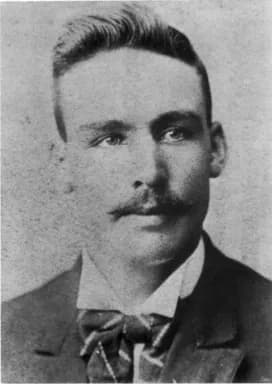
Now the interesting story of James O’Neill O’Reilly’s grandson, William Godwin (“Bill”) O’Reilly, the renowned Orange Free State artilleryman born in 1877 in the OFS (as recorded in the Military History Journal of December 1977, written by Ian S. Uys:
“Bill O'Reilly was raised as a staunch Vrystater. He was thoroughly bilingual (his English still characterised by the distinct Irish brogue) and very patriotic. As a young man he joined the fledgling 'Vrystaat Artillerie' and was commissioned as a lieutenant. He was a tall man for the time, 6 foot 2 inches (1,87 m), with large strong hands and blue eyes. The 22-year-old officer had no doubt where his loyalties lay when the South African War commenced in October, 1899.
“Bill's baptism of fire was at Stormberg, a resounding victory for the Boers. General Gatacre had planned a surprise dawn attack on the pass near Stormberg junction, which was guarded by General Olivier and 2,300 burghers and Cape Rebels. Gatacre's force of 3,000 men tramped through the night to launch an attack on the 'Kissieberg'.
“The alarm was raised by Boer pickets as the Irish Rifles began scaling the hill. Sheer cliffs barred their progress and in the face of accurate Boer fire they fought desperately to hold their ground. Their plight was compounded when their own gunners, who were firing into a rising sun, poured shells amongst them. As the demoralised infantry fell back the OC of the Northumberland Fusiliers ordered a general retreat.
“The retreat became a rout when the troops were attacked by a Boer Commando. Fortunately, a well-directed rearguard action saved the day. Over 600 prisoners were taken by the Boers. Bill O'Reilly felt as elated as his men, despite the fact that the Irish Rifles were among the defeated enemy. He had learnt an important lesson as an artillery officer when he saw the English swept from their positions by their own gunners.
“The Vrystaat Artillerie fought in many famous battles including Belmont, Modder River and Graspan, which were, however, largely nullified after the capture of their OC, Major R. Albrecht, at Paardeberg on 27th February, 1900.
“Lt O'Reilly served on, as the war degenerated into guerilla activities, and took part in engagements and skirmishes at Aliwal North, Thaba N'chu, Sand River, Bethelehem, Vredefort and Venterskroon.
At 24 years of age Bill O'Reilly was a hardened campaigner. After fourteen months of continuous fighting, he expected little else. His home was gone, as were those of his companions, and there remained nothing to do but continue the struggle against the 'invaders'. If only the Cape Dutch (Afrikaans-speakers of the Cape Colony) could be persuaded to join them there might yet be a chance of defeating the British.
“At the end of 1900, Bill, in the company of Lt Muller of the artillery, entered the Cape to harass the British, and to drum up support for their cause…
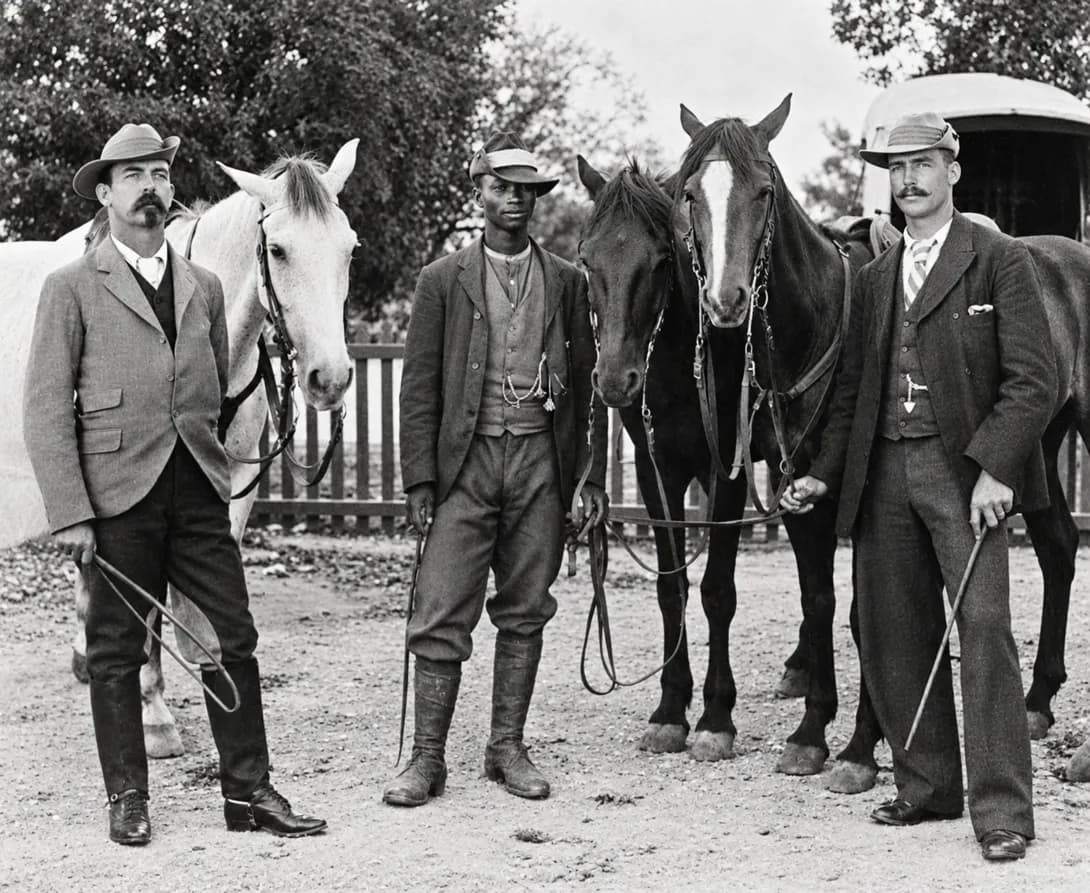
“On 11th April, 1901, Bill was at a farmhouse at 'Salt Pans' when a large British column approached. He rapidly issued orders and then retired to a koppie (hill) from where they opened fire on the column. The British troops dismounted, deployed and advanced on the barren hillock, taking advantage of what little cover they could find.
“The constant British sniping had to be answered, and it was simply a matter of time before O'Reilly and his section ran out of ammunition.
“They then smashed their rifles on the rocks as the jubilant enemy advanced on them.
“A British Officer ordered them to surrender and in his broad Irish brogue Bill replied, 'I'm damned if I'll put up my hands to a bloody Englishman!' Bill was immediately labelled a deserter, which he strongly denied. He was taken to a British camp where he and a Dr Brown, who was also in captivity, were formally accused of being traitors. On three occasions they were marched out at dawn to be shot. On the third morning Dr Brown was in fact shot. (Author's note: This is as told by the family and could not be verified).
“The British POW roll records, between 'Opperman' and 'Otto', that No. 18999 William Godwin O'Reilly, aged 24, of Thorn Grove, Bloemfontein, was received at a Cape Town POW camp on 29th April, 1901.
“Bill was shipped with other POWs on the 'City of Cambridge' to Madras in India and thence to the Trichinopoly POW camp. He was a handyman and one of his jobs was mending the tailors' sewing machines. He and friends attempted to escape by tunnelling from under one of these machines. They distributed the excavated sand over the parade ground from small tailors' bags which they concealed in their trousers. Their efforts came to nought though as the tunnel was discovered by the British. Bill later recalled that some Boers drank vinegar to 'thin their blood' and thus to report sick.
“Camp life dragged on interminably. Bill was a POW in India for over a year before the Armistice was signed. He was an exceptional handyman and was responsible for most of the electrification of the camp. In order to plan this task, he drew a remarkably fine Indian-ink map of the camp which he retained after his release.
“On 22nd July, 1902, Bill signed the Oath of Allegiance at the Boer parolers camp (Kaity Nilgiris, India) and thereafter returned to South Africa. He married Christina Maria Meintjies and was to have seven children. He was fortunate to find work on the Meyer and Charlton Mine where he remained for about three years, and then set himself up as a borehole driller and windmill erector.
“In 1922 Bill was living at Bezuidenhout Valley when his Dekoratie voor Trouwe Dienst and Anglo Boere Oorlog medals were awarded (reference S.A. Army 3004. Medals issued 14th August, 1922). The award of the 'Boer DSO' to O'Reilly was recommended by his old OC, Major R. Albrecht, who was then living in Bloemfontein. Of the 662 DTDs issued to Boer officers, only a handful were awarded to English-speaking volunteers; and none was more worthy than Bill O'Reilly.”
7. Back to my direct bloodline, to my great-great grandfather Captain John Robert O’Reilly.
Born on 28 June 1812, John Robert O'Reilly was baptised at Maidstone on 2 August 1813 (remember, his father had been transitioning between regiments and the UK/India/Cape at that time, from there the apparent delay between birth and baptismal). John Robert appears in 19th-century genealogical works (Burke’s Landed Gentry) as one of the sons of Colonel Anthony Alexander O’Reilly.
John Robert followed his father into British military service. Commissioned into HM Cape Mounted Riflemen (CMR), the light cavalry unit tasked with patrolling the volatile Eastern Cape frontier, he would rise to the rank of Captain. It should be noted that John Robert was a commissioned officer in the first, imperial Cape Mounted Riflemen, not the later colonial regiment formed from the Frontier Armed and Mounted Police. That distinction matters because the two successive forces used closely related names. The imperial HM CMR was a regular mounted corps in full-time British military service under the War Office. Its men combined cavalry mobility with infantry-style fighting and performed patrol, escort, reconnaissance, frontier-policing and field duties. JR O'Reilly's recorded title, "Captain in HM CMR", confirms him as a commissioned officer in the regular British Army, rather than having been a local honorary captain.
On 19 February 1838, while still an ensign in the CMR, John Robert was at the Fraser’s Camp military post when shots were fired through the windows of the officers’ mess, wounding two officers. He assembled some men from the 73rd Regiment and captured five of the mutineers.
In August 1839, in Somerset-West, John Robert O’Reilly married Catherina Gertruida Wilhelmina Hendrickz (different spellings survive, due to the Dutch/Afrikaans/English variations, but that used above seems the most plausible, given her Dutch origins). She was the sister of the lady that John Robert’s brother James O’Neil O’Reilly had married.
In 1843 John Robert O’Reilly was recorded as in command of the military fort at Trompetter’s Drift on the Fish River.
On 16 March 1851, in Grahamstown, he and his wife celebrated the baptism of their first-born, a daughter they named Antoinette Augusta. Four more children were to be born to them: Cathrine Gertrude Hendrehetta, Anthony, John Robert and James William (my forebear) who was born on 7 August 1855.
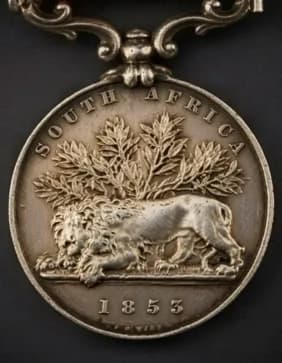
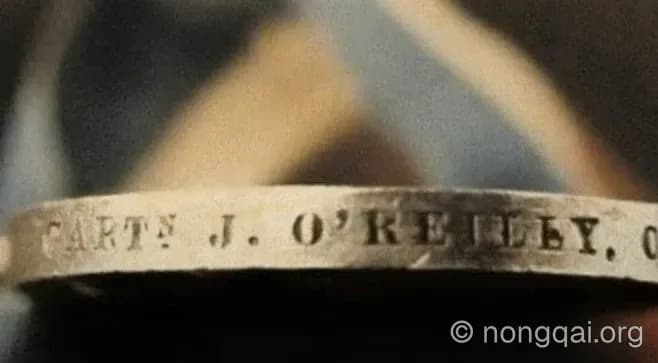
Captain John Robert O’Reilly received the South Africa Medal, dated 1853, which was instituted in 1854 for surviving officers and men who had served in any one of the qualifying Cape colonial operations, being the campaigns of 1834-36, 1846-47 and 1850-53 and the 1852 Basotho expedition. As per tradition, his rank, name and unit were inscribed on the rim of the medal: Capt. J. O’Reilly, CMR.
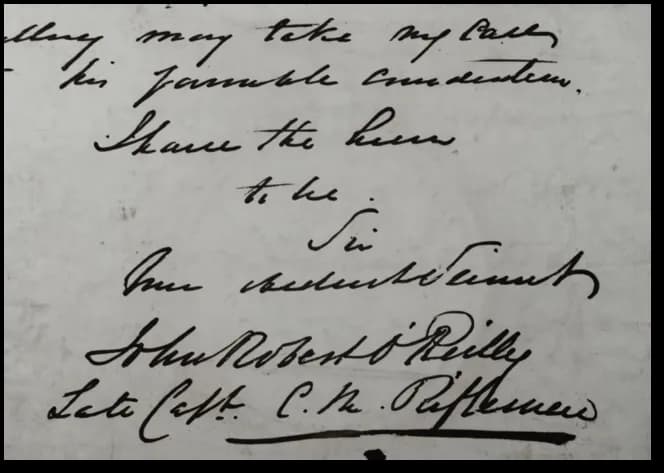
In recognition of their frontier service, the Cape colonial authorities often granted border farms to officers, with the intent of thereby establishing a line of defensive agricultural settlements along the Eastern Cape frontier. However, these grants were regularly beset by contestations and revocations (the latter often occurring just when such an erstwhile wilderness farm had been tamed). This happened to Captain John Robert as well, with his farm repossessed in lieu of another tract of undeveloped land being offered him further north. As Google’s Gemini AI summed it up: “Unwilling to accept this arbitrary decision, Captain O'Reilly wrote a remarkably eloquent yet blisteringly forthright letter to the governor”. In this he detailed precisely what he thought of this modus operandi.
To fully understand the circumstances that led to my forebear’s decision to pack his wagons, load up his family and trek into the wild north-eastern interior on the borders of the Zulu kingdom, we now need to revert to the travails suffered by Capt John Robert’s elderly father, Lt Col Anthony Alexander O’Reilly, who after having retired from his position as Grahamstown Garrison Commander had ploughed all his means into a large farming venture in the Eastern Cape, on the outskirts of the Albany/Grahamstown district.
In December 1850, the frontier erupted in the longest and most devastating of all the Xhosa conflicts – the Eighth Frontier War (Mlanjeni's War). Due to his high profile as a former British commander, Colonel O’Reilly’s estate was explicitly targeted by Xhosa forces and rebel Khoikhoi fighters from the Kat River settlement. His homestead was thoroughly plundered and burned to the ground, his crops were destroyed, and hundreds of cattle and sheep were swept away or killed. Overnight, the primary financial asset of the head of the O'Reilly family was wiped out.
Because the British War Office and Governor Cathcart refused to pay out adequate compensation to colonial settlers for war losses, the elderly Lt Col Anthony O’Reilly was pushed into near-bankruptcy. This desperate situation culminated in December 1852 when his close military allies took the radical step of presenting a formal petition directly to the British House of Lords in London, pleading for financial restitution for his severe losses. The petition was introduced and championed on the floor of the House of Lords by the Duke of Richmond, one of the most prominent Tory politicians and advocate for military veterans in Britain at the time (he had served as an aide-de-camp to the Duke of Wellington during the Peninsular War). His pleadings were to no avail, though.
The appeal was flatly denied by the British government, establishing a cold imperial precedent that infuriated the colonial settlers of the Eastern Cape. When the Duke of Richmond sat down, the Secretary of State for the Colonies and other government representatives responded with rigid bureaucratic defiance, maintaining that the British Treasury in London was not responsible for compensating individual settlers for property damage or livestock stolen during frontier wars, regardless of their military rank or decades of loyal service. The Lords shifted the burden, ruling that any financial compensation or frontier security was strictly the responsibility of the local, cash-strapped Cape Colonial government, not the home empire. Because the Cape government was itself nearly bankrupt from fighting the prolonged war, no payout ever materialised.
The combined impact of the treatment meted out to his father, as well as to himself regarding the arbitrary revocation of his own farm grant, is what caused Captain John Robert O’Reilly to trek North in the mid-1850s.
To comprehend the life they had to build anew from scratch in untamed, disputed land, one must understand the political geography and history of that contested area during the latter half of the 19th century. The three main forces contesting control were the British, the Zulu Kingdom and the Afrikaner Boers.
Before the British provoked the Anglo-Zulu War in 1879, the more-or-less recognized frontier between the colony of Natal and the Zulu kingdom in those parts was the Buffalo River. Having settled at Rusoord (the combined farms Gordon and Tweefontein, on which the town of Newcastle was established), Captain John Robert O’Reilly found himself on the notional British side of that divide – although the mix of English and Afrikaans farm names indicate that Boer/Brit tribal division among the local whites was somewhat geographically unsettled there. In 1864 the colonial government acquired part of Gordon to lay out the new town of Newcastle, intended to be the most north-western border bastion of British rule and future defence against possible Boer and Zulu encroachment.
When during the latter part of the 1870s the British intention to bring all of Southern Africa under their control took shape, Fort Amiel was established as the main regional British base and field hospital.
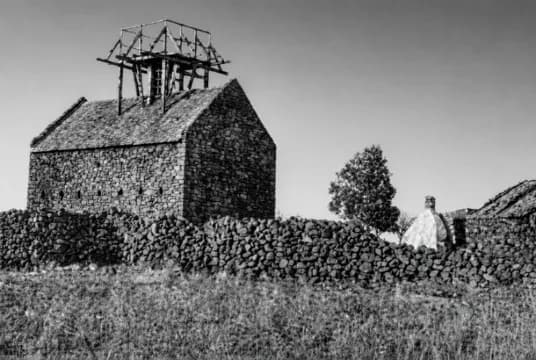
The fort, constructed by a team under Major Charles John Amiel, was located on a 112-acre section of Tweefontein, which the British bought from my great-grandfather James William. Lt Col Anthony Durnford signed the deed of transfer on behalf of the British War Department (Dunford would die soon after, at the Battle of Isandlwana during the Anglo-Zulu War, when his entire column of 1,200 men was wiped out by a Zulu army).
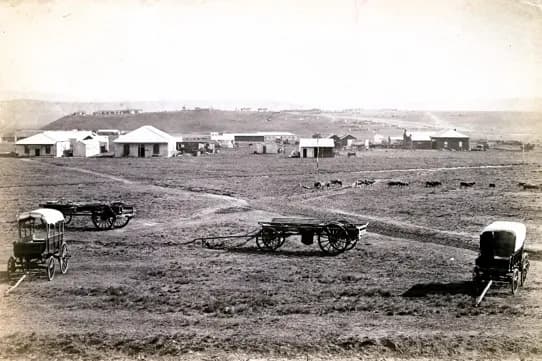
Soon after the Anglo-Zulu War, the 1st Anglo-Boer War broke out, and was fought in that exact frontier area between Natal and the Transvaal. During the 1870s, British Colonial Secretary Lord Carnarvon sought to consolidate all white-ruled territories in Southern Africa (the Cape Colony, Natal, the Orange Free State, and the Transvaal) under British rule. Accordingly, in April 1877 Sir Theophilus Shepstone marched into Pretoria with a small police escort and unilaterally declared the Transvaal British territory. Boer leaders organized widespread peaceful opposition.
Paul Kruger led two diplomatic delegations to London (in 1877 and 1878) carrying petitions signed by the majority of the Boer population demanding the reversal of the annexation. The British government refused. Even when William Gladstone took office as British Prime Minister in 1880 – having previously criticized the annexation during his campaign – he declined to restore Transvaal independence.
All this came on top of the earlier British annexation of the Cape in 1806 (which had caused the Boers to leave the colony, embarking on the Great Trek of the 1830s) and then the British annexation in 1843 of the newly-established Natalia Republic, which the Boer Trekkers had established only five years before after having purchased the land in a treaty with the Zulu king Dingaan (after which annexation the Boers left there as well, trekking back across the Drakensberg Mountains into the interior, establishing the Free State and Transvaal republics).
By late 1880, Boer passive resistance turned into active rebellion. British authorities in Potchefstroom seized an ox-wagon belonging to a local Boer farmer, Piet Bezuidenhout, after he refused to pay what he considered illegal imperial taxes. An armed group of roughly 100 Boers forcibly reclaimed the wagon from British court officials. Over 8,000 Boers then met at Paardekraal (near present-day Krugersdorp). On 13 December 1880, they elected a triumvirate: Paul Kruger, Piet Joubert, and former president Marthinus Wessel Pretorius, to restore the republic.
Boer commandos subsequently surrounded British garrisons across the Transvaal, and on 20 December 1880, a Boer force cornered the British 94th Regiment at Bronkhorstspruit, officially starting full-scale military operations.
After having suffered early setbacks at Laing's Nek and Schuinshoogte (Ingogo) with the defeat of his forces attempting to invade the Transvaal from Natal, Major-General Sir George Pomeroy Colley – Governor of Natal and High Commissioner for Southeastern Africa – sought a decisive victory to force the Boers into submission. On the night of 26 February 1881, Colley led a force of 405 British regulars on a gruelling night march climbing Majuba Hill, a flat-topped mountain rising nearly 300 metresfeet above the surrounding terrain, directly overlooking the main Boer positions defending Laing's Nek and the road pass to Transvaal.
Having reached the summit unopposed, Colley assumed his position impregnable.
When sunrise revealed taunting British soldiers standing along the rim of the mountain, Boer Commandant-General Piet Joubert quickly ordered a counterattack. An about equal number of Boer volunteers started scaling the steep slopes under British fire, using superior fieldcraft (the Boers had no regular army; the volunteers were farmers, but were experienced hunters and superb marksmen). As concentrated Boer rifle fire intensified from multiple angles around the summit, British lines fractured into panic. When a final Boer charge overran the crest, the British retreat disintegrated into a desperate scramble down the steep southern face of the mountain.
Colley was shot through the head, becoming one of 92 British soldiers killed and 134 wounded. The Boers, even though they had to attack a defended mountaintop against British regulars, suffered only one dead and five wounded.
In all, some 400 British patients were treated at the field hospital at Fort Amiel, right there below Rusoord (the 134 from Majuba, plus the earlier 111 from the British defeat at Laing’s Nek and 67 from Schuinshoogte, as well as some 90-odd suffering from dysentery and typhoid).
British Prime Minister William Gladstone’s government quickly opened peace negotiations after these catastrophic defeats, signing the Pretoria Convention in August 1881, which granted self-government to the South African Republic under nominal British suzerainty.
However, this did not last long, because the world’s richest gold deposits were discovered along the Witwatersrand in March of 1886 – the British of course had immediately coveted this, and therefore engineered first the Jameson Raid (intended to start an uprising against the Boer government) and when that failed miserably, then set out to wage a full-blown war of conquest against the two Boer republics – the ZAR (Transvaal) and the OFS. This became known as the Second Anglo-Boer War.
Which would severely impact the Boer-Irish O’Reilly’s of Rusoord...
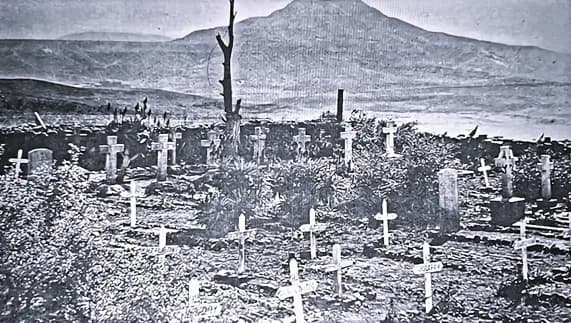
What the Anglo-Zulu War had in 1879 done to the region, was to split the Zulu Kingdom into 13 puppet fiefdoms. This fragmentation of traditional centralised Zulu rule led to a large tract of land across the Buffalo River (which had hitherto been Zulu) being ceded in 1884 by one of those new chiefs to a group of Boer volunteers who had helped him overcome a challenger. The Boers declared this the “New Republic” and established the town of Vryheid as their capital. Germany and Portugal then recognised their independence, which prompted the British to summarily annex the coastal portion of Zululand. Whereupon the founders of the New Republic, fearing that the British would annex them too, successfully petitioned the Transvaal for incorporation, which happened in 1888.
The final regional borders in that contested area were only fixed in 1906 after the 2nd Anglo-Boer War of 1899 - 1902, when the erstwhile New Republic’s territory was incorporated by the British into a new, expanded Natal.
Which history goes to show how fraught and in flux the situation had been in those border lands when my forebears had settled there.
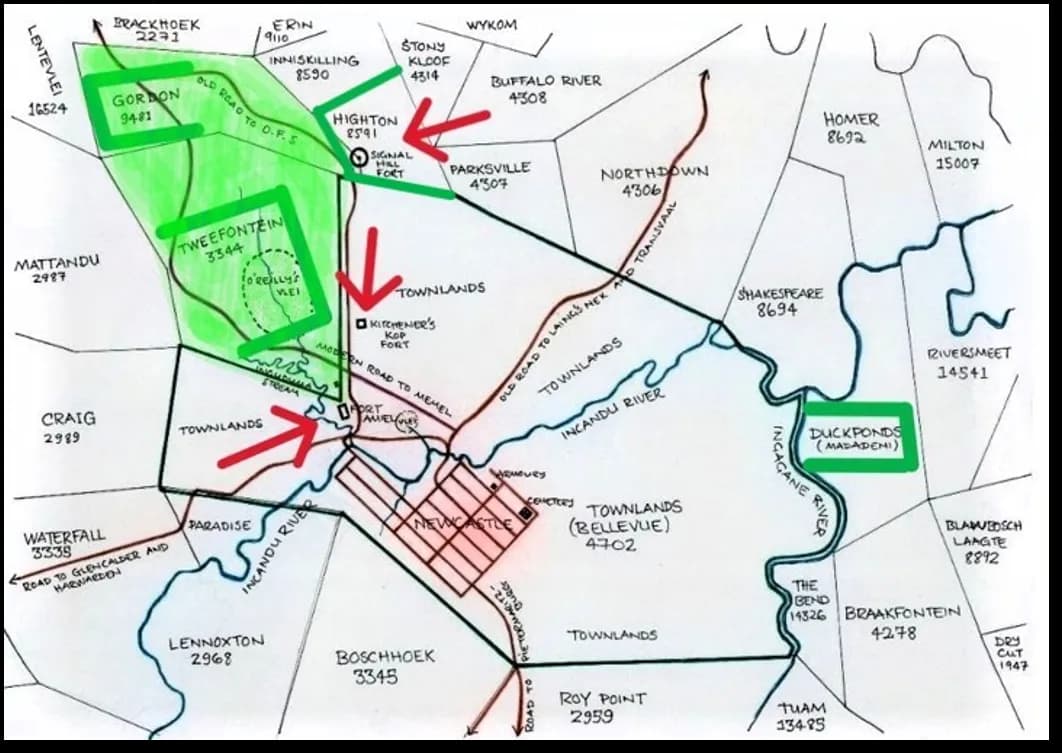
The map below shows the location of the main O’Reilly farm holdings of Tweefontein, Gordon, Highton and Duckponds with dark green bordering (except for their other farms Leeds and Surry, which are off-map). “Rusoord” – the combined Gordon and Tweefontein, where the main residence was – is indicated in light green shading and the three British forts it overlooked, with red arrows.
In addition to managing his pastoral holdings, Captain O'Reilly operated an extensive ox-wagon transport contracting business. Before the advent of regional railways, his teams hauled vital freight, trade goods, and machinery across the rugged routes connecting Natal, the Orange Free State, and the Transvaal – which all passed directly by his Newcastle land holdings.
This business thrived under his son James William, particularly after the discovery of gold on the Witwatersrand and the establishing of the rapidly growing city of Johannesburg. The heyday of the hauling of heavy loads from Durban to the interior by ox-wagon was the years prior to the connection of Johannesburg by rail to the ports (to Cape Town and Port Elizabeth in late 1892, Delagoa Bay in Mozambique in 1894 and Durban in 1896).
Before the railway, James William O’Reilly and his teams would also go down twice a year to buy supplies for home and farm at Morrisons in Pietermaritzburg.
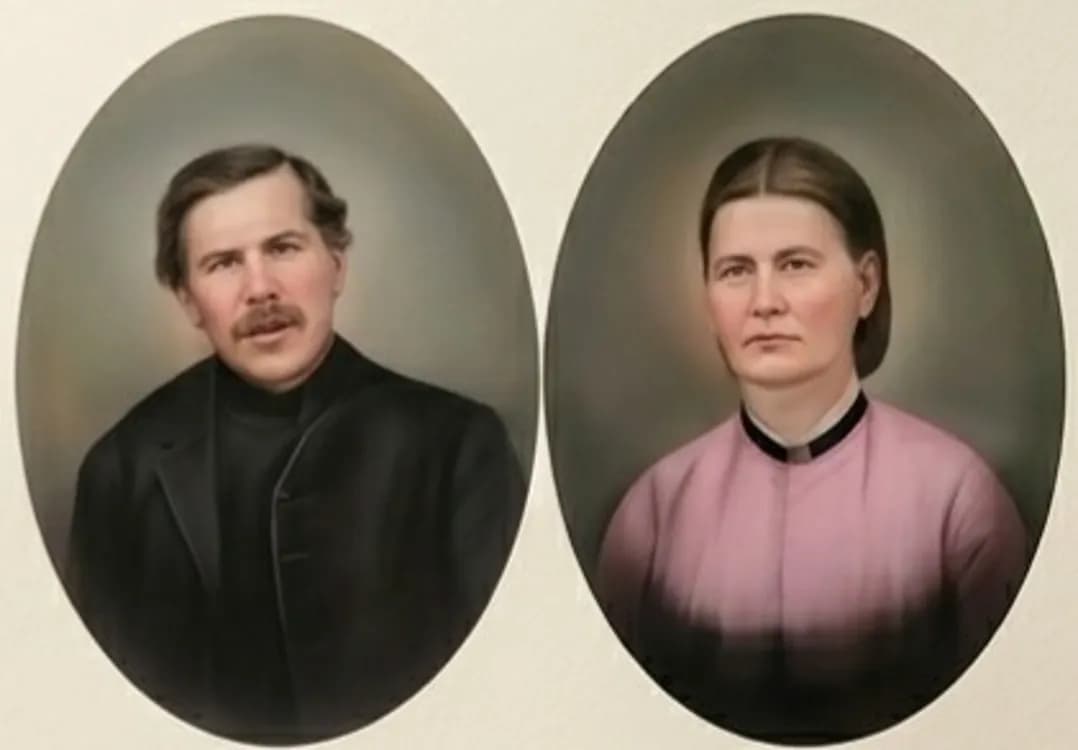
Captain John Robert O’Reilly passed away at Newcastle on 30 July 1889, at the age of 77. His wife died three years later, on 21 September 1892, at the age of 72.
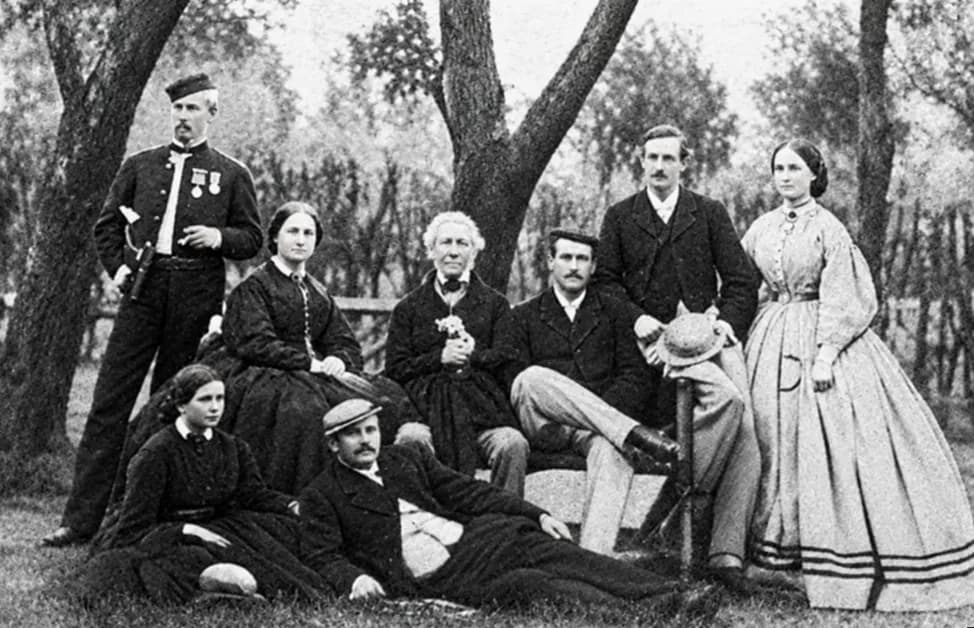
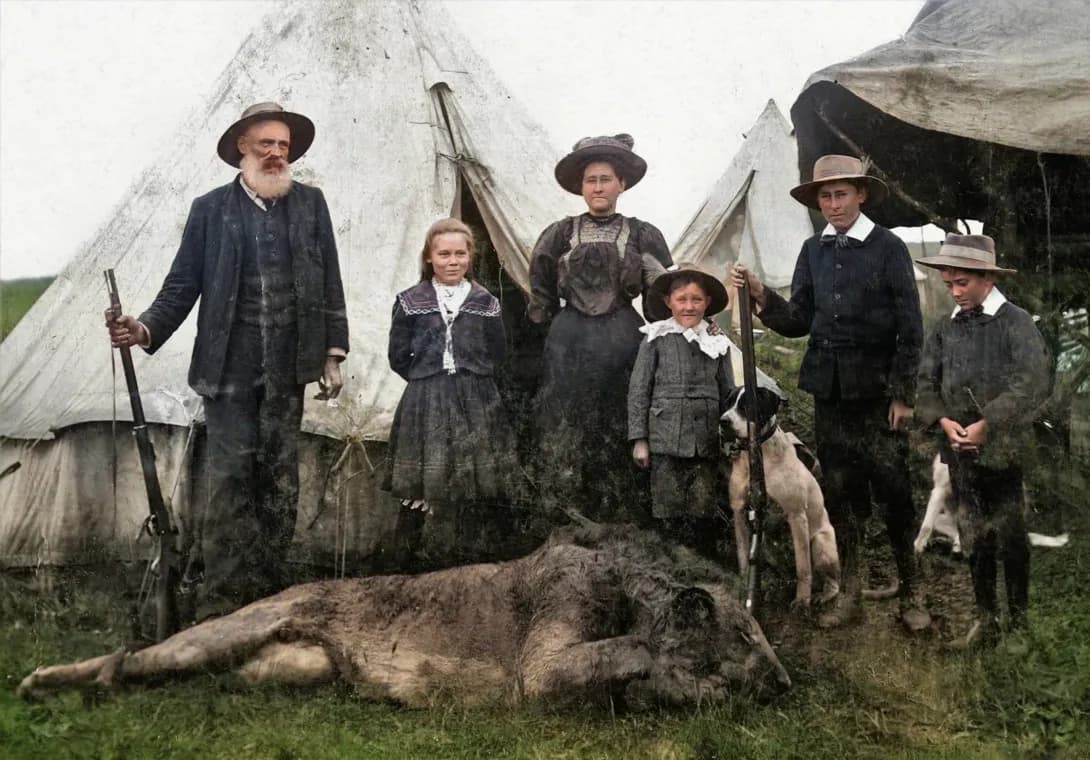
Another important part of frontier life in Northern Natal was organised hunting excursions undertaken in late autumn and early winter to the nearby Umfolozi River basin in Zululand (later to become a nature reserve). This wasn’t recreational – the main purpose was to make copious stocks of biltong (wind-dried salted meat, like jerky), as well as to obtain zebra hides (prized for making shoes – called velskoene) and hippo hides for making sjamboks (whips). On occasion a lion would be shot, in defence or as trophy. The photo below is of such an outing, which typically united a number of families and could last months (note the Bell tents and the canvas-covered wagon). Who exactly all the participants on this particular occasion were, I’m not sure – apart from knowing this photo as part of my Mom’s family collection).
8. My great-grandfather, James William O’Reilly
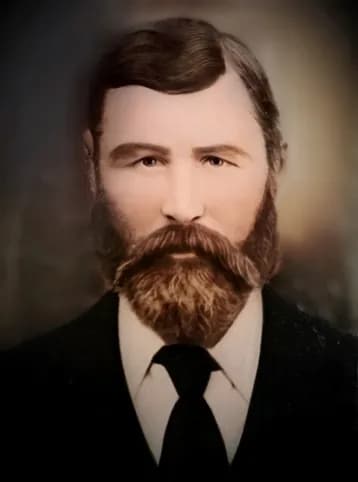
James William O’Reilly was born on the 7th of August 1855 at Graaff-Reinet in the Eastern Cape, the youngest child of Captain John Robert O’Reilly.
Like his father, James William married an Afrikaans lady, Maria Magdalena Martens of Greytown (Zululand), born on 10 July 1867. From this marriage was born seven children, two of whom died young. The five surviving children were: John Robert, Annie Catherine Elizabeth, Catherine Gertrude Henrietta, Elizabeth Caroline, and as youngest my grandpa John James Thomas (Tom) O’Reilly, born on the 3rd of March 1897 at Newcastle.
Apart from the transport business and hunting, my Oupagrootjie James William was known for his prowess as an innovative farmer. He had been one of the first to introduce Angora goats to the country (prized for their long, silky hair) and had won the gold medal for his stud ram at the first Witwatersrand Agricultural show, held in Johannesburg in May 1895 – as can be seen in the press clipping below.
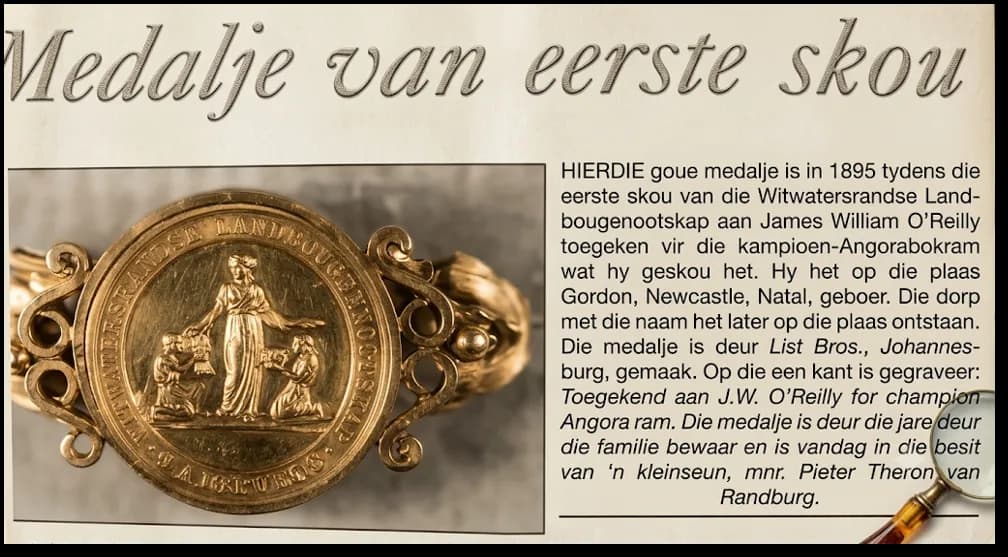
Translation: MEDAL AT FIRST SHOW This gold medal was awarded in 1895 during the first show held by the Witwatersrand Agricultural Union to James William O’Reilly for the Angora ram he had entered. He farmed on Gordon, Newcastle, Natal – the town with that name came into being on his farm. The medal was produced by List Brothers of Johannesburg. It was engraved with: “Awarded to J.W. O’Reilly for the champion Angora ram”. The medal has stayed in the family over the years, who have treasured it. Today (i.e., at the time the article was published, many decades ago) it is in the possession of a grandson, Pieter Theron of Randburg.
After the outbreak of the 2nd Anglo-Boer War in 1899, the strategic location of Rusoord, Oumagrootjie Martens’s regular verbal clashes with the Tommies, and the inability of the British to conquer the Boers, had combined to cause great hardship for this well-to-do, respected family. When the British couldn’t conquer 40,000 Boers with their 450,000 British and Imperial troops (the largest military force Britain had ever sent overseas up to that point in history, and its most costly war ever, till the two world wars of the 20th century) they resorted to scorched earth tactics, systematically burning Boer towns and dynamiting farmsteads, as well as killing all livestock and burning crops. They also forced the Boer women, children and elderly into concentration camps, where 28,000 would die in unspeakable conditions – more than 50% of the youth under 15 of the two republics perished in these death camps.
Oumagrootjie Martens used to regularly go into Newcastle town to sell her butter, eggs and greens, which she would continue to do after the war broke out – first under Boer occupation, and then under British military rule after the British had regained control of the area in 1900. To make her trips across the Ncandu River she had to pass British guard posts and sentries. This frequently led to heated verbal exchanges – she had a sharp tongue and had double reason to hate the Tommies (being a staunchly pro-Boer Afrikaner and married to a Boere Irishman at that).
These altercations revolved around her absolute refusal to carry the pass that the British insisted upon.
Of probably equal importance, though, was the British fear of pro-Boer spies providing information to the Boer Commandos about British military dispositions and troop movements. And, as we have seen, Rusoord was supremely well located for such observation of the British: overlooking Newcastle, the three forts, as well as the two roads to the mountain passes leading to the Free State and Transvaal. Accordingly, given the clear pro-Boer sentiment of the O’Reilly Boer-Irish of Rusoord and the animosity amply demonstrated by Oumagrootjie Martens’s verbal jibes, it wasn’t long before the entire family was packed off to the concentration camp in Pietermaritzburg, the Natal capital. My 3-year-old grandpa Tom included. The photo below is of them at that camp, which they fortunately all survived. (It was somewhat better than the Highveld camps, since it had access to fresh water and had tin-sheet framed housing, leading to it being derisively called “tin town” by its unhappy residents).
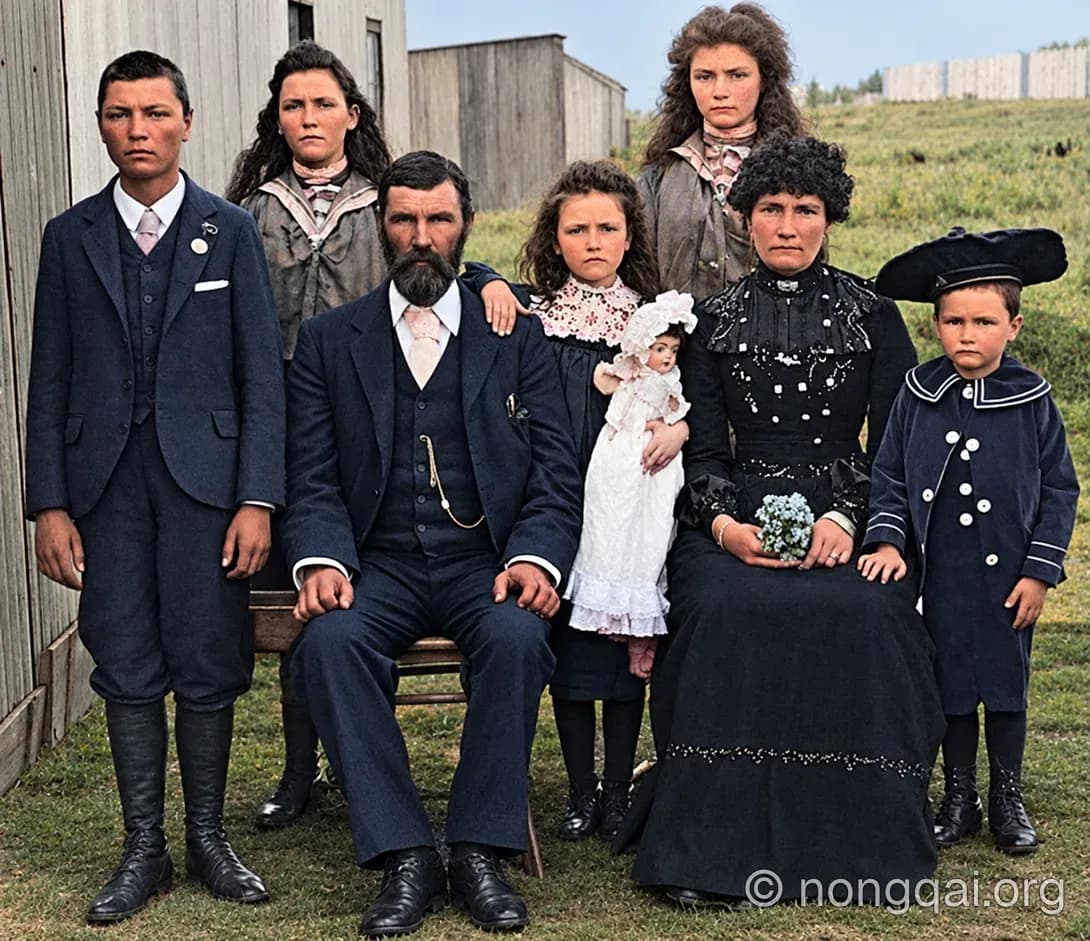
I’ve seldom seen a family photo of people looking so “gatvol” (i.e., seriously annoyed) with their enforced circumstance at the hands of the doubly-hated “na nGaeil” (Irish name for the English) or in Afrikaans, the “Rooinekke” (the “red necks”, from the exposure their lilywhite skins suffered under the African sun).
During their enforced absence in the Pietermaritzburg concentration camp the Newcastle farms had gone to ruin and had to be re-developed. James Wiliam had to petition for bank leniency on repaying outstanding loans. But the wheel would turn – Fort Amiel was abandoned by the British in 1904, and two decades later its surrounding land would be leased back to my grandparents. With the railways now well established and motorised transport becoming more common, the transport business by ox-wagon had fallen by the wayside, but thanks to South Africa’s rapidly-expanding urban population, growing national wealth and improved export infrastructure for produce such as wool, the farming operation as such became increasingly profitable, pivoting to beef and wool production. By the time that my great-grandfather James William passed away on 27 April 1928 (and his wife just four months later on 1 September 1928), the family’s fortunes had been restored.
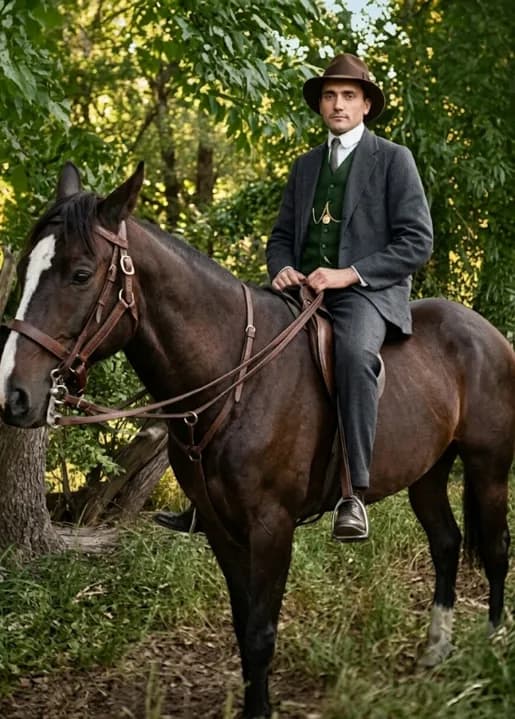
9. My Oupa Tom – James John Thomas O’Reilly, (3rd of March 1897 – 9 October 1959).
Oupa Tom married my Ouma Annie (Anna Christina, née Uys – born on 18 October 1903) on 5 April 1921. Like his own grandmother and mother, she was ‘n Afrikaanse meisie, so that the family were Afrikaans-speaking at home, although they were fluent in English too (as well as Zulu).
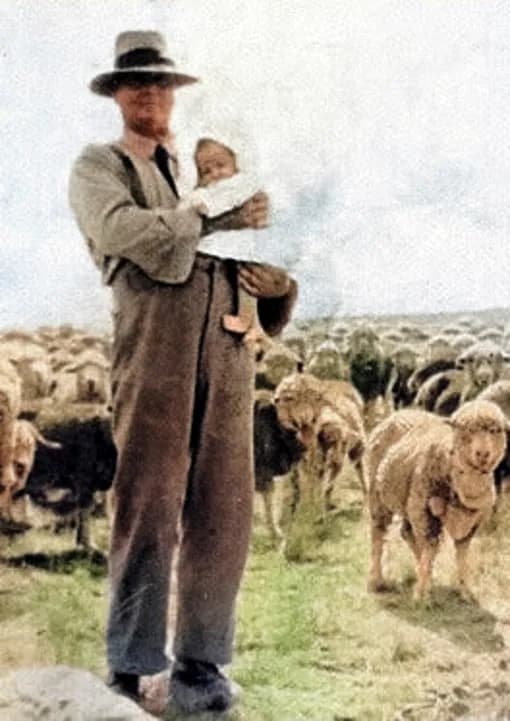
Oupa Tom and Ouma Annie had six children, of which my mother Maria Magrieta (aka Maxie) was the middle child.
During the Great Depression Oupa Tom had nevertheless succeeded in building the ample new Rusoord “opstal” (main house) of which the thick outer walls were faced in cream-coloured Drakensberg sandstone blocks. In the old photo below, taken when the construction was nearing completion, one can see some of these blocks stacked near the outer wall. Together with the broad “stoep” (verandah) running round the house, these thick walls ensured a cool interior during summer.
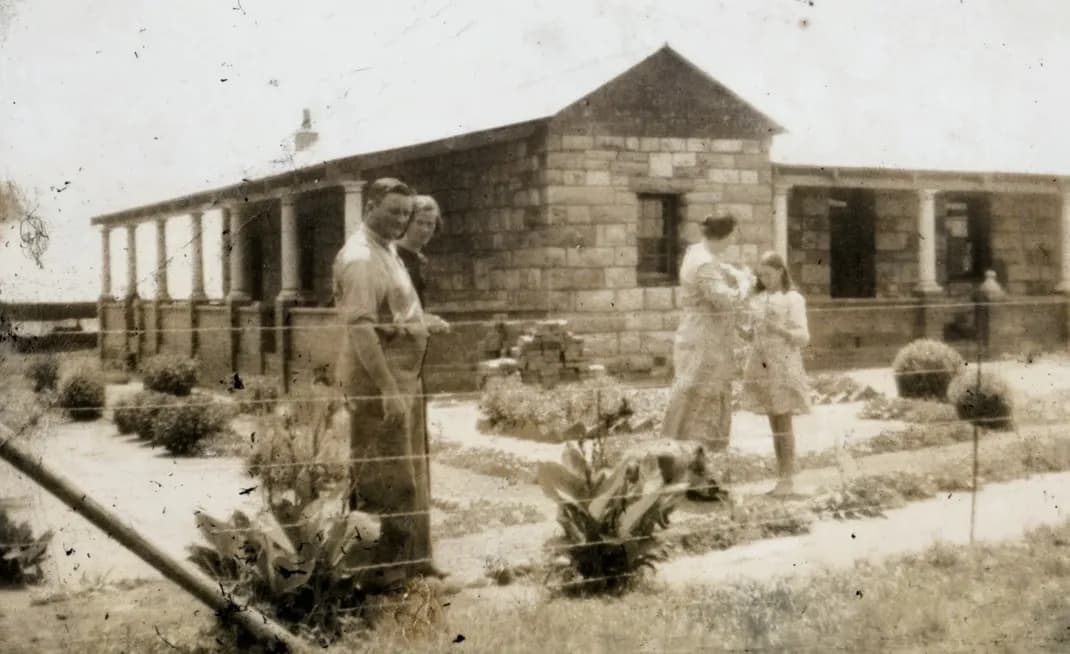
Today (2026) the big old farmhouse serves as an orphanage, since it is no longer the heart of the large working farm that once had existed around it.
Oupa Tom had bought a brand new Chevrolet motorcar in 1929 – just when the Great Depression began to bite. He single-handedly converted the car into a pickup truck, which he often used a team of horses to pull when fuel was scarce.
I myself saw and admired this old Chevvy standing in its own garage at the Montague Street “dorpshuis” (in-town house) in Newcastle, which Oupa Tom had bought when Ma Maxie started high school. It was still there after Ouma Annie’s death, when eventually it was sold as a collector’s item.
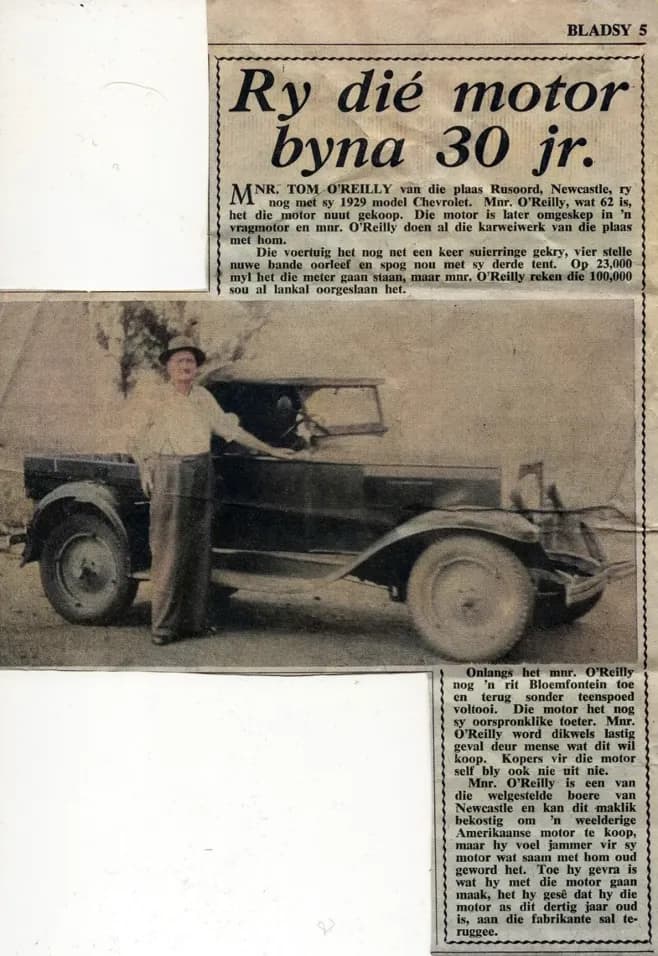
The newspaper article appeared not long before Oupa Tom’s passing on 9 October 1959. Translated, it reads as follows:
“Driving the motorcar for nearly 30 years”.
“Mr Tom O’Reilly of the farm Rusoord, Newcastle, is still driving his 1929 model Chevrolet. Mr O’Reilly, 62, bought the car new. The car was later converted into a pickup truck, and Mr O’Reilly does all the farm’s carting with it. The vehicle has only once needed its piston rings replaced, has had its tyres replaced four times, and is on its third canvas canopy. The odometer stopped working at 23,000 miles, but Mr O’Reilly believes that he has driven it for much more than 100,000 miles already.
“Recently Mr O’Reilly made a trip to Bloemfontein and back without any mishap. The car still has its original hooter. Mr O’Reilly is often approached by people who want to buy the car from him. Others want to buy the engine.
“Mr O’Reilly is one of Newcastle’s wealthy farmers and could easily afford buying a new luxury American motorcar, but he feels attached to his car which has grown old together with him. When he was asked what he will eventually do with the car, he said that once it had reached 30 years of age, he will hand it back to the manufacturer.”
That latter intention could not come to pass, because Oupa Tom unfortunately took seriously ill with diabetes later in 1959, and passed away on 9 October that year.
10. My mother, Maria Magrieta “Maxie” Steenkamp, née O’Reilly (1 June 1932 - 7 July 2018)
My mother was the fourth of the six children born to Oupa Tom and Ouma Annie, but in terms of their age spread (which was quite large, from youngest to oldest) she was actually situated around the middle, year-wise.
Before she started attending school in Newcastle the family had called my mother “Maggie”, after her second name. When she arrived at school for her first day there, she accordingly said “Maggie” when the teacher asked her for her name. However, being shy, she had spoken so softly and under her breath that the teacher heard “Maxie” – and from that day on she became Maxie to one and all.
Ma Maxie had been a year or so into her high school career when she was noticed by a young 18-year-old police constable who had arrived in Newcastle at the beginning of November 1946 on his first posting – a certain Frans (Francois Michiel Alexander) Steenkamp.
Frans knew no one in Newcastle and lodged with another policeman – Sergeant Davidson – and his wife, whose home was on Montague Street (on which the dorsphuis of Tom and Annie O’Reilly was also located). One day Frans and Sergeant Davidson were standing outside the gate when Maxie rode past on a bicycle in her school uniform towards her parents’ end of the road.
‘I’m going to marry that girl’ Frans said.
‘Oh, do you know her?’ asked the sergeant.
‘Not yet,’ replied Frans.
Eventually, at a special church service one New Year’s Eve, Ouma Annie noticed the lonely police constable and, taking pity on him, invited Frans to come and have tea with them the next day. And so Frans and Maxie got formally acquainted.
With the O’Reilly affinity for men in uniform, Maxie married Frans Steenkamp, who was to become the national commanding officer of the SAP Special Branch with rank of Major General.
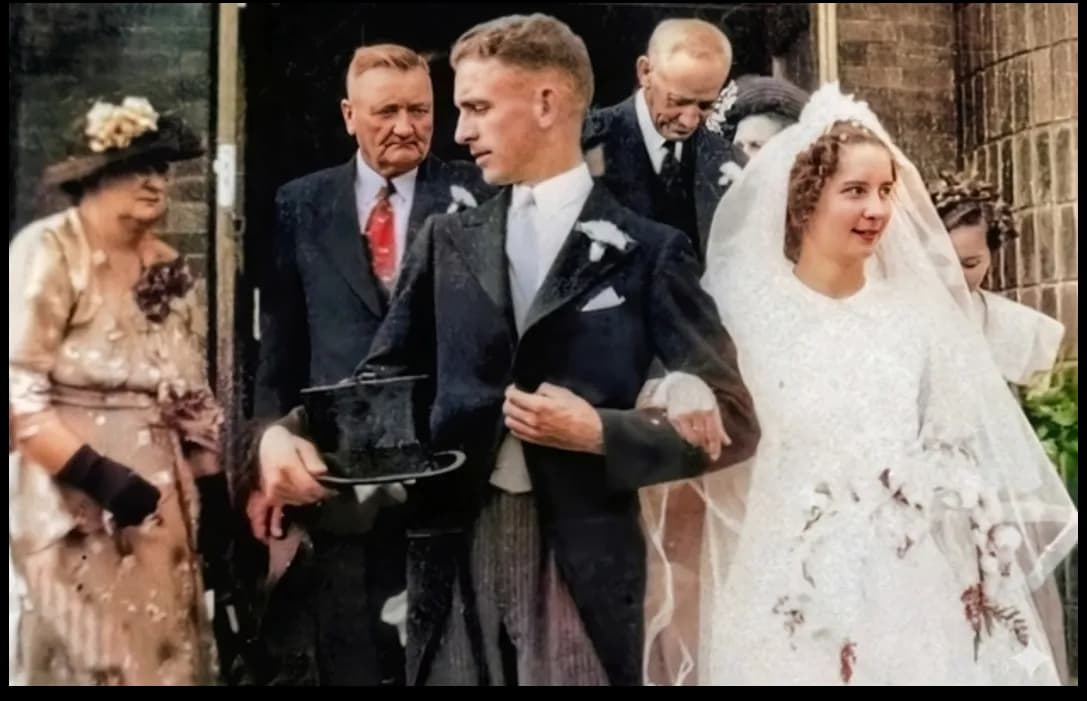
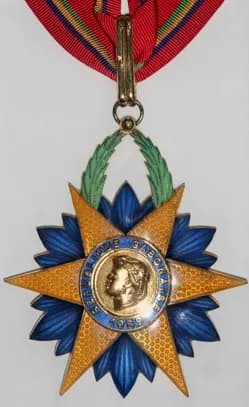
As their first-born, I seem to have inherited from her the Irish “gift of the gab”, winning the national debating contest for Afrikaans high schools in my matric year. I completed my national service and Public Service bursary obligations as a senior intelligence analyst with the NIS, whereafter I qualified and was admitted as an attorney. Having that in my back pocket, I returned to service of volk en vaderland, i.a. heading the diplomatic academy and serving as the New South Africa’s first ambassador to six countries in previously-hostile Black Africa, with the Republic of Gabon (where I was resident) awarding me its Order of the Equatorial Star in the commander class. Which seems like a good enough point at which to end this exploration of the decorated military heritage of my Irish lineage…
© nongqai.org
Write to us about this article
Do you remember this, or know more? Your comment appears here once an editor has read it.
The editors may print your comment, with your name, in the monthly edition.
Related Articles
The Battle of Sannaspos – A Tactical Triumph
November 14, 2026
NONGQAI SERIES THE MEN SPEAK Dr Willem Steenkamp Part 2
March 1, 2024
The Life and Times of Lieutenant Colonel John Walter McLean OBE VD (MID), 1855–1939
November 11, 2026

S.a. Police Security Branch Series #3
March 22, 2024
NONGQAI SERIES THE MEN SPEAK Dr Willem Steenkamp
February 24, 2024