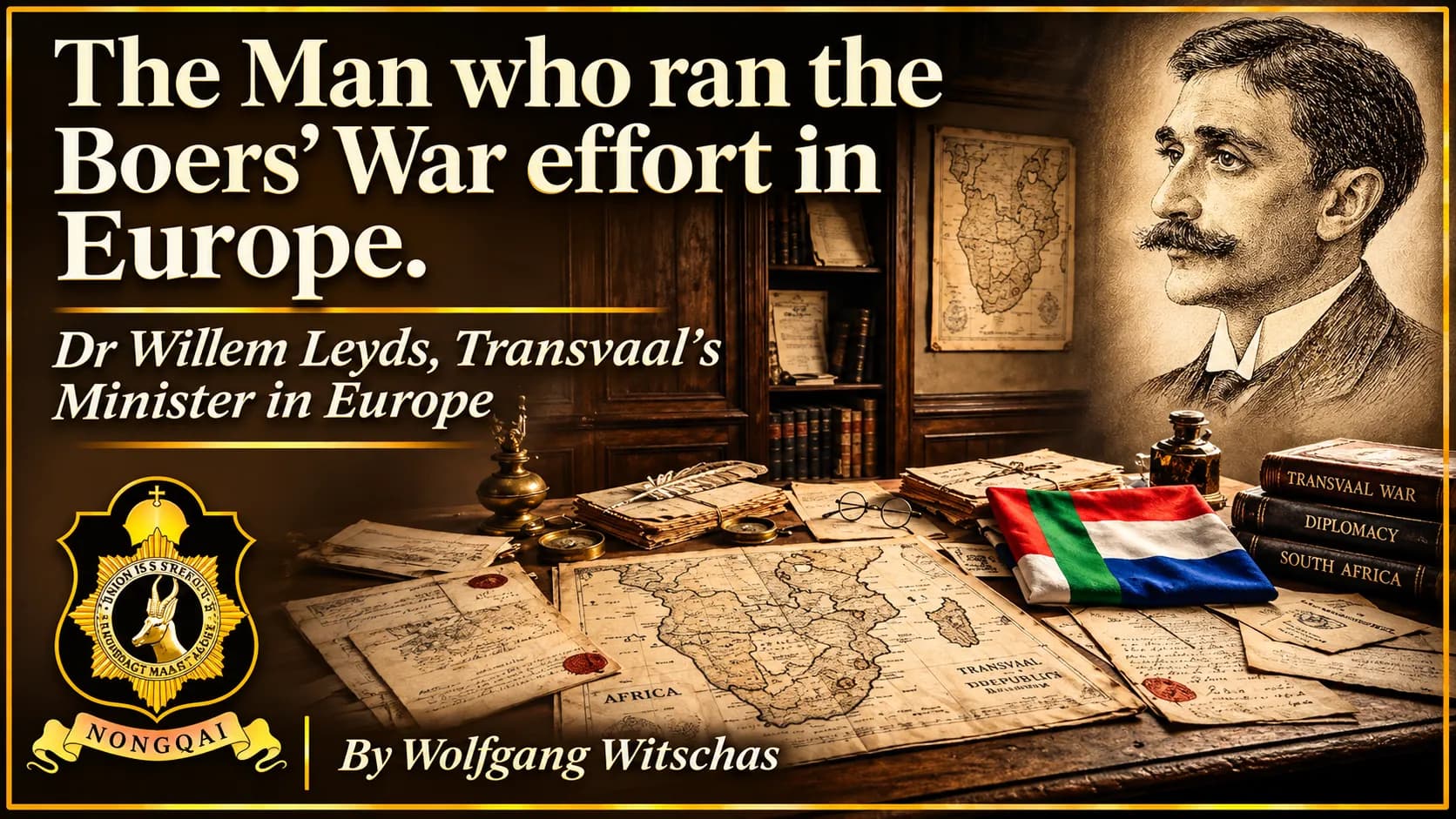
The man who ran the Boers' War effort in Europe
The key role during the 2nd Anglo-Boer War of Dr Willem Johannes Leyds, the ZAR's Minister Plenipotentiary in Brussels.

Introduction
When the Anglo-Boer War broke out on 11 October 1899, the Zuid-Afrikaansche Republiek (ZAR) faced a problem that could have ended the war in months. It was landlocked. It had no port. Its commandos depended on rifles, ammunition, explosives and medical supplies that all had to come from Europe, i.e. Germany and France.
Britain, with the most powerful navy in the world, was determined to cut that supply line completely.
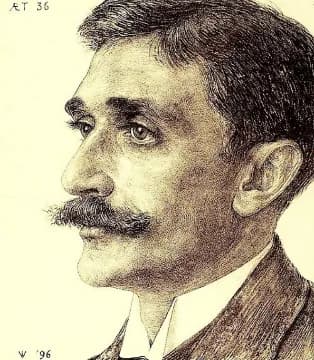
The man who kept the supply line open was not a general on the battlefield. He was a Dutch-born lawyer sitting in an office in Brussels. His name was Dr Willem Johannes Leyds, the ZAR's Man in Europe.
Leyds had been the State Attorney and then State Secretary of the ZAR under President Paul Kruger (1884 to 1889). From 1898 he was the ZAR's official diplomatic representative in Europe with the rank of Minister Plenipotentiary. His appointed to this task at that time was due to the ZAR (correctly) anticipating that war with Britain was imminent.
When war indeed started, Kruger was trapped in Pretoria. Leyds was free in Europe. That made him the Republic's buyer, banker, propagandist and smuggler-in-chief.
.
A Lifeline Through Mozambique
The ZAR's only lifeline was the Pretoria to Delagoa Bay Railway line (present-day Maputo). Before the war ahd started, Dr Leyds had ordered the acquisition of tens of thousands of 7mm Mauser rifles Model 1895/1896 from Ludwig Loewe & Co. and Deutsche Waffen- und Munitionsfabriken (DWM) in Germany. He had also acquired Krupp field guns from Essen in Germany as well as Schneider-Creusot howiters (the famous "Long Toms") from France, plus Maxim guns, and millions of rounds of smokeless ammunition. These had all been bought and hastily shipped to the ZAR.
After 11 October 1899, Britain declared all of that contraband of war. The Royal Navy could stop and search neutral ships. Portugal, as a neutral power, was under intense British pressure to enforce neutrality.
Dr Leyds had to make contraband look innocent
False Paperwork
This was the core trick of Leyds to smuggle war material to the ZAR. The cargo left Hamburg, Rotterdam and Antwerp with consignment notes that deliberately misdescribed it. A crate of rifles, cartridges, explosives or heliographic apparatus for the ZAR artillery would be entered as general merchandise, machinery or agricultural goods, or supposedly consigned to a neutral Portuguese firm in Lourenço Marques, not to the ZAR government.
British historians summarise the whole system in one sentence: "Dr Leyds succeeded by means of bribery and misleading consignment notes to smuggle through contraband throughout the war and he was still busy with this when the war ended. Paperwork could be falsified faster than it could be checked. That was the point."
Bribery
Portugal was officially neutral, but local officials in Mozambique were poorly paid and far from Lisbon. Leyds' network paid them to clear goods without proper inspection, to release seized cargo, and to warn of British inspections.
In London, MPs were already asking in early 1900 whether Portuguese officers at Delagoa Bay were loyally carrying out Lisbon's orders. The Foreign Office admitted: "General allegations have been made that the local authorities fail to carry out as completely as might be desired the instructions of the Portuguese Government in regard to contraband, but no proof has been produced."
That gap between Lisbon's orders and local practice was exactly what Leyds exploited.
Many Ports, Not Just One
When Lourenço Marques became too closely watched, Leyds shifted to smaller, less-watched ports:
"Goods were smuggled through Inhambane, Quelimane and Beira and transported overland across the border and into the ZAR".
From there, goods went overland by wagon and carrier, and where possible by rail, across the Mozambique - ZAR border. British intelligence in August 1900 found that "overseas cargoes continued to be brought into Delagoa Bay and landed at Lourenco Marques (and elsewhere in Mozambique). They were then presumably transhipped by rail into the ZAR" - even though Johannesburg and Pretoria had already been in British hands for months. Munitions were "being discreetly moved - or smuggled - across the Mozambique-ZAR border at strategic points" as far as Komatipoort.
The Man on the Spot
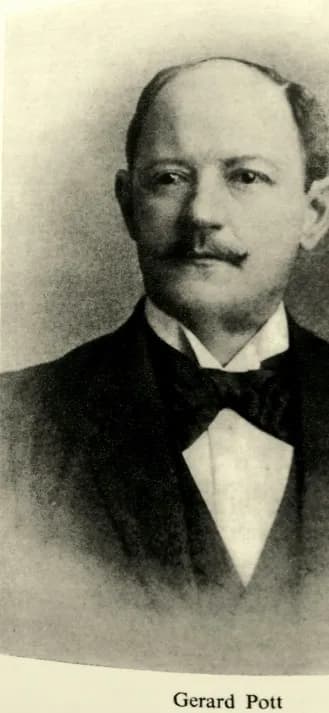
Dr Leyds could not run this from Brussels alone. He needed a man in Lourenço Marques, who was Gerard Pott, the ZAR Consul-General in Delagoa Bay.
Background of Gerard Pott
Gerard Pott was born on 21 December 1858 in Amsterdam and died on 20 December 1927 in Lourenço Marques. He was a central figure in the diplomatic, intelligence, and supply networks of the ZAR and later the Orange Free State (OFS) as well. Operating from Portuguese East Africa/ Mozambique, he acted as the primary external lifeline for President Paul Kruger's government in Pretoria.
Triple Consulate & Commercial Power
- Diplomatic Appointments: Pott arrived in Lourenço Marques in the 1880s. He was appointed Honorary Consul for the Kingdom of the Netherlands in 1889 at the of age 29, and Consul-General for the ZAR in 1890, later adding the Orange Free State to his portfolio.
- Wealth and Influence: Alongside his diplomatic duties, Pott built a massive commercial trading empire handling imports and exports between Delagoa Bay and the ZAR . His wealth funded major landmarks in Lourenço Marques, including the historic "Prédio Pott"/Pott Building downtown and his lavish mansion, Vila Jóia, located next to the Vasco da Gama (now Tunduru) Botanical Gardens.
Role in the Anglo-Boer War (1899–1902)
- Pretoria’s Supply Lifeline: Because the Boer Republics were landlocked and surrounded by British territories, the Delagoa Bay railway line from Lourenço Marques to Pretoria was their only neutral corridor to the outside world. Pott worked directly with the Proviandkommissie (Provisions Commission) in Pretoria and Dr. Willem Leyds (the ZAR's envoy in Europe) to procure and route food, ammunition, and military equipment to the Boer commandos.
- "The Contraband King": Pott used his diplomatic immunity, commercial warehouses, and bribery of local port officials to bypass British naval blockades. He falsified consignment notes to smuggle war materials through Lourenço Marques and smaller ports like Beira and Inhambane.
- Paul Kruger’s Exile & Gold: Following the British occupation of Pretoria in 1900, Kruger was evacuated along the railway line to Lourenço Marques. Pott hosted and assisted the aging president in securing safe passage aboard the Dutch warship HNLMS Gelderland in October 1900, while helping coordinate the movement of ZAR state gold reserves out of British reach.
British Pressure & Loss of Status
- Revocation of Credentials: Pott's operations were a constant frustration to British intelligence and the UK's Consul-General Fritz Crowe in Lourenço Marques. Under intense diplomatic pressure from Britain—Portugal's oldest ally—the Portuguese colonial authorities formally revoked Pott's exequatur (diplomatic accreditation) on 15 November 1900, citing his conviction for smuggling war contraband.
- Later Life: Despite losing his diplomatic immunity and enduring heavy financial and legal pressure from British and Portuguese authorities, Pott remained in Lourenço Marques until his death in 1927. Through his relationship with Angelina Moyasse, he was the father of Karel Monjardin Pott (1904–1953), who became the first mixed-race Mozambican to compete in the Olympic Games (representing Portugal in the 1924 Paris Olympics) and a prominent civil rights lawyer in Mozambique.
"The long-range orchestrations of Leyds were supported locally by Gerard Pott, until his exequatur was withdrawn in November 1900."
Pott used his consular position to receive goods consigned to neutral firms, arrange transhipment, and issue passports and papers for ZAR agents. Portugal eventually bowed to British pressure. Lisbon was told as early as 17 November 1899 that it would be necessary to cancel Pott's exequatur "on account of irregularities with reference to the transhipment of contraband of war from Lorenzo Marques to the ZAR".
Specific charges later named against him were the illegal importation of heliographic apparatus for the ZAR artillery and the wrongful grant of passports. His exequatur was finally withdrawn in November 1900 - but the network survived him.
Front Companies
In the British Parliament on 22 February 1900, MPs directly accused a company at Lourenco Marques in the following terms, alleging that a Portuguese company: "directed and controlled by British subjects, called the Empreza Africana Company, has been and is still importing and exporting materials for the Transvaal Government at Lourenco Marques". It was said to be loading large quantities of ZAR wool - the ZAR's export to pay for imports - and to be "directed from the office of Mr. Pott, the consul for the ZAR at Delagoa Bay."
The British government, on the given word of Sir Donald Currie of the Castle Line, denied it and said the Empreza was "solely concerned in the carriage of goods between ship and wharf."
Whether the Empreza was innocent or a front, the debate shows how the system worked: neutral Portuguese company + British-owned shipping + ZAR consul's office = a perfect cover to move goods ship-to-wharf-to-rail without ever appearing as a ZAR shipment.
The trade was two-way: wool and gold out, rifles, ammunition, explosives, medical supplies and money in. Boer gold was converted in Dutch, Swiss and German banking houses into hardware.
What Was Smuggled
Not just guns. Leyds' shopping list included:
- Explosives - including saltpetre for making gunpowder. In one famous case, Britain forced the reshipment to Hamburg of 300 tons of saltpetre from the German steamer Herzog, seized early in the war on suspicion of carrying contraband.
- Ammunition - millions of rounds for Mauser rifles and the Krupp artillery
- Medical supplies - for field hospitals and commandos
- Money - ZAR treasury funds, gold sovereigns, and loans raised in Europe to pay agents and fund the commandos still fighting
- Communications equipment - heliographs and field telegraph material
Why Britain Could Not Stop It
Britain tried everything: naval interception, intelligence officers in Lourenço Marques from the Field Intelligence Department, Von Steinaecker's Horse unit that was deployed on the then ZAR -Mozambique border (present day Kruger National Park), with one big objective to blow up the Komatipoort bridge, plus diplomatic pressure on Portugal, and warnings to British firms that trading with the enemy was illegal.
It failed because Portugal wanted to stay neutral and keep the port revenue, local officials could be bribed, paperwork could be falsified, there were too many small ports and overland routes to police, and pro-Boer sympathy in Mozambique was strong.
A Bungled Smuggling Expedition
During the last months of the Anglo-Boer War (no definite dates available), an odd trio was moving down the Mozambique coast. They were on a secret mission, planned by Dr Leyds in Brussels, to smuggle a quantity of explosives, ammunition, medical supplies and money to the ZAR. A German, Dr Aurel Schultz (Schulze?), was the leader and he was assisted by Piet Burger, a law clerk from Middelburg, ZAR. To avoid suspicion, the third member travelled separately and only joined them in Beira. He was the former journalist of the "Land and Volk" newspaper (and a vociferous critic of Kruger), Eugene N Marais, who had just completed his law studies in London. He was destined to become an acclaimed Afrikaans poet, author and exceptional naturalist.
Dr Schultz, being German, could travel on a German passport, deal with German shipping firms like the Deutsche Ost-Afrika Linie (the Herzog / Bundesrath line), and pass as a neutral foreigner - not a Boer burgher who would be arrested on sight.
Piet Burger as Schulze's assistant and a Law clerk from Middelburg, ZAR. That was a perfect cover. A law clerk knows paperwork, consignment notes, customs forms, railway waybills - exactly what you need to make false paperwork look real and as a local from Middelburg, he knew the roads, the border crossings, and who to bribe on the Middelburg - Komatipoort - Delagoa Bay route.
The expedition ended up a failure, and they were still in Beira when they learned that the peace treaty had been signed. Schultz was convinced that the report was false and they continued to the mouth of the Save River, where they lingered in the malaria-infected mangrove forests near Machanga for several months. The incompetent Burger absconded; the other two got rid of the ammunition and explosives before they eventually returned to Beira. Schultz departed for Europe, and Marais sailed for Delagoa Bay in August, from where he only arrived in Pretoria at the end of 1902.
The gold of the ZAR government
Between May and August 1900, the ZAR evacuated over £2 million in state gold bars and pond coins from Pretoria along the Eastern Railway Line to Lourenço Marques, using Consul-General Gerard Pott’s diplomatic and commercial network to convert the bullion into war funds and supplies before British forces could seize it.
"While popular legend claims this fortune—known as the "Kruger Millions"—was buried in the Lowveld, historical records show the bulk of the gold was systematically moved through Mozambique to fund the Boer war effort".
Evacuation from Pretoria (May–June 1900)
- Emptying the Vaults: Days before British troops occupied Pretoria on June 5, 1900, State Attorney Jan Smuts and ZAR treasury officials emptied the National Bank and the State Mint
- The Railway Corridor: The gold was loaded onto special trains on the NZASM Eastern Line (Oosterlijn)—the only rail link outside British control—moving east through Middelburg, Machadodorp, and Waterval Onder toward the Mozambican border at Komatipoort
Smuggling and Laundering the Gold Through Lourenço Marques
Disguised Ownership: Because British warships blockaded Delagoa Bay and scrutinized ZAR state assets, Pott and ZAR officials used neutral intermediaries and temporary "paper sales" to disguise the gold's origin.
The German ship SS Bundesrath Shipment
In mid-1900, roughly 210,000 ounces of gold (nominally transferred to the Nederlandsche Bank en Credietvereeniging) was smuggled through Lourenço Marques onto the German-flagged vessel SS Bundesrath. It arrived in Vlissingen, the Netherlands, on 11 July1900, where ZAR envoy Dr. Willem Leyds used it to finance European diplomatic and arms accounts. [1, 2]
Local Supply Credits: On August 31, 1900, another 62 cases of gold (approximately 64,000 ounces) were delivered across the border into Lourenço Marques and handed over to the German trading firm Wilcken & Ackermann. In exchange for the gold, the firm credited the ZAR government's supply accounts, shipping massive quantities of provisions—including 44,000 bags of flour—back up the railway line to the Boer commandos.
The Remaining Gold & Kruger's Departure
The remaining gold was handed over to the Commandos: Smaller portions of minted pond coins were kept in mobile field treasuries to pay individual members of commandos to buy horses, and settle local debts during the guerrilla phase of the war.
Conclusion
Dr Leyds did not win the war. No amount of smuggled ammunition could change the final balance of men, money and industrial power. But he did something remarkable; he kept a defeated, landlocked republic supplied for two and a half years after its capital had fallen. He did it not with ships and armies, but with deception, false consignment notes, bribes, neutral ports, a consul willing to risk his career, and a network of companies that could make a ZAR shipment look like an ordinary Portuguese cargo.
When the Peace Treaty of Vereeniging was signed on 31 May 1902, Leyds was still arranging shipments. That is why his secret pipeline matters. It shows that the Anglo-Boer War was not only fought in the ZAR, Orange Free State (OFS) and Cape Colony. It was also fought in the customs sheds of Lourenço Marques, in the offices of Brussels, and on paper - where a single misleading line on a consignment note could keep a commando in the field for another month.
The ZAR's "Secret Service" was created between December 1895 and January 1896, around the time of the Jameson Raid. It was a period of upheaval for the ZAR. The discovery of gold on the Witwatersrand had triggered a gold rush, and with it came political unrest among the "uitlanders" in Johannesburg over their status and safety.
Dr Willem Johannes Leyds, who was the State Attorney of the ZAR from 1884 to 1889, State Secretary of the ZAR 1889 - 1898 and Minister Plenipotentiary in Europe from 1899; played a key role in building a secret service to protect the Republic's interests.
Dr Leyds can be regarded as being one of the first South African "Sanction Busters" (as they were called in modern terms) to assist a South African War effort.
© nongqai.org
References
- Face Book: The Anglo-Boer War (South African War) - 1899 - 1902: Pieter Cloete: A Bungling Smuggling Expedition: The Anglo Boer War
- Article:
- Die Geheime Diens in die Zuid-Afrikaansche Republiek (ZAR) 1894 - 1900: Wolfgang Witschas
- https://www.angloboerwar.com/books/cambell-neutral-rights-and-obligations/cambell-chapter-iii-contranand-of--war-and-neutral-portsangloboerwar.com
- https://samilitaryhistory.org.za/place/delagoa-bay-now-known-maputo-mozambique
- https://samilitaryhistory.org/vol032gb.htmlsamilitaryhistory.org
- https://en.wikepedia.org/wiki/Willem_Johannes_Leydswikipedia.org
- https://delagoabayworld.wordpress.com/category/pessonas/gerard-pott/delagoabayworld.wordpress.com
Write to us about this article
Do you remember this, or know more? Your comment appears here once an editor has read it.
The editors may print your comment, with your name, in the monthly edition.
Related Articles
The Battle of Sannaspos – A Tactical Triumph
November 14, 2026
The Military Lineage of the Afrikaner O'Reillys
November 17, 2026
The Life and Times of Lieutenant Colonel John Walter McLean OBE VD (MID), 1855–1939
November 11, 2026

Whispers of War
April 22, 2026

Wolfgang Witschas: DIE GESKIEDENIS VAN KRYGKUNDE IN SUIDER-AFRIKA. Vol. 17 Nr. 8.
August 19, 2026