
All Articles
996 articles
1975–1976 grensoorlog
Pantserkultuur
Pantserkultuur Hier volg: • The Tanker's Prayer, • Pantserlied en • Armour Song - Die laaste twee gedigte is saamgestel deur WO1 D.E. Green (afgetree) vir die SA Pantsermuseum, Julie 2000.

Foreign Armies / Buitelandse Weermagte
Krygsgevangenes lê nou naamloos in hulle grafte
The Zonderwater Italian Military Cemetery, once a well‑maintained memorial site for 277 Italian prisoners of war who died in South Africa between 1941 and 1947, has fallen into serious neglect. Repeated break-ins have left the electric fencing destroyed, the office ransacked, and the grounds largely abandoned. Thieves have removed the bronze name plaques from the graves, leaving the fallen soldiers unidentified. The museum, formerly home to the prisoners’ artwork and craftsmanship, now stands empty, with its collection stored elsewhere for safety after the alarm system was disabled. The cemetery forms part of the history of the Zonderwater POW camp, the largest Italian prisoner-of-war camp in South Africa during the Second World War. Established near Cullinan, the camp was designed to house up to 100 000 prisoners and developed into a self-contained settlement with barracks, hospitals, schools, theatres, workshops, sports fields, and cultural institutions. After the war, many prisoners were temporarily employed on nearby farms, and some remained in South Africa, later founding the Zonderwater Ex‑POW Association in 1965 to preserve the cemetery. The Italian government supported maintenance efforts until 2020. Since 2021, the site has been under the administration of the South African Department of Correctional Services, but the Italian consulate reports ongoing difficulties in securing and maintaining the grounds. Requests to resume management of the cemetery have been unsuccessful. The current state of decay stands in stark contrast to the historical significance of the site as a place of remembrance, cultural heritage, and shared wartime history.
SAP Chatsworth
Captain Nelson Kabalamurthi Nayager
Captain Nelson Kabalamurthi Nayager (1932–1975) was a pioneering Indian member of the South African Police whose career embodied professionalism, integrity, and resilience during the apartheid era. Joining the force in 1952, he rose steadily despite systemic racial barriers, completing advanced technical training and earning widespread respect for his discipline and dedication. In 1970, he became one of the first two Indian policemen to receive a commissioned rank, later advancing to Captain in 1974—milestones that marked significant progress for Indian representation in the police service. Throughout his 23-year career, he was commended by senior judicial authorities for his exemplary conduct and became a mentor and advocate for the advancement of Indian policemen. His sudden passing in 1975 at the age of 43 was deeply mourned across racial lines, reflecting the high esteem in which he was held. Today, his legacy endures in police history records, including the Nongqai archives and the University of KwaZulu-Natal’s Gandhi-Luthuli Documentation Centre, where he is honoured as one of the great legends of the South African Police and a symbol of the Indian community’s contribution to public service.
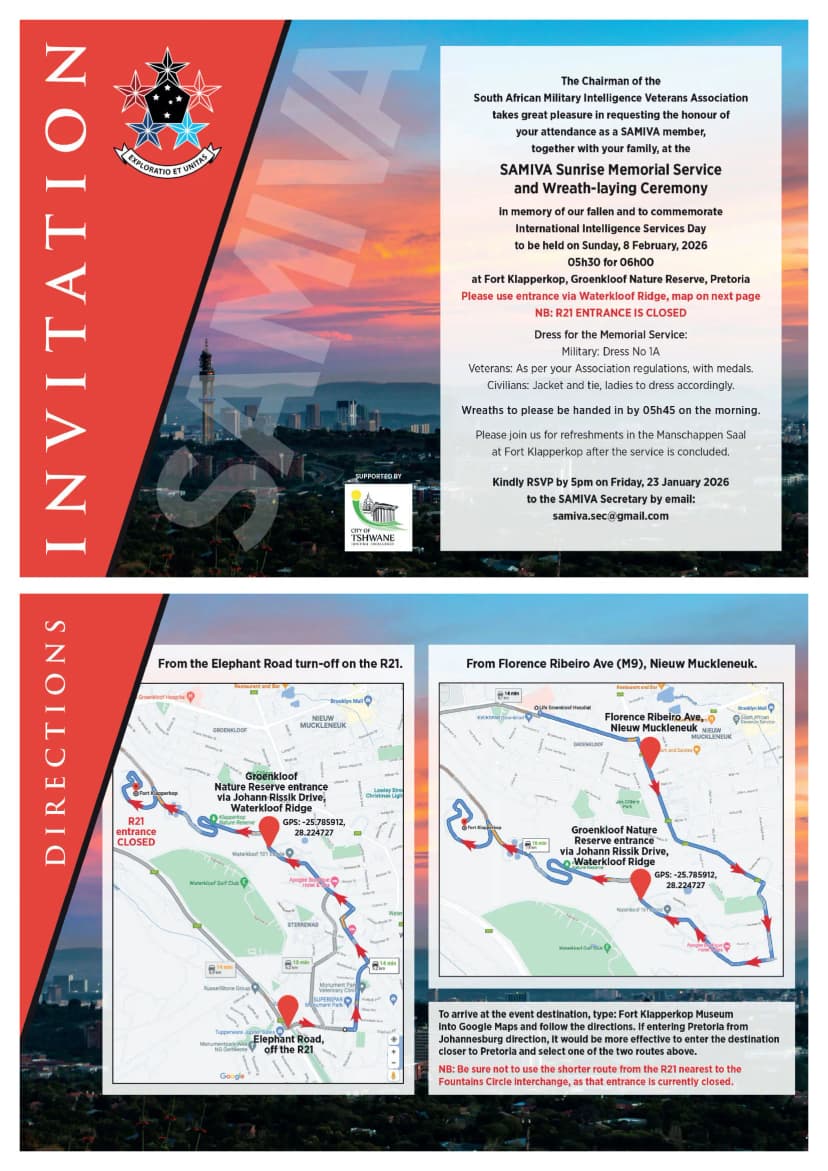
SAMIVA - South African Military Intelligence Veterans Association
SAMIVA SUNRISE MEMORIAL SERVICE: 8 February 2026
SAMIVA SUNRISE MEMORIAL SERVICE: 8 February 2026


1939 - 1945 2nd WW
Spotty Dog Roadhouse
The Spotty Dog Roadhouse in Retreat, Cape Town, is a whimsical and much‑loved landmark whose origins trace back to 1937–1938, when musician Ralph Barnes and his wife Enid created South Africa’s first dog‑shaped roadside restaurant. Designed with the help of an architect and built in secrecy, the two‑storey white dog with black spots quickly became a popular stop between Wynberg and Muizenberg, serving simple roadhouse fare and attracting families, sailors, and local farm communities. Its hollow cement‑and‑wire head, later the subject of wartime spy rumours, added to its mystique, while decades of pranks, repairs, and weather damage shaped its evolving appearance. After Ralph’s death in 1947, Enid managed the business until selling it in 1963. The original structure deteriorated and was nearly destroyed in 1972 when a runaway lorry crashed into it, leaving only memories and fragments cherished by local children. In 1988, Andrew Louw of Cape Concrete built a smaller ferro‑cement replica as a nostalgic tribute, later joined briefly by a “puppy” statue. Today, the 2.5‑metre replica still stands outside BUCO on Honeywell Road as a non‑functional but iconic symbol of local heritage. Maintained by Louw’s daughter, it remains a beloved reminder of Cape Town’s quirky roadside history, complete with enduring legends of wartime espionage.

Brokkies
Moleste Daar Doer Bo - Herman Toerien
Nongqai Rubrieke - Herman Toerien, Moleste Daar Doer Bo

1975–1976 grensoorlog
ROR: Ops Savannah
Abstrak Die kort mediaberig in Die Burger van 18 Desember 1975, waarin Minister P.W. Botha die verlenging van nasionale dienspligtiges se dienstyd en die opkoms van sekere burgermageenhede aankondig, het ’n kettingreaksie van logistieke, persoonlike en militêre gebeure ontketen. Hierdie vertelling fokus op die mobilisering van Regiment Oranjerivier (ROR) vir deelname aan Operasie Savannah, die administratiewe druk by die eenheid se hoofkwartier, en die ingrypende impak van die oproep op individue se gesinslewe, akademiese verpligtinge en beroepsroetes. Die verhaal illustreer die haastige, maar doeltreffende mobiliseringsproses van die Suid-Afrikaanse Weermag in ’n era sonder moderne kommunikasietegnologie, en bied ’n persoonlike blik op die spanning, onsekerheid en trots wat die voorbereiding en ontplooiing voorafgegaan het. Die uiteinde is ’n terugblik oor vyf dekades heen, met ’n kritiese vraag oor of ’n soortgelyke proses vandag met dieselfde spoed, akkuraatheid en professionaliteit uitgevoer sou kon word.

Military History
ROR Remembers
On 11 January 2026, former members of Regiment Oranjerivier (ROR) gathered at the NG Church in Melkbosstrand for a wreath‑laying ceremony commemorating the regiment’s involvement in Operation Savannah fifty years earlier. Led by former Honorary Colonel A.P. Stemmet, with support from Lt H.O. de Waal and RSM Karel Minnie, the event honoured the regiment’s fallen—particularly the single cavalryman lost during the operation. The ceremony drew strong attendance, including veterans who had served in Savannah and members who travelled long distances to be present. The church community, under the guidance of Rev Louw, offered warm hospitality. Participants expressed a desire to revitalise the Armour Corps Association in the Western Cape as a space for veterans to reconnect and preserve shared memories. The occasion evoked pride, reflection, and a deep sense of remembrance among all who attended.
1966 Beginning of the Bush War
Regiment Oranje Rivier (ROR)
Burgermag-regimente uit Kaapstad is destyds opgeroep, onder andere die Regiment Oranjerivier (ROR), wat in Desember 1975 gemobiliseer is. In Januarie 1976 het ons die grens oorgesteek in Angola en ons eerste verlies gely: ’n jong man van Kaapstad, ’n eggenoot en vader van twee klein kindertjies. Sy opoffering bly ’n wond en ’n erfenis.
Brokkies
Markus Wolf
Markus Wolf, long known as “the man without a face,” served as the elusive and highly effective head of East Germany’s foreign intelligence service (Hauptverwaltung Aufklärung - HVA) during the Cold War. Operating within the vast and intrusive Stasi security apparatus, Wolf built one of the most sophisticated espionage networks of the 20th century. His methods—ranging from deep-cover infiltrations to the deployment of “Romeo spies” who seduced West German officials—allowed the HVA to penetrate political and military structures at the highest levels. His most dramatic success came in 1974, when a Stasi agent infiltrated the West German chancellor’s inner circle, triggering a national political crisis. Although Wolf faced legal scrutiny after German reunification, many felt he never fully answered for the human and political damage caused by the Stasi’s operations. His legacy remains a stark reminder of how state surveillance, when unchecked, can turn ordinary citizens into instruments of a hidden and manipulative system.