NONGQAISouth Africa’s National Security MagazineEstablished in 1907
DONATE

All Articles


995 articles

BSAP
British South Africa Company Police (Rhodesia)

BSAP

This article provides a comprehensive historical overview of the formative years of the British South Africa Police (BSAP), tracing its evolution from 1889 to 1902. Emerging from the British South Africa Company Police and several regional mounted units, the BSAP developed as a uniquely paramilitary force shaped by Cecil John Rhodes’s imperial ambitions and the political dynamics of southern Africa. The narrative outlines the BSAP’s early operations, including its role in escorting the 1890 Pioneer Column, its involvement in territorial disputes with Portugal, and its participation in the Matabele War of 1893, the Jameson Raid of 1895–96, and the Matabele and Mashona Rebellions of 1896–97. The article highlights how the BSAP, “a police force in name only,” functioned as both a military and civil authority during the establishment of Rhodesia. It also details the organisational changes, uniforms, equipment, and the integration of various mounted police units into a single national force. Through these developments, the BSAP became deeply intertwined with the political, military, and colonial expansion of the region, laying the foundation for its later role in Rhodesian history. Quoted lines: “Thus was born Rhodesia’s national police force, the BSAP, quintessentially paramilitary…” “The Pioneer Column reached the site of the new country’s capital, Salisbury, on September 12, 1890.”


Bosletterkunde
Bosletterkunde

Bosletterkunde

Die bosoorlog as genre in die Afrikaanse letterkunde

Genl LG Snyman
1939 - 1945: The Wartime SA Police

Genl LG Snyman

The life & Times of Maj-Gen LG Snyman, MBE, of the SAP Brigade & SAP College

Gister se onthou
1975–1976 grensoorlog

Gister se onthou

Abstract 1: Koevoet Experience and Counter‑Insurgency Operations: This section recounts first‑hand experiences accompanying Koevoet teams during counter‑insurgency operations in northern Namibia. The narrative highlights the tactical differences between Koevoet and the SADF, the intensity of spoor‑tracking, and the dangers of improvised explosive devices. A vivid description of a patrol ambush illustrates the suddenness of violence: “Then there were an explosion and shrapnel whistled through the air.” The account also reflects on the cooperation between units, the role of helicopters, and the emotional impact of casualties, including the death of a tracker. Abstract 2: Pastoral Duties, Rural Infiltration and Civilian Vulnerability This portion describes the author’s pastoral responsibilities during periods of insurgent infiltration in farming districts. Farmers were restricted from using roads, making the pastor the primary link to town. The narrative conveys the constant threat of landmines and ambushes, as illustrated by the soldier who “sat with his nose almost against the window” while scanning for disturbed soil. The text also recounts earlier attacks on farms, the psychological strain on visitors, and the uneasy coexistence of danger and routine community life. Abstract 3: Divine Protection, Attacks on Oshakati, and Human Resilience This section reflects on multiple mortar and rocket attacks on Oshakati between 1985 and 1987, emphasizing moments of perceived divine protection. Mortars fell on both sides of the house, yet “not a single window was broken.” The narrative includes encounters with unexploded ordnance, narrowly avoided ambushes, and the emotional aftermath requiring psychological support. It also recounts the 1988 Oshakati bank bombing and the pastoral role in supporting bereaved families. The closing anecdotes introduce moments of humour amid tension, illustrating the resilience of communities living under constant threat.

Parlement 1972 of 1973
Military History

Parlement 1972 of 1973

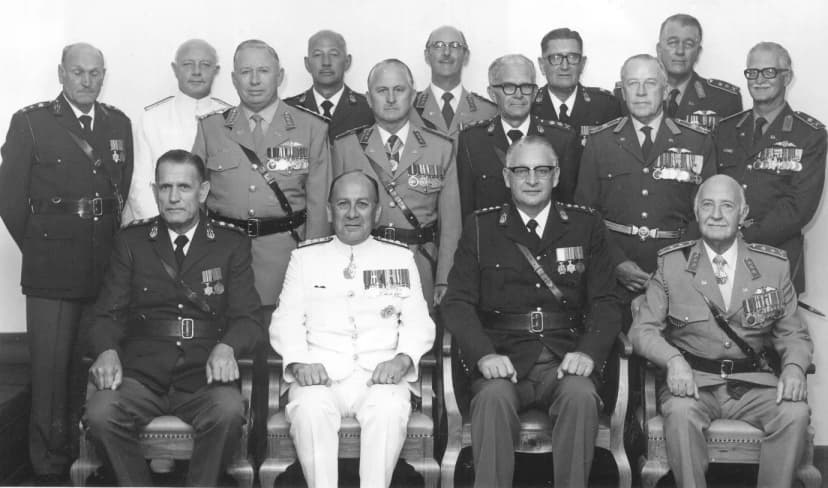
Opening of Parliament - 1972 or 1973 - General staff SADF & SAP at opening of Parliament

Goofy Vetten
SAP History / Geskiedenis

Goofy Vetten

1960's - Memories of SAP King's Rest

The SANDF’s Crisis Is Not Financial — It Is Strategic, Joan Swart
Africa and Global Power

The SANDF’s Crisis Is Not Financial — It Is Strategic, Joan Swart

South Africa’s defence crisis is often framed as a problem of insufficient funding. This article argues that the deeper challenge is one of strategic incoherence. Using the Clausewitzian framework of ends, ways, and means, it examines how misalignment between political ambition, force design, and available resources has contributed to the SANDF’s gradual erosion. The article contends that sustainable defence renewal requires sequenced institutional regeneration, realistic strategic prioritisation, and a revitalised defence-industrial base rather than aspirational expansion alone.

ZABS
1913 ZA Berede Skutters

ZABS

Abstract This short article examines the reorganisation of policing in the newly formed Union of South Africa between 1911 and 1926, focusing on the creation, structure, and eventual dissolution of the South African Mounted Rifles (SAMR). Established under Act 14 of 1912 and formally constituted on 1 April 1913, the SAMR unified several former colonial — the Cape Mounted Police, Cape Mounted Rifles, Natal Police, Orange Free State Police, and Transvaal Police — into a single paramilitary policing organisation. The SAMR comprised five geographically dispersed regiments supported by an artillery brigade of five batteries. From 1916, a Military Police detachment was incorporated into the establishment, with specialised duties performed from ordinary police stations and small garrison-based units such as the 14‑man detachment at Roberts Heights. Comparable detachments likely operated in other Union garrison centres. In 1920, the five regiments were disbanded, with 26 officers, 196 non‑commissioned officers, and 1,022 troopers transferred to the South African Police. The remaining personnel were consolidated into a single regiment stationed at Roberts Heights, which continued to function until its final disbandment in 1926. The study highlights the SAMR’s transitional role between colonial policing traditions and the emerging national police system of the Union.

Horses: ABW
1899 - 1902 Anglo Boer War

Horses: ABW

A Tribute to Horses during the Anglo Boer War

Water Police: Durban
Durban Borough Police * Durban Gemeentelike Politie

Water Police: Durban

Durban Borough Police - Water Police at Point + Photographs