NONGQAISouth Africa’s National Security MagazineEstablished in 1907
DONATE

All Articles


995 articles

Trump se Buitelandsebeleid
Donald Trump (President: USA)

Trump se Buitelandsebeleid

The article evaluates Donald Trump’s understanding of foreign‑policy principles during his second presidential term, beginning in January 2025. It explains how his America First approach reshaped the United States’ global posture by abandoning long‑standing alliances, treaties, and aid commitments established after World War II. Trump’s foreign policy is described as personalised, transactional, and commercially driven, prioritising national interest, economic leverage, and rapid deal‑making over traditional diplomacy. The article highlights Trump’s criticism of European allies, his pressure on NATO members to increase defence spending, and his belief that the U.S. has been economically exploited through trade imbalances. His administration bypasses Congress, relies heavily on loyal advisers, and sidelines career diplomats. The 2025 National Security Strategy outlines Trump’s aim to expand U.S. influence in Latin America and Asia while reducing focus on Europe. His unilateral tactics, including trade wars and extensive executive orders, raise concerns about weakening multilateral institutions and expanding presidential power. Scholars warn that Trump’s legacy may reshape future U.S. foreign policy and executive authority. Trump’s approach treats international relations as negotiations centred on geo‑economics, using economic and financial tools as primary instruments of national power. Alliances and regional agreements are judged by their contribution to U.S. prosperity, industrial capacity, and job creation. His strategy seeks to constrain strategic competitors and re‑establish U.S. economic security at the core of a more contingent, deal‑driven international order.

Henning van Aswege

Afrikaner en Suid-Afrikaner - Johan Mostert

Johan Mostert asks a tough question in this Nongqai article: Should South Africa search for a new value-based cultural and political system to solve the country's multiple layers of political, economic, social and cultural problems?

Col J “Tollie” Vreugdenburg
Crime Intelligence

Col J “Tollie” Vreugdenburg

This chapter provides a detailed account of one of South Africa’s most significant modern counter espionage investigations: the case of Navy Captain Bradley Stanford Morris. It contextualises espionage in South Africa by outlining historical examples of foreign intelligence penetration during the apartheid era, including the Kozloff and Wierzba cases, and the high profile treason conviction of Dieter Gerhardt. The chapter then documents the operational process followed by South African security structures—State Security Agency, Defence Intelligence, Crime Intelligence, and the Hawks—in identifying, infiltrating, and prosecuting Morris for unlawfully possessing and distributing highly classified military information. Through undercover operations, forensic searches, and extensive document analysis, investigators uncovered 43 sensitive documents and multiple security breaches. The chapter concludes with Morris’s conviction under the Protection of Information Act and reflects on the broader implications for national security, intelligence oversight, and the enforcement of Minimum Information Security Standards in South Africa.

1SWA Spes
1 SWA Specialist Unit

1SWA Spes

1 SWA Specialist Unit, or 1 SWASpes, was a unique South West African Territorial Force (SWATF) counter-insurgency unit during the Border War. Formed in 1977 as 101 Specialist Unit in Oshivelo (in 1980 became part of the SWATF), it combined horse-mounted infantry, motorcycles, expert trackers, and specialized dogs. The idea of this combined unit rose from the use of tracker dogs and mounted infantry that the South African Defence Force (SADF) at the beginning of the Border War.

Sergeant’s Ranks
SAP Black Members

Sergeant’s Ranks

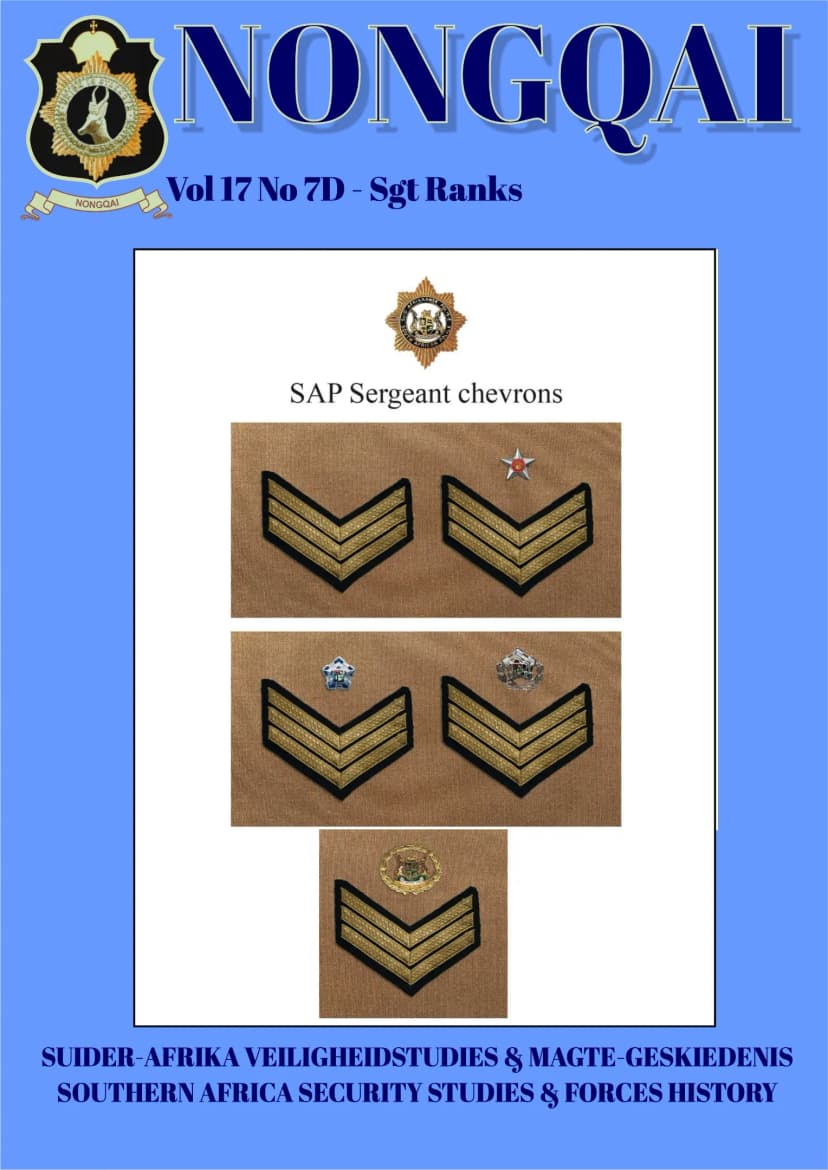
The research explains the different Sergeant ranks used in the South African Police during the 1960s and 1970s. It focuses on the ranks held by Non-White members and how these changed over time. It also describes the promotion system and the challenges faced because of racial discrimination. It highlights the service and achievements of several dedicated police members. The research aims to preserve an important part of South African policing history.

Kriptografie
Cryptology

Kriptografie

This article recounts the professional journey of Ida Steyn, who began working at the SAP/SAPS Security Branch in Potchefstroom in 1986 and later qualified as a cryptographer through the highly classified SAKSA training programme. She describes the demanding nature of cryptographic work, strict security protocols, and the responsibility of safeguarding confidential, secret, and top‑secret police communications. Steyn outlines the operational environment, including controlled access facilities, inspections, key‑card management, and the introduction of modern encrypted communication systems such as the Data 6. Her later appointment as crypto controller for the former Wes‑Transvaal province illustrates the high level of trust, discipline, and integrity required in police cryptographic operations. The article preserves an important part of South Africa’s policing and intelligence heritage. “Kriptografiese toerusting is gespesialiseerde kommunikasietoerusting… om Vertroulike, Geheime en Uiters Geheime inligting veilig te versend en te ontvang.” “Dit was ’n posisie wat groot verantwoordelikheid, absolute integriteit en onwrikbare dissipline vereis het.”

Strategic Petroleum Stocks: A Test of South Africa's National Strategy, Joan Swart
Defence Policy and Strategy

Strategic Petroleum Stocks: A Test of South Africa's National Strategy, Joan Swart

South Africa's draft Strategic Petroleum Stocks Policy is about far more than fuel security. It signals a renewed appreciation that national resilience cannot be left entirely to market forces, and that strategic endurance requires deliberate investment before—not during—times of crisis.