
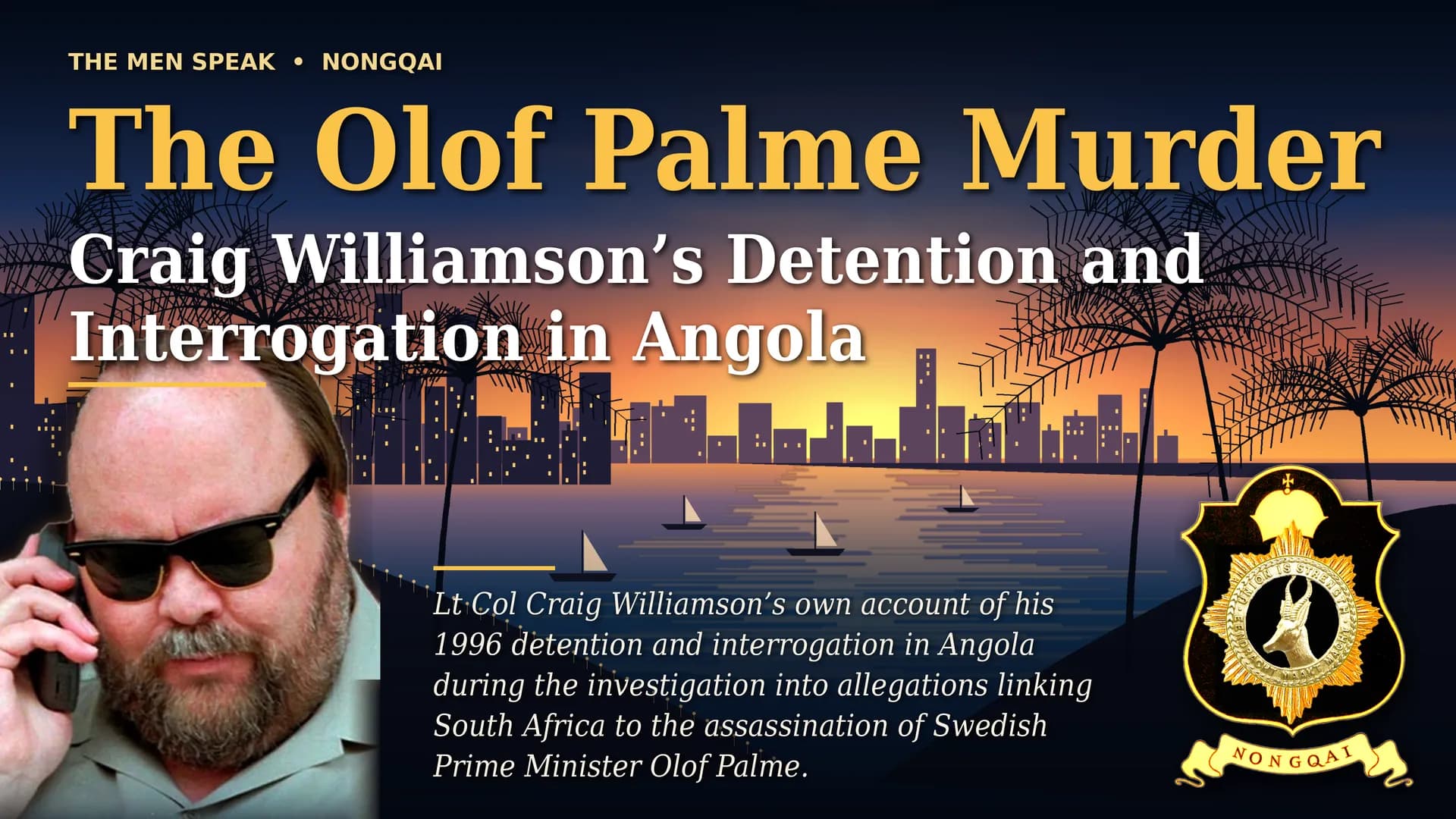
The Olof Palme Murder - Craig Williamson's Detention and Interrogation in Angola
Lt Col Craig Williamson relates his detention and interrogation in Angola during the investigation into allegations linking South Africa to the assassination of Swedish Prime Minister Olof Palme.
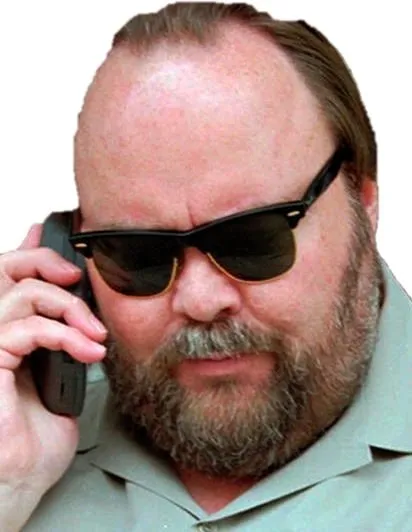
Two decades ago, in September 1996, during his evidence in mitigation of sentence, Eugene de Kock alleged that the killing of Swedish Prime Minister Olof Palme had been carried out by a covert intelligence operation, "Longreach", of which I was the commander. Longreach was a project of the South African Defence Force (SADF) Chief of Staff Intelligence, Directorate of Covert Collection (CSI DCC).
In reality, the operation codenamed Longreach did not yet exist at the time of Palme's death on 28 February 1986. I was appointed as a Commandant (Lieutenant Colonel) at CSI DCC on 1 January 1986, and my first task was to coordinate with and assist a group of influential American political figures who were to tour South Africa and the operational area in South West Africa/Namibia. The purpose of the visit was part of a lobbying effort aimed at persuading the Reagan administration to supply UNITA with Stinger missiles.
On 28 February 1986, I organised the group's visit to Military Intelligence offices in Pretoria, where they were briefed on the Angolan war by Major General Tienie Groenewald. Ironically, it was General Groenewald who, years later, told a Swedish journalist that Palme's killing had been a South African operation headed by me.
Longreach Ltd. was, in fact, a shelf company purchased later from an offshore management company in the Channel Islands for use as a private military company (PMC) providing security and intelligence services to governments and corporations.
In 1987, I resigned from the SADF and was nominated by the National Party to stand in the general election of that year. I subsequently served on the President's Council of the tricameral Parliament until 1990, when I resigned and entered business, largely in Angola.
In October 1996 (a month after De Kock's allegations during his criminal trial) I was in Luanda, staying at the Hotel Tropicó, when I was suddenly confronted by journalists seeking my comments on De Kock's allegations. Before I had any opportunity to investigate the matter or formulate a response, I was detained by a group of armed Angolan State Security agents and transported to a cell in a facility near the international airport.
My detention and interrogation were overseen by Colonel Fernando Miala, now a General and Director-General of the State Intelligence and Security Service (SINSE). The interrogation was rigorous and prolonged, involving repeated and highly detailed written statements in a style reminiscent of the Stasi and KGB.
Miala remained in continuous contact with Swedish and South African officials involved in investigating alleged South African involvement in the Palme murder. In South Africa, those involved included the Minister of Safety and Security, Sydney Mufamadi; the Minister of Justice, Dullah Omar; and the Attorney General, Klaus von Lieres und Wilkau. On the Swedish side, Chief Prosecutor Jan Danielsson and the head of the Palme murder investigation, Detective Superintendent Hans Ölvebro, travelled to Luanda and interrogated me on 18 October.
One of the matters raised by the Swedish investigators was an allegation that I had supplied Eugene de Kock with the handgun allegedly used to kill Palme. I confirmed that I had given De Kock a pistol, specifically a Heckler & Koch P7 9mm, but not the .357 Magnum revolver believed to have been used in the assassination.
Conditions in the cells were poor. There was no light other than that which entered through a hole in the roof. A hole in the floor served as a toilet, and a concrete slab as a bed. During the day, I was permitted access to a high-walled exercise yard open to the sky. It was there that I found a plastic milk crate to sit on.
Curiously, the crate was branded Douglasdale Dairy, located approximately one kilometre from the house where I grew up in Johannesburg. Fortunately, a group of South Africans working with Executive Outcomes had recently been held in the same cells and, true to military form, had left the place in a reasonably clean condition.
Water was supplied from a drum swarming with mosquitoes, and I refused to drink it or eat the food provided. As I had trading stock in my Luanda warehouse, I was able to arrange a barter for food and bottled water from a nearby Lebanese restaurant.
The only unpleasant incident during my detention occurred when I was discovered to have a mobile phone, which I had been using to communicate. South Africa's National Intelligence Service had my Johannesburg home telephone tapped and informed Miala that I was not, as he had assumed, completely incommunicado.
Apart from that incident, I was treated with respect, probably because I was personally well known to Angolan security officials and to several of the senior officers involved in my case. In 1987, as a member of the President's Council, I had been involved in facilitating the first direct contact between President Eduardo dos Santos and President P.W. Botha. After leaving politics and right up until my arrest in 1996, I had maintained close business, political and personal relationships in Angola.
Shortly after the Swedish investigators completed their questioning I was informed that I was free to leave Angola and that the South African Police were dispatching an aircraft to return me to South Africa. I was driven to the airport to await the SAP flight.
I did not wait.
Instead, I purchased a ticket on a commercial flight to Windhoek and from there caught a connecting flight to Johannesburg.
© nongqai.org
Write to us about this article
Do you remember this, or know more? Your comment appears here once an editor has read it.
The editors may print your comment, with your name, in the monthly edition.
Related Articles
National Intelligence Service – Covert Collection
October 28, 2026
NONGQAI SERIES THE MEN SPEAK Dr Willem Steenkamp
February 24, 2024

The Daisy Spy Ring
March 30, 2025

The Daisy Spy Ring: About Maj Craig Michael Williamson (RS 167) and his Clandestine Overseas Operation of how the SA Communist Party was infiltrated locally and abroad during the Cold War.
September 13, 2025
Admiraal Dieter Felix Gerhardt
July 17, 2026