NONGQAISouth Africa’s National Security MagazineEstablished in 1907
DONATE

All Articles


995 articles

Various Crimes
Contemporary Police History / Eietydse Polisiegeskiedenis

Various Crimes

This publication records a selection of important criminal investigations conducted by dedicated police officers over many decades. It highlights their commitment, skill and determination in bringing offenders before the courts. It also recognises the long hours, personal sacrifices and teamwork required to solve serious crimes. Above all, it honours the officers who served with integrity and the families of victims who finally received answers and justice. It is a tribute to those who worked tirelessly in the pursuit of truth and justice.

SAP Long Service Medal
1906 Bambatha Rebellion (Medal)

SAP Long Service Medal

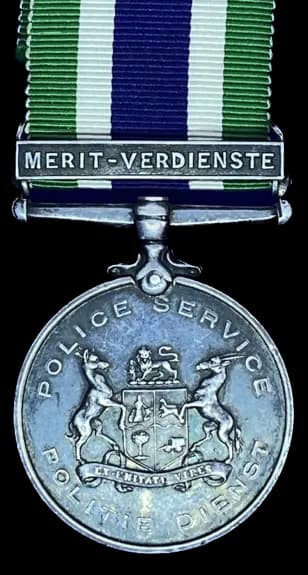
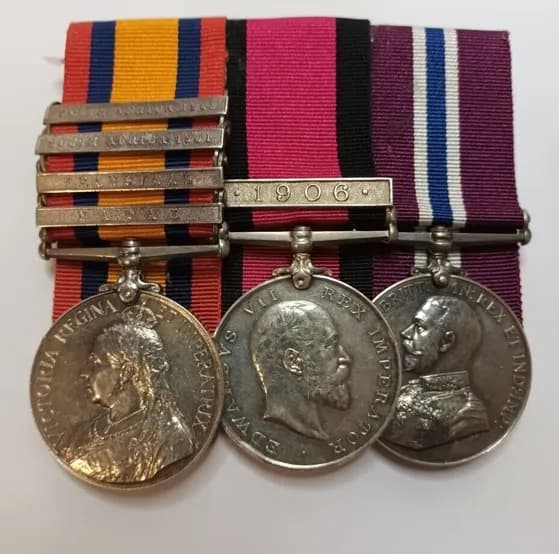
This article explores the long and distinguished policing and military career of Grade 1 Head Constable Charles Detmold Robbins, a Natal Policeman who later served in the 2nd South African Mounted Rifles (SAMR) and earned the Permanent Forces of the Empire Beyond the Seas Long Service & Good Conduct Medal. Robbins’ service reflects the transitional period during which the Natal Police were absorbed into the newly formed Union Defence Force and South African Police, with the SAMR assuming policing duties across Natal. Robbins participated in the Anglo Boer War, earning the Queen’s South Africa Medal with bars Natal, Transvaal, South Africa 1901, and South Africa 1902. He also served during the 1906 Natal Native (Bambatha) Rebellion, receiving the 1906 Medal with Clasp. His shooting achievements were notable, winning multiple competitions including the Hine Cup in 1912. His long service award, although earned in 1911, was only issued in 1916 after administrative delays. The medal is particularly interesting because it bears a police rank on a military long service medal, reflecting the hybrid nature of SAMR service. Robbins retired in 1923 as a state prosecutor and died in 1940, leaving behind a legacy intertwined with the evolution of policing in Natal and the early Union period. “The medal is named No 710 1st GDE. HD. CONST. C.D. Robbins 2nd SAMR.” “He served in the Boer War with Natal Police… earning the Queens South Africa Medal with bars.”

Const WL Bos/ss
1906 Bambatha Rebellion (Medal)

Const WL Bos/ss

This article examines the complex service history of Constable William Lodewyk Bos/Boss, a member of the South African Mounted Rifles (SAMR) who later transferred to the South African Police (SAP). His career illustrates the transitional period in South African policing after Union, when militarised police forces evolved into national services. The article contextualises the development of long‑service awards, including the Permanent Forces of the Empire Beyond the Seas Long Service and Good Conduct Medal and the later Police Good Service Medal, instituted under Government Notice GN938 of 8 June 1923. Constable Bos/Boss’s military and police service included participation in the 1914 Afrikaner Rebellion, the German South West Africa campaign, and later enlistment in the Union Defence Force during World War II. His unusual change of surname from Bos to Boss, confirmed only by a newspaper notice, highlights administrative irregularities of the era. Despite disciplinary infractions that could have disqualified him, he ultimately received the SAP Good Service Medal in 1949. The article reconstructs his career through service records, force orders, medal documentation, and family history sources, offering a detailed case study of early 20th‑century South African policing and medal policy. “The award was to be known as the Police Good Service Medal…” “A letter dated 2nd January 1920… confirms to staff records at HQ that William Bos has changed his name to Boss.”

Helena M. Jacobs
Civilian Women

Helena M. Jacobs

Helena M. Jacobs recounts a distinguished career in the South African Police Service marked by dedication, resilience, and unwavering integrity. Beginning her service in 1990 as a clerk in Ogies, she went on to support several specialised units, including SANAB, Serious Violent Crime, Legal Services, and Organised Crime. Her journey reflects both professional challenges and profound personal loss, notably the tragic passing of her daughter in 1999, during which her SAPS colleagues offered exceptional compassion and support. Jacobs played a vital administrative role in complex investigations, high pressure environments, and sensitive case preparations, earning recognition as Gauteng’s second best Support Employee of the Year in 2014. Her career stands as a testament to the indispensable contribution of administrative personnel within policing, and she retires with a legacy of loyalty, discipline, and meaningful service to her country.

Capt Jan Taillard (SA Police)
1939 - 1945: The Wartime SA Police

Capt Jan Taillard (SA Police)

Captain Johannes “Jan” Taillard (1904–1987) was one of South Africa’s most effective and least known undercover policemen. Fluent in German and trusted across social divides, he played a decisive role in dismantling the Nazi Party in South West Africa in 1939, stealing the complete membership index and enabling the arrest of 2 284 members. In 1941 he infiltrated anti government networks in the Brits district, gained the confidence of Abwehr agent Robey Leibbrandt, and led him into a police ambush — an operation that prevented a planned assassination of Prime Minister Jan Smuts. Taillard’s long police career included senior command posts in Queenstown, Umtata, Johannesburg, and Cape Town, where he managed political unrest, labour strikes, and major security operations. Despite his contributions, his pension was severely affected by a break in service during undercover work, and his later life was marked by hardship. He died in 1987 without honours or police representation at his funeral. His story remains one of the most remarkable — and overlooked — chapters in South African policing history.

S/G/C/Sgt VR Moodley
Generals of the SAP

S/G/C/Sgt VR Moodley

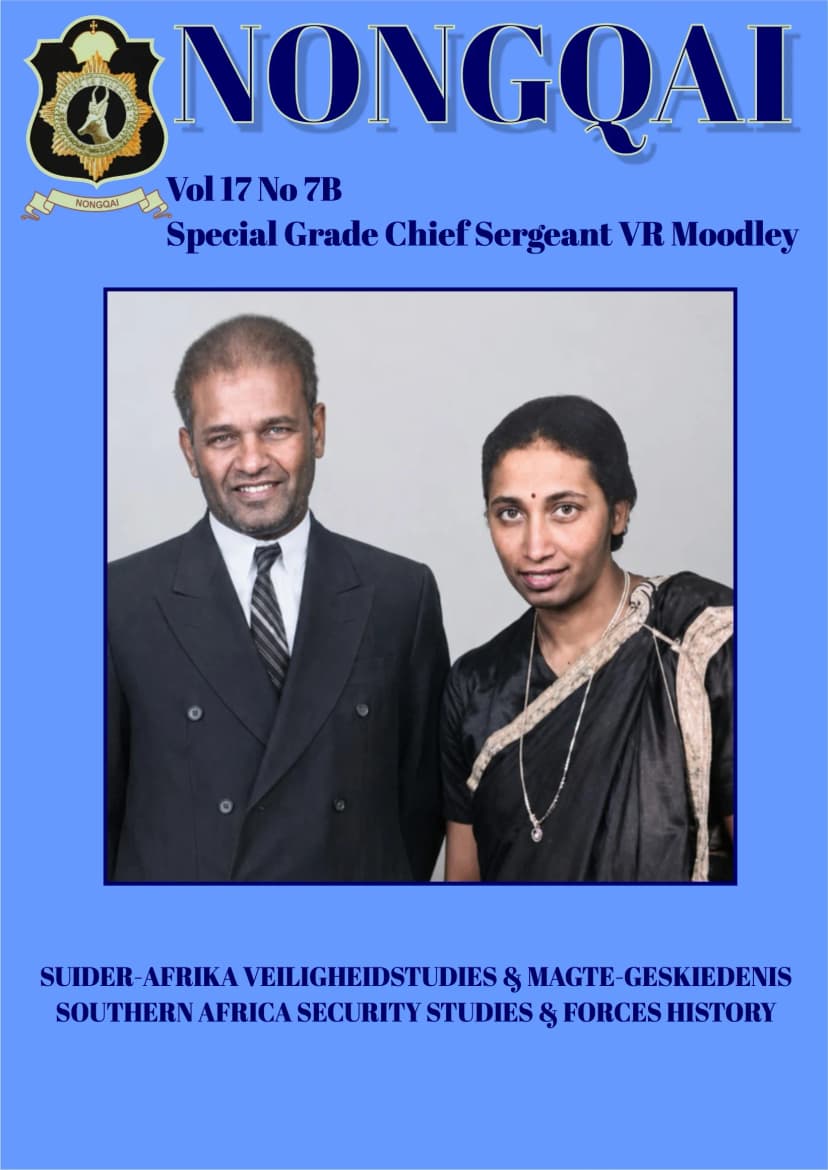
Nongqai Vol 17 No 7B - Special Grade Chief Sergeant VR Moodley was one of the first Indian police officers to achieve senior rank in the South African Police. He served with dedication for 39 years and became a respected detective and leader despite racial barriers. His work in Pietermaritzburg, Durban, Cato Manor and Chatsworth helped improve policing and inspired future generations of officers. The biography highlights his achievements, awards, family life and lasting contribution to South African policing history. It honours his courage, professionalism and commitment to public service.

Det/Head-Const. LWJ Arangies
Contemporary Police History / Eietydse Polisiegeskiedenis

Det/Head-Const. LWJ Arangies

Detective Head Constable Lourens Wilhelm Johannes Arangies served nearly 36 years in the South African Police, distinguishing himself as one of the most capable detectives of his era. Joining the force in 1913, he worked through major events such as the 1914 strike and later became a key figure in the Criminal Investigation Department. Arangies was renowned for his exceptional ability to gather, interpret, and connect information, a skill that contributed to solving an estimated 500 murder cases. His career included service in Johannesburg, Durban, Newlands, and Krugersdorp, where he rose to the respected rank of Head Constable. He volunteered during World War II, earning the Africa Service Medal and the Good Service Medal. Arangies played a decisive role in several high profile investigations, including complex murder and robbery cases between 1934 and 1946. He retired in 1949 and passed away in 1969, leaving behind a legacy of dedication, investigative excellence, and service to his community.

1988: SAP-Obelisk Kimberley

1988: SAP-Obelisk Kimberley

This article reconstructs the history and significance of the South African Police (SAP) 75th Anniversary Commemorative Obelisk unveiled on 15 October 1988 at SAP Headquarters, Transvaal Rd, Kimberley. Drawing on first hand recollections, limited archival sources, and contemporary media enquiries, it highlights the role of Brigadier “Klokkies” De Beer in initiating the project and the collaborative efforts of SAP members and police sport clubs in funding the monument. A central feature of the obelisk is a sealed time capsule containing messages from Northern Cape municipalities, transported to Kimberley during a symbolic torch relay by young police members. Intended for opening during the SAP centenary in 2013, the capsule remains unopened due to institutional changes after 1994, raising questions about its present condition and historical value. The article situates the obelisk within the broader administrative landscape of the Kimberley police complex in 1988 and reflects on its symbolic meaning for the generation of SAP members who contributed to its creation. Despite limited surviving documentation, the study underscores the monument’s enduring heritage significance and the importance of preserving such commemorative artefacts for future historical inquiry.

W/O JR David
Motor Cycles

W/O JR David

John Raymond David’s life is a story of hard work, determination and service. He was born in Estcourt, KwaZulu-Natal Midlands and grew up with strong family values. From a young age, he dreamed of making a difference. Through dedication, he built a respected career in the police service. He faced many challenges but never gave up. His leadership, honesty and courage earned the respect of others. He always believed in serving the community with fairness and compassion. His journey shows the importance of discipline and perseverance. His achievements continue to inspire future generations. His legacy is one of honour, integrity and lifelong public service.

SAPS Forensiese Wetenskapslaboratorium
SAPS - Forensic Science Laboratories

SAPS Forensiese Wetenskapslaboratorium

South Africa’s Forensic Science Laboratories (FSL) are facing a severe operational crisis marked by extensive DNA backlogs, lapses in mandatory medical surveillance for analysts, and concerns over equipment maintenance and processing capacity. These failures undermine the integrity of criminal investigations, particularly in cases involving rape, murder, gender based violence, and serial offenders. Effective forensic science management requires strict quality control, adequate staffing, proper training, and regular on site inspections by senior officers—yet these inspections appear inconsistent or absent. The Democratic Alliance’s (DA) recent alarm highlights the urgent need for decisive intervention by the South African Police Service (SAPS) to restore full laboratory functionality, protect analysts, and ensure timely justice for victims. This article examines the systemic weaknesses contributing to the crisis and outlines the critical questions SAPS must answer to rebuild public trust in forensic processes.