
 AI image
NONGQAI's Mission and Editorial Policy Explained
Preserving the history of South Africa's Forces by affording contributors a modern publication platform and archiving

Translated from Afrikaans with AI and checked by our editor.
[Two-minute read]
From the Executive Committee
1. Our Mission:
1.1 Preserve the History of the South African Forces
The greatest truth about any history is that it has many facets. Historical “truth” is practically never singular. In any war there are always at least two sides – with each side experiencing and understanding that shared reality in its own way. If only one side records its own “truth” (while the other side does not bother to write down its version), then the historical record will inevitably be one-sided.
NONGQAI’s preservation of the history of our Forces – as told first-hand by those who were there, in their own words as they experienced and understood it – therefore serves to balance the overall historical record. We welcome contributions across the entire spectrum of South Africa’s military, intelligence, diplomatic, policing and security history – with the understanding that true balance requires that every institution, rank and role be heard. So that later generations will have the full story available, illuminated by the personal experiences and motivations of every side – and can then draw the right lessons from it.
We value honest reflection, shared in good faith, requiring that the basic human dignity of former participants in the conflicts of the past is respected.
NONGQAI is a platform for each contributor’s “own truth”, because therein is reflected the driving forces and rationalisations that determined the course of the dynamics of the past. Not as propaganda or excuse – but authentically placed on record without malice. Also without trying to glorify the past or wanting again to live in it – but knowing that later generations should not be left at the mercy of the danger which the Nigerian thinker Chimamanda Ngozi Adichie rightly identified as “the danger of the single story”.
Because our story also deserves to be preserved, so that the record will be complete.
1.2 Promote Strategic Understanding and Insight, for South Africa’s Future
Besides preserving the history of our security, intelligence and diplomatic institutions, NONGQAI also aims to contribute to a better understanding of South Africa’s present-day as well as future strategic interests.
In a changing, multipolar and increasingly interconnected world, it is essential not only to preserve our historical experiences, but also to use the lessons from them to understand and deal with present-day strategic challenges.
NONGQAI therefore seeks to offer a platform for informed discussion, research and analysis on South Africa’s defence, national security and strategic management, with particular attention to the development, protection and use of national assets and capabilities that underpin our sovereignty, security and resilience.
This focus recognises that history and strategy are inseparably linked: our historical experiences, institutional heritage and past strategic decisions offer important perspectives on the choices and challenges facing South Africa today and in the future.
2. Editorial Policy
2.1 Seeking contributions from across the spectrum
NONGQAI’s editorial policy is geared towards fulfilling our mission. Meaning, to have the history of our Forces illuminated from as many angles of experience as possible, as well as to examine present-day strategic issues from diverse perspectives. NONGQAI is therefore a platform for preserving its contributors’ “truth” – as an institution, the NONGQAI magazine therefore does not itself have an agenda or viewpoint on any aspect of our Forces' history that we wish to impose. The content of any contribution we publish is strictly the responsibility of the individual contributor.
Now, taking into account our mission that we also want to see the “side” of the statutory forces in the conflicts of the past find its place in the historical record, and do not want “single stories” to dominate by default, it follows logically that we will have to apply the same policy with regard to covering the many-faceted way in which our contributors experienced their own statutory institutions at the time. We do not tamper with the substance of the contributions received, other than language editing in accordance with our magazine’s style norms and basic grammar and spelling editing.
The same principle of diverse perspectives and informed debate also applies to contributions on present-day strategic issues. NONGQAI provides space for different analyses and viewpoints on South Africa’s defence, national security and strategic interests, without prescribing a particular political or ideological point of departure.
This does not mean, however, that there are no requirements regarding the relevance and substantive quality of contributions. When contributions are presented as in-depth historical analyses (as distinct from the sharing of personal experiences), they must be supported by reliable sources. The distinction between facts, personal memories, interpretation and opinion must be clear to the reader.
2.2 What we DO NOT permit
What we will NOT publish is:
- Party-political advocacy or attacks;
- Religious polemics;
- Plagiarism or excessive use of the work of others without copyright acknowledgement;
- Defamatory allegations, polemical disputes and attacks on the personal integrity of others;
- Obscenities; and
- Advertising for personal gain.
2.3 What we as editors don't do
We will also definitely NOT CENSOR contributions (i.e., withhold them from publication) because others may differ from a given contributor’s “own truth” about a particular institution or events.
2.4 What to do if you as reader do not agree with a contributor's version
When someone disagrees with a contribution, the remedy is to use the comment function on our web journal, and/or to send in your own contribution with your "own truth". Provided it is the ball that is being played and not the man, and that your replicating contribution meets the relevance and quality requirements of our editorial policy, you can be assured that we will publish your contribution / comment. Because for us (and futire generations of reserearchers) it is about the completeness of the record in all its authentic, honest diversity – that is what future generations will find most valuable (remember how enforced one-dimensional groupthink was responsible for so much damage in the past).
In the larger historical picture, the very reason for NONGQAI’s existence is drawn from the fundamental principle of “hear the other side” (“audi alteram partem”). Because our former statutory forces’ “side” must also be heard and placed on record. And, similarly, any views alternative to what another contributor may have published (as long as the objective is elucidation, and not personal crucification).
In the same way, therefore, the full diversity of views from people within those former statutory institutions must also be freely heard on the who, what, how and especially the why of what had really happened within departments and between departments (without wanting to fight the old bureaucratic internal battles all over again). With, of course, full opportunity for anyone to comment or to submit a contradictory / supplementary article for publication.
Because, from such diversity of input which illuminates from different angles of personal experience our Forces' history, the complex truth (and the lessons to be learnt from it) best comes to the fore.
Thank you for your understanding – we look forward to your contributions!
(For new contributors, please send your drafts to: admin@nongqai.org with a copy to: editor@nongqai.org)

© nongqai.org
Write to us about this article
Do you remember this, or know more? Your comment appears here once an editor has read it.
The editors may print your comment, with your name, in the monthly edition.
Related Articles
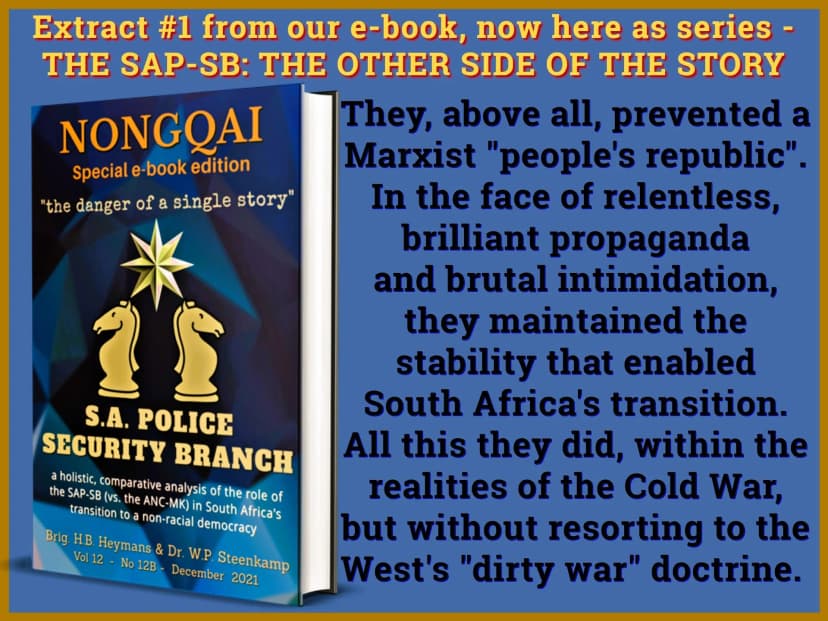
S.A. Police Security Branch and the Armed Struggle: Part 1
November 19, 2023

South Africa's Transition What Really Happened and Why
July 23, 2026
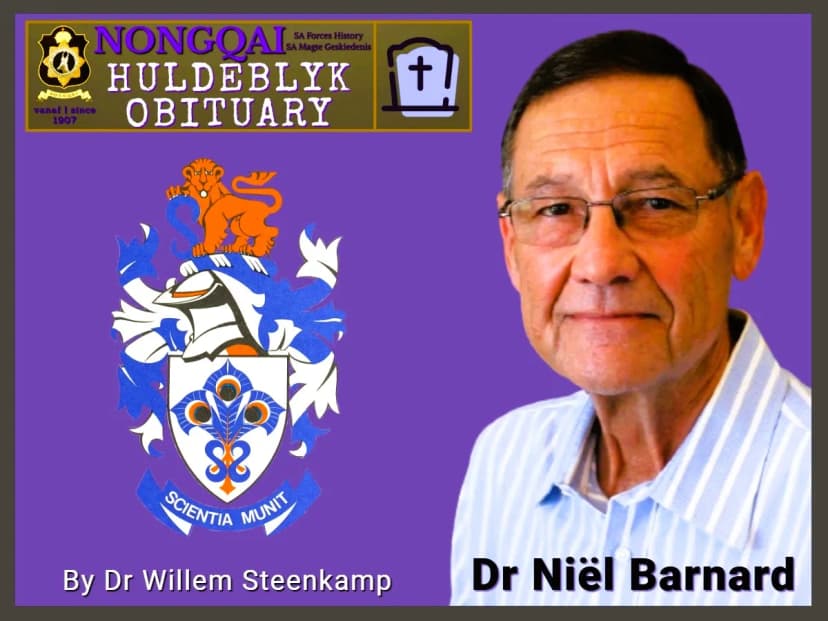
Dr LD (NIëL) BARNARD - AN APPRECIATION
February 7, 2025
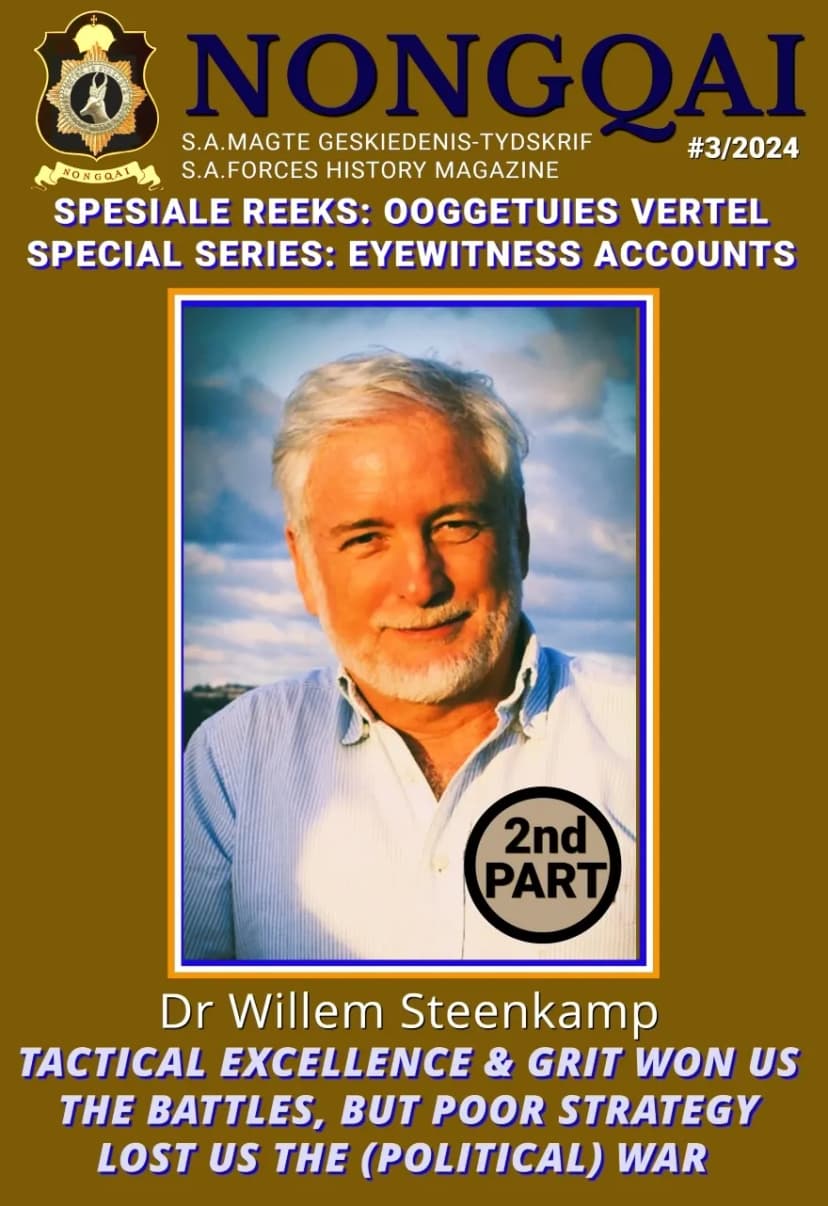
NONGQAI SERIES THE MEN SPEAK Dr Willem Steenkamp Part 2
March 1, 2024
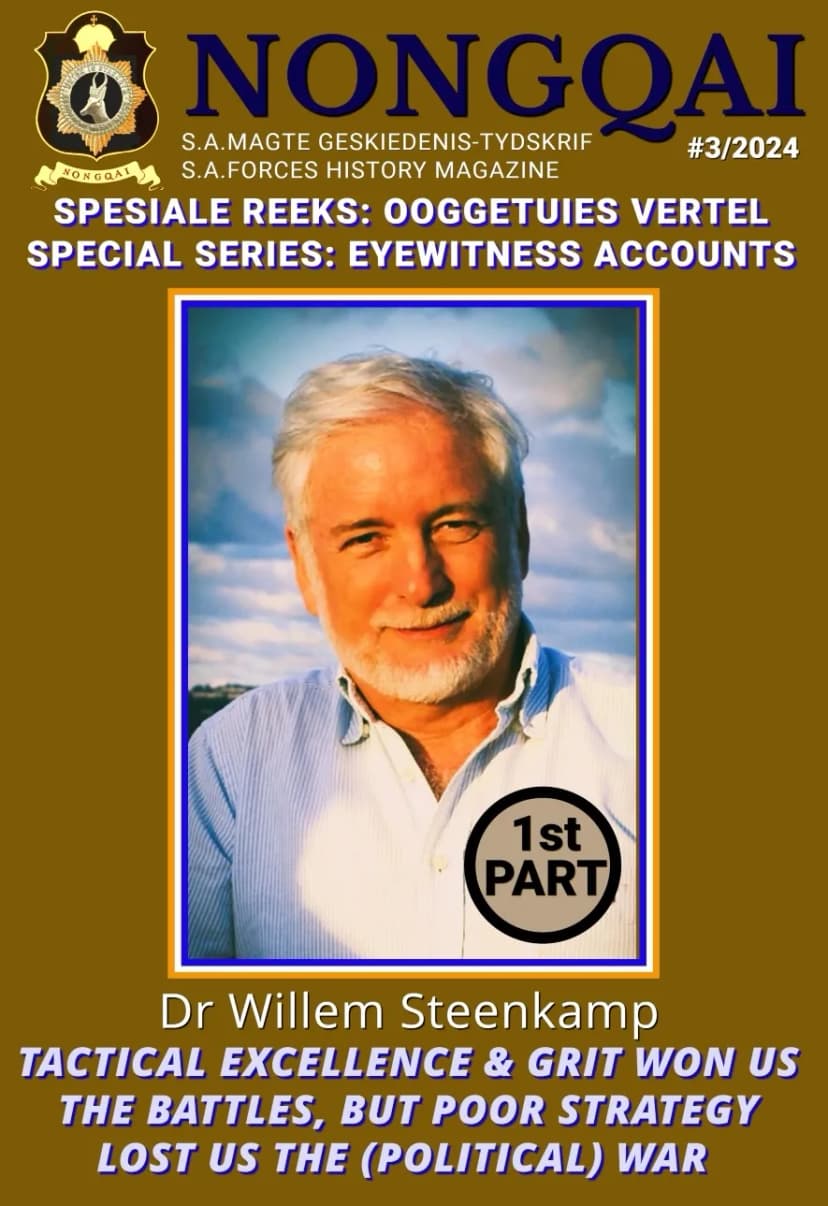
NONGQAI SERIES THE MEN SPEAK Dr Willem Steenkamp
February 24, 2024