 AI image
Part 1
One of the elements of the civilian intelligence service in South Africa was its deep secrecy. Very little is on record about their actions, modus operandi, tactics and training. This is how it should be, given the highly sensitive nature of their mission, but the unintended consequence of this deep secrecy is that journalists use the absence of verifiable information as proof of nefarious activity.
The purpose of this article is to bring about some clarification of the activities of the Chief Directorate Covert Operations (CDCO) that existed within NIS from 1986 to 1994. This meant that they were only in existence for eight years. That is a very short time to build a self-sufficient entity that was capable of operating at strategic level, in a profoundly hostile environment, with no collateral damage.
Let us unpack this to understand why it was created in the first place, how it developed its own operational doctrines and protocols, and what the impact was.
Why was the CDCO created?
The simple answer is that in 1985 at the Kabwe Conference held in Zambia, a formal decision was made to integrate underground MK combat operations directly with the mass civilian uprisings and boycotts that were taking place in South Africa. For more details of this the reader can consult the documents entitled The Anatomy of a Policy Dilemma in South Africa (Part 1): The African National Congress (ANC) and the South African Communist Party (SACP)[1] and The Anatomy of a Policy Dilemma in South Africa (Part 2): The Pan Africanist Congress[2].
The Kabwe Conference therefore changed the nature of the threat facing South Africa in a fundamental way. This policy shift was first signalled in a public statement made by Oliver Tambo in January 1985 in which he spoke of the need to “make South Africa ungovernable” by making “Apartheid unworkable”. This launched what came to be known as the People’s War for which the security forces were ill-equipped.
The reason they were ill-equipped was the simple reality that part of the ‘peoples war’ was ‘armed propaganda’, which was supported by a sophisticated coalition of anti-apartheid forces operating out of London, Amsterdam and America. The big lesson that had been learnt by NIS came from the unintended consequences of the bombing of the Penton Street offices of the exiled ANC/SACP in London in 1982. The fallout from this was entirely detrimental to national security in South Africa, because it provided evidence of an ‘unreasonable’ and ‘unjust’ state, that was unwilling to listen to the ‘reasonable’ aspirations of the masses. This became powerful propaganda that created a growing wave of hostility across Europe and the Americas. More importantly, it fed into two very dangerous dynamics that were already discernible in the early 1980’s.
- South Africa had lost its capacity to counter any propaganda when the Info Scandal destroyed the only means available to counteract the messaging. The Anti-Apartheid Movement consistently outclassed any government initiative to counter their effectiveness. This was a simple reality.
- Britain was a strategically important country for South Africa, because they carried substantial diplomatic leverage. Of greater relevance was the fact that Britain was resisting the call by other nations to totally isolate South Africa. The bombing turned that strategic ally into a powerful enemy unnecessarily. It also made operations against the ANC/SACP in London and Europe riskier than they should have been.
How was the CDCO Created?
There had been considerable experimentation taking place within the NIS in the early 1980’s. I cannot mention all the names because of sensitivities, but pioneers include ML, MS and JJ, who first experimented with covert structures outside of South Africa. These had some degree of success, so many lessons were learnt, but all were dependent on support from an embassy. This was problematic for two fundamental reasons:
- What if diplomatic relations are severed in response to events like the Penton Street bombing in 1982? This meant that all knowledge of tactic and strategy that was based on the assumption that embassy presence could be used for operational support was inherently flawed. Therefore, to rely on those tactics, and the training that encapsulated those methods, was the weakest link in the national security chain.
- All embassy staff is under routine surveillance by the host government, so all personnel used in these early experiments were potentially compromised. This meant that to incorporate those persons into the new covert units, would create a structural security risk from the moment of inception.
To overcome these two fundamental challenges, a decision was taken that the CDCO must be created using only ‘clean’ members. By ‘clean’ I refer to people who had never been exposed to any foreign counter-intelligence service by virtue of them having operated out of any structure that had even the slightest link to an embassy.
With this now clearly defined, a dilemma was created. A dilemma is something for which each possible alternative solution is unappealing.
The NIS dilemma is defined by the two questions:
- How can we create an effective covert operational capacity, capable of functioning for extended periods of time in a foreign hostile environment, without the risk of accidental compromise by bringing in members of the early experimental teams that had knowledge, but were also potentially known to foreign counter-intelligence agencies?
- How can we be maximally effective in the shortest time with the least risk of unintended consequences that would in all cases be used against us as propaganda?
To deal with these two dilemmas, the CDCO was created as a deeply compartmented sub-structure, at roughly the same time that the SADF created Project Barnacle, which evolved into the Civil Cooperation Bureau (CCB) over time. Details of the CCB can be found in The Anatomy of a Policy Dilemma in South Africa (Part 3): The Security Force Hawks and Operation Katzen[3]. At headline level the question of how the CDCO was created can be summarised as follows:
- Only ‘clean’ members were recruited, typically from other security force formations in which they had already proven themselves as being capable of their new mission.
- The management level of the CDCO consisted of seasoned NIS members with deep experience in past operations such as Daisy. For example, the Director K2 was a key player in Operation Daisy.
- There was deep compartmentation between the sub-sub-structures below directorate level. The need-to-know principle was strictly enforced upon pain of prosecution.
- On the vertical scale there were cutouts that were rigidly applied between Concilium – The Office of The Chief Director Covert Operations (K1) – the two main deep cover operational Directorates K2 (Internal Covert Operations) and K3 (External Covert Operations) – and the deep cover Directorate of Special Operations (K4).
- So strict was the application of the need-to-know principle that nobody in K2 or K3 were aware of the existence of K4. To the average operational member, the CDCO consisted only of K2 and K3.
- The truly pioneering work was conducted within K4, most notably by K44, which rapidly amassed a skill set of considerable depth and range.
- The challenge was how to integrate these highly skilled specialists into one coherent team capable of operating independently in a foreign hostile environment without any embassy support.
- A structural challenge related to the training program, because all existing skills in NIS were housed within the Intelligence Academy, but few of those skills matched the operational needs in a foreign hostile environment.
- For this reason, K44 developed techniques, doctrines and tactics that could execute surgical operations with the lowest risk of diplomatic blowback, in the shortest possible time.
- K44 pioneered the concept of small teams in the CDCO, replicating the success of a similar approach in the Special Forces[4] of the SADF[5].
- These skills were then transferred to the covert operators through dedicated interventions conducted by the covert training wing.
- An unintended consequence of this was structural tension between the CDCO and the Intelligence Academy that had to be managed, but could not be mitigated, for the simple reason that time was not on our side.
- As noted in the introduction, the CDCO only existed for eight years, so it was impossible to liaise with the Academy, convince them to adapt their training curriculum, and maintain the necessary levels of secrecy in the timeframe required.
- The outcome of this is a persistent hostility towards any member of the CDCO, who is typically accused of being ‘arrogant’, ‘maverick’ and ‘aloof’.
- This is not uncommon among the elite units of the world, of which the CDCO has a legitimate place of pride.
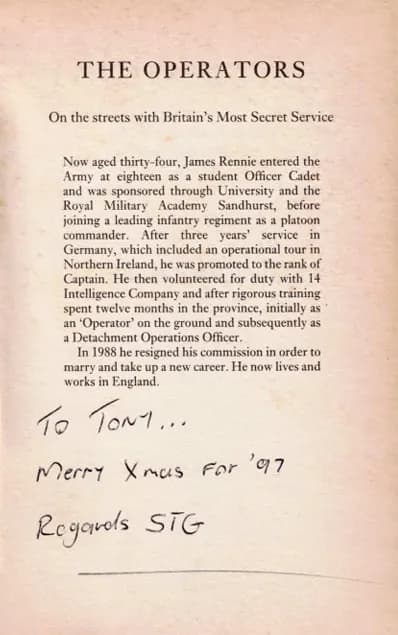
- For an analogy the most accurate comparison is with a special close-in surveillance unit created by the British for their operational requirements against the IRA. Through the same process of trial and error that the CDCO experienced, the British developed a highly effective capability known as 14 Field Security and Intelligence Company. Very little is publicly known about these operations, but a few good books have been written. These include The Operators[6], One Up: A Woman in Action with the SAS[7], and She Who Dared: Covert Operations in Northern Ireland with the SAS[8].
- Learning specifically from these operational tactics, K2 and K3 made extensive use of women, who were highly disciplined, extremely effective, and fully capable of doing anything that their male counterparts were tasked to do. To place a number on it, maybe 1/3 of all covert operators within the CDCO were women. They were generally capable of speaking multiple languages before recruitment, and in all cases were highly effective.
What was the Impact of the CDCO?
I have evaluated this impact in considerable detail in my forthcoming book, The Faceless Few: The Evolution and Impact of South African Covert Operations[9]. This has been peer reviewed by professionals with considerable insight, so it is as accurate as we can get, in a subject that is highly classified, about which nothing has been published. Most of the sources are public domain, so the challenge was to piece together easily verifiable information that negated the need to use classified documents as source material. This took three decades to complete. To summarise the impact of the CDCO, it is safe to say that they consistently avoided controversy and never resulted in a major diplomatic incident. The closest we came to that situation was a debate in the British House of Parliament over the discovery of an electronic surveillance device in the home of Howard Wolpe. This was covered in the British media[10], but it never became a major incident capable of causing the withdrawal of diplomatic recognition to the South African delegation. In other words, the collateral damage was minimal, in accordance with the mandate given when creating the CDCO.
The other major positive impact was that no member of the CDCO ever had to apply for amnesty from the Truth and Reconciliation Commission (TRC). This created a high level of credibility at a time when other security force structures were being ravaged by mistrust and TRC investigations.
On the benefit side of the strategic balance sheet, we find the Track II Diplomacy Initiatives that eventually resulted in constitutional reform through the negotiated ending of the armed struggle shown in Figure 1. Note how fast the CDCO was able to hit the ground running, because these Track II Diplomacy Initiatives started in 1987, just months after the CDCO was created. It is this speed and tactical agility that defined the CDCO.
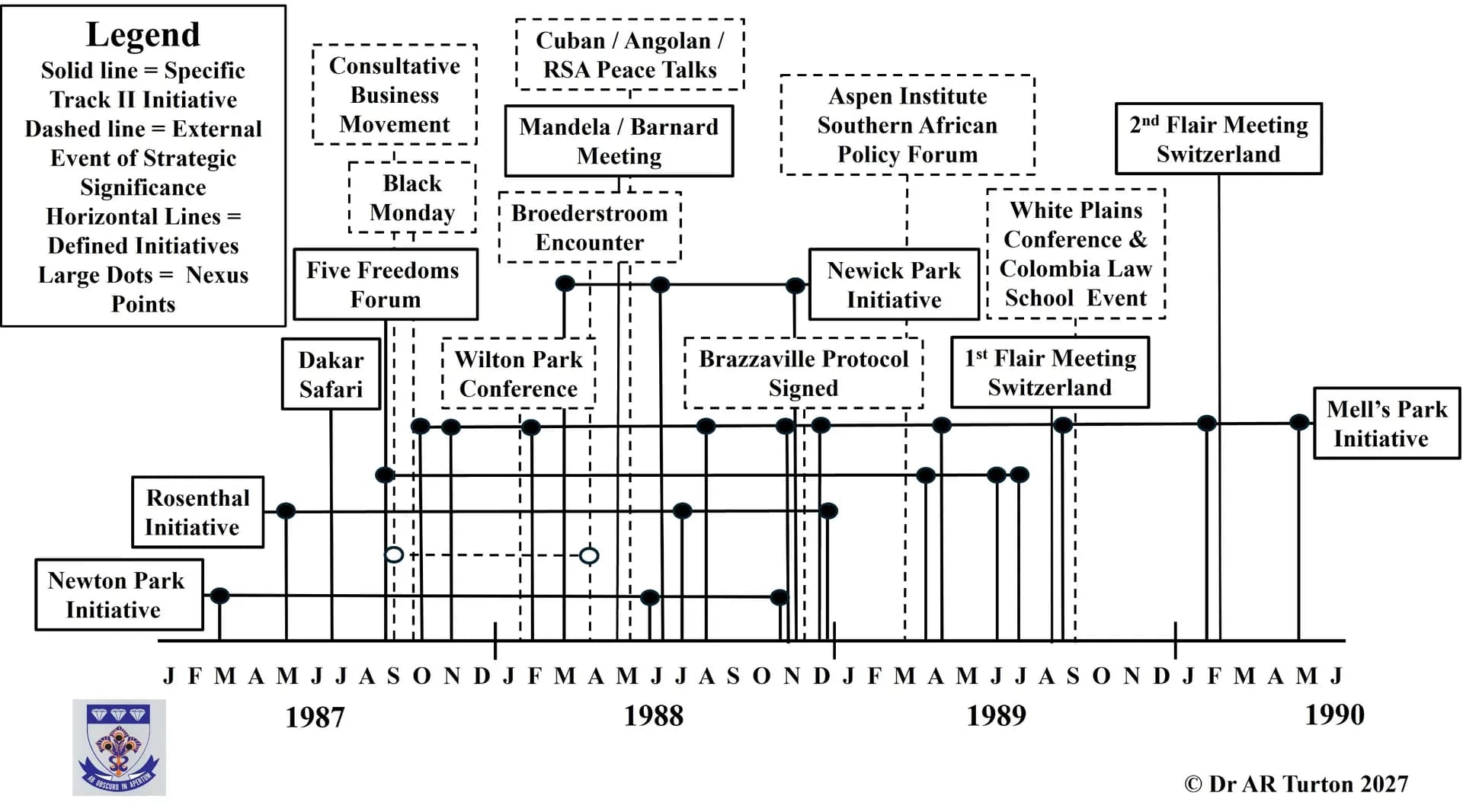
For more details of these events the reader is referred to The Anatomy of a Policy Dilemma in South Africa (Part 4): The Security Force Doves and Operation Flair – The Unseen Burden Behind South Africa’s Negotiated Transition[11].
While there is currently a lot of anger over the long-term outcome of the CODESA talks, with many speaking of betrayal, there is little genuine analysis of what happened, why it happened and what we need to do next as a nation in perpetual distress.
This is where Nongqai plays a significant role. By capturing our history, we can learn lessons about what we did right, and where we went wrong.
Conclusion
The CDCO was a remarkable unit that we should be collectively proud of as a nation. It was tasked to engage in strategic level operations that had never been conducted before in the history of South Africa. This implied a rapid rate of learning and adaptation as the tactical needs dictated. No comprehensive history of the unit has ever been written. Where it has been written about, it is typically by outsiders who have no real knowledge about the inner working of one of the most top-secret organs of the South African security forces. Insiders, with the capacity to record that history, are incentivized to remain silent by virtue of the anger that has persisted. This is a pity, because if anything, the CDCO was a highly successful entity engaged in an asymmetrical war where the opposition had a powerful propaganda capability that could not be matched in the time available. While those veterans are still alive, it is now time to document their proud history. The operational circumstances that drove the need for absolute secrecy, are no longer present. Therefore, to hide behind the fact that nothing can be written about highly classified matters, merely perpetuates that power asymmetry.
The real history of the CDCO is about agility, adaptation, devolved leadership and meticulous planning. While the circumstances have changed, these core aspects will always be relevant, so they deserve to be captured, recorded and analysed in an objective manner. This is what Nongqai is all about. Let us set aside our petty rivalries and start to respect what we, as a collective in the South African Security Forces, were capable of achieving against enormous odds. This is our collective history. Let us celebrate it with humbleness, pride and wisdom.
…………………………………………………………………………
Part 2
This article has been prompted by three recent developments that have played out on the Nongqai platform. These are:
- A challenge of the validity of statements made by Johan Lotriet about K44.
- An accusation by Prof Fanie Cloete that my “hands are dirty”.
- Actual statements made by Johan Lotriet about K44.
Collectively these have prompted me to respond, which I do comforted by the fact that Nongqai is assembling the oral histories of veterans before they die.
As a point of departure, I wish to make a clear statement.
As a professional I have always believed that “facts are our friends” and that accountability is an essential part of any organization tasked to operate in secret. Therefore, I note that I have responded directly to Prof Cloete on the thread where he named me directly. I will therefore not respond further as it is unnecessary. The same applies to the allegations that the CDCO did not really exist, the logo is a fraud and the appointment of all members in leadership positions is invalid because the documents were not printed on NIS letterhead.
My answer to all these accusations is simple. The very fact that they have been made, and apparently supported by archival “evidence” to “prove” those allegations to be correct, are nothing more than validation of the effectiveness of the level of compartmentation, the unwavering application of the concept of plausible deniability, and the strict enforceability of the need-to-know principle that were the foundation of the CDCO.
The CDCO was created to be invisible, and guess what? We have been proven to be invisible. That has always been the sole objective.
Stated differently, the foundations of all that is to come about the evolution and impact of covert operations in NIS rests on (a) the strength of the concrete, and (b) the quality of the steel reinforcement used. Strong concrete and good steel enable enduring structures to be built. The durability comes from sceptical interrogation by people like Prof Cloete and others levelling these accusations. The more we are accused of misrepresentation, the stronger becomes the case we present, because each step in that process will have been tested and found to be truthful. Each gap in our story will have closed.
Facts are our very best friends – and we are the Faceless Few.
My First Introduction to the CDCO
In the 1980’s I was busy with four core activities.
- As a conscripted soldier I was reaching the end of my mandatory 720 days of active service in the Armoured Corps of the SADF.
- I was running a business, employing about 50 people, in an unstable economy where interest rates were running into the 20% range and trucks were being hijacked daily.
- I was operating as a contract agent for O61 being handled by SvD (Steve 1) and SW (Steve 2) as the alternative. Line functionally we fell under FS.
- I was studying part time to educate myself about what was happening in my country.
Then, one day when I was being debriefed by SvD, I was introduced to a senior NIS officer that wanted to talk to me. His name was MB. He was a humble man but with a mind like quicksilver and piercing eyes partially obscured by bushy eyebrows. He spoke up to me, which was odd, because he was clearly senior to SvD, who was my handler and therefore senior to me. I was at the lowest rung of this chain of authority, and yet the most senior man in that chain was talking up to me. This unsettled me somewhat, because it was totally out of left field.
In the SADF all leadership spoke down to their subordinates, so I had been brainwashed to accept that this was normal.
The conversation was interesting because it was clear to me that I was being “felt out” but I could not determine why this was the case, or what the objective was. After a while – maybe a few days – I was again called to a debriefing by SvD. I cannot recall if MB was present, but in essence I was invited to submit paperwork to initiate the process of testing my suitability for a new unit that was being created. I had no idea what the unit was about, or precisely what they saw in me as a potential candidate. All I knew was that the economy was being ravaged by high inflation, labour unrest and seething violence as a relentless campaign of bombing, necklacing, and social decay was making all commercial activity very risky. My business was not flourishing as a result, and my experience as a conscripted soldier in the cauldron of the East Rand Townships, had told me that the military was unable to manage this problem.
I had experienced that first-hand as Two Nine Foxtrot operating out of Esselen Park into the seething volatility of Thokoza, Katlehong, Vosloorus and Tembisa.
I therefore put in the paperwork required. Reams of documents about my lifestyle, my circle of friends, my alcohol consumption and a full declaration of my personal financial situation. This was fed into an invisible machine that I knew nothing of, at a time of profound uncertainty where the livelihoods of my ±20 employees, and their ±100 family members, was weighing on me like a massive burden.
The process of vetting took some time, so I simply got on with my life and continued with the four activities noted above. Two things then started to crystalize out for me. Firstly, I realized that South Africa was becoming ungovernable, and the SADF had no clue about how to deal with this. Secondly, I realized through my studies, but also through my ongoing contact with NIS members like MB, FS and SvD that there was an alternative. Professors Deon Fourie and Marie Müller, with whom I had developed an intellectual relationship, were teaching me things I had never heard of before.
I did not yet know what that alternative was, but what I saw comforted me. These were quality people. These were quietly professional people. These were enigmatic people because they had minds like quicksilver and piercing eyes beneath bushy eyebrows that peered into your soul, without speaking a word. These people were fundamentally different from the Hawks I had often encountered in the SADF, all full of the bluster of tough talk, but collectively devoid of any coherent plan that I could believe in. These were not talkers. These were thinkers and doers. They understood stuff.
I liked all of this because it came as a breath of fresh air blowing across a landscape of growing despair. Here I believed I could prosper and grow.
When the vetting was completed, I was invited to a safe house where I underwent psychometric testing and a full psychological evaluation. This included an IQ test. I met the polygraph machine for the first time and was fascinated at the jiggling movement of those needles as each question was asked and answered in rapid succession. Apparently, I passed the polygraph and psychometric testing. I was comforted by the fact that I was apparently not a psychopath, but I was concerned when the results indicated that I was an introvert. This is not how I saw myself, but I accepted the results from what was a thorough assessment conducted by highly qualified specialists.
Silence for the next few days. I paid attention to the woeful reality of my business, and I resigned myself to the fact that I simply had to keep the cashflow going because I had no alternative.
Then a phone call from SvD, again summonsing me to a meeting. This time MB did all the talking and SvD simply listened. In short, I was offered a job with a salary and benefits including medical aid, housing allowance and a car. This was a lifeline under the prevailing economic circumstances of truck hijacking, political unrest and inflation above 20%. When I asked what the job was about, I was told that it was too sensitive to talk about.
I wavered.
But I was also excited after years of futility in my army uniform, doing things I knew were incapable of making our country safer again. We were unprepared for the Peoples War. Maybe this was my chance to engage in that war? Not as a chest-beating macho soldier behind a Browning machine gun that was useless in the theatre of war – the townships of the East Rand – Katlehong, Tembisa, Thokoza and Vosloorus.
I was reminded of the experiences of a famous British soldier named Lisle March Phillipps, serving with the imperial cavalry unit Rimington’s Guides, who captured this harrowing reality in his contemporary account With Rimington in the Boer War[12]. His skillful description of their mission to burn the houses of the Boer women whose husbands were out on Commando resonated with me. I did not like the feeling. It placed me on the wrong side of history, but I was unable to change anything. I was not Phillipps, and I was reminded of my grandmothers’ admonition “that I must never forget that I am a Botha” even if I carried the name Turton through a quirk of cultural praxis.
Here I was being offered a job, in an organization I knew very little about, other than my compartmented contact with O61, without any clarity of the task at hand, or the objective to be reached. All I had was my long-term trust in FS, SvD and SW, and the newly forming confidence in MB.
I was learning about trust and confidence in leadership, something I had never experienced in my 12 years of service as a conscripted soldier in the SADF.
I signed the papers and was given a letter of appointment, on a blank piece of paper, without any letterhead or corporate branding, citing a file reference number that was alien to me. This was processed and I was given instructions to prepare myself for training at an unidentified location. From that moment things moved fast.
I closed my business down. One of my members of staff named Lenny – a veteran of the Battle of Ebo that I had taken under my wing to help him sort his life out – committed suicide. Apparently, the security that I provided was what was keeping him going, and now, faced with a new reality, he was unable to cope. His death is something I carry with me constantly. I console myself that I had done the best I could, with what I had available, and that was all I could do. He made his choice and I made mine.
This argument somehow seems hollow, but it is all that I have, for there is nothing more.
Meeting the K4 Team
Someone came to fetch me on my first day. I never learnt his real name. Even to this day I don’t know what it was. Let us call him Jan. I cannot even give him an initial because I never knew his surname. He drove me in his new VW Jetta to the home of another member of the team, in the vicinity of Megawatt Park. There I was introduced to KD, HB, BB and a man that introduced himself as Dries. Many years later I learnt that Dries was actually Johan Lotriet, but I never knew that at the time.
First impressions matter.
At that stage of my life, I was super fit, running half marathon distances with ease. The others were generally quiet and unengaging. The vacuum between us seemed to be overpowering, tempting me to fill it with something. I resisted. We were like shadows flitting in the underbrush of a forest, mostly concealed from view, except for those fleeting moments when someone spoke. There was no chest beating here. No macho warrior stuff puffed up to hide the underlying confusion that I had experienced in the army. None of us knew each other. We did not know each other’s real name and were told to keep it that way. The less we knew the less we could reveal if captured. Each had an operational name. Mine was Terry, so everyone knew me as that person. Dries was clearly in a leadership position, but his exact role was unclear to us all. MB was given the name Snuffles and Mike Kühn, who I had not yet met, was called Napoleon. People spoke with reverence of Napoleon. I wondered why but said nothing.
Now I ask the reader to imagine this.
Any normal social engagement starts by exchanging names. This establishes identity. You are John and she is Mary, but I am Peter. The next normal step is to ask where you live, or where you went to school. This places John, Mary and Peter in a social context. They become more than just a name. Suddenly common denominators become evident. If you are John that went to St Stithians, then you must know Brian who also went to that school and played lock in the rugby team. This is how the strands are brought together to create a network that slowly evolves into group identity.
Think of Ubuntu. I am because you are and therefore, collectively we also are.
None of this was possible. We were each lonely shadows floating in a gossamer cloud of anonymity, but now part of something neither of us knew anything about. Yes, we all knew that we were now part of NIS, but not one of us knew anything about the structure, administrative procedures and hierarchies within that structure. At best we knew that we were now part of something called K4, but none of us knew what that actually meant. I was one of the few that knew that O61 existed. Dries seemed to know about other structures within NIS, but certainly not too much detail.
I believed that we were called K43, whatever that meant. It was only decades later that I learnt I was wrong. We were in fact K44. Dries told me that when we met at a farewell party given by veteran covert operators as I was emigrating from South Africa to Australia. He showed me his letter of appointment to prove it.
The same letter that someone later said is fake because it was not written on letterhead with a logo. The letter that shaped my life for the next decade of reality at the cutting edge of change. The letter that did not exist, but actually did, in an alternative universe separated from the rest of the world by a flimsy membrane of invisibility.
We clung to that invisibility, because instinctively we knew it would be our only protection, once we were told what the mission was. None of us were issued with any identity cards, because officially we simply did not exist.
We were the Faceless Few.
Conclusion
All that we knew was that each of us had been selected for some or other reason that none of us was aware of. None of us knew how to execute the most basic administrative function. When writing an internal letter, it must be addressed to someone and have a certain format and reference number. None of us knew anything about this level of detail. We were shadows unwilling to expose ourselves to each other, flitting around in a vacuum, hiding in the undergrowth of a forest. None of us knew the names of the spouses and whether each had a family. We didn’t even have an office to work from. We all knew that each had served either in the police or military, but none of us knew in what capacity. We knew that Napoleon was somewhere out there, but we never saw him. We knew that MB was obviously in charge, but he never cracked the whip and always spoke up to his subordinates. He always treated us with respect, which was a new experience for me as a former conscripted soldier that had only been shouted at, and spoken down to for twelve years. We knew that Dries was in a leadership position close to Snuffels, and we knew that he came from the Railway Police Special Task Force that no longer existed, but it was also clear that he was unfamiliar with the administrative role and function he was executing. None of us had come through the “system” known as NIS, so we were all flying blind without any common navigation point to help us to determine where we were at that moment in time. Then came the big shock when our salaries did not materialize as promised, and I was unable to pay the bond on the new home I had just purchased, using a financial guarantee that apparently never existed.
I quietly asked myself if I had jumped from the frying pan of financial insecurity, into the fire of hell, as the suicide of Lenny, my former employee, slowly ate me away from the inside.
…………………………………….
Part 3
So, there I was, alone and confused. I had closed my business down, moved off the family farm, and bought my first house in the wide world that was alien to me. I did this in faith because I trusted Snuffels (MB) when he made me the offer that I accepted. I believed him that my salary would be paid and that I would receive a housing allowance to cover my bond repayment. The salary was not big, but it was a salary that would come every month. That was new to me. My business was a farming operation, where I generated the cash to pay others. I had not received a salary for years while running my own business employing others at a time when interest rates were climbing to 20%. I would get the leftovers after paying the staff and other bills.
Two shocks came in quick succession. The first was the delay in the salary and the second was the absolute shock that NIS rules dictate that a housing allowance only happens after a year of service. This was like throwing a bucket of cold water over my head. Doing the maths, it was clear to me that with my promised salary, minus the promised housing allowance, I was unable to pay my building society bond and still have money left to put bread on the table to feed my family.
Had I been lied to? Could I really trust these people?
This is where Dries (Johan Lotriet) came in. He was the steady hand on the tiller, explaining to me the challenges of establishing a deep covert structure. Through him I learnt of the complexity of being so invisible that head office never knew we existed. This meant that pension and medical aid records could not exist, for their very presence would provide a paper trail that any skilled counter-intelligence investigator could mine to compromise us. Dries was working like a man possessed to solve these problems. I was unaware of the complexity at that stage.
He solved the problem partially by initially paying salaries with brown envelopes until the official system could be set up and secured. This was the very first lesson that came out of the Faceless Few. There are consequences to being faceless. Your pension contribution cannot be listed in the NIS group payment to the fund manager. Your medical aid contribution cannot be recorded, and you cannot go to the NIS doctor or dispensing chemist if you needed something for your family health.
You were faceless, but part of a team. It was that team that mattered, not the individual. Survival in the vacuum of that space that never existed, but really did, required a team effort.
The first problem that was solved was the need to manage the incompatibility of a rigid civil service bureaucracy, with the fluidity of the operational world that depended on total invisibility. This was done by creating what we called a Nodal Point.
How The Nodal Point Worked
Let us call NIS the mother ship. Radiating from that central massive entity was a single umbilical cord that linked the first tier of the covert structures to that mother ship. This was like a placenta embedded in the womb of the mother. Nutrients and oxygen were exchanged across that placenta, but the two living organisms – mother and foetus – each had separate blood systems, organs and personalities. That umbilical cord was attached on the covert side to K1 for which Mike Kühn (Napoleon) was legally accountable. His office was ostensibly a commercial one, located in a business park type of setting. Central to this was the Nodal Point. In that nodal point a set of personnel files was kept for each covert member. The only thing visible on the outside of each file was the ‘service number’ and what we called the ‘service name’ of each member. My service name was Roger Cronin, and I was asked to develop a signature to be stored in that file for record purposes.
This had legal implications, because NIS was built on a culture of accountability. This lesson had been learnt in the BfSS days when the Info Scandal destroyed the service, so Dr Niël Barnard and his executive team had built an administrative system that institutionalized accountability by recording each transaction for audit purposes. Therefore, my service name of Roger Cronin was a legal link to every signature I would ever make, for all transactions ranging from a financial claim for the reimbursement for operational expenditure, to the most sensitive information reports I would submit to the Chief Directorate Research. The use of a ‘service name’ created a legally accountable identity for a person that was otherwise invisible.
This was smart, because like the placenta that separates two blood systems, it retains full legal accountability through a consistently applied audit system. In the case of an audit, the information in that one file could legally prove that Roger Cronin was Anthony Turton. Anything signed by Roger Cronin, that was not authorized, would constitute fraud that Anthony Turton would be accountable for. Every authorization signed by Roger Cronin was filed at the Nodal Point, under a precise reference system, that any auditor with the necessary security clearance could audit at will.
The second part of the enabling system was the allocation of unique service numbers to all members of the CDCO. The first few digits were encoded in a way that nobody ever thought about, but still created iron-clad accountability. This is how it was done:
- Each member of the CDCO was given a service number with a unique sequence of the first few digits. I will not say what that sequence was, because it is still classified.
- No member knew the service number of other members, so they never compared them to figure out the coding for themselves.
- Each time any transaction was made with higher authority, that number was used as part of the reference system.
- Administrative personnel selected for Nodal Point duty were regularly vetted and given the top security rating possible.
- Only those vetted administrative staff were allowed to deal with any document that had as an official reference, the personal number of each member.
- If they were not cleared to deal with that sequence of numbers, they were legally obliged to hand that document over to someone that was legally cleared.
This was bureaucratic stuff, but it was very important because it became the skeleton around which the entire CDCO was built. That construction happened fast because time was not on our side, and any flaw in the architecture of this central support system would later come back to haunt us.
Snuffels (K4) and Mike Kühn (K1) were both accomplished administrators, capable of meeting the legal and audit requirements, while simultaneously rolling out a formidable machine that was being assembled. Dries (K44) was an excellent implementer, because he understood the need for completed staff work, and he established that process within the team.
Finding A Home
With the nodal point now established, the admin flowed smoothly. Salaries were paid on time and medical aid claims were dealt with efficiently through the Nodal Point. This created the head space needed to find a suitable home for the K44 team that was still being assembled. Dries took the lead on this matter and found us a suitable place on a small holding in what was then known as the Halfway House area. This was chosen for various reasons. It was not in Pretoria, but close enough to it for Nodal Point interaction. There was an industrial area with many companies operating normally, but located adjacent to an area of smallholdings, some of which were becoming commercial. There was enough normal “noise” to provide sufficient cover for us to disappear in.
Our first structure was a large private estate that had a spacious home on it, but with enough distance to build in our own security systems. As with all things of this nature, there were niggles. The first arose from the fact that our cover was a commercial one, representing a company that had a significant footprint into Africa. When the neighbours got to hear of this, they protested, thinking that their peaceful peri-urban lifestyle was going to be destroyed by a fleet of trucks coming and going.
The lesson we learnt here was that building relations with neighbours is vital for maintaining cover. While our assumption was that the biggest threat to our personal security would come from a media investigation, the real threat came from an angry neighbour who was spying on us to prove that our activities should get us evicted as unwanted tenants.
The media investigation risk was real however, as we discovered when investigations began into the activities of Project Coast. This was a military project, so we had nothing to do with it, but the media never made that distinction. To our surprise, one of their component structures was in our general vicinity, and it was increasingly being named in the media. We learnt how to fly below the radar and with hindsight, we were successful.
With our home now established, Dries wrote reams of motivations on blank sheets of paper to procure office furniture. Great was or happiness when desks and chairs arrived. I was allocated an office with KD, the only other English-speaking member of the team at that stage. We were soon to be joined by a third. He was a Captain in Special Forces (1-Recce) that we will call PB.
Training
It must be noted that while the hurly burly of finding a home was taking place, we still did not know what our mission was. There was obviously a lot of internal chatter taking place, but none of us truly knew why we had been assembled as a team. This leads us now to a discussion of the training.
What we did know was that we would be executing a high impact special operation outside the borders of South Africa. We did not yet know where, so there was a lot of speculation. Most of the team was familiar with Africa, so that is where most of the speculation gravitated. During this interaction the team began getting to know each other. As I explained in Part 2, we were like faceless ghosts flitting around in the shadows of a forest, not knowing any detail about each other beyond the obvious that you were formerly a Recce, you were formally a policeman, and you were formally a pilot. It was blatantly obvious that each member was highly competent, with a proven track record of operational experience at the very sharp edge of kinetic combat.
With an office and a boardroom, we received our first formal training. It was given by a highly competent NIS instructor named DT. He had been sent to other intelligence services known to have an effective covert capability, and he returned with a training curriculum that had not yet been approved by the Intelligence Academy (IA), because to do so would be to announce to the ‘open’ part of NIS that this new deep cover unit had been created. DT was therefore the Nodal Point with the Academy. It was clear that sensitivities existed in this institutional architecture, but we were novices and naive, so we left it to DT and Snuffles to manage.
The initial training was of a hybrid nature. I say hybrid because at a minimum, it familiarized us with the basic organizational requirements of how to administer an agent. It never taught us how to recruit that agent, but it taught us to keep his file up to date once he had been recruited. While this was interesting, it was also relatively useless to us. We also learnt about surveillance techniques and target analysis. This was obviously of great interest to us, but again the training was rudimentary at best.
This is where innovation took over. K44 developed its own requirements and then shopped around to meet those requirements. The IA-type training was therefore the bare minimum. It set the bar that we needed to consistently exceed, which was not difficult to be honest. You see, the IA had effectively codified the institutionalized knowledge of NIS and BfSS, but that all came from an era before the Peoples War had been declared, a year before the CDCO had been created.[13]
In January 1985, while announcing the Year of the Cadre, Oliver Tambo issued an instruction to the youth to make South Africa ungovernable[14]. Speaking on Radio Freedom in July 1985, Tambo said[15], “Our own tasks are very clear. To bring about the kind of society that is visualized in the Freedom Charter, we have to break down and destroy the old order. We have to make apartheid unworkable and our country ungovernable. The accomplishment of these tasks will create the situation for us to overthrow the apartheid regime and for power to pass into the hands of the people as a whole.”
The CDCO was the institutional response by NIS to this new reality. The rules of the game had changed, so to expect bureaucratic inertia to slowly come up to speed, would perpetually place the NIS on the back foot. The Faceless Few was tasked to rapidly develop appropriate capacity to enable NIS to go onto the front foot, in the changing national security landscape, that had not yet been mapped.
Early cartographers[16] from the 1500’s, used the Latin phrase hic sunt dracones to warn explorers of the risk of discovering unanticipated surprises, should they venture into territories marked with this inscription – here could be dragons – on their maps. It was now our task to map that new landscape, and determine (a) whether dragons actually lived there, and (b) what the most appropriate response might be to either i) slay that dragon, or ii) to tame it before it could consume South Africa with its flaming breath.
As we proceeded with the training, we also started to innovate and adapt. The IA training set the foundation, and we rapidly built on it at a speed that was astonishing. This was the agility of a special operations entity that could become world class in its field.
Looking back with the benefit of 20/20 hindsight, the following was the most useful training:
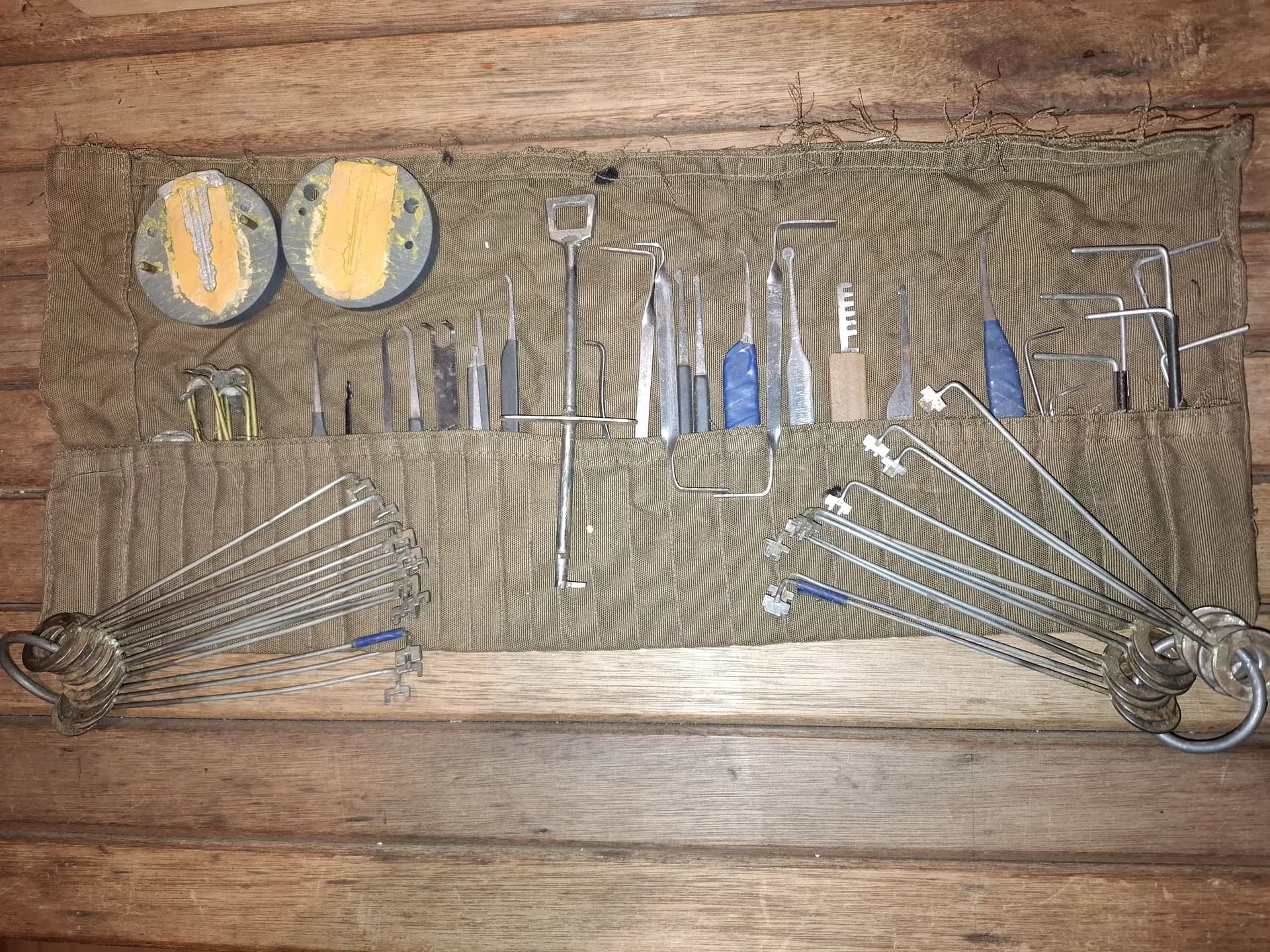
- Lockpicking. This taught us how to do a sophisticated appreciation of any target with a view to bypassing all security measures in place. It also gave us the skills to manufacture our own lock-picking tools.
- Advanced driving. This taught us how to act decisively when split second decisions need to be made. It taught us how to mitigate risk in a high-risk activity.
- Flaps and seals. This taught us how to do a risk assessment on mail during the analogue era. This became a critical element of future success in Operation Cruiser for example.
- Surveillance. This taught us the basic skills of both offensive and defensive surveillance. What it failed to teach us was how to do this in a foreign hostile environment, before mobile phones, using small teams, without the use of vehicles or duplex radio communications.
- Photography. This gave us the skills needed to generate high-quality images during surveillance. It also taught us how to photograph documents and produce micro squares. Remember, this was analogue, so no digital technologies existed. What it did not teach us was how to conceal cameras, while taking photos of a target in a foreign hostile environment. We had to figure that out for ourselves. We also had to figure out how to get surveillance equipment across international borders, where the detection of such kit would automatically trigger a security alarm.
Conclusion
The early days of K44 were like being in a tumble dryer without a means of escape. We were still in the dark concerning our actual mission, and none of us had a clue about the bigger picture unfolding around us as the Peoples War gained traction. We all had faith in Snuffels, even when the salary glitches presented us with real cause to believe this was a circus. Without any doubt, Dries was the anchor. His calm demeanor when addressing an agitated team, whose salaries had not been paid, was like sooting balm on severely burnt skin. Just the way he prepared for each engagement, and then delivered it in the matter-of-fact way that any competent commander would address his subordinates prior to battle, made a significant difference. It doused the fires of mutiny before they could eat into the structure of the ship we were now sailing on. The fact that Snuffels had set the foundation of never talking down to us as subordinates made us feel unique and valued. It must be remembered that the team at that stage consisted of officers with the rank of Captain and Major, who had served in elite units before becoming the Faceless Few.
Which takes us to the whole issue of selection, which I will deal with in Part 4.
……………………………………………
Part 4
Having dealt with the early headaches associated with the establishment of an operational capability that was invisible but still accountable, we can now shift our focus onto the issue of recruitment and selection. Here we will do a deep dive, using the immediate experience of the early days of K44, along with the hindsight of almost four decades that has passed in the rearview mirror.
Let us start by focussing the reader on just two issues – the speed with which the operational landscape was changing in the 1980s after the launch of the Year of the Cadre in 1985, and the capacity of the state to respond.
Stated differently, could the South African security forces be overwhelmed by the rapidity of change once the call went out to make the country ungovernable? If we did not respond fast enough, then we would be overwhelmed by the sheer magnitude of the numbers shown in demographic trends. If we responded inappropriately, then not only would we be overwhelmed by the sheer scale of a popular rising in a people’s war, but the levels of anger would increase in intensity as each new intervention became an accelerant to a fire that could burn the entire house down.
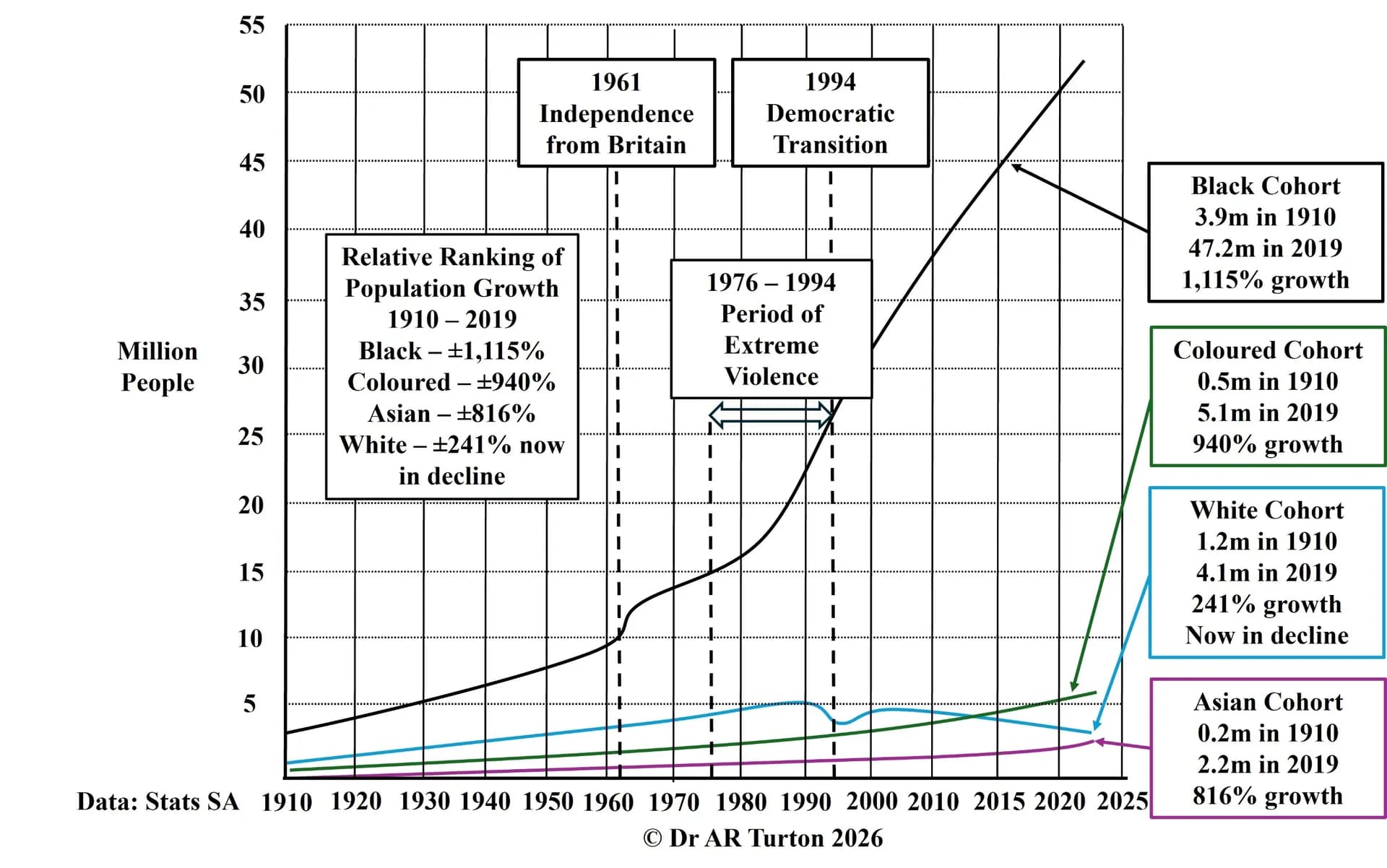
Demographic trends that defined the national security risk profile when the People’s War was declared in 1985. The question was how a minority could retain power with these numbers in a popular revolution.
The two critical success factors were therefore speed and appropriateness. It came down to how fast we could adapt in the first place, and whether those adaptive responses were effective in a revolutionary environment controlled by external factors.
Selection
Noting the issues above, we can now analyze how selection took place. In this regard, we start off by saying, without fear of contradiction, that all special operations units, wherever they are found, are elite in nature. Then we can say that their elite status is derived without question from the process of selection. No person that has bypassed the selection process, will ever be accepted by those that have been through that process.
A great example is Selous Scouts in Rhodesia. They were a top tier special force unit, and selection at Wafa Wafa Wasara Wasara was brutal. The name means “who dies, dies; who survives, remains”. Their role was deep penetration and close surveillance, which was similar to ours. Their selection took time that we did not have. Because the speed of change was accelerating, they were unable to keep up, so a decision was made to waive selection for specialists. If one listens to the video conversations of former operators like Sgt Maj Andy Balaam, on platforms like Fighting Men of Rhodesia and Underground Strategy, you will immediately hear the resentment that exists between those who had passed selection, and those who had not.
This was the first factor that we needed to deal with, because it was real, and it could destroy the unit before it even began.
A possible answer to this dilemma can be found in the existence of two other elite units, with similar capabilities to those we were building. After the Munich Olympics Massacre in 1972, Israeli security forces launched Operation Wrath of God[17]. This was tasked to rapidly respond to that massacre. It was made up of members of different units who had already proven themselves before selection for the final team. Whether their response was appropriate is not at issue here, for they were tasked to eliminate the perpetrators, which is not what K44 was tasked with. The issue at stake is the speed with which an appropriate team was assembled and then deployed.
We will return to the Israeli model later.
A completely different model was 14 Intelligence Company operating in Ireland. They are so secretive that even today little is known of them. Their mission was to penetrate areas in which the IRA operated, and perform accurate close-in surveillance needed to guide appropriate interventions by other units. They grew from failed attempts by the elite Special Air Service (SAS) to provide accurate intelligence, so they evolved into what became the most effective special operations unit that Britain has ever produced.
We will return to this model later.
With this as background, the reader can now begin to ponder what the selection process might be. The reader’s answer might differ from what we actually implemented in the end.
Remember, the Faceless Few had to be fast, but we also had to be appropriate in our actions. Above all, we had to be accountable when full scrutiny fell on us. The structural tension between speed, appropriateness and accountability, therefore became our guiding principles. Snuffels, Napoleon and a very talented HR specialist (Dr M) solved that problem as follows:
- No selection program could be announced, because that would imply that the unit existed.
- People could not apply for a job.
- Therefore, talent spotters were used to identify potential candidates from existing units within the armed forces and police.
- Each candidate must have proven themselves under conditions of high stress, and in a consistent manner, to be able to deal with extreme pressure, while making decisions that could have serious implications if they were the wrong choice of options available.
- It was accepted that to get into the units they were already in, and apparently flourishing, they had to have passed a selection process. The CDCO could not emulate those programs in the timeframe available.
- Each candidate was then thoroughly screened for mental health, psychological stability, an appetite for risk-taking that was not psychopathic or deliberately reckless, while also maintaining a healthy lifestyle that showed no obvious signs of pathologies that might manifest as operational risks.
- Introverts were preferred, because they do not need external validation, so they can function well under conditions of isolation, sleep deprivation and loneliness.
- They must be physically fit, and in a good state of health, but the kind of fitness needed differed fundamentally from that which a deep penetration reconnaissance soldier would require for them to survive.
- They must be able to work in a team, while each retained their unique individual skills.
Integration
With this first phase of filtration having been defined, what was left was a small group of individuals, each with different types of training, but all with generally strong personalities. Therefore, before the mission could be compromised by revealing it to a candidate that might be unsuited, even after the rigorous selection that had created the short list, an additional step had to be introduced. This became a defining feature for every covert operator from that moment onwards. This was the process of integration through stress testing, in an extremely harsh and unforgiving environment, prior to first operational deployment.
K44 pioneered what later became known as “the Canyon” to every member of the Faceless Few. If you haven’t done the Canyon, then you are not a covert operator. It is as simple as that.
The objective was to place the team in an environment that was unforgiving. It had to be psychologically overwhelming by overloading the senses with the sheer vastness of the landscape, in order to demonstrate just how insignificant the individual was. The concept was developed by Napoleon and Snuffels together. I later learnt that Dr M also played a key role in defining the psychological dimension of what could otherwise degenerate into what the Army called an “oppie”, a “long march” or a “vasbyt’.
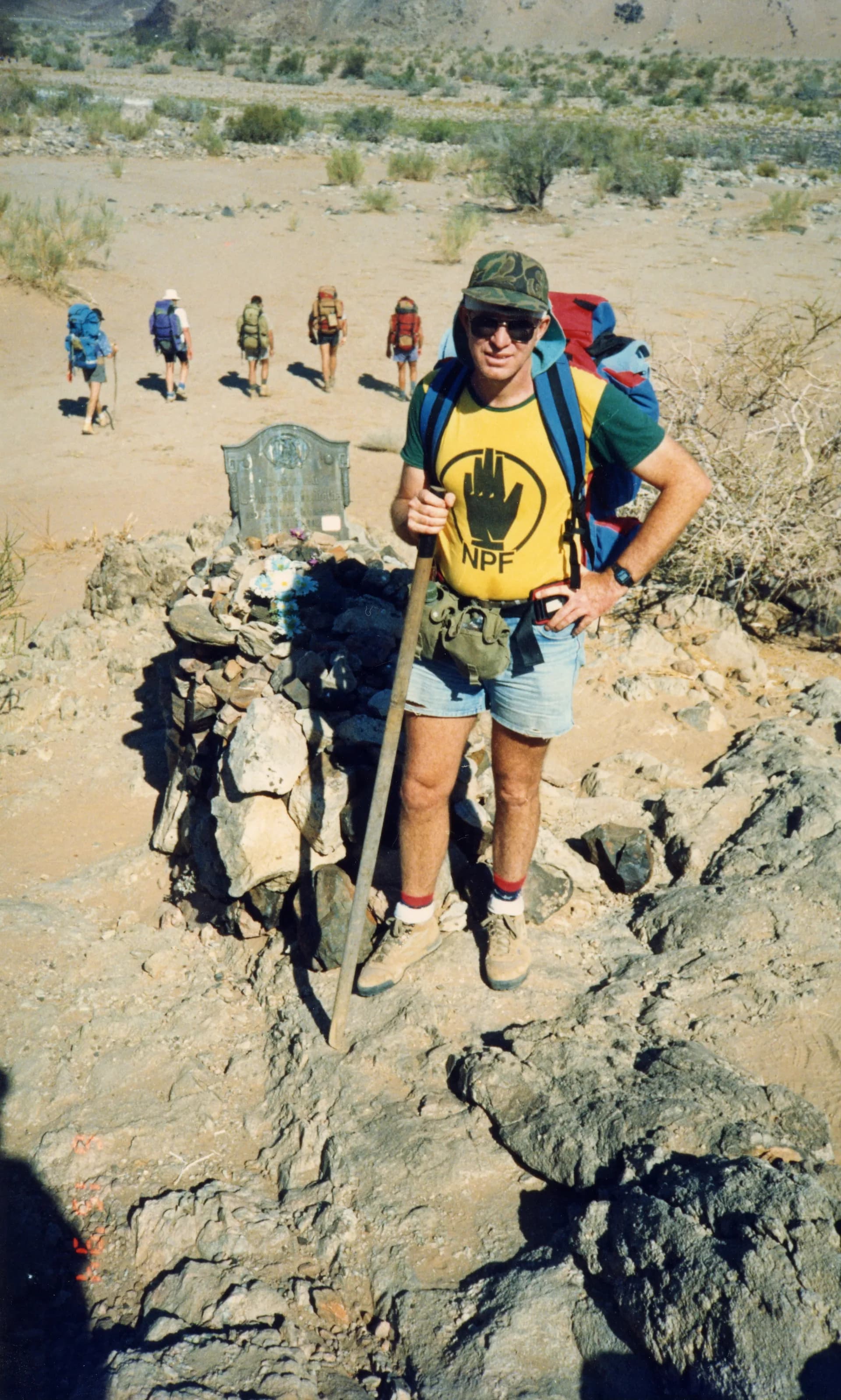
The place chosen was the Kalahari Gemsbok National Park, but this eventually evolved into the Fish River Canyon over time. The details of that first vasbyt have been dealt with by Johan Lotriet, so I will merely add my own perception of what it was all about.
Going into the exercise, I experienced some trepidation. I knew that we would be under intense scrutiny, and I didn’t want to ‘blow it’ under pressure. My biggest challenge was the mental perception that I would be ‘competing’ against highly competent special force soldiers that had been through rigorous selections of their own. My ‘fear’ was that I would not be able to hold my own against them, and that somehow, I would be judged as ‘unworthy’. Among all those participating, I was on the nerdy edge of the spectrum, and I was unsure how that would play out. They were generally hairy chested men of action, while I was somewhat of an intellectual with a lifelong experience of having to play this down in any group interaction.
As it turned out I was extremely comfortable in the Kalahari. My father had run a safari outfit into the Kalahari, around Soa Pan in the Makgadikgadi Salt Pan, also up past Nata to Pandamatenga in Botswana, and the Chobe/Linyanti in the Caprivi. I had accompanied him on some trips, so I had learnt how to walk among buffalo, elephant, hyaena and other predators. In fact, it was under the vastness of the Karahari sky that I had learnt, as a child, that while I am insignificant as an individual, I am not irrelevant – for my relevance is derived from being part of a greater whole.
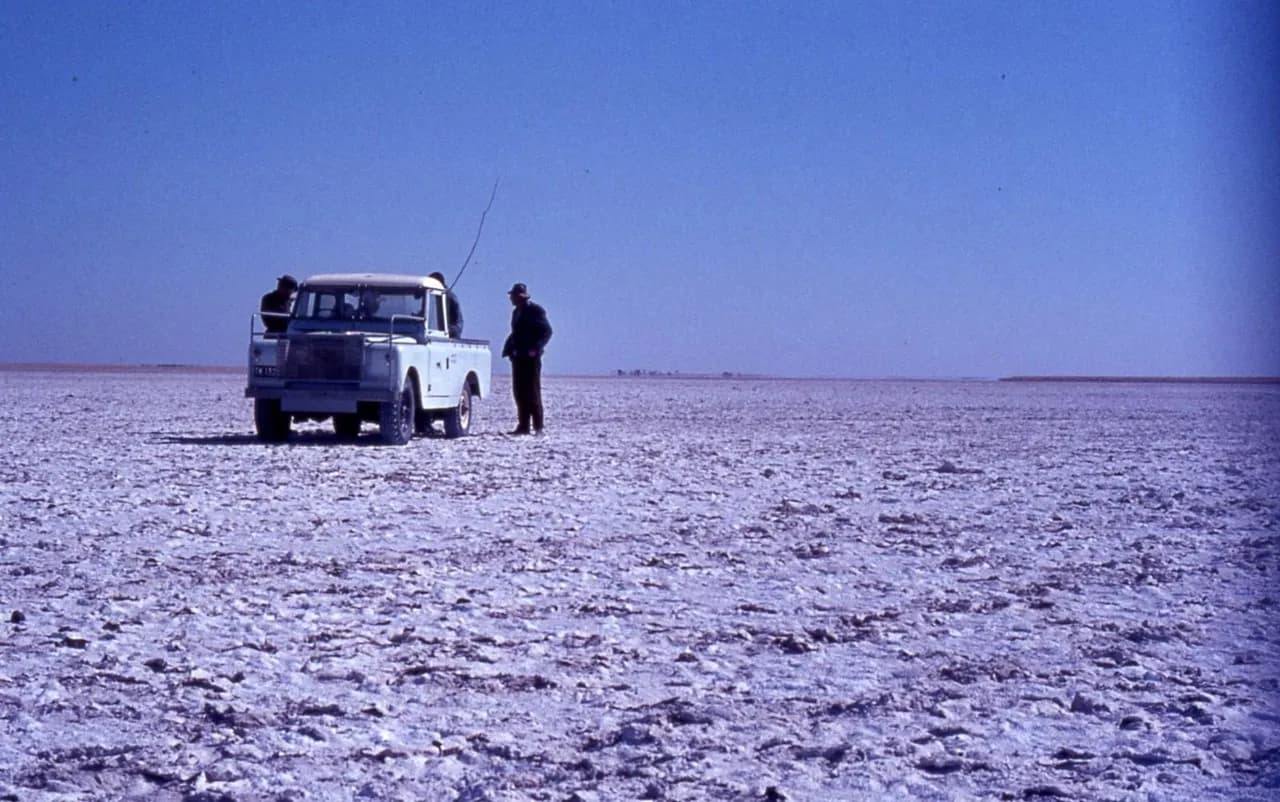
Therefore, if anything, I was actually at an advantage if this was to be a competitive evaluation.
As the event played out, I realized that my only limitation was inside my own head. It was a self-imposed limitation that can be managed. I guess this is true of most people. We all generally undermine ourselves by not believing we are up to the task ahead. This is what I learnt while gathering Tsamma melons with Vet Piet, and watching the fear being displayed by what I considered to be a tough hairy chested man of action, only to find that he was a city boy and I wasn’t. He was afraid of a hyaena that I simply knew meant us no harm.
Walking through those desert sands, under the blazing sun, sinking into the underground warren of mice, was liberating. I truly felt at home, and when we were brought real meat one night, I tucked into my lamb ‘tjop’ with relish, not knowing that I was being photographed at the time.
What I later realized was that the purpose of the Kalahari, was not to reject us as unsuitable, but rather to select us each for our own individual roles in a small team of two to three men, who were about to be given their mission. If any of us were blatantly unsuited to the task ahead, it was best to eliminate us before the mission was revealed, because that ensured maximal operational security. It was also important, in a two or three-man small team, that compatibility must be guaranteed, because the risk of falling apart during the mission was simply too high to ignore.
Conclusion
K44 came together with remarkable speed. Each member was strong-willed and could be an alpha-male if needed, but the remarkable thing, was that the team simply gelled. Snuffels walked every meter of that journey with us. He was considerably older than any of us, yet he was as tough as nails. He always spoke up to us, even though we were subordinates, and that was empowering. He was a wise man, with deep operational experience, and he had now demonstrated that he was not an armchair commander, for he led from the front with his quite but authoritative demeanor. None of the team were braggarts. None spoke of their own past in terms designed to impress. These people were quiet, competent, cerebral, reliable and tactical. In fact, they were quite exceptional, and I was impressed at the recruiting profile that had been used by Napoleon, Snuffels and Dr M. It was clear that NIS was in a different league to what I had been used to during my twelve years of conscripted service in the SADF.
I came out of the Kalahari confident in our leadership, and trusting of every member of our team. I needed that for what was to come, when we were given our mission shortly after our return.
My career later took me into the role of instructor, where I was tasked to refine the metrics we were trying to measure in the Canyon. As far as I recall, I walked ten of them in my career with the Faceless Few. First as a candidate, then as an instructor, and multiple times as an observer, for this was a rite of passage for every covert operator that was trained to perform deep penetration operations, with minimal logistical support, into a foreign hostile environment. I was part of the final Canyon ever walked, after amalgamation and the birth of SASS. The Canyon never failed to reveal the deeper parts of an individual’s soul, exactly as Napoleon and Snuffels said it would.
It did not survive the transition to SASS and NIA.
If you ask any former covert operator about their time with the Faceless Few, they will consistently tell you about the Canyon, their service name, and their service number. Any wannabe operator that exists – and there are many – will never pass the simple test of these three defining features. If you never did the Canyon, if you had no service name, and if your force number did not have a unique sequence of digits, then you were never a covert operator.
In Part 5 we will deal with the moment we were given our mission, leading up to our first operational deployment in small teams.
……………………………………
Part 5
Having built the K44 team within a relatively short timeframe, and then putting everyone through the rigours of the Kalahari, decisions could be made about who was in and who was out. This was necessary before the mission could be revealed. I was not party to any of these decisions as they were made at a pay grade way above me. What I am now relating is what I perceived when we were given our mission, with one caveat. What I remember from those days has now also been influenced by subsequent events. It is therefore a combination of memory that has subsequently been informed by empirical fact. I say this because at the time we were given our mission, we did not know what we now know. I therefore alert the reader to this fact. I will relate the story as I recall it, from the perspective we all had in K44 at the time. When I contextualize specific moments, I will alert the reader to the fact that I am now interpreting those pivotal events from a different perspective. That perspective is the 20/20 vision of hindsight. The reader will soon grasp what I mean by this caveat.
Summary of Where We Were
To briefly recap why the CDCO had been created in 1986, and why K44 was now ready to deploy in 1987, here is a headline level summary. NIS had grown from the ashes of DONS, which was the result of the Info Scandal. As a result, Dr Niël Barnard and his leadership team had hardwired accountability into the architecture of the NIS. The decade of the 1980’s was characterised by a relentless bombing campaign. In 1985 the ANC/SACP launched the Peoples War by calling for an internal uprising to render the country ungovernable[18]. Speaking on Radio Freedom in July 1985, Tambo said[19], “Our own tasks are very clear. To bring about the kind of society that is visualized in the Freedom Charter, we have to break down and destroy the old order. We have to make apartheid unworkable and our country ungovernable. The accomplishment of these tasks will create the situation for us to overthrow the apartheid regime and for power to pass into the hands of the people as a whole.”
Chase Manhattan Bank, succumbing to pressure from the Democratic Party and rising calls to isolate South Africa, decided to withdraw from the country. The combined impact of these two events – the declaration of a People’s War and the Chase Manhattan decision – triggered a financial crisis in South Africa. This has been dealt with in detail in my forthcoming book The Faceless Few: An Operators Journey. The country was teetering on the brink of disintegration, so the SADF responded by creating the Civil Cooperation Bureau (CCB) and NIS responded by creating the CDCO. The political situation was extremely fluid and unpredictable. The trajectory of the outflow of foreign direct investment (FDI), had been linear since the Dellums Bill had been introduced by the Democratic Party in the US House in 1972, so the risk of financial collapse was the one thing that was predictable. Things were moving fast and frankly the security forces were scrambling to stabilize the situation as best they could. The Hawks were going onto the offensive, and the Doves were still exploring a range of options, and had not yet settled on one firm strategy.
The South African government was facing an existential crisis that it could not ignore. Options were needed because nobody in decision-making positions had the big picture.
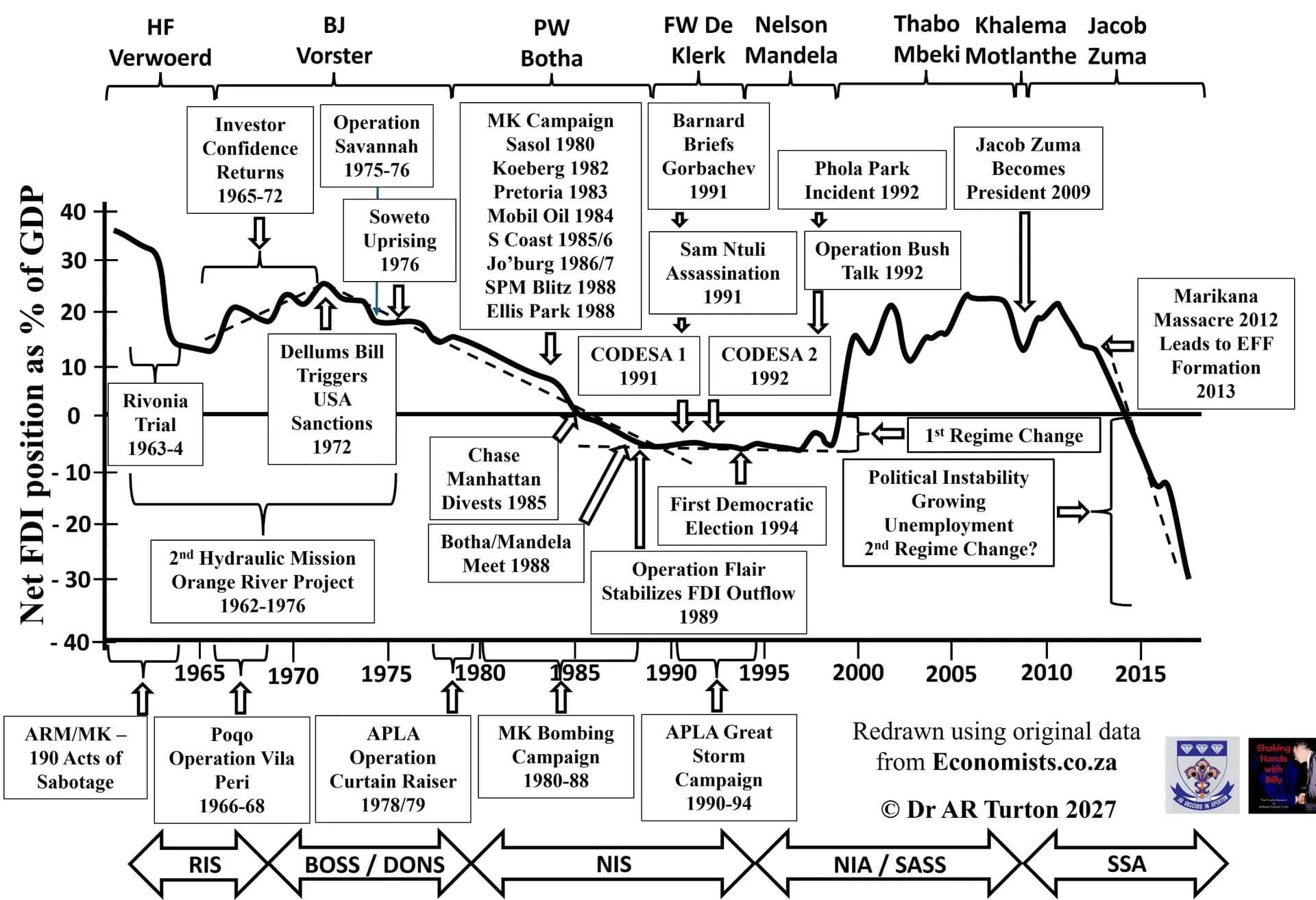
The National Security landscape in the 1980’s was defined by the ANC/SACP bombing campaign and the net outflow of foreign direct investment. Source: The Faceless Few – An Operators Journey.
This meant that when the CDCO was created as a top-secret special purpose vehicle in 1986, the main response was to the bombing campaign. To meet this objective, there were at least three distinct thrusts within the CDCO – maybe more – and each was invisible to the other. The one thrust was the K44 mission that I will deal with below. The second thrust was the K2 initiative that was building capacity to support Operation Flair, and the third was the K3 initiative that was building capacity to support the Cuban/Angolan peace negotiations. Neither of these three initiatives were aware of the existence of each other at that time. The reader needs to understand this to place the rest of this article in context.
The Mission
Confident of each other’s capacity to stay cohesive under pressure, the K44 team was now stable and viable. Decisions could be made about how to respond to the mission we were about to be given. I have dealt with this in my book Shaking Hands with Billy, so I will summarise it here. We were informed that a decision had been made somewhere – we were told by the State Security Council – that our response to the ANC/SACP bombing campaign was to go onto the offensive with a surgical operation that had as its sole objective, the interdiction of Joe Slovo in his capacity as Chief of Staff of Mkonto we Sizwe (MK). The interdiction was to be surgical with no collateral damage allowed. The stated objective of the interdiction was to bring him back to South Africa unharmed, to stand trial in a court of law where he would have the right of presumption of innocence, and an attorney of his choosing. Under no circumstances was he to be injured in any way. It was vital that we retain the moral high ground throughout the evolution of the mission.
The model we were to use to guide our planning was Operation Finale[20], launched by the Israeli Mossad, that successfully captured Adolf Eichman in Argentina in May 1960. While it took 15 years to track down, and eventually capture Adolph Eichman[21], we did not have that luxury. We had to do it in the shortest possible time, given the urgency of the matter, and the precarious nature of our national security in the face of the People’s War that was now the new normal.
Our orders were to prepare our planning for approval by higher authority for the deployment of small teams to perform a close-in surveillance of any physical location where we could get a confirmed fix on Slovo. Once we had that fix, we would follow him wherever it led us. He was given the code name Billy. We were not to use his name under any circumstances, given the extreme sensitivity. Our planning had to be of such a nature that we did not escalate the conflict through a botched operation. We were not told how to execute the operation, only what the objective and parameters were, one of which was plausible deniability.
In summary, our mission was to identify a firm location from which Billy could be tracked. We needed to understand his movements with a view to informing any decision about where he would finally be interdicted – probably in Africa – and how that interdiction would take place. We were to do this by means of close-in surveillance using small teams deployed into a foreign hostile environment. No contact with any embassy, or any other organ of state, including NIS, was allowed.
It is at this point that I need to step away from the narrative, because I know exactly what the response will be from certain parties. I have been directly accused of acting in a unilateral and unethical manner, so I know this same response will happen when this article is posted. I therefore wish to place the following statement on the record:
It is the responsibility of any government to protect its citizens. The ANC/SACP bombing blitz of the 1980’s was harming citizens of all races. A bomb is indiscriminate. Furthermore, there was an indication that those bombs were becoming more sophisticated. They were migrating away from timer detonated devices to command detonation of multiple devices. It was later confirmed by Kader Asmal[22] that the IRA[23] were supporting MK in their bombing, but this had not yet been confirmed at that time. A BBC report[24] notes that, “Professor Asmal also claimed that the IRA had a significant role in an attack on a major oil refinery in South Africa in June 1980.” If the South African government failed to act, it would be capitulating to a terrorist movement, so the collapse of the state as we know it would surely have followed. This was the objective stated by Oliver Tambo in 1985 when he called on the youth to render South Africa ungovernable. My answer is therefore that I was not acting unilaterally, for it was a coordinated and fully authorized team effort. Furthermore, it would have been unethical to leave a terrorist group unchallenged, for that would have betrayed every citizen that would be affected by the revolution that was gaining traction. The CDCO response was appropriate under the circumstances of an existential threat to national security.
I therefore stand firm in my position that what NIS did in creating the special purpose vehicle (CDCO) to support the three thrusts noted above was appropriate and ethical:
- K2 to develop what became the Mells Park Initiative and Operation Flair;
- K3 to support the Cuban/Angolan peace negotiations;
- K4 to develop the plan for the interdiction of the MK Chief of Staff.
All three were necessary. All three were viable. All three were ethical and therefore defendable. Each influenced the other. All three were deeply compartmented from each other, and even more so from the open service, protected by the need-to-know principle. Neither officially existed, until it became evident that they did in fact exist. All three are now matters of verifiable historic fact. All three gave the government more options than they had before the CDCO was created.
This is the story of the Faceless Few that even they do not fully know about.
The K44 Response
Now that we had our mission, planning began in earnest. We requisitioned all the files on Billy that were in the registry. This posed a serious challenge. Firstly, any bulk requisition would create awareness within the open service that something was happening. This was a risk we had to deal with. Secondly, those files were highly classified, so transporting them from Concilium to K1, and then into K3 would place serious strain on the Nodal Point dealt with in an earlier article. Thirdly, storage of those files on our own premises posed a risk of massive proportions.
Once we had identified these three risks, we began systematically mitigating each. The first risk was mitigated by staggering the requisition of files, and feeding the paperwork through different entities so it did not create an obvious paper trail back to K4. This was not easy, because every file had to be signed in and out on a routing slip that was retained for audit purposes. These were highly classified documents, containing agent reports dating back to the 1960s and the very birth of the armed struggle. So bulky were they, in their brown manilla folder covers, each tied with a piece of pink tape, that they had to be transported on a wheeled trolley in multiple trips.
The second risk was mitigated by giving close-in support to the couriers moving between Concilium, K1 and K4. The risk of hijacking a vehicle filled with top secret documents could not be left unmanaged. This tested the administrative staff in the Nodal Point to the extreme and they came through with honours.
The third risk was mitigated by building a strongroom at K44, and then storing those files inside locked wheeled trolleys when not in use. Johan Lotriet has dealt with this in some detail, so I will say no more.
We now had to read thousands of reports. It suddenly became clear why I had been selected for the team, because I became the in-house operational analyst. There were multiple files. Literally trolley loads of them that had to be processed. At first, we did not really know what we were looking for, but as we read them, a plan began to emerge.
For starters, the was a major operation called Olyfberg that had been conducted after the Rivonia Trial era. Basically, the assumption within BfSS was that the ANC/SACP had been smashed when they went into exile. Olyfberg shattered that illusion by showing the extent to which the SACP had regrouped in exile and gone underground. Therefore, Olyfberg became a useful point of departure because it established a list of names of the SACP elites, along with their addresses and other known information. From this we began to develop a list of ANC/SACP elites that had some form of cross correlation with Billy.
From this we started to develop a map of known places of residence, and offices used by each person on that list. From this we could see clusters of activities located in specific geographic areas. Each cluster became a place of interest to us.
Onto this we began to develop a second overlay. This was of known people that were not ANC/SACP elites, but that had contact, specifically with Billy. Again, there was a cluster of names and activities in specific geographies. We developed this further, and began to distil out specific categories of people, asking the questions:
- Who had direct access to Billy?
- What was the nature of the relationship between those individuals and Billy?
- What structural cross-linkages could be found?
- What telephone numbers were on record for us to target for technical interception?
I cannot go into much more detail, other than to say that what emerged was a list of names, addresses and telephone numbers, including liaison personnel from the broader Anti-Apartheid Movement that provided support to the exiles. One category in that group was the Communist Party of Great Britain (CPGB) that maintained a safe house for the exclusive use of the SACP membership in London. Four addresses were of particular interest:
- Anson Road – CPGB safe house used by the SACP.
- Lyme Street – Billy’s home.
- Oakshott Crescent – a cluster of SACP activities.
- Wimbeldon – home of an SACP member that was often referenced as being relevant to Billy.
Preparation for the First Deployment
Now that we had a good idea of what we were looking for, and where we were likely to find it, we began the preparation for the first deployment. K44 was a small entity, so we were limited with our choices. With the information we had gathered on each member’s core skills and compatibility profile, a decision could now be made about how many teams would be inserted, and who would be in each team. That decision was made by Snuffels in close conjunction with Dries. I cannot add anything to what Johan Lotriet has already said about those teams. I will defer to him on all detail, but what I can recall is that we had four small teams. Most were two-man teams, but one was a three-man team. I was teamed up with BB. As I recall Dries was in the three-man team with HB and John without a surname. KD was teamed up with someone whose name I cannot remember. The command team consisted of Snuffels and PB.
Once the teams had been announced, deep compartmentation was placed on each team. The need-to-know principle was strictly applied. The objective was to protect each team in the event that one was compromised. If anyone was captured and interrogated, they would not be able to give any details of the names and routes being taken by each of the other teams. Each team then proceeded with their final planning for insertion. Different travel agents and airlines were used, and different destination cities were selected. Each plan was individually presented to Snuffels for his final approval. He was the only person that knew where each team was, as his core function was to coordinate the rotation of each team into and out of the immediate target areas. His second-in-command was PB. Dries was the tactical commander embedded in one of the sharp-edge teams.
This was our first small teams’ deployment, so we had a lot to learn, and many mistakes were made. The objective of the first deployment was to familiarize ourselves with the target area and become comfortable with the border crossing processes and procedures within the European Union. More importantly, we were to use this as a dry run to test our assumptions, refine our techniques, and learn whatever lessons needed to be learnt. In Part 6 I will go into details of what happened on the ground.
Conclusion
K44 was learning fast. The way that we managed to process significant amounts of information, before the era of computers and AI, was quite impressive. It gave me my first taste of being a nerdy operational analyst, embedded in a high-impact tactical team of hairy-chested men-of-action that spoke softly, moved slowly but deliberately, and never panicked.
What none of us knew at the time of our first insertion, was that at least three top secret initiatives were being run in parallel. These were designed to give the government more options than they initially had when the Peoples War was launched, and Chase Manhattan Bank decided to plunge the economy into an existential crisis in 1985. For the first time in my 12 years of service in the security forces of South Africa, I began to feel confident that we could deal with what was coming our way. Under the laser focussed analytical competence of Dr Niël Barnard, and in the capable hands of his senior officers, Napoleon (K1) and Snuffels (K4), South Africa had a fighting chance.
Deep inside me I felt an enormous sense of pride and optimism welling up. I was part of the Faceless Few on a journey that would literally change my life forever. But if we got it right, it would also change the trajectory of South Africa in a fundamental way, so literally millions of people would be affected. This was my first strategic level operation, and I just knew that I had found my raison d’être in life. As a small boy sleeping in the Kalahari, under the vastness of the African night sky, I had pondered on the philosophical notion that as an individual, I was insignificant but not irrelevant, for my relevance was derived from being part of a greater whole.
I had found my greater whole.
I had found the hill I was willing to make a stand on and die if need be.
It was that magnificent body of ghostlike creatures that occupied a world that didn’t exist, at the very same time that it clearly did exist. These were the Faceless Few, and I feel so privileged to be able to tell their story.
……………………………………….
Part 6
The year 1987 was one of extreme activity within the CDCO, but I was deeply unaware of that fact. All that I knew was that K44 was now a viable special operations entity and we were about to deploy in four small teams to execute our mission.
There was a lot that I did not know at that time. For example, I did not know what any of the other directorates – K2 and K3 – were doing. I did not know what the other divisions in our own directorate were doing – K41, K42, K43 – for that is the nature of compartmentation. In fact, I thought that we were K33 until I was later corrected. I did not know what was going on in the SADF, although we were aware in those early days of Project Barnacle[25], D40 and the CCB[26]. We were living in close proximity to elements of Project Coast[27] that were starting to be investigated, so the best way to describe it would be to say that it was like the geelperske reën (yellow peach rain) we used to get on the Highveld, with a constant drizzle of revelations from the media that consistently portrayed the state as evil oppressors, with this narrative being framed in the context of the bombing blitz and people’s war that was gaining traction.
The people’s war was above all else a propaganda war. It was here that I learnt that all truth is factual, but not all facts are truthful. It was a war involving a blizzard of facts, only a small portion of which were truthful, mostly controlled by the enablers located in Amsterdam, London and Washington. In the swirling mists of that blizzard, the liberation movements were portrayed as heroic freedom fighters whose cause was just. Security forces were portrayed as evil oppressors without compassion and somewhat ignorant as knuckle dragging buffoons. The narrative they presented offered the consumer of information a binary choice between good versus evil, in which the security forces were consistently portrayed as being monolithic. By this I mean that the police were seen to be the same as the SADF, which was seen to be the same as the BfSS, that had now magically become NIS. One monolithic block supposedly made up of homogenous little people, all thinking the same thoughts, and all intent on preserving White privilege by actively supporting Apartheid.
The First Small Teams Deep Penetration Operation by the Faceless Few
As I stepped through the processing line at Jan Smuts International Airport, I was awash with a cocktail of emotions. I was travelling solo, as were the other members of K44. I had no idea of their names, routes or schedules, so I occupied my mind by constantly running through details of my cover. Who I was, where I was born and the town I grew up in. The name of the school I attended and my identity number. What my address was and details of my cover structure such as telephone numbers and product range. This played on an endless loop inside my head as I stepped onto the aircraft and into a whole new world. After settling into my seat, and making my selection between chicken and beef provided by the SAA hostess, my body contorted into a shape that fitted the space I had available.
On arrival at my destination, passport control went more smoothly than I anticipated, and before I knew it, I was disgorged onto the streets of a European city that I was unfamiliar with. I will skip the details. My link-up with BB went exactly as planned, and from that moment we travelled together. Winding our way through the crisp clean air we began doing exactly what any tourist would do. A cover must be plausible, so it must be lived, and that is exactly what we did.
One little story needs to be told, because it explains the cultural challenge we faced. Those were the days of analogue, so there were no cellphones and therefore no WhatsApp or Sim cards. Coordination was by adherence to a defined schedule of rendezvous points where either a brush meeting, or a dead letter box (DLB) would be used as appropriate. Where phone calls were to be made, public phone booths were to be used. These were selected at random and only used once. Payments were made by tele card, where several units of time were purchased from a tobacconist who provided what looked like a credit card with a small chip on it. I found myself at one such phone booth, armed with my newly purchased tele card. Each time I inserted the tele card, and closed the cover that was supposed to lock it in, the cover never latched. I needed instructions on how this machine works, for I was a Neanderthal, now roaming unattended in Europe. I find them in French that tells me to “décrochez SVP”.
What the hell does that mean?
What followed was a lesson in problem solving that illustrates just how steep the learning curve was for us. I solved the problem by placing a phone booth under surveillance, and then watching the sequence of actions used by a local person. Only later did I learn that SVP is the abbreviation for s’il vous plait (literally meaning “if you please”), and the verb “décrocher” means to unhook, but because the instruction is formal, the verb is conjugated into the “vous” form of formal engagement – the “u” in Afrikaans, as opposed to “jy” – hence the tail “er” is replaced with “ez”.
That was how I learnt to unhook the handset before inserting the tele card into the machine. That is how the Neanderthal started to adapt to the reality of a European theatre of operations. That was the first bit of French – a language in which I later became street-level proficient – that I ever learnt.
My First Covert Rendezvous (RV)
One day, during my routine sign of life check-in with higher echelon, I received an instruction to make my way to a specific spot at a precise time where I was to wait for new orders. I did all the things we were trained to do when approaching a covert RV, like checking for active surveillance by the AO (active opposition). All clear. I initiated the sequence exactly on time, and to my surprise, as I rounded the corner, there was Snuffels. The meeting was brief and to the point. Our plans had changed, and my team was to make its way to Amsterdam where we were to relocate, and place under surveillance, a person that had been involved in the Pretoria Car Bomb.
Let us call him Pantoffel (Slipper).
This came out of left field, so I asked Snuffels if there were any leads on where we might pick up the trail. He said there were none. We must figure that bit out.
OK. Off we go. An order is an order. We changed our schedule and aimed for Amsterdam. Once we found appropriate lodgings, we started to buy newspapers, which were full of stories about Pantoffel. He was somewhat of a hero it seemed, and a very high-profile figure, so we started scouring the most likely places in the city to see if we could find him. In the process we started bumping into other members of K44, all of whom had apparently also converged on Amsterdam. They were doing exactly what we were doing, so we made a tactical decision to combine forces. We decided to meet at the Krasnapol Hotel on Dam Square. A sense of jubilation prevailed as we decided to live our cover and do what all tourists do – have a beer – as we discussed options available to us.
Now the reader needs to be aware that the Krasnapol is a famous hotel, and Dam Square is also a famous place. The Central Railway Station is linked directly to Dam Square by the Damrak, which is very touristy in its orientation. As one walks along Damrak one is offered all sorts of exotic entertainment and other pleasures of a chemical nature. Typically, it is the kind of place we would avoid, because of the likelihood of police surveillance. On the opposite side of Dam Square is the Royal Palace and the National Monument. It is a busy place, awash with tourists, much like Buckingham Palace in London.
So, picture this. We were sitting at the Krasnapol Hotel, sipping a beer, overlooking Dam Square, where a street vendor was demonstrating his wares for tourists to buy. One of the gimmicks he was selling was a wind up ornithopter that was flapping around the circular square. Each time it landed, the vendor retrieved it, wound it up again, and set it free once more to do its job attracting tourists to his wares.
We watched with interest, for this was not something we typically saw at home. Sitting alongside me was HB, a highly skilled Special Task Force operator and bomb disposal expert. I was looking at his face and his expression suddenly changed. Like a hawk he focused on what he suddenly saw on Dam Square. He pointed with his finger as we turned to see what he was showing us. There, before our very eyes, strolling across the square, was Pantoffel in all his splendour as a terrorist bomber turned celebrity.
We left our beers unfinished and jumped into action. We had our mark. Johan Lotriet has provided more details in his own story, along with a photo of Pantoffel relaxing at a café, unaware that he was under surveillance.
That was a euphoric moment.
The first deployment of small teams by the CDCO had worked.
Into the Heart of the Whore
That little success gave us enormous confidence as a team. It proved that the harder we try, the luckier we get, which is a lesson that I learnt from Gary Player when I was a young boy. The bigger team broke up once more into its smaller components as we were rescheduled to deploy into the heart of the ANC/SACP stronghold in London.
When taking the ferry from Netherlands to the UK, I rewarded myself by buying a Sony Walkman from the duty-free shop. I later gave this to my son, and he still has it. His children are unable to comprehend what it is because it is not Bluetooth enabled, and they have never seen a cassette tape.
After finding a place to call home, we began operating as planned. It must be noted that we never pre-booked accommodation, because that could give the AO the opportunity to service the site with electronic surveillance devices. The internet did not exist, so we had to find our own way around. My first impression of the areas that housed the ANC/SACP elite was different to what I had anticipated. These were working class areas that were predominantly left leaning in their political orientation. Outsiders were immediately identifiable by the way they walked, the clothes they wore, and the things they did. We knew Britain had a high level of surveillance cameras that were routinely used by law enforcement agencies. Avoiding these cameras was impossible, so we had to adapt to their presence by modifying our behaviour.
We avoided Penton Street, because of the ill-advised bombing of the Anti-Apartheid Movement’s offices in 1982. That single event had turned the local security forces against us, and destroyed the sense of security among the ANC/SACP community that would enable us to do our job. That single event also fed into the sophisticated propaganda machine that we were unable to counter, after the Info Scandal had destroyed whatever capacity we once had. It was one of the most spectacular own goals possible, because it reduced the South African government to the level of a terrorist organization, thereby proving exactly what the anti-apartheid propaganda was saying about why the state had to be overthrown at all costs.
I have dealt with details of this period in my book Shaking Hands with Billy, so I will not repeat them here, save to say the following.
A few months ago, I was one of the many South African veterans who were celebrating Anzac Day in Australia. After the march, it is normal for the different veteran associations to break away and go to a local pub for a pint. I was sitting there minding my own business, when a bald-headed gentleman sidled up to me. With an intense gaze he peered into my soul as he asked me whether I was Anthony Turton. My response was, “that depends on who is asking, and why they want to know”.
His eyes twinkled with mischief that I instantly resonated with as he glanced at my name tag and laughed. We shook hands. He told me that there was a rumour doing the rounds in veteran circles that I was now living in Australia. I confirmed that I am. The conversation flowed freely between us, both relaxed in this wonderful place we now call home. Me, with my South African Accent, and him with his wonderful Irish lilt that is impossible to hide. As the beers flowed the conversation gravitated towards the old days.
The tone of the conversation suddenly changed when the topic drifted towards close-in surveillance in hostile territory. They were now two professionals speaking, both in a new country, but both with shared experiences in vastly different places that were unforgettable.
He was a close-in surveillance operator in the IRA areas of Londonderry during the height of The Troubles. We had now found our common ground after stripping away all the fluffy outer layers of decorum and social pleasantries.
As these occasions tend to do, we started by comparing experiences. He told me about the IRA areas where collaborators were dealt with as traitors using the most extreme form of violence possible. Kneecapping, torture and murder were the fates of close-in surveillance team members that had been compromised. I told him about South Africa during the People’s War, explaining how the narrative of an “impimpi” was conflated with that of a “collaborator” to be sentenced by a people’s court to death by necklacing. I told him the story of Maki Skhosana[28] who was murdered[29] in July 1985 when the Peoples War first gained traction after the call by Oliver Tambo on Radio Freedom on 10 October 1984, and again on 8 January 1985[30].
I explained that Maki Skhosana was murdered as a direct result of the call by the leader of the ANC to make South Africa ungovernable. I explained the direct causal link between those two events that marked the opening phases of the Peoples War that the South African security forces needed to respond to. We spoke of the link between the IRA and the ANC/SACP[31]. We spoke of the complexity associated with security force responses to the presence of a terrorist movement that later became a registered political party, contesting an election, in a democracy with a constitution. We spoke of post-conflict reconciliation and the rehabilitation of veterans who had been harmed in the execution of their duties.
But above all we spoke of the intense loneliness of the operator doing close-in surveillance in a hostile area. We spoke of the tunnel vision that came with heightened senses of sight, sound, movements and smell. We spoke of the prickling sensation on the surface of the operators’ skin when each hair follicle was activated in an involuntary response to these heightened senses. We spoke of the paranoia that accompanies each operator like a suit of armour that later becomes a terrible prison that entraps one in perpetuity. We spoke of the need to maintain a sense of self-preservation through awareness that paranoia is a mental health issue and not an appropriate defense mechanism. We spoke of the constant companionship of the Black Dog that came from hyper-vigilance over extended periods of time, during deep penetration operations, where any moment could be a threshold that triggers an unpleasant fate for the operator.
We both spoke with deep respect about 14 Intelligence Company and the Faceless Few, for we were flip sides of the same coin of innovation, in the face of an existential threat to national security, by a non-state actor that uses terror as a tactic disguised as popular legitimacy.
From that conversation I experienced the catharsis of acknowledgement among peers, and the liberation that arises when one no longer needs to hide behind secrecy by being unafraid of being held accountable for one’s actions. It was here that I learnt that some veterans are unwilling to confront this reality, so they hide behind the myth of secrecy, and attack anyone daring to lift that protective veil. I now know there is a correlation between these actions, because a direct relationship exists between the need to remain anonymous by hiding behind the protection of secrecy, and the desire to hide the ugly details of the role played by those individuals in the past.
I am open, for I have nothing to hide, and I am unafraid of being held accountable for my actions.
Conclusion
When we returned from that first deployment in 1987, we completed mountains of paperwork. We converted hundreds of receipts for train tickets, tele cards and cheap accommodation in seedy youth hostels, each paid for in different currencies before the Euro became the single currency, into a format acceptable to the Nodal Point, using exchange rates that the auditor would accept as valid. We removed every address from every piece of paper that could later be used to explain where we had been, for that was the price of being invisible. That was the cost of not existing, even while we actually did exist. It was the price we paid for straddling that gossamer membrane around the invisible world that protected us, while still holding us accountable.
My report was detailed and thorough. It spelt out all the risks that the government would face if we chose to interdict Billy in the UK, which was one of our last allies in a world of united hostility towards the racial policies of South Africa. It was the first report of substance that I had ever written in the top-secret world of the CDCO, and frankly I was uncertain about how it would be received. But I wrote it nonetheless, emboldened by the support from the K44 team that had proven that small teams were capable of successfully executing deep penetration missions, without any radio equipment with which to coordinate a close-in surveillance team, operating under the very noses of our enemies as they plotted their acts of terror against the citizens of South Africa.
After all, the bombing campaign that we were experiencing in South Africa, was planned by people living under the sovereign protection of countries in Europe. Those same people that were regarded as heroes by the media in those countries, were simply terrorists in our eyes.
Great was my surprise when I was called in to a private meeting with top management. It was my first high level debriefing, and I thought I was about to be roasted for daring to call out the risks of the planned interdiction of a high-profile person of interest. Instead of being roasted, I was transferred to K3 where I was about to encounter the second of three major thrusts that were underway in the CDCO.
- The planned interdiction of the MK Chief of Staff being developed by K4 (Billy Operation).
- The need to support the Cuban/Angolan peace negotiations being developed by K3.
- The as yet invisible Mells Park Initiative, being developed by the highly competent team at K2, with his legendary operators MD, JdJ and NB working out of Stellenbosch.
What I thought of as the be-all and end-all of the Faceless Few – K44 – was about to pale into insignificance as I began to realize just how sophisticated the special purpose vehicle was that had been created in 1986 as an appropriate response to the Peoples War that had been declared a year earlier.
This is the end of the six-part series of an assessment of the evolution and impact of the Chief Directorate Covert Operations in NIS. I now have to shift my time and energy onto getting my book The Faceless Few – An Operators Journey across the finish line. I submitted it to the publisher in late 2025, and they agreed to publish it in 2027. That time delay has enabled me to submit the text to various professionals with the inside knowledge of NIS for peer review and fact checking. It has also enabled me to verify the many hundreds of references that I have used to piece together the story of a unit that never officially existed, using information that was scattered in thousands of different pieces, across a debris field left in the wake of our turbulent transition from the isolation of a pariah state at war with itself, into a constitutional democracy that we believed had a fighting chance of survival.
We did not interdict Billy, not because we were unable to, but because our new capacity had given us a wider range of choices. From those choices we could develop sophisticated deep penetration operations like Cruiser, Spaghetti, Hardekool and Bush Talk, to name but a few from the K3 ecosystem alone. But undoubtedly the biggest of them all was Flair[32], being developed within the cloistered confines of K2 that I was yet to learn about, on my new career trajectory, that would eventually take me across all three directorates within the CDCO. This included the most intense period of the Peoples War that was yet to come, as the Bantustans were cleverly targeted, and began to fall like dominoes. This happened when the SADF was confined to barracks, and elite units like 32 Battalion were disbanded completely after the Phola Park incident in Thokoza – my old stomping ground as a conscripted soldier before joining the Faceless Few.
Tribute to the Faceless Few:
The Faceless Few
A country in flames
Without claiming glory
On this canvas an artist
Will now paint our story
Missiles and steel
So great the divide
Cold War’s embrace
Nowhere to hide
Revolution stirred up
Powerful bloodlust
Emotions run high
A system unjust
Part of their story
A struggle for dominance
As old as Mankind
No leader with prominence
Ab Obscuro in Apertum
Guiding their fight
What’s hidden in darkness
They bring into light
Constantly flowing
An hourglass of sand
A relentless quest
To gain upper hand
They train really hard
And spoil for the fight
Doing what’s needed
Asymmetrical might
Their presence a shadow
Across the land
Taking form as it must
Reading the cards in your hand
But who are you?
What is your plan?
How many of you are there?
They know because they can
Who supports you?
The big question is why?
How can they block you?
When your choice is blue sky?
A bombing campaign
To hurt, maim and shake
Unleashing pure terror
The will of a nation to break
Gatekeepers with skill
Claim their war to be just
Hands tied behind their back
They respond as they must
A Ho Chi Minh Trail
Their road back home sought
Luthuli Detachment now legend
After they fiercely fought
Twice in Mozambique
Thrice through Rhodesia
First by land and then sea
Now lost to amnesia
Like swirling fog
War of ideology
Angry men blur
Fact with mythology
Cloistered by anonymity
At the Beast taking aim
With silent precision
They enter the game
Stemming the tide
After careful analysis
A Trojan named Cruiser
Their instrument of paralysis
Misery and pain
What course must we plot?
Can we untie
Our own Gordian Knot?
In the shipyard Gdansk
Weary of fiefdom
Solidarity rose
Yearning for freedom
In Tiananmen Square
Tanks sent in a rush
The will of a nation
With cold steel to crush
In Czechoslovakia
To topple the regime
A fist of velvet
Was part of the dream
A defiant Ceauşescu
Angry, not shy
His regime simply fell
In the blink of an eye
Flag with a hole
A symbol so proud
Uniting the masses
Demanding out loud
To the STASI in Dresden
The focus now turned
A crowd growing angry
Not easily spurned
Putin’s call for tanks
Ignored by the Kremlin
The USSR crumbles
Our very last Gremlin
This single event
Was all that we need
For our talks to blossom
And nurture the seed
Some things we hold sacred
Like the rule of law
We support your right to differ
But revolution has a flaw
Finding a tree
We climb for the view
No vantage point?
A virtual one must do
Kill the Boer
Take back his land
Ignoring market forces
And the plummeting Rand
As you craft your plan
We watch what you do
The safer you feel
The more vulnerable you are too
When we succeed
We return once more
But never the same
Why even the score?
Your own people that steal
From today but way back
We know of them too
Your flow of money we track
But what of the Hawks?
Will they have their day?
Derailing peace talks?
Denying others their say?
CODESA or COSAG?
Which way is best?
In the dust of Mmabatho
All doubt laid to rest
From rolling mass action
Honecker to unseat
Ronnie Kasrils learns
How to turn up the heat
The Berlin Wall breached
By orders unclear
Crowds surging through
Nothing to fear
Meiring with confidence
Unleashing his force
First Bop then Bisho
Lovers of peace rejoice
When Harms, Steyn and Goldstone
Opened the gate
Like floodwater we flowed
In time not too late
Your flames of hate gave us
Boipatong, Shell House, Trust Feed
Of the rage in Marion
Bush Talk takes great heed
In search of peace
To Dakar we were taken
Laying a foundation
Strong and unshaken
Madiba must consult
Talks gain traction
Vula now penetrated
Time for action
First universal vote
Placing a cross as they must
Unaware of the process
From whence came their trust
From the flash-pan removed
All powder and tinder
Voters now cast
Ballots without hinder
For better or worse
Democracy was born
And the Faceless Few
To no side were they drawn
Never raising their voice
A silent stone wall
Even in the shadows
They always stood tall
Individually insignificant
Collectively relevant
Silently serving
Always benevolent
Although not many
The Faceless Few
Their mission was clear
To find hope anew
Few people know
Just what they did
In the shadows of night
Where they silently hid
Here, there, everywhere
But nowhere, all at once
Ghosts of the darkness
Ready to pounce
The Faceless Few did
What had to be done
Felt but unseen
Their work not much fun
Ab Obscuro in Apertum
From darkness into light
Deployed in small teams
With precision they fight
Like a predator
With calibrated might
Stalking their prey
Owning the night
Now we look back
At the journey they took
And with pride we can say
Their resolve never shook
Sculpted by need
Were the Faceless Few
The flaming dragon
In silence they slew
They did what they must
For the rule of law
Enabling reform
They opened the door
Next time that you vote
Place your cross as you must
Remember the enablers
From courage came trust
…………
© Dr Anthony Richard Turton 2026
References
- https://arclightafrica.substack.com/p/the-anatomy-of-a-policy-dilemma-inarclightafrica.substack.com
- https://arclightafrica.substack.com/p/the-anatomy-of-a-policy-dilemma-in-5e7arclightafrica.substack.com
- https://arclightafrica.substack.com/p/the-anatomy-of-a-policy-dilemma-in-5a5arclightafrica.substack.com
- Diedericks, A. 2007. Journey Without Boundaries: The Operational Life and Experiences of a SA Special Forces Small Team Operator. Durban: Just Done Publications.
- Stadler, Koos. 2015. Recce: Small Team Missions Behind Enemy Lines. Cape Town: NB Publishers.
- Rennie, J. 1996. The Operators. London: Arrow Books Ltd.
- Ford, Sarah. 1997. One Up: A Women in Action with the SAS. New York: Harper Collins.
- George, Jackie. & Ottaway, Susan. 1999. She Who Dared: Covert Operations in Northern Ireland with the SAS. Barnsley: Pen and Sword.
- Turton, A.R. 2027. The Faceless Few: An Operators Journey from Two Nine Foxtrot to C11 – The History and Impact of Covert Operations in South Africa. (With Publisher)
- Campbell, D. 1990. Carry on Spying? De Klerk and Mandela are talking but intelligence operations against the ANC seem to be continuing. In New Statesman & Society. Pp 16-17. Available online at carry on spying.pdf (duncancampbell.org)duncancampbell.org
- https://arclightafrica.substack.com/p/the-anatomy-of-a-policy-dilemma-in-803arclightafrica.substack.com
- See Phillipps, Lisle March. 1901. With Rimington in the Boer War. London: Edward Arnold.
- See https://www.academia.edu/180076883/Anatomy_of_a_Revolution_in_South_Africaacademia.edu
- See https://www.sabcnews.com/sabcnews/opinion-free-the-anc-youth-league-in-honour-of-tambo/sabcnews.com
- See https://en.wikipedia.org/wiki/Make_South_Africa_ungovernableen.wikipedia.org
- See https://en.wikipedia.org/wiki/Hunt–Lenox_Globeen.wikipedia.org
- https://www.britannica.com/topic/Operation-Wrath-of-Godbritannica.com
- See https://www.sabcnews.com/sabcnews/opinion-free-the-anc-youth-league-in-honour-of-tambo/sabcnews.com
- See https://en.wikipedia.org/wiki/Make_South_Africa_ungovernableen.wikipedia.org
- https://en.wikipedia.org/wiki/Adolf_Eichmann%27s_captureen.wikipedia.org
- https://youtu.be/SUyOtd8OX0I?si=p8MfJl6jM7a8vgI1youtube.com
- Asmal, Kader., Hadland, Adrian., & Levy, Moira. 2011. Politics in my Blood. Jacana Media.
- Moloney, Mark. 2011. IRA Key to Anti-Apartheid ‘Spectacular’ by ANC Bombers. In Anfoblacht. No.2. Available online at https://www.anphoblacht.com/contents/1106anphoblacht.com
- https://www.bbc.com/news/uk-northern-ireland-14706470bbc.com
- https://www.litnet.co.za/first-sip-death-flight-by-michael-schmidt/litnet.co.za
- https://sabctrc.saha.org.za/reports/volume2/chapter2/subsection37.htmsabctrc.saha.org.za
- Gould, Chandra. & Folb, Peter. 2002. Project Coast: Apartheid’s Chemical and Biological Warfare Programme. Report No. UNIDIR/2002/12. Geneva: United Nations Institute for Disarmament Research (UNIDIR).
- https://en.wikipedia.org/wiki/Death_of_Maki_Skosanaen.wikipedia.org
- https://www.justice.gov.za/trc/media/1997/9702/s970204c.htmjustice.gov.za
- https://en.wikipedia.org/wiki/Make_South_Africa_ungovernableen.wikipedia.org
- https://www.irishtimes.com/news/ira-aided-anti-apartheid-bombing-claimed-asmal-1.609314irishtimes.com
- Barnard, Niël. 2017. Book Extract: How Apartheid’s Top Intelligence Operative Met the KGB and Got to Hang in Lenin’s Office. In Daily Maverick. 25 June, 2017. Available online at https://www.dailymaverick.co.za/article/2017-06-25-book-extract-how-apartheids-top-intelligence-operative-met-with-the-kgb-and-got-to-hang-in-lenins-officedailymaverick.co.za
Write to us about this article
Do you remember this, or know more? Your comment appears here once an editor has read it.
The editors may print your comment, with your name, in the monthly edition.
Related Articles
Part 2 of an Assessment of the Evolution and Impact of the Chief Directorate Covert Operations in NIS
November 2, 2026
National Intelligence Service – Covert Collection
October 28, 2026
NONGQAI SERIES THE MEN SPEAK Dr Willem Steenkamp Part 2
March 1, 2024
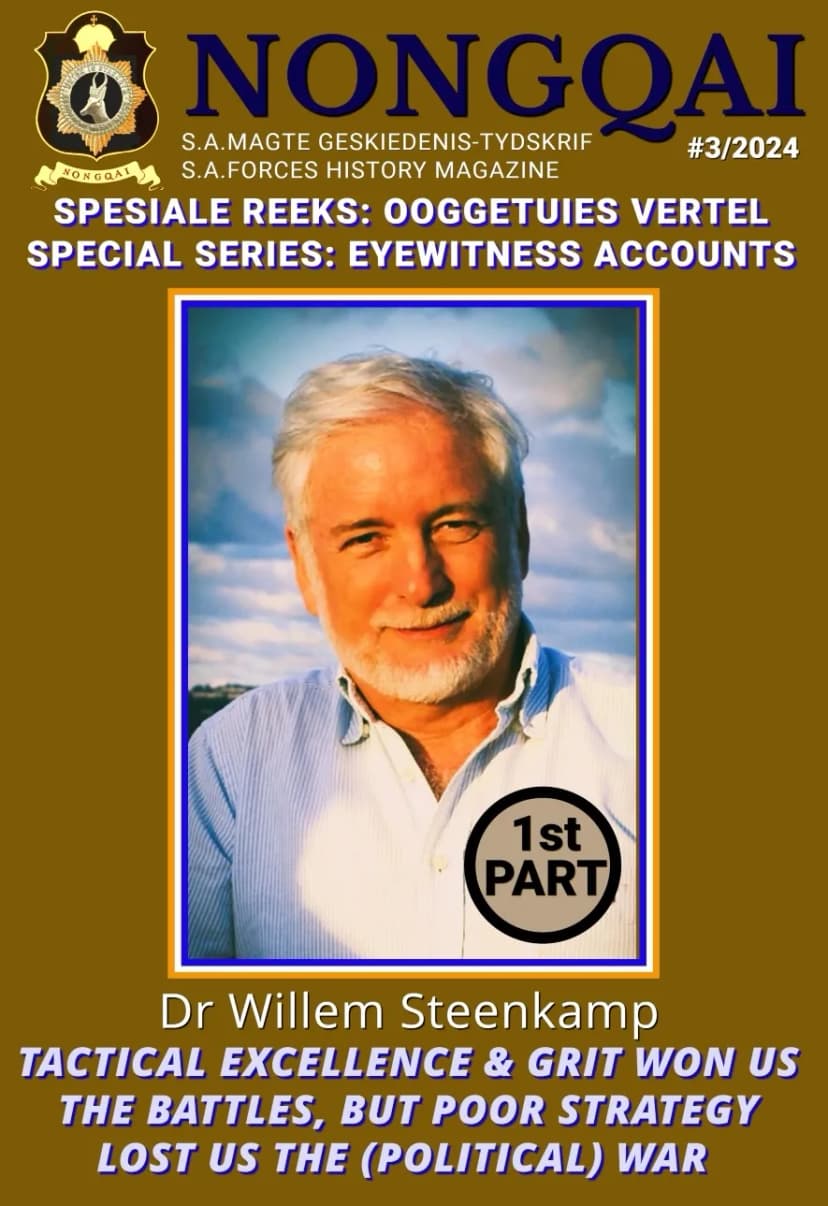
NONGQAI SERIES THE MEN SPEAK Dr Willem Steenkamp
February 24, 2024

South Africa's Transition What Really Happened and Why
July 23, 2026