
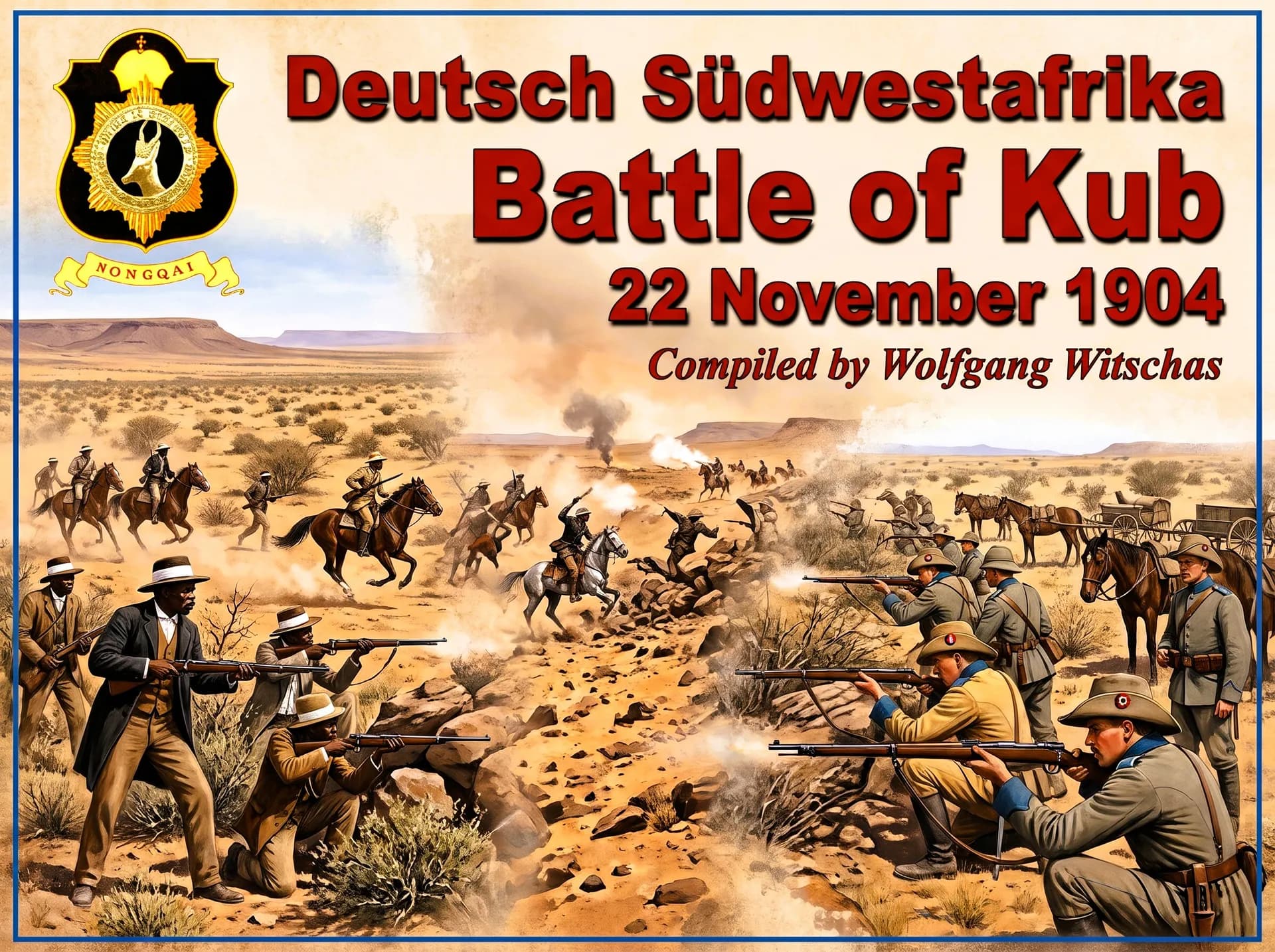
Deutsch Südwestafrika Battle of Kub 22 November 1904
Fought in German South West Africa between the Schutzruppe Deutsch Südwestafrika and the Nama

Introduction
Deutsch Südwestafrika (DSWA)/German South West Africa (GSWA) became a Imperial German colony in 1884 until 1915 when South Africa invaded the territory during World War I.
The Herero - Nama Wars
In 1904, the Herero and Nama people of South-West Africa rose up against the German colonisers in a war of rebellion. This war, and the extermination order issued by General Lothar von Trotha that followed its end, is considered by most historians to be the first genocide of the 20th century.
By 1904, the tensions in the colony had risen to a peak. Under the leadership of their paramount chief, Samuel Maherero, the downtrodden Herero rose up against their colonisers in a wide-spread rebellion. This rebellion quickly turned into a war. Kaiser Wilhelm II of Germany, who was determined to defeat the Herero, sent thousands of troops, under the leadership of General Lothar von Trotha, from Germany. In August 1904, von Trotha and his troops cornered the Herero at Waterberg, where they defeated them in battle. The Herero then fled into the Omaheke Desert, a waterless wasteland, where they were left to die of thirst and starvation.
The Nama initially fought alongside the Germans, including against the Herero at Waterberg. In October 1904 the already over 80-year-old Hendrik Witbooi rose again against German colonial rule, after shortly before he had still supported the German campaign against the Herero with troops. As background are seen the replacement of the previous governor of the colony Theodor Leutwein by the much more radical Lothar von Trotha as commander of the Schutztruppe in June 1904 (Witbooi had personally sworn loyalty to Leutwein) and reports about his drastic actions in the Battle of Waterberg, but also the influence of the radical Prophet Shepherd Stuurman.
The Nama in the South revolted against the Germans in September 1904. They rose up against the German colonisers, starting the Nama-German war. With the use of guerrilla tactics, the Nama were able to engage the Germans in war for over two years.
The Battle of Kub - 22 November 1904
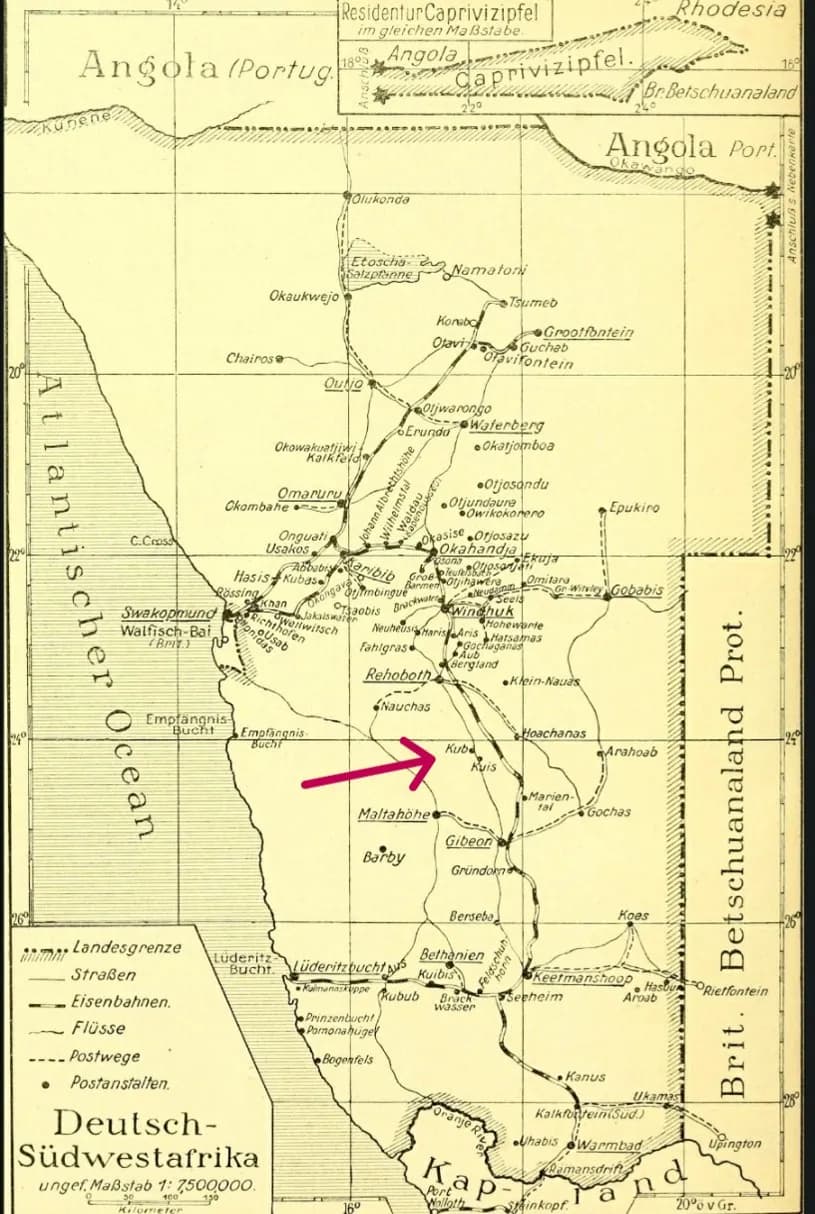
The Battle of Kub took place on 22 November 1904 during the Nama-German War at Kub, a historical settlement situated along the Fish River on the Farm Voigtskub.
Kub lies a few hundred metres east of the road connecting Kalkrand and Maltahöhe in the southern-central region of the territory, in what is now the Hardap Region of Namibia.
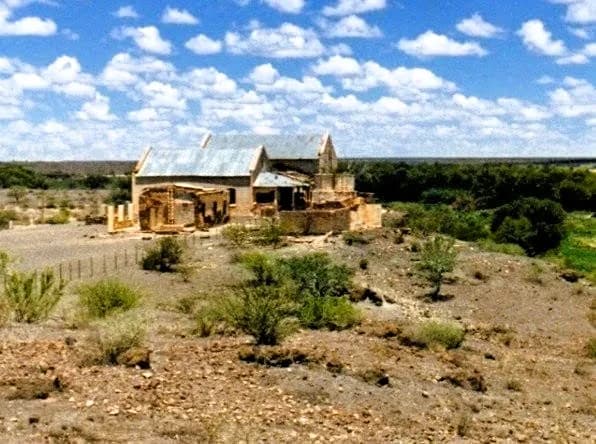
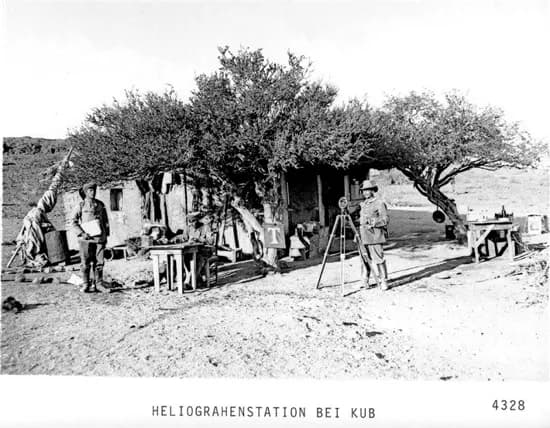
Kub itself was a heliograph / military post from 1893, after Hendrik Witbooi had raided 3,000 sheep there. In 1904, Kub was a notable regional outpost featuring a police station (with a surviving two-cell German jail), a hotel, and early settlement infrastructure. The Kub area itself is Witbooi heartland - the Gibeon / Mariental corridor.
The battle marked a major, organized assault by the newly revolting Nama forces against a German stronghold in the south. When it failed, the Namas resorted to guerilla warfare.
The Nama tactical Objectives and the Siege of Kub
When Chief Hendrik Witbooi declared war in October 1904, his immediate strategic goal was to clear German military and communications outposts across the southern plains. Kub was a vital target. It featured a fortified German police station, a post office, and a hotel, serving as a hub along the Fish River.
However, Kub was not merely a German military post; it was a key Boer settlement with substantial Afrikaner livestock herds grazing nearby. One of Hendrik Witbooi’s primary objectives in attacking Kub on 22 November 1904 was to capture the cattle herds belonging to the local Boers.
The Nama forces implemented a swift encirclement strategy, cutting off the settlement from external communication and laying siege to the buildings where the defenders had barricaded themselves.
The Defensive Stand & The Boer Factor
The initial defence of Kub was highly unconventional because it relied heavily on local civilian (Afrikaner farmer) combatants alongside the small Schutztruppe contingent initially present. Hauptmann (Captain) von Krüger was the local company commander of the Kub / Gochas district in late 1904. The German records for that period are very fragmentary - most were burned or lost after the Nama uprising started 03 October 1904 when the church books on Marienthal were destroyed.
The Barricade
Hauptmann von Krüger's small German detachment of 40 men alongside a contingent of 31 local volunteer Boer settlers, fortified the central stone buildings of the settlement. At that time in Kub also lay the 2nd Company of the 1st Field Regiment, half of the 2nd Mountain Battery.
The Conflict of the Boers
The role of the Boers at Kub remains one of the battle's most distinct historical footnotes. Prior to the uprising, many Boers had settled on farms in the surrounding district. While Witbooi had initially explicitly ordered his fighters to target only German imperialists and leave British and Boer settlers unharmed, chaos erupted as the fighting spread. With settlers already murdered and cattle having been taken, starting 3 October 1904 (details to follow below, in the Maritz account) and believing that they would be massacred regardless, local Boers took up arms in self-defence, alongside Captain von Krüger's men.
The Battle
On the night of 22 November Chief Hendrik Witbooi arrived in front of Kub with about 300 armed tribesmen, where the cattle herds of the Boers as well as the military post offered prospects of booty. Witbooi was also accompanied by a substantial number of Nama non-combatant camp-followers and supply wagons.
Oberleutnant Werner Haak of the 2nd Mountain Battery set out with Lieutenant von Mosch and twelve riders on a reconnaissance patrol and fell into an ambush by the Nama, who opened fire on the patrol. Werner Haak and seven of his riders fell immediately, while the remaining men were able to withdraw.
At dawn the Nama succeeded in removing the transport animals of the mountain battery from their pastures and lured a German patrol into an ambush. Encouraged by these successes, the Nama subsequently attacked Kub from the east, southeast and northeast and tried to encircle the place. Desperate fighting ensued, with the Whites heavily outnumbered. To relieve pressure a small group sallied out to attack the Namas on a strategic nearby hill.
When things started to look bad for the farmers and the small local contingent of German soldiers, Oberst (Colonel) Deimling with 230 men reached Kub from Windhoek. They had just returned from the battle against the Herero’s at Waterberg. There were also about 80 volunteer Rehoboth Basters who had come along. This timely arrival of reenforcements turned the course of the battle against the Namas, who could not resist the field artillery and machine gun fire.
Casualties
The fighting was intense and fought at close quarters. The defensive perimeter held, but at a massive cost to the settler volunteers. Seven Boer fighters—including notable members of the early local farming community—were killed during the onslaught.
The Schutztruppe suffered relatively light casualties given the intensity of the assault, recording 10 to 12 killed (including officers) and roughly 20 to 30 wounded, along with significant losses among their horses.
The Nama suffered heavy casualties—estimated at 60 to 100 fighters killed and many more wounded—due to the devastating effect of German artillery and machine guns in the open terrain. Crucially, as Witbooi’s forces retreated, German troops overran the nearby Nama encampment, capturing dozens of wagons, large herds of cattle and small stock, and taking numerous prisoners, including women and children.
Aftermath
After Kub, fighting escalated through the Gross Nabas area from 02 - 04 January 1905 and at Swartfontein on 15 January 1905.
The German capture of Nama non-combatants at Kub foreshadowed the harsh internment policies that soon followed. By early 1905, German authorities under the harsh Governor Trotha began deporting captured Nama prisoners—including the Witbooi clan—to concentration camps, most notoriously on Shark Island (Haifischinsel) off Lüderitz, where mortality rates were catastrophic.
The Nama Insurgents (The Witbooi Clan)
The anti-colonial forces at Kub were composed of the Witbooi Nama. They were highly mobile guerrilla fighters operating on horseback and armed with rifles. Their tactical knowledge of the rugged southern terrain made them formidable opponents. Kub was the last major conventional, large-scale frontal assault attempted by Hendrik Witbooi against a fortified German position.
Recognizing that the Nama could not match German artillery and machine guns in open battle, Witbooi permanently abandoned conventional tactics. Immediately following Kub, Witbooi transitioned his forces into small, highly mobile mounted commandos. Over the next year till Witbooi's death in action at Vaalgras in October 1905 and then under leaders like Jakob Morenga and Simon Kooper, the Nama waged one of the most effective asymmetrical guerrilla campaigns in African colonial history, striking isolated patrols, supply columns, and outposts before vanishing into the arid terrain.
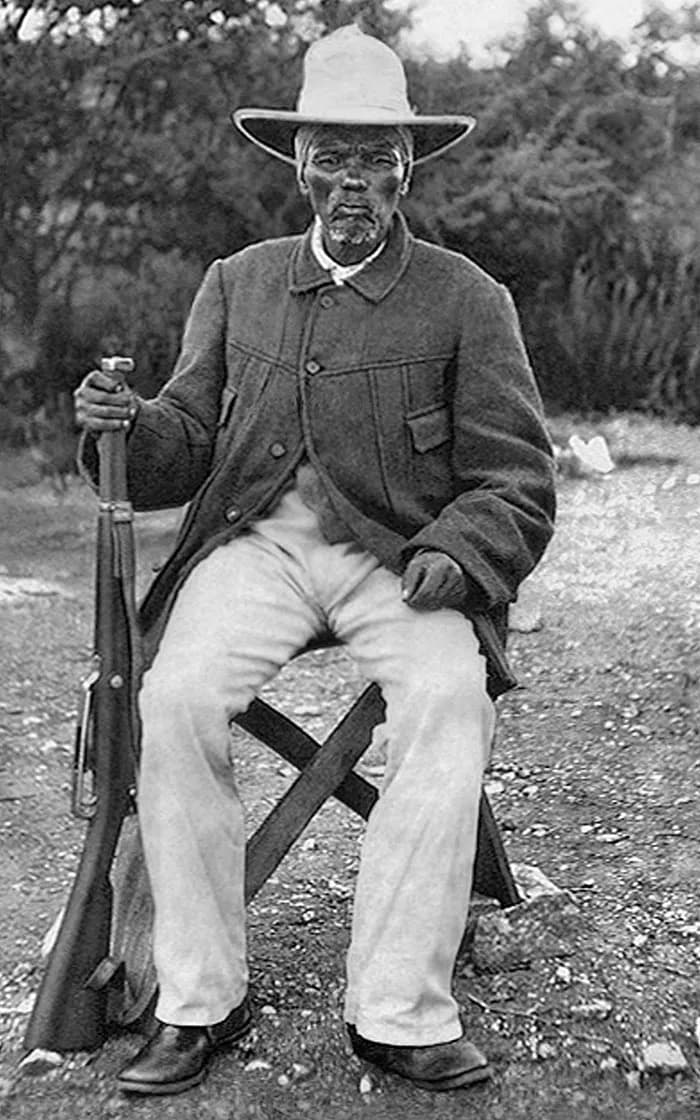
Boer farmer Andries Fancois "Andrew" Maritz's account of the Nama war and battle of Kub
Andries Fancois "Andrew" Maritz was one of DSWA/GSWA pioneers who came to the territory in 1900, under very difficult circumstances. As a child of nine years, he and his sister of 7 years had to, together with the rest of the family, manage for nine months without bread, coffee and sugar. The two of them also had at times to drive the livestock along with the wagons and when they became too tired, their father would then put them on the wagon to rest and he himself would look after the livestock. As a child he had to endure many hardships.
In October 1904 the Nama War broke out and they had to flee at night through bushes on foot, more or less 36 miles to the place called Kub. All they could take with them was as much as one horse could carry. There was a small group of farmers who then formed a laager and had to fight against the hordes. With rifle in hand and trusting in God they had to fight.
In 1902 Hendrik Smit and Frans Smeer had succeeded in recruiting Albertus Kooy and his wife as a teaching couple from the Netherlands. Kooy intially had gone to Swartmodder and establishes a farm school there. Since Kub was more central, the school was moved to Kub and during March 1903 the first Afrikaans Church school was opened at Kub with Albertus Kooy as the first teacher. It opened with 17 Afrikaans children.
Hendrik Witbooi had in the meantime sold several farms to the Trekkers, among others the farm Swartmodder to Hendrik Smit. There was a good relationship between the Witboois and the farmers and Hendrik Smit and Hendrik Witbooi were friends.
The next phase was initiated by the uprising of Hendrik Witbooi. While the German forces were still busy with the 1904 Herero uprising in the North, Witbooi saw his chance to restore his dominion. He listened to Baal Stuurman and the holy instruction to kill all white men and boys - "Gesél van Namaland".
On 02 October 1904 he started his attack and the German policemen stationed at Mariental were killed.
On 03 October 1904 Hendrik Witbooi sent two of his council members, Samuel Isak and Petrus Jod, to Gibeon with a letter to Von Burgsdorff. In it he declared war. On 03 October 1904 Von Burgsdorff, accompanied by two envoys went to Rietmond. He warned his comrades that should he not return they must accept that he is dead and that war has broken out. He was led into a trap and is shot dead by Samuel Saal at the police post at Mariental.
Also on 03 October 1904 two young men who were not aware of the war were doing transport when a group of Witboois also unexpectedly arrived and murdered them. They were Jacobus Coetzee and Christoffel Rossouw. Three more men, Cilliers and his two sons-in-law Willem Johannes Kuhn and Thomas Johannes Knoesen were also murdered there.
The next day, on 4 October 1904, the elder Johannes Mähler, his brother Johannes Mähler as well as his brother-in-law Delport were also murdered at Orab. The people still knew nothing of the war, except for Sergeant Ficke, who was shot dead.
The widow Maritz had to flee with her family from her farm Garies through the dark and on foot to get to Kub. Letters were then sent out to all the farmers in the area so that they could form a laager. The trekkers who were warned all arrived there safely except for those who were too far and could not be reached. Some of them were horribly murdered.
All church documents were destroyed and stolen with the murder of the elder Frans Smeer on the farm Mariental on 3 October. Also the church money of £650.
On 05 October 1904, at the police post at Kuis, Sergeant Ficke was killed and all the ammunition was looted. Bogalecki was attacked and brings news to Kub. Master Kooy has now sent out reports to warn the trekkers and to gather at Kub. On the same day Reverend Holzapfel was also murdered. The women and children were however spared and had to go to Gibeon. They were transported by wagon but had to get off and walk themselves through bushes and rocks. The women had to endure great hardships without water or food.
The murders of Hendrik Smit and his family were particularly cruel and horrible because so many people were murdered. Also because Hendrik Smit and Witbooi were friends. Witbooi had let Smit know that war was coming.
Hendrik Smit, Johannes Potgieter and his little boy of 18 months, Hendrik van der Westhuizen and his two sons, Cornelis Bothma, Hendrik van der Westhuizen, father-in-law of Hendrik Smit and Gys van der Westhuizen, a young unmarried man were all murdered. Only one little boy who was wearing a little dress and was mistaken for a little girl was spared. Also one who was seriously wounded was spared because the Witboois reckoned that the Lord did not want the child.
The women had to flee and later fled together with the Steyn and Fourie women and children to Rietfontein and from there to Upington. They only arrived there a month later. Johannes Potgieter's wife lost her 18-day-old baby on the way. She dug a grave with her hands. In Damaraland a trader from Stampriet, Dawid Uys, was murdered as well as Dorsland trekkers such as Botha, De Wet and Watermeyer.
The Battle of Kub took place at the end of 22 November 1904. The Trekkers were alone there with about 31 able-bodied men. The commander among them was Commandant Dirk Booysen with Willem van der Merwe who was Field Cornet. Later a German detachment of 40 soldiers with rifles, cartridges and a cannon arrived to come help. The livestock and horses that the trekkers brought with them were mostly stolen.
During this time the children who were at boarding school also suffered from smallpox as well as some of the adults and so many people were sick. Commandant Dirk Booysen and Nicolaas Swart were both killed when they went out on patrol.
Hendrik Witbooi and Simon Koper marched against Kub with 1,500 mounted men and about another 1,000 on foot. The enemy surrounded the entire laager and attacked from all sides. The small group of farmers and the small detachment of German troops were not enough to protect Kub.
Seven men stormed a hill and took it from the enemy and thus protected the laager. The seven men were Jan Lambrechts, Jan Jurgens, Harry Gird, Adriaan Croese, Willem Dreyer, Albertus Kooy, and Piet Brand. (Jan Coetzee, a German soldier and Fritz Brand later went to help).
When things started to look bad for the farmers and the few German soldiers, Colonel Deimling with 230 men reached Kub from Windhoek. They had just returned from the battle against the Hereros at Waterberg. There were also about 80 volunteer Rehoboth Basters who came along.
The fact that the farmers fought together with the Germans restored mutual trust. The Germans were afraid that the farmers would fight together with the Witboois against the Germans.
Eduard Mostert, Willem Rossouw and Fritz Brand afterwards helped the Germans to pursue the Witboois. Eduard Mostert received the German Iron Cross for bravery after he was wounded.
The people who had gathered at Gibeon also at first remained there alone without protection. Gibeon was also attacked, but a thunderstorm came up and it hailed only over the Nama warriors and not on the village. They considered this a bad omen and after Hendrik Witbooi's house and church were destroyed they sounded the retreat.
The Boers gathered at Kub, Gibeon and Aris as well as Maltahöhe and Aroab. These were refugee camps and they stayed there for the next three years. From 1903 - 1905 Only then could they return to their farms again.
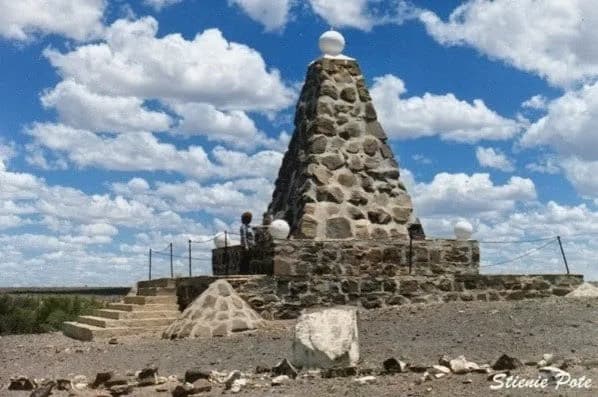
In 1904, Kub was a notable regional outpost featuring a police station (with a surviving two-cell German jail), a hotel, and early settlement infrastructure. A monument commemorating the battle and fallen Boer volunteers stands near the site today.
The later South African Police (SAP) station at Kub
When South Africa took over DSWA/GSWA later South West Africa (SWA) in June 1915, public security was first run by the Military Police, then from 1920 by the South West Africa Police (SWAP). The SAP took over policing in SWA in April 1939, due to the growing National Socialist sentiment and Nazi affinity amongst the German population of SWA. As from 1939 to 1981 Kub was a SAP station. The SAP police station at Kub was not a new SAP station but the SWAP and SAP re-used the station which was built by the Germans as a Landespolizei depot around 1905-1907.
When the railway station in Kalkrand was opened with the construction of the Windhoek–Nakop railway line, the slow decline of the Kub settlement began. In the middle of the 20th century it was finally abandoned.
The police station that was near the monument has since been demolished when it was closed in the mid 1950s, but a large concrete “SAP” sign near the monument remains as a reminder of its existence.

A graveyard of early Boer settlers as well as one with fallen German soldiers can also be found at Kub.
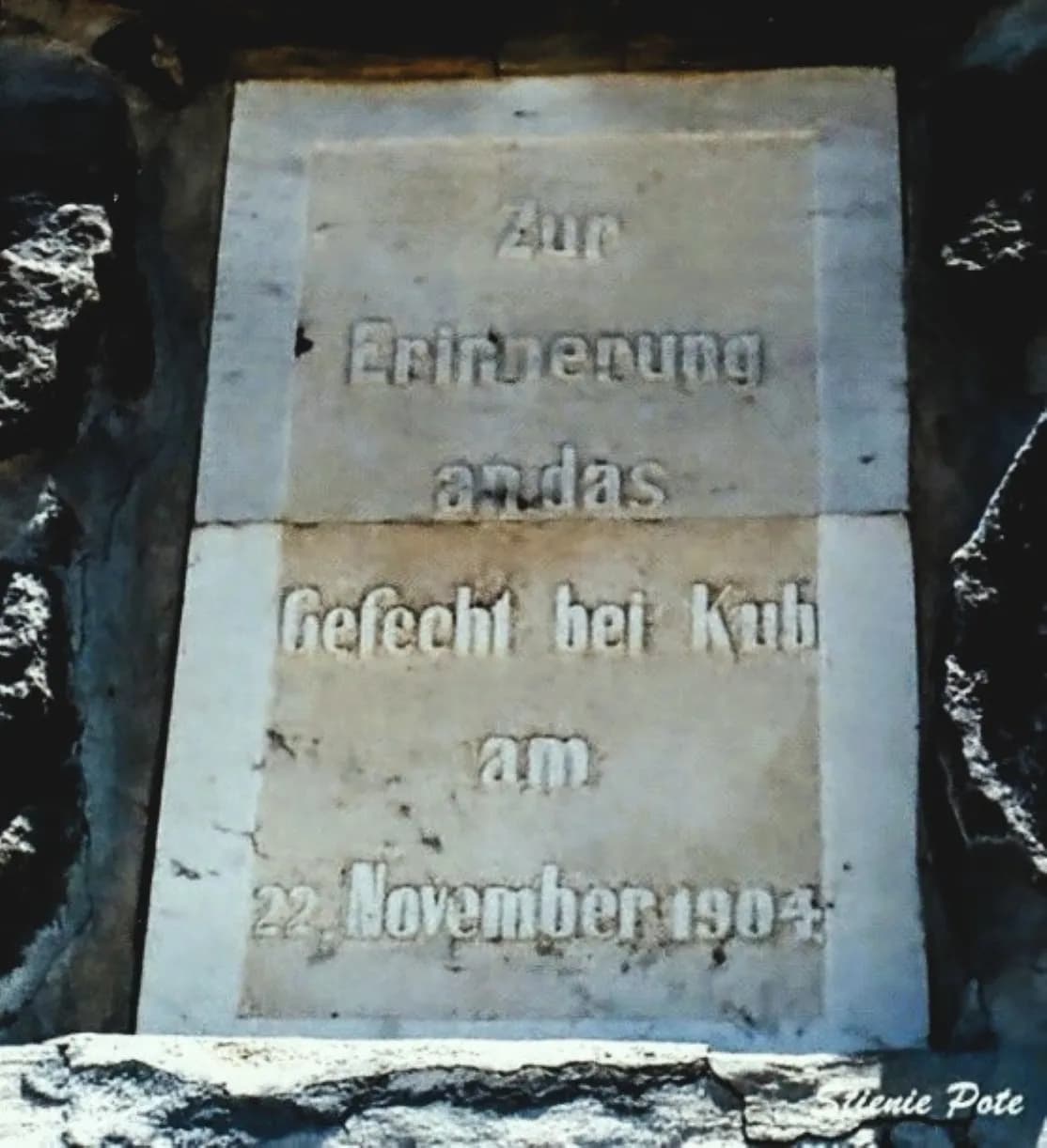
The monument that commemorates the seven Boer volunteers who were killed in the battle at Kub, is an impressive pyramid believed to once have been topped by the German Imperial Eagle, although no proof exists. It is situated about 0.5 km on the eastern side of the C21 road, 25 km from Kalkrand, en route to Maltahöhe.
References
https://de.wikipedia.org
https://www.klausdierks.com/Chronology/61.htm
https://www.namibia-accomodation.com/listing/monument-at-kub-kalkrand
Book:
Tagebuchblätter aus Südwest Afrika:
(Diary Pages from South West Africa).
Oberleutnant Werner Haak: Schutzruppe 1904
Peter's Antiques, Swakopmund Namibia
Andries Fancois "Andrew" Maritz's account of the Nama war and battle of Kub:
Forum 47 David du Plessis
© nongqai.org
Write to us about this article
Do you remember this, or know more? Your comment appears here once an editor has read it.
The editors may print your comment, with your name, in the monthly edition.
Related Articles

The Story of Jacob Morenga: The Namibian Fighter Who Frustrated the Germans Schutztruppe During the German-Herero/nama Uprising: 1904 To 1907
June 13, 2025

Intelligence War in GSWA
September 16, 2026
1906: the Ferreira Raid in the Cape Colony
September 17, 2026

Camels in GSWA
June 28, 2026

Kaiserliche Schutztruppe für Deutsch-Südwestafrika (DSWA): Imperial Schutztruppe for German South West Africa (GSWA)
July 19, 2025