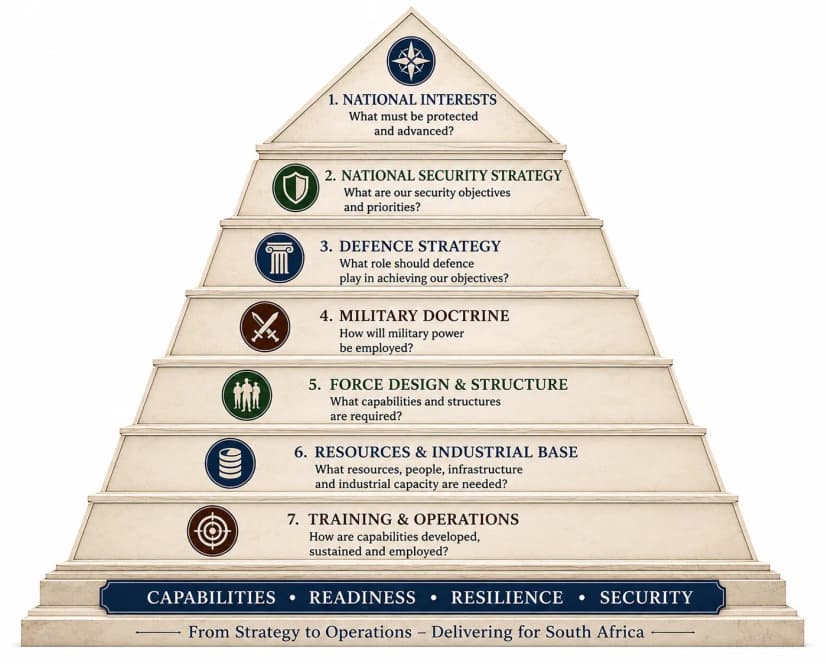
The debate over defence spending is often framed as a choice between security and development. This article argues that the real challenge is not choosing between "guns" and "butter", but ensuring that resource allocation is guided by clearly defined national interests, strategic objectives and long-term priorities. Strategy should inform budgets, not the other way around.
South Africa's defence sector does not appear to suffer from a shortage of audits, reviews, investigations or task teams. It suffers from a shortage of implementation. Using recent calls for a new defence task team as a starting point, this article explores why many of the same governance, capability and institutional challenges continue to reappear, and argues that meaningful reform may require greater strategic clarity, alignment and accountability across South Africa's defence ecosystem.
South Africa’s defence crisis is often framed as a problem of insufficient funding. This article argues that the deeper challenge is one of strategic incoherence. Using the Clausewitzian framework of ends, ways, and means, it examines how misalignment between political ambition, force design, and available resources has contributed to the SANDF’s gradual erosion. The article contends that sustainable defence renewal requires sequenced institutional regeneration, realistic strategic prioritisation, and a revitalised defence-industrial base rather than aspirational expansion alone.
This article examines the persistent gap between symbolic recognition and functional capability in Africa’s post-independence statecraft. Using the Alliance of Sahel States and South Africa’s defence-industrial ecosystem as empirical anchors, it argues that strategic autonomy is engineered through institutional coherence, fiscal discipline, and accountable state-industry alignment. Sovereignty is not inherited; it is continuously built.