NONGQAISouth Africa’s National Security MagazineEstablished in 1907
DONATE

All Articles


7 articles match your filters

SAP Camou
1966 Bush War / Coin

SAP Camou

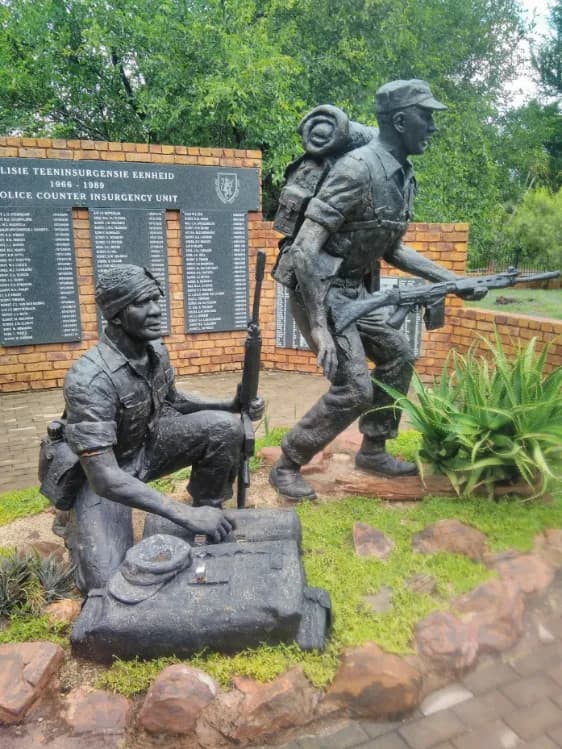
From 1968 to 1994 the South African Police (SAP) Counter Insurgency Unit (COIN) and the SAP Special Task Force used distinct camouflage uniforms. First the SAP Pattern 1 and later the SAP Pattern 2, from 1970 to1994. With the SA Police Service (SAPS) only the Special Task Force still use camouflage uniforms.From 1968 to 1994 the South African Police (SAP) Counter Insurgency Unit (COIN) and the SAP Special Task Force used distinct camouflage uniforms. First the SAP Pattern 1 and later the SAP Pattern 2, from 1970 to1994. With the SA Police Service (SAPS) only the Special Task Force still use camouflage uniforms.

Military Books by Paul Els
1966 Bush War / Coin

Military Books by Paul Els

Warrant Officer First Class (retired) Paul J. Els descendant of Boer General Louis Botha, Voortrekkers Andries Potgieter and Hans Dons de Lange, was born in Empangeni, Zululand. After completing his schooling in Durban, he enlisted in the Signal Corps of the South African Defence Force in January 1964. At the end of that year, he was transferred to 5 SA Infantry Battalion in Ladysmith. He did a three-month stint on the border in 1968, after which he spent a year on Gough Island as radio operator. On his return to South Africa in 1969, he became an instructor at Signal School in Voortrekkerhoogte and was deployed for a few weeks towards the end of that year in Africa. In 1972 he married Annelie. Two children were born of this marriage - Johan in 1974, and Nelie in 1976. Paul and Annelie have four granddaughters and one grandson. During 1975/1976 he took part in Operation Savannah and at the end of 1978 he was transferred to SA Special Forces as the first long distance non-commissioned officer radio operator and cryptographer for 5 Reconnaissance Commando. At the age of 36 years he completed the Parachute Course at DukuDuku and was awarded his parachute wings.

The Bomb: 20 May 1983
1966 Bush War / Coin

The Bomb: 20 May 1983

Certain events in human experience remain indelibly imprinted on the mind — the precise place, date, and time, the individuals present, and the conversations or activities shared. The bomb explosion in Church Street, Pretoria, on 20 May 1983 constitutes one such defining moment. The incident not only sent shockwaves through South Africa’s domestic sphere but also precipitated a significant transformation at all border bases administered by the South African Police. At the time, I was serving as a young visiting conscript police chaplain on the Eastern Border. Within the ranks, speculation persisted regarding when the first landmine might detonate inside South Africa’s borders. Until then, the conflict had been largely confined to the territory then known as South West Africa, as well as Ovamboland and Angola. The South African Police maintained deployments across three operational regions: two internal borders — the Eastern and Western Borders — and one external, in northern Namibia. During the early weeks of May 1983, relative calm prevailed along these borders. Policemen stationed there experienced boredom due to the absence of operational activity and often occupied themselves with peripheral tasks, such as taming local wildlife or engaging in minor recreational pursuits. Following the Church Street (20 May 1983) bombing, however, circumstances changed dramatically. Discussions among personnel assumed a far more serious tone, and border security was intensified. Seasoned policemen undergoing refresher training at the Police College were immediately mobilised, in double strength, to reinforce the South African border positions. The first part of these memoirs provides an account of the calm and at times monotonous conditions on the internal police borders prior to the Pretoria bombing. The second part analyses the developments following the explosion — events that profoundly altered the operational and emotional landscape of those serving at the border bases. In its aftermath, a range of psychological, pastoral, and social difficulties emerged, often escalating beyond manageable levels, while permanent remedial measures remained elusive.

Border Duty: Police Families
1966 Bush War / Coin

Border Duty: Police Families

Ek skryf hier as 'n persoon wat self in bg. tydperk in die sg. bosoorlog (alternatiewelik ook daarna verwys as 'grensdiens') betrokke was, beide op die Suid-Afrikaanse grense en in Ovamboland in Namibië